Analysis model: gpt-5.5 xhigh
Aquarium by CNCD - Technical Dissection
Scope
Aquarium is a Finnish Amiga OCS/ECS demo by Carillon & Cyberiad, the group
now known as CNCD. It was released on 7 August 1993 and placed sixth in the
European Computer Conference 1993 Amiga demo competition. Demozoo credits
Fraction for code and Dean for graphics and music. The demo's own end screen
also credits Drifter for the explosion. Fraction, Dean and Drifter are each
individually recorded in Finland; the country check does not rely only on
CNCD's group identity.
Useful public references:
- Demozoo production: https://demozoo.org/productions/26942/
- Pouet production: https://www.pouet.net/prod.php?which=6533
- Demozoo CNCD history: https://demozoo.org/groups/26/
- Individual Demozoo records for Fraction, Dean and Drifter
- Preserved disk download: https://files.scene.org/view/parties/1993/ecc93/amiga/demo/cc_aquarium.zip
The original disk image, its boot and loader code, its packed payloads and a complete direct run were examined. This is a full demo, not a cracktro, intro or reconstruction from an online video.
Complete Direct Silent Run
The unchanged disk image was booted directly under FS-UAE 3.2.35 as an Amiga 500 with 512 KiB chip RAM and 512 KiB slow RAM. Host audio used a null output driver, so the demo retained its normal audio timing while the lossless FFV1 capture contained video only.
The production passes through its full credits and reaches the animated Aquarium boat end screen after about four minutes. Every GIF below is a continuous six-second excerpt from that one direct run, cropped to the Amiga display and encoded at 400x320 and 10 fps. None is a contact sheet, isolated still or online-video extract.

The opening portrait is held for nearly a minute, but it is not inert. Bubbles rise through the branching hair while a narrow vertical line of lettering changes beside the face. The long hold makes the later rupture effective: a small expanding form gives way to a bright flash, an explosion and CNCD lettering that stretches, compresses and reforms.

The still makes Dean's image readable without losing it among the bubbles: the hair branches into bronze tubes, the face is modelled with a tight copper palette, and the small vertical signature balances the otherwise empty blue field.

The middle section is deliberately graphic rather than a standard effect reel. Two stippled faces turn and combine; fragments then assemble into curved panels in perspective. The motion exposes separate panel angles and depth ordering, so the result is more than a flat logo being scaled as one piece.

At the end of the excerpt, the separate fragments resolve as FUS lettering.
The fixed frame shows the stepped depth and seams between sections; the GIF is
still needed to show how those sections arrive and turn.

The visual joke labelled “hypothesis” and “proof” is mechanically simple but well directed. Red circles move independently over a field of repeating group names, overlap into temporary compound shapes and separate again. It sets up the more polished reflection scene instead of merely filling time.

Five shaded spheres orbit the CNCD mark. Each sphere carries a reflected copy of the red lettering, and the copies change position and curvature as the spheres move. The disk cannot prove whether every reflected frame was calculated live, and a later author comment describes the balls as precalculated. What the run does prove is the compositional result: five independently moving reflections remain synchronised with the central logo.

The final effect changes material completely. A red solid travels and rotates inside a blue-grey tunnel made from converging line segments. Its faces split into a fan, close into a cube and change depth while the tunnel keeps its own vanishing point. It is short, but it gives the demo a real technical ending before the credits rather than another logo hold.
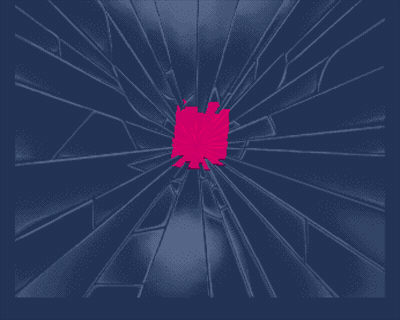
The close-readable frame catches the red solid while its faces are fanned apart. The blue-grey tunnel remains a separate converging construction, which makes the contrast between object deformation and camera depth explicit.
A DOS Signature Without an AmigaDOS Disk
The preserved 901,120-byte ADF has SHA-256:
2758d8ea200747c3a9ba73f678b82749d9101b83c5cbbaac67c40c1ab2e5f70a
It is byte-identical to the ADF unpacked from scene.org's preserved
cc.aquarium.dms, rather than a later hard-disk conversion.
Its first four bytes are the normal DOS\0 boot signature, and the boot-block
checksum is valid. That resemblance stops at the boot block. There is no
valid AmigaDOS root block or directory tree for a filesystem tool to list.
The disk is organised for the demo's own loader.
The first boot-stage instructions make the handoff explicit. Using the
trackdisk.device I/O request already supplied to boot code, they request
10,240 bytes from disk offset 1,024, place them at address $30000, shut down
the operating-system display activity and jump there:
move.w  #2,$1c(a1)          ; read command
move.l  #$2800,$24(a1)      ; 10,240 bytes
move.l  #$30000,$28(a1)     ; destination
move.l  #$400,$2c(a1)       ; after the 1,024-byte boot block
jsr     -456(a6)            ; perform the I/O request
...
jmp     $30000
This is a useful distinction. Aquarium is not a set of named executables
launched by a script, and the ADF is not merely a container for files. Boot,
loading, depacking, scheduling and presentation are one production-specific
path.
The Second Stage Moves Low and Owns the Machine
The second stage initially runs at $30000, installs a small supervisor
transition, and copies 2,500 longwords—exactly 10,000 bytes—from $30064 down
to $1000. It then jumps to that low-memory copy. The relocated code clears
registers, puts $dff000, the base of the Amiga custom-chip registers, in
a6, and directly programs display, DMA and disk hardware.
The loader includes a complete raw-track path rather than returning to AmigaDOS. Its decoder:
- searches the DMA buffer for the Amiga MFM sync word
$4489; - masks odd and even bit streams with
$55555555; - reconstructs 512 bytes for each sector;
- checks the decoded sector checksum;
- repeats eleven times and advances the destination by
$1600, exactly 11 x 512 bytes.
Those constants explain both the invalid filesystem and the reliable direct boot. The disk preserves normal 512-byte sector contents, but the production locates tracks, decodes their MFM representation and verifies them with its own code while running.
A Tiny Command Language Schedules the Parts
The loader does not hard-wire every phase into one enormous branch chain. After relocating a payload it walks a data stream and compares four-byte tokens against a compact set of commands:
move    copy a loaded range to its destination
play    start the current packed music
stop    stop it
paus    wait a specified number of display frames
hypp    call a loaded part entry
hyp2    call the alternate part entry
The pause routine waits on the changing vertical-beam position in $dff005,
so its count is tied to display refresh. Other commands resolve loaded
segments through a small start/end table, relocate their addresses and call
their entry points. The show is therefore data-directed: the disk stream
decides when a part is moved, invoked, paused or accompanied by music.
This structure also fits the visible pacing. The portrait can remain active while its internal bubbles and lettering continue, then the scheduler can hand control to a completely different logo, face, circle or tunnel routine without needing an AmigaDOS overlay manager.
StoneCracker and The Player Are Visible in the Disk
The image contains three S401 headers. The loader's matching depacker checks
that identifier, reads a stored output length and reconstructs bytes with a
literal/back-reference loop. S401 is the identifier used by StoneCracker
4.01 compressed data; this is not an identification based only on entropy or
a filename.
Three P50A signatures are also present, at disk offsets $2ca8, $160b4
and $39f78. Demozoo independently tags the production with The Player
5.0A, and the scheduler's play, stop and pause commands call the relocated
player entry points. Together these are strong evidence for packed tracker
material and a resident replay routine.
Demozoo identifies Dean's Strychnine 9 as the soundtrack. The three on-disk
signatures do not by themselves prove that there are three distinct
compositions: packed data, repeated support material or separate sections can
all retain the same format marker. The analysis therefore does not invent a
three-song soundtrack from three byte matches.
What the Evidence Supports
The direct run and disk agree on a specific architecture:
- a valid boot block loads a 10 KiB second stage;
- that stage relocates itself to low memory;
- a custom track reader decodes and checks eleven sectors at a time;
- packed segments are expanded through an
S401depacker; - a token stream schedules movement, calls, frame waits and music control;
- independently loaded visual parts supply the changing design language;
- The Player 5.0A material accompanies the show without AmigaDOS files.
The evidence does not expose source-level names for every renderer. In particular, it would be unjustified to label the curved panels as a specific polygon algorithm or to claim that the five reflected spheres are calculated pixel by pixel in real time. Their motion is directly observable; their exact asset-generation pipeline is not.
Why Aquarium Holds Up
Aquarium is not important because it overwhelms an A500 with dozens of
effects. Its strength is the opposite: one portrait, a sequence of controlled
graphic transformations, one memorable reflected-logo composition and one
compact 3D finale are given room to register.
Under that unusually calm surface is a complete trackmo system—boot code, raw disk reader, checksum decoder, depacker, relocator, music control and a small presentation language. CNCD used that machinery to make a designed four-minute piece rather than showing the loader itself off. That combination of restraint on screen and ownership underneath is what makes the demo still worth examining.