Analysis model: gpt-5.5 xhigh
Atmosphere by Stone Arts - Technical Dissection
A Norwegian OCS Demo From The Gathering 1993
Atmosphere is Stone Arts' Amiga OCS/ECS full demo, released at The
Gathering on 9 April 1993. It is not an intro, cracktro, slideshow,
musicdisk or game.
Every contributor named by the production is individually documented in Norway:
- Ice: all code.
- BCR, Coke, Joachim of Crusaders, and Kekken: graphics.
- Syntex: music.
- Dolphin, Ice, and Shape: design.
The last three design credits are visible in the demo's own ending but are missing from the shorter public database credit list. Dolphin and Shape are also Norwegian. That direct-credit check matters here: membership in a Norwegian group alone is not being used as a substitute for checking the actual people.
Public references:
- Demozoo production, date, platform, release and credits: https://demozoo.org/productions/100935/
- Demozoo Stone Arts history and individual locations: https://demozoo.org/groups/1155/
- Individual records: Ice, BCR, Coke, Joachim, Kekken, Syntex, Dolphin and Shape
- Demozoo Crusaders record locating guest artist Joachim in Oslo: https://demozoo.org/groups/12/
- Pouet production and contemporary reception: https://www.pouet.net/prod.php?which=31361
- Preserved original DMS: https://archive.scene.org/pub/mirrors/amigascne/Groups/S/Stone_Arts/STA-Athmosphere.dms
- WHDLoad preservation notes and patch source: https://whdload.de/demos/StoneArts_Atmosphere.html
The original disk was run from boot through the complete repeating end pages. Host audio was disabled, no music was played, no audio stream was downloaded, and no video file is published.
The Complete Direct Silent Run
The preserved DMS expands to a bootable 901,120-byte disk image. It ran directly in FS-UAE 3.2.35 as an A500 with a 68000, 512 KiB chip RAM, 512 KiB slow RAM and the AROS replacement ROM. The release was not patched. The page GIFs are excerpts from one continuous 240-second video-only research capture made on 25 July 2026.
The disk does not expose an AmigaDOS root block. This is a boot-and-trackload
production rather than a disk full of separately named effect executables.
The authored sequence reaches its credits, member pages and explicit
THE END screen, then cycles those ending pages.

The long opening picture is not filler disguised as an effect. Coke's
armoured figure establishes the production's graphic weight before a circular
wipe, an illustrated ATMOSPHERE title and a sequence of group marks take
over. At one frame per second the GIF preserves the editorial timing without
making a mostly static picture twitch unnecessarily.

The still preserves the hand-drawn opening at its readable hold: a symmetrical
armoured figure, long horizontal weapon and sandy paper-like ground. Small
asymmetries in the armour and the signed COKE corner keep it from reading as
a generated mirror image.

The logos are treated as separate title cards rather than being forced through one universal transition. A metallic wordmark, a noisy numeral and a shaded Stone Arts logo each use a different surface language. That variety is a good summary of the demo: it is less a single visual system than a compact display of hand-drawn graphics and small technical routines.
A Cube Made From Moving Slices

The purple object begins as a recognisable cube and repeatedly breaks into offset slabs, grids and nested frames. Its important property is continuity: the fragments retain enough of the previous silhouette that the eye keeps reading one object while its construction changes.
This is not merely a sequence of unrelated cube stills. The five-frame-per- second excerpt shows the planes advancing through the volume and rejoining. The extremely restricted palette helps: almost all depth information comes from overlap, motion and the alternation between filled and open areas.

In a single frame, the cube's construction is unusually clear. Filled squares, open frames and the dark central cavities remain aligned as nested layers; the GIF supplies the essential evidence that those layers travel and rejoin.
Flat Shading Before Fractal Line Density
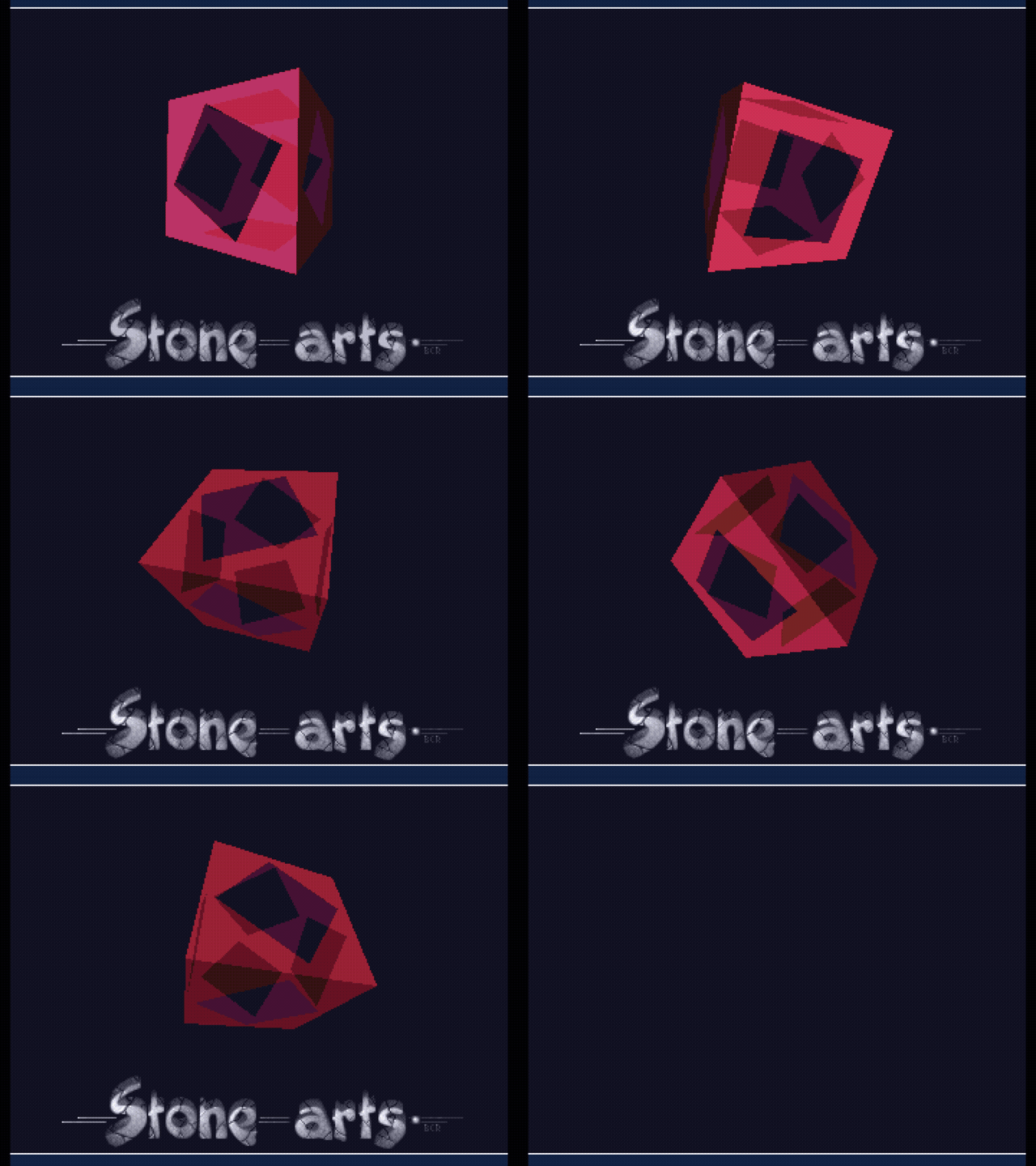
The next small solid is a more conventional flat-shaded renderer. Dark holes remain attached to the red faces while the whole form rotates, so both the outer silhouette and the internal negative space communicate orientation. It is modest in screen area, but clean enough that it does not need a busy background.

The late Kefrens vector passage takes the opposite approach. Repeated
triangular motifs build a long curved body in blue and magenta. The object
looks dense because the same small angular vocabulary is nested at several
scales, not because the machine is filling a large smoothly shaded mesh.
The demo itself introduces the routine as 256 pixels wide by 256 pixels high
and claims that it runs in one frame. It then jokes that the following
impossible fractals cannot be done with modulo and scrolling. The phrasing
is part technical boast, part scene in-joke; the runtime is the useful
evidence. The result stays animated at frame rate while preserving a large
amount of repeated line detail.

The still exposes the routine's repeated vocabulary: long bands are assembled from successively smaller triangular outlines in alternating blue and magenta. Joachim's metallic logo above gives the extremely dense line field a stable graphic reference.
The Final Bars Behave Like A Hinged Ribbon

The last effect uses a row of broad vertical strips. Their upper and lower edges follow different phases, making the row fold like a hinged ribbon rather than a flat sine-wave scroller. Alternating beige and brown faces provide just enough ordering to follow individual segments.
It is a restrained ending. After the dense fractal field, the demo returns to large readable pieces and lets motion carry the illusion. The handwritten Stone Arts logo below it also keeps the technical display tied to the group's graphic identity.
The Disk Layout Is Deliberately Non-Filesystem
The preserved files used here are:
7b3d109f50f9b6b35f96131874498450520429bc6a711fb55d991de68e71be5b  STA-Athmosphere.dms
4bdab84a48e124c6bd132146f59f8255afab9e8ddcc8bf6f5e64aea98d7ace79  expanded original disk image
The DMS header says it was made with DMS 1.11 Evaluation using HEAVY2, covers tracks 0 through 79 and was created on 10 April 1993 at 18:37:56. That is the day after the documented release date and is consistent with a party-era disk being archived after release.
The preservation source makes the high-level loader map explicit:
- a 107,008-byte title payload is loaded from byte offset 788,480 to
$64000; - its expected CRC16 is
$6991; - a 112,640-byte main payload is loaded from byte offset 675,840 to
$40000; - later parts are requested through a table-driven disk loader.
The main payload is itself a valid AmigaDOS LoadSeg image with one 110,156-byte code hunk. It contains no relocation hunk, library hunk, overlay table or separate data segment. Code, tables and linked assets therefore travel as one self-contained segment even though the outer disk is custom trackloaded.
This hybrid is practical. The boot disk controls placement and loading, while the central program retains a simple standard hunk envelope that could be recognised and relocated by preservation tools.
Direct Hardware Ownership Is Visible At Entry
The title payload begins with 68000 code, not a packer signature. Its startup
waits on the video beam, writes $7fff to DMACON to clear previous DMA
enables, enables its selected DMA set, saves the old interrupt and Copper
state, installs a vertical-blank handler at vector $6c, and programs the
custom-chip register block directly.
The fade timing is tied to explicit waits around PAL lines 307, 308 and 309.
That explains why the later WHDLoad patch has a specific Atmosphere logo timing repair rather than a vague compatibility workaround. The preservation
source replaces those busy waits with a raster-safe helper, fixes interrupts
and ROM access, and sets the missing BPLCON0 colour bit for one part.
None of those preservation patches were used for the GIF run. They are useful as independent documentation of the original code's assumptions:
- 512 KiB of base chip memory is sufficient;
- the demo reads from the ROM address
$fc0000; - it owns vertical blank and level-2 interrupt paths;
- one scene depends on the OCS/ECS colour-enable state in
BPLCON0; - the original timing is coupled closely enough to the raster to need repair on a modern hard-disk installation.
The title also contains a proper restoration path. On exit it disables its interrupts, restores the saved level-3 vector and interrupt state, reinstalls the saved Copper pointer, re-enables system DMA and returns. The direct run does not depend on killing the emulator between effects.
Why Atmosphere Still Works
Atmosphere is strongest when it lets a small number of graphic elements
change construction in front of the viewer. The purple cube becomes slices,
the red solid makes holes part of its orientation, the vector passage turns
triangular repetition into density, and the final bars turn a row into a
folding surface.
The binary is equally economical: a bootable non-filesystem disk, a table-driven trackloader, one relocation-free main code hunk, direct custom-chip ownership and raster-coupled timing. It is recognisably a 1993 OCS production, but not a random bag of old effects. The hand-drawn pictures, logos and compact geometry all share the same preference for clear silhouettes and controlled transitions.