Analysis model: gpt-5.5 xhigh
Bad Street Brawler by Bentley Sidwell Productions - Technical Dissection
Bad Street Brawler is a 1988 MS-DOS CGA cracktro / title intro by Bentley
Sidwell Productions. Pouet lists it as a May 1988 MS-DOS 32K cracktro. Demozoo
lists the production as released on 17 May 1988, marks it as an advert for the
same two BSP boards named on the source pages, and describes it as BSP release
#17.
Release year: 1988.
The examined archive is the scene.org bad_street_brawler_cracktro.zip copy.
The technical payload is BSPTTL.COM, a 16,624-byte COM program that is almost
entirely one raw CGA screen page.
The bundled documentation contains old BBS/phone contact listings. This writeup uses the safe catalogue and file-structure facts but does not reproduce those numbers or board-contact blocks.
Sources
- Pouet production page: https://www.pouet.net/prod.php?which=56609
- Demozoo production page: https://demozoo.org/productions/129254/
- Scene.org file page: https://files.scene.org/view/demos/compilations/lost_found_and_more/cracktro/bad_street_brawler_cracktro.zip
- Scene.org archive download: https://archive.scene.org/pub/demos/compilations/lost_found_and_more/cracktro/bad_street_brawler_cracktro.zip
Visual Reference
The title screen below is decoded directly from BSPTTL.COM, not redrawn. The
source bytes are the raw CGA page at file offset 007Fh, copied by the program
to B800:0000.

The local DOSBox-X 2026.01.02 capture confirms the same page and also catches
the opening reveal-copy frame. The capture used machine=cga, cycles=50000,
dummy SDL video/audio, no sound hardware, and:
dx-capture /v BSPTTL.COM
Timing zero is the start of the DOSBox-X capture stream. The ZMBV stream did
not provide a reliable duration through ffprobe, but extracting at 4 fps gives
stable frame picks from the captured frame timestamps:

The interesting runtime moment is the 00:00.250 frame. It shows the title page
shifted and split by the opening memory sweep before the final painter copies
the canonical CS:017Fh page over the whole screen. By 00:00.500, the final
page is stable and remains visible until keypress.
The following map ties the visible behavior to the actual control code:
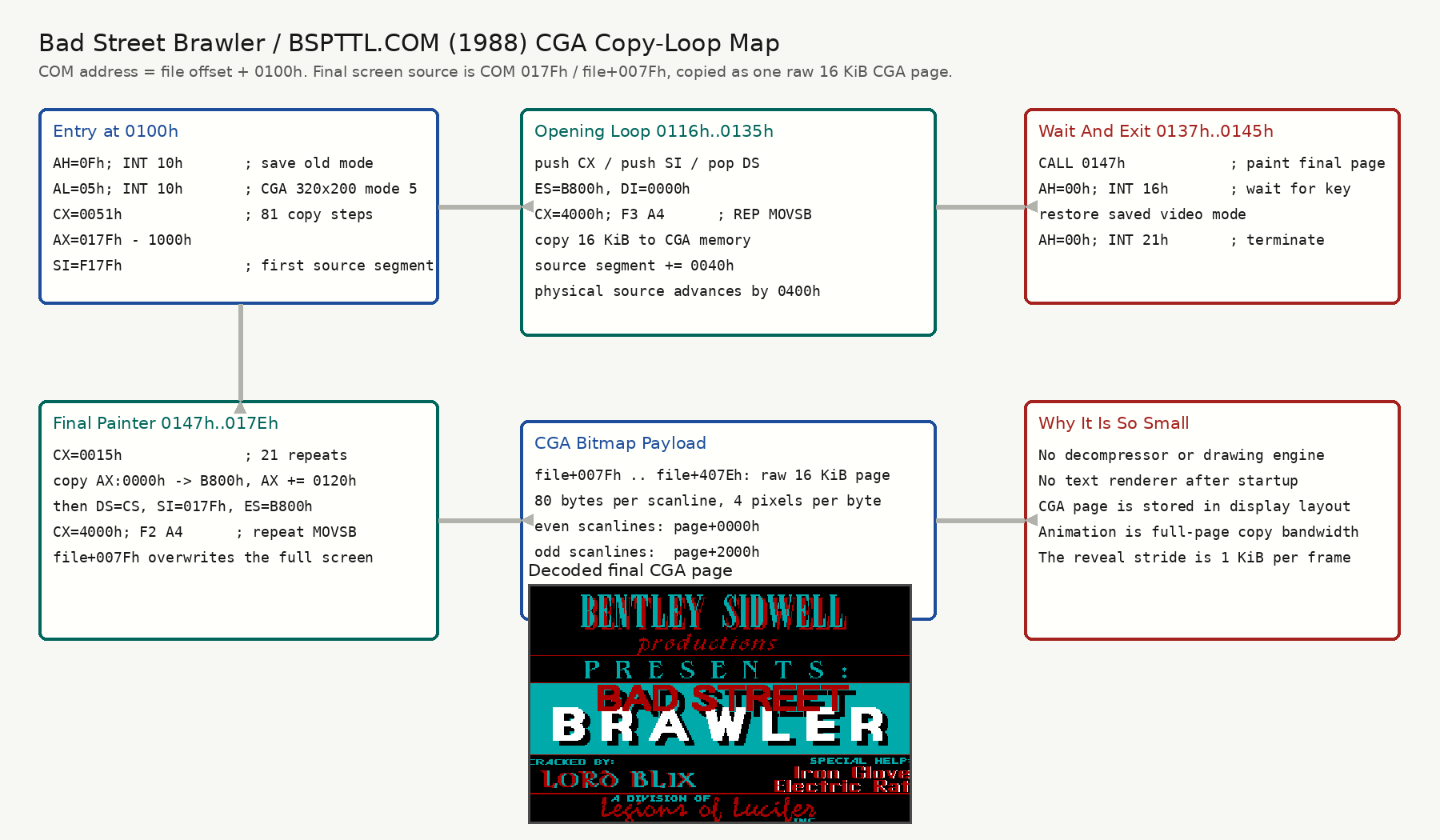
The front-page card uses the decoded CGA page and runtime contact sheet as
direct still previews. They are not combined into a GIF because the useful
published images are different artifacts and dimensions: a 320x200 decoded
page, a 1020x450 contact sheet, and an 1800x1050 code map.
Archive Inventory
Archive:
bbe0cbb75c959fbc0a91e5e2e8033138740426b60b6c62f29a66ca0b6e04781b bad_street_brawler_cracktro.zip
Archive contents:
BADST.DOC    5913 bytes  1988-05-17 14:27
BSPTTL.COM  16624 bytes  1988-05-17 16:44
README.BSP   1214 bytes  1988-05-17 16:39
Extracted file hashes:
0b5d93f93d5a691082ac35c12e33704377e766d64059a6e03f5a6f8dc5a8cd78  BADST.DOC
f5f6c00876485753707eb12a81e1e39585ba29456b1ef7fa19685adc14e65937  BSPTTL.COM
0062bf7ba2a5e054645b8f6fa59cd0bd88510fcae435be9e16817aaa140b885f  README.BSP
Derived public images:
aa2e45e1cd6d0c87effacec7be29f71b8a72a115482c3623a67fca9dccb8e93f  bad-street-brawler-decoded-cga.png
7ce25ac026a106db44bf857fe50a9e89683a6393480adaa6495d75c1ca4792de  bad-street-brawler-runtime-contact.png
db3525e97cc135741ac855f08bac976cb2c5ae957eb319140e4d1e0a30bf5889  bad-street-brawler-copy-loop-map.png
BSPTTL.COM is 40F0h bytes:
file range       size     COM address       purpose
0000h..007Eh     007Fh    0100h..017Eh      all executable control code
007Fh..407Eh     4000h    017Fh..417Eh      raw CGA page copied to B800:0000
407Fh..40EFh     0071h    417Fh..41EFh      tail bytes, not used by final page copy
That split is the whole trick. The executable part is 127 bytes; the title graphic is exactly one CGA framebuffer.
Entry And Mode Setup
The program starts at COM address 0100h:
0100  mov ah,0fh
0102  int 10h
0104  push ax              ; save current video mode in AL
0105  xor ah,ah
0107  mov al,05h
0109  int 10h              ; CGA 320x200 mode 5
INT 10h AH=0Fh returns the current video mode in AL. The program pushes the
whole AX word and restores AL at exit:
013a  xor ah,ah
013c  int 16h              ; wait for key
013e  pop ax               ; restore saved AL
013f  mov ah,00h
0141  int 10h              ; set original video mode
0143  xor ah,ah
0145  int 21h              ; DOS terminate, AH=00h
That is a clean cracktro wrapper shape: show the page, block on keyboard, put the user back in the previous video mode.
The chosen video mode is BIOS mode 05h, the CGA 320x200 four-colour graphics
mode variant. In DOSBox-X's RGB output for this mode, the page uses black, cyan,
red, and white. The page bytes themselves are still ordinary two-bit CGA pixels.
Opening Full-Screen Sweep
After setting mode 5, the program runs an 81-step copy loop:
010b  mov cx,0051h
010e  mov ax,017fh
0111  sub ax,1000h         ; AX = F17Fh
0114  mov si,ax

0116  push cx
0117  push si
0118  pop ds               ; DS = current source segment
0119  push ds              ; save it for increment
011a  xor si,si
011c  mov ax,0b800h
011f  mov es,ax
0121  xor di,di
0123  mov cx,4000h
0126  rep movsb            ; copy 16 KiB to CGA memory
0128  pop ax
0129  add ax,0040h         ; source segment += 0040h
012c  mov si,ax
012e  pop cx
012f  sub cx,0001h
0132  cmp cx,0000h
0135  jne 0116h
The hot copy itself is just:
DS:0000 -> ES:0000
ES      = B800h
DI      = 0000h
CX      = 4000h
prefix  = F3h
opcode  = A4h
So every iteration copies a complete 16 KiB CGA framebuffer.
The odd part is the source address. It does not start from CS:017Fh. It starts
from absolute segment F17Fh, then advances by 0040h segments per step:
iteration i source segment = (F17Fh + i * 0040h) & FFFFh
physical start             = (source segment << 4) & FFFFFh
physical stride            = 0040h * 16 = 0400h bytes
copy size                  = 4000h bytes
This is an overlapping 16 KiB window with a 1 KiB stride. Because the source segment begins near the top of the real-mode address space, the sequence wraps through the 20-bit boundary and sweeps into low conventional memory during the later iterations.
On the DOSBox-X run used here, that sweep catches the loaded COM page in low
memory and briefly shows a shifted/split version of the final title page. That
is the 00:00.250 runtime frame in the contact sheet. The exact transient
shape is loader-layout-sensitive because it depends on where DOS placed the COM
image, but the final screen is not sensitive: the next routine copies from
CS:017Fh explicitly.
Final Painter
After the opening sweep, the entry calls 0147h:
0137 call 0147h
That routine repeats 21 times:
0147  mov cx,0015h
014a  xor ax,ax

014c  push cx
014d  push ax
014e  mov ds,ax
0150  xor si,si
0152  mov ax,0b800h
0155  mov es,ax
0157  xor di,di
0159  mov cx,4000h
015c  repnz movsb          ; F2 A4, effectively a repeated MOVSB here

015e  push cs
015f  pop ds
0160  mov ax,017fh
0163  mov si,ax
0165  mov ax,0b800h
0168  mov es,ax
016a  xor di,di
016c  mov cx,4000h
016f  repnz movsb          ; copy raw page from CS:017Fh to B800:0000

0171  pop ax
0172  pop cx
0173  add ax,0120h
0176  sub cx,0001h
0179  cmp cx,0000h
017c  jne 014ch
017e  ret
The F2 A4 encoding is displayed by objdump as repnz movsb. For MOVSB,
the repeat prefix is controlled by CX; the zero-flag condition is relevant to
CMPS/SCAS, not to a byte copy. Practically, both F3 A4 and F2 A4 act as
full CX-counted repeated moves on this code path.
Each final-painter pass has two full-screen copies:
- Copy 16 KiB from segment
AX:0000htoB800:0000. - Copy 16 KiB from
CS:017FhtoB800:0000.
Since the second copy overwrites the whole 16 KiB display page, the first copy
is visible only as delay/flicker between frames. The stable result is always
the raw page embedded at COM 017Fh.
The AX += 0120h step in the first half is another low-memory sweep, this time
with a 4,608-byte physical stride:
0120h segments * 16 = 1200h bytes
But it is immediately covered by the CS:017Fh copy. The practical purpose is
timing and visual disturbance, not durable composition.
CGA Page Format
The copied page is exactly 4000h bytes. In CGA 320x200 two-bit graphics:
screen bytes per visible scanline = 80
pixels per byte                   = 4
visible scanlines                 = 200
visible pixels                    = 320 * 200

even scanline y source offset     = (y / 2) * 80
odd scanline y source offset      = 2000h + (y / 2) * 80
The high bits of each byte hold the leftmost pixel:
bits 7..6 -> pixel x+0
bits 5..4 -> pixel x+1
bits 3..2 -> pixel x+2
bits 1..0 -> pixel x+3
The decoded pixel distribution for the embedded page is:
colour index  pixels
0             39023
1             13680
2              7588
3              3709
total         64000
That matches what the image looks like: mostly black background, a large cyan field, red title/credit strokes, and a smaller amount of white lettering.
Why This Is Historically Useful
This is not a fancy 1990s VGA engine. It is a strong example of the older IBM PC cracktro/title-card idiom:
- use a
.COMfile so DOS gives a flat, tiny launch path; - store a complete hardware-format CGA page in the file;
- use BIOS only for mode set, keyboard wait, and restore;
- use
REP MOVSBinstead of per-pixel drawing; - spend the remaining bytes on a reveal/flicker sweep rather than an asset decoder.
The whole visible piece is carried by memory bandwidth. The "inner loop" is not mathematical:
mov es,0b800h
xor di,di
mov cx,4000h
rep movsb
The cleverness is in the placement of the data and in the absolute source
segment sweep. The final painter is robust because it uses CS:017Fh; the
opening reveal is more of a DOS memory-layout stunt.
Verification Boundary
Verified directly:
BSPTTL.COMstarts at COM address0100h;- the only reachable code before the graphic is
0100h..017Eh; - the stable title page source is
COM 017Fh, file offset007Fh; - the final screen copy length is exactly
4000hbytes; - the program waits on
INT 16hand restores the saved video mode; - DOSBox-X 2026.01.02 reaches the same final page and shows a transient reveal frame during the opening copy sweep.
Not claimed:
- the exact appearance of the reveal sweep on every 1988 DOS memory layout;
- any reconstruction of the original game loader after the cracktro;
- any publication of the bundled BBS/phone contact listings.