Analysis model: gpt-5.5 xhigh
Breathtaker by Virtual Dreams - A Rendered Dream in Ten Loads
Finnish AGA imagery at Assembly 1994
Breathtaker is a full Amiga AGA demo by the Finnish group Virtual Dreams,
released at Assembly 1994, where it placed second in the Amiga demo
competition. Alien (Sami Arola) did the programming and music; Jaco, now known
as Sulevi, made the graphics. The production's own readme gives the same
division of work.
That unusually compact credit list fits the result. Breathtaker is not a loose collection of guest parts. It is a continuous sequence of distorted terrain, soft solids, enormous typography and dark reflective spaces with one visual temperament.
This analysis comes from two independently preserved archives, their matching demo payloads, the executable and data headers, disassembly, and one uninterrupted 555.5-second silent A1200 run. No online video was used to reconstruct the visual route.
- Demozoo production, release and credits
- Assembly 1994 results
- Virtual Dreams at Demozoo
- Pouet production
- Aminet archive and original readme
- WHDLoad install and machine requirements
- Preserved amigascne.org archive
Texture becomes handwriting
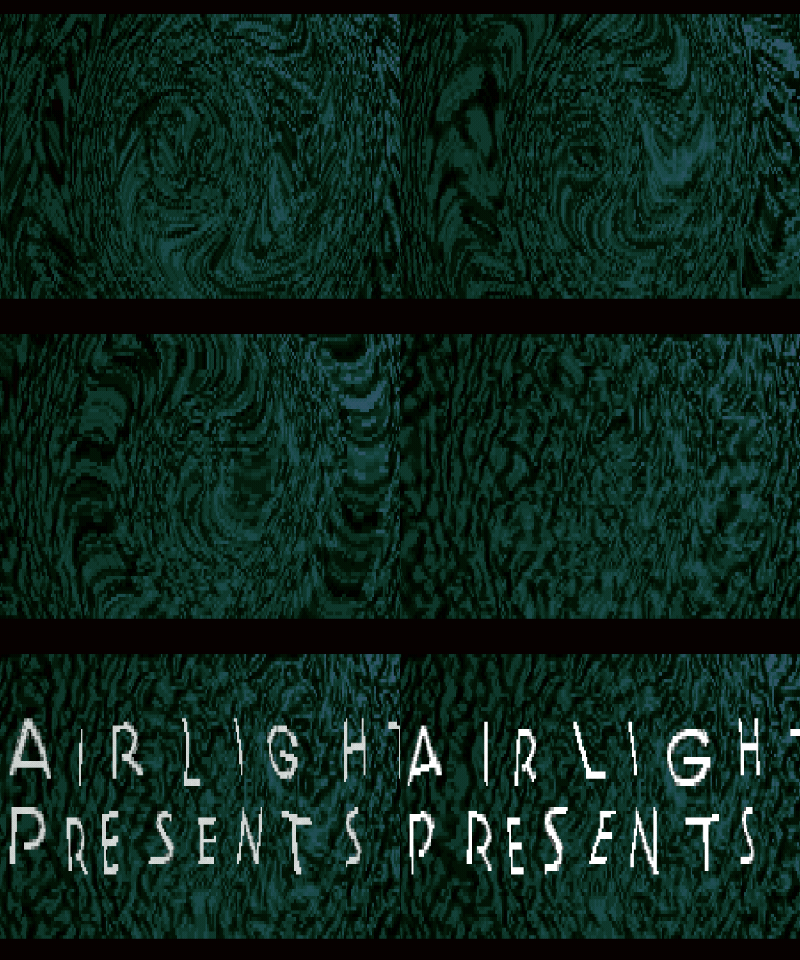
The opening does not introduce a clean logo over a neutral field. A blue-green surface boils, folds and smears while rough white marks resolve inside it. Image and lettering seem to be made from the same unstable material. It is a good statement of intent: Breathtaker will use the AGA machine less as a polygon benchmark than as a device for transforming pictures.

A VIRTUAL DREAMS PRODUCTION is deliberately awkward handwriting, not the
polished chrome logo expected from many 1994 demos. The background keeps
moving through the title. Nothing pauses to become a title card.
Words set the programme

The next sequence enlarges single words until they become screen architecture:
DREAM, VISION, IMAGINATION, CREATION, then ENTERING THE INNER UNIVERSE. The progression is almost a manifesto for the images that follow.
It also controls the pace. Instead of another logo, the demo gives the viewer
a vocabulary and then moves into its world.
The executable contains those phrases as data, along with later labels such
as MOTION BLURRED, GOURAUD SHADING, ARTIFICIAL LIFE, GOURAUD LENS,
BLOW YOUR MIND and SPACESCAPE. They are part of the sequencer, not captions
added to this analysis.
Landscapes without ground

The first long visual movement passes through pale pink and blue terrain, mountain silhouettes and hovering ring forms. The landscapes have perspective but no stable physical scale. A ring can read as a small object, a portal or an entire structure depending on the next deformation.
The colour is important. Breathtaker avoids the hard primary ramps that would make the geometry easier to parse. Its chalky surfaces and slow dissolves keep the scenes between rendered object and remembered place.
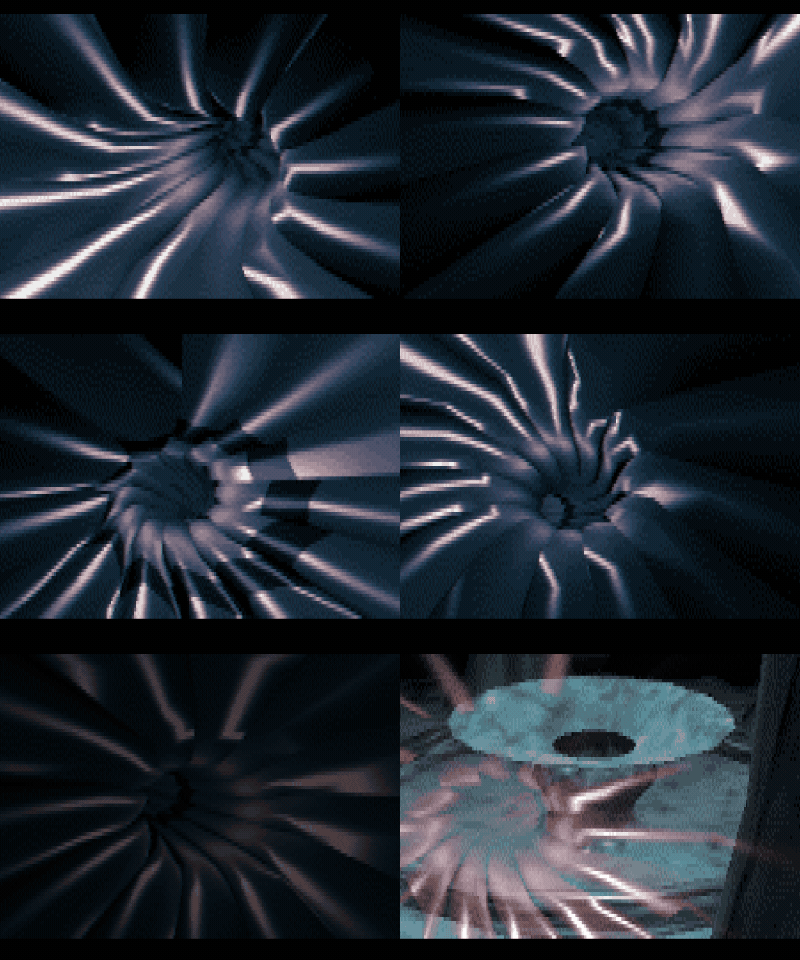
Later geometry becomes darker and more metallic. Radial surfaces pull the eye into the centre while a lens or solid turns against them. The rendering is showy, but the edit never isolates an effect for applause. Forms arrive from the previous texture and are absorbed by the next one.

The translucent form is the clearest expression of that method. Its boundary is visible, but the interior remains contaminated by the surrounding image. It reads as an object only provisionally. The technical effect serves the demo's larger idea that every image is permeable.
The lens becomes a place

GOURAUD LENS announces the final movement, but the label is not a dry
algorithm name. The lens becomes a dark blue corridor: reflective walls,
repeated highlights and a central opening create an inhabitable space from a
distortion effect.

The closing images accelerate through liquid reflection, expanding light and
an explosion-like field before the credits. MUSIC AND PROGRAMMING and
COMPUTER GRAPHICS finally name the two disciplines that have been fused for
the whole production. After the last credit the display becomes black and
stays there.
Ten compressed stage payloads
The archive is a hard-disk production: one 466,208-byte Amiga executable and
ten .aaa files. The filenames occur in the executable in this exact order:
aa:start.1st.aaa
aa:start.2nd.aaa
aa:2_spheres.aaa
aa:tunnel_1.aaa
aa:tunnel_2.aaa
aa:Mountainloop.aaa
aa:Miracle.aaa
aa:Miracle2.1st.aaa
aa:Miracle2.2nd.aaa
aa:end_expl.aaa
Every payload starts with the S404 signature used by StoneCracker 4.04.
Each header declares the same 601,600-byte unpacked length, while the packed
files vary from 137,024 to 414,448 bytes. Together they occupy 3,357,636 bytes
on disk and declare 6,016,000 bytes after decompression.
That regularity is stronger evidence than guessing at their pixels. The files
are fixed-size stage packages loaded by the executable, but they do not decode
as simple consecutive full-screen frames. Their unpacked data may combine
images, animation material and renderer inputs. The public
amigadepacker implementation
corroborates S404 as StoneCracker 4.04 and identifies Jouni “Spiv” Korhonen's
decompressor; it does not by itself define Breathtaker's internal stage
layout.
A large executable around the streams
The executable is an Amiga LoadSeg hunk file with four segments:
| Segment | Kind | Declared size | Memory |
|---|---|---|---|
| 0 | code | 164,600 bytes | any |
| 1 | BSS | 3,110,400 bytes | any |
| 2 | data | 301,004 bytes | chip |
| 3 | BSS | 230,408 bytes | chip |
The large ordinary-memory BSS supplies working space for the expanded stages; the chip-memory segments hold material the AGA custom chips must see directly. This agrees with the original readme's request for 4 MB of fast memory and the later WHDLoad install's roughly 3.2 MB additional-memory requirement.
At entry, the program opens graphics.library and dos.library, saves the
machine state, disables interrupts and DMA, and takes direct control of the
custom chips. A restoration path at the other side re-enables the machine,
restores the view, closes both libraries and returns. The executable also
contains a left-mouse test at CIA-A $bfe001 in its effect dispatcher.
This is an AGA production with an operating-system loading shell around hardware-level display code. The ten external streams let the comparatively large renderer reuse its memory while the visual material changes.
Archive agreement
The amigascne.org and Aminet LHAs are not byte-identical wrappers:
2f37840e0711213114b0389de0fa222a6a723f814f7fb7cc0427bdae2252e6b2  VD-Breathtaker.LHA
02317ece0773fb2b6e0b3f990dcd8e2ae728a1c8eded21e3a653fad4d701e46e  flt.vdbt.lha
One includes Workbench launch metadata while the other includes a
file_id.diz. More importantly, the executable, readme and all ten .aaa
payloads match byte for byte between them. The main executable hashes as:
8ad5e4403f91507edd50b1ce59e181928e29a1ae2a4c549e1017198b5930174a Breath_taker.exe
That agreement matters because the runtime was made from the preserved payloads themselves, not from a repack whose visual equivalence had merely been assumed.
The observed ending
The authored sequence begins at about 28 seconds, reaches its credits around 207 seconds and becomes black at approximately 216 seconds. The emulator and capture remained active for another 339 seconds with the display unchanged.
The executable has a normal cleanup-and-return path, but the capture alone does not prove that the terminal black display reached it. It could be an intentional wait, a sequencing boundary or a machine state preceding cleanup. The honest runtime finding is therefore narrower: the full visual route completed, then persistent black remained through the 555.5-second capture ceiling. No key or mouse input was sent.
Why Breathtaker works
Breathtaker's ten loads do not feel like ten parts because Alien and Jaco keep reusing the same visual proposition: matter is unstable, typography is physical, and an effect is most interesting while it is turning into another image. The StoneCracker streams solve storage and memory movement, but the artistic achievement is continuity.
It is also a very 1994 AGA demo without being reducible to “more colours and faster solids.” The expanded palette is used for bruised blues, mineral greens and pale flesh tones; the memory is used for long image transformations; the rendering makes ambiguous places. Its second place at Assembly belongs to a full production with a point of view, not a numbered effect reel.
Direct-run boundary
emulator        FS-UAE 3.2.35
machine         PAL Amiga 1200, 68020, AGA
memory          2 MiB chip, 8 MiB fast
program         preserved executable and ten original payloads, unchanged
input           none
audio           disabled in the emulator
capture         FFV1 video only, 1024x768 at 10 fps
duration        555.5 seconds
authored route  approximately 28–216 seconds
terminal state  black and unchanged from about 216 seconds to capture end
published media eight continuous five-second GIFs
The lossless capture contains one video stream and no audio stream. The eight published GIFs are continuous excerpts from that run, not contact sheets. There is no MP4, H.264 media or published soundtrack. The original LHAs, full lossless capture and extracted working data remain private; public preserved archives are linked above.