Analysis model: gpt-5.5 xhigh
CCCP by Juliet+Case - Technical Dissection
Scope
CCCP is a Finnish Amiga AGA full demo by Juliet+Case, released on 7 August
1994 and placed fifth in the Assembly 1994 Amiga demo competition. It is a
four-minute audiovisual sequence, not an intro, cracktro, slideshow or video
wrapped in an executable.
The production credits only three people. Each is individually documented in Finland:
- Case: code.
- Groo: music.
- Juliet, Jussi Räsänen: code.
Pouet currently records 29 positive votes, two neutral votes and no negative
votes. That unusually clean reception agrees with the artifact: CCCP is not
being selected merely because it fills a date or party-result gap.
Public references:
- Demozoo production and credits: https://demozoo.org/productions/6831/
- Demozoo Assembly 1994 party and results: https://demozoo.org/parties/102/
- Pouet production: https://www.pouet.net/prod.php?which=14991
- Original Assembly archive: https://files.scene.org/view/parties/1994/assembly94/amiga/demo/cccp.zip
- Demozoo Case profile: https://demozoo.org/sceners/8038/
- Demozoo Groo profile: https://demozoo.org/sceners/1801/
- Demozoo Juliet profile: https://demozoo.org/sceners/8037/
The original party executable, its complete direct runtime, outer Amiga hunk, 704-byte Titanics loader and all 15 reconstructed internal segments were examined. The mechanism claims below distinguish recovered code from visual inference.
Complete Direct Silent Run
The unchanged CCCP.EXE from the Assembly archive was run from an emulated
hard disk under FS-UAE 3.2.35 as an AGA Amiga 1200 with 2 MB chip RAM and
8 MB fast RAM. FS-UAE used its AROS replacement ROM. Host audio output was
disabled before launch; no music or other audio was played.
The 280-second observation begins before AmigaDOS loads the executable. The authored sequence starts after the Titanics loading display, traverses the complete effect programme and reaches the bottle-framed credits. A separate 247-second archival recording was checked only for completeness. Every GIF below comes from the direct silent run, not from that recording.
The GIFs are continuous excerpts sampled at 8, 10 or 12.5 frames per second according to the motion in the scene. They are not collections of stills and do not use frame interpolation. No video or audio asset is published.
Agitation as the Design System
The opening is not a conventional title over a neutral background. Red and black text fragments are repeatedly displaced into horizontal strata. The screen looks damaged, but names and phrases periodically align long enough to be read. That tension—information becoming legible and then being attacked by its own display process—continues through the whole demo.

The first sharp break turns the red field into a yellow-black radial rupture. Large red polygons close over it from the edges while the centre rotates and stretches. This is actual continuous motion: the wedges do not simply swap between prepared cards.
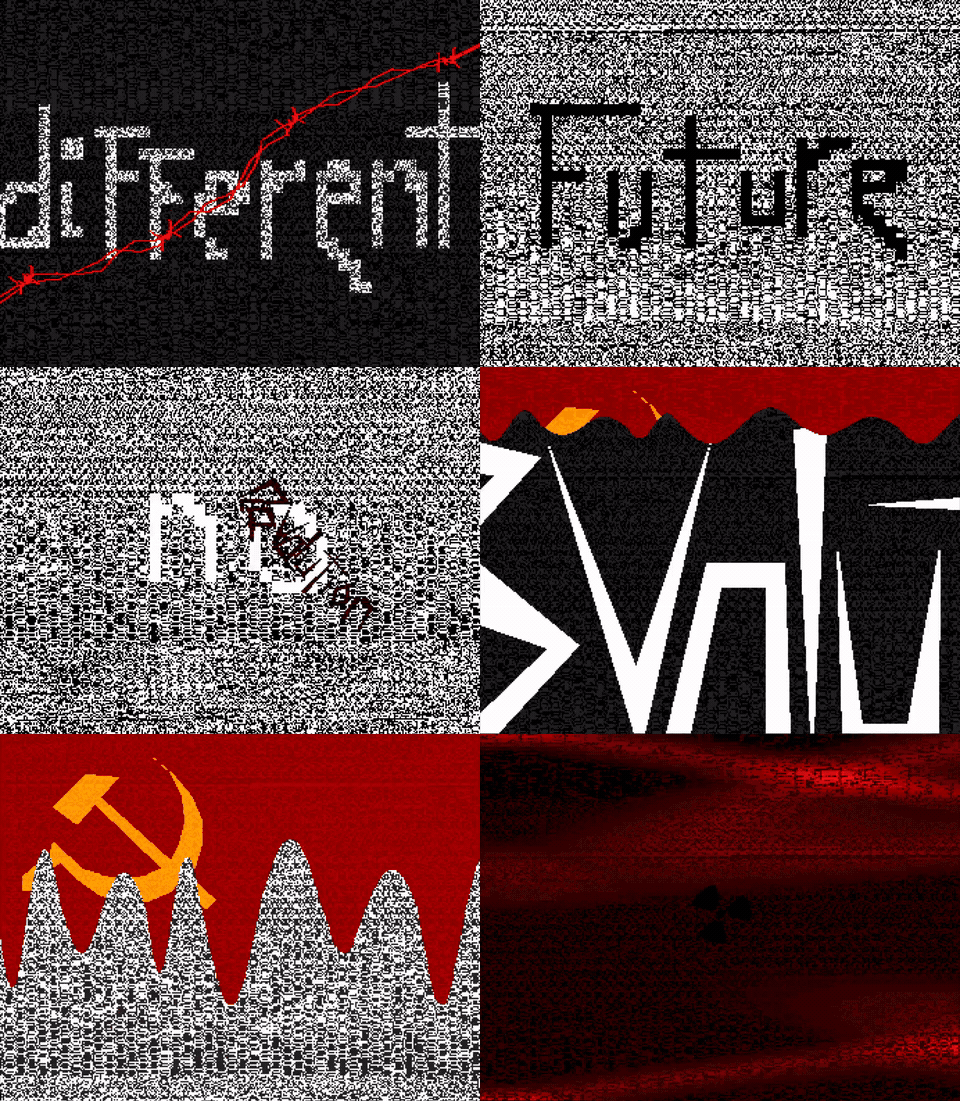
The next passage reduces the palette to red, black and white and composes thick diagonals, a diamond and a moving skyline-like edge. Its resemblance to constructivist print is structural rather than decorative. Flat high-contrast shapes carry the composition, and motion continually changes which shape is figure and which is ground.

A red-and-black checkerboard then becomes a stage for a folded yellow object. The object changes silhouette and apparent depth while scanline fragments continue moving behind it. The board supplies a fixed screen-space reference, making the object's rotation and deformation much easier to read than it would be on black.
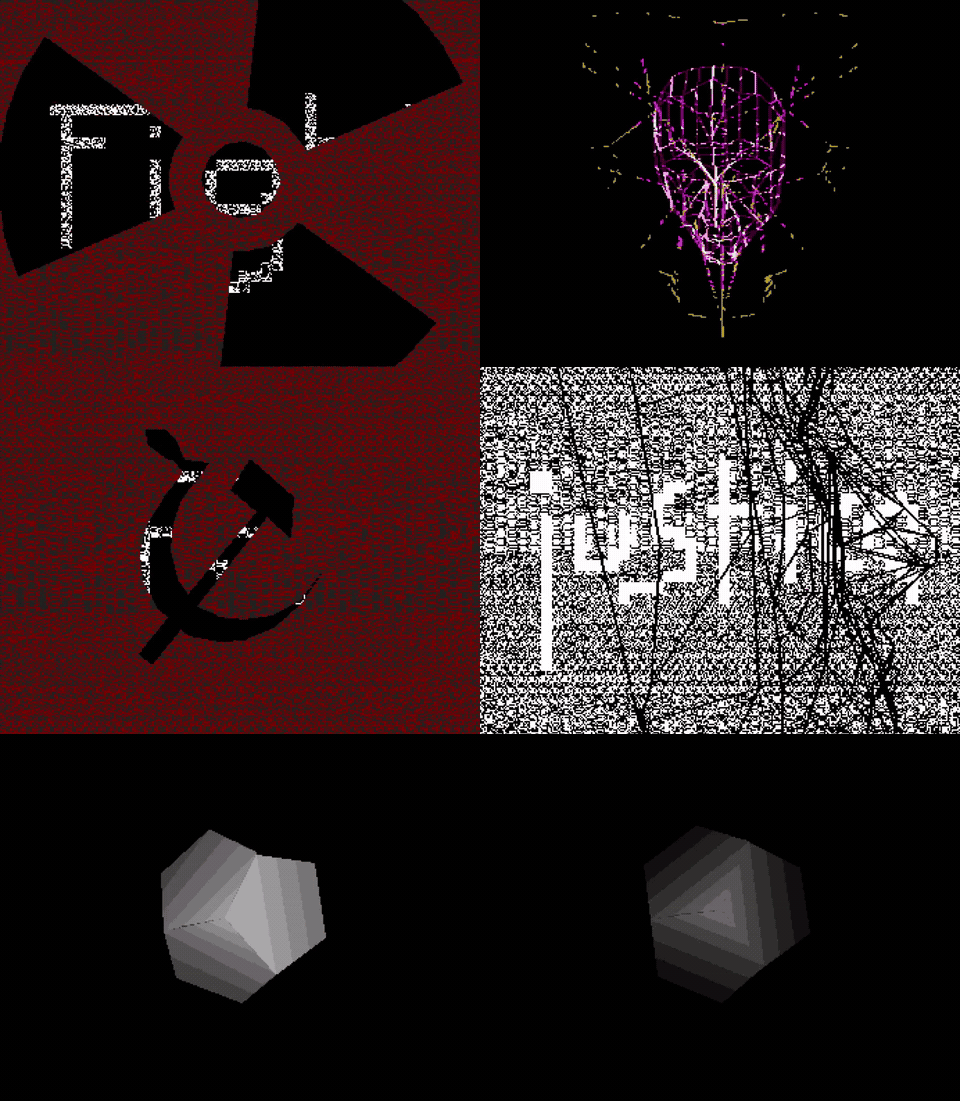
The circular sign is assembled from separate hard-edged pieces rather than drawn as one clean emblem. It gives way to a small shaded polyhedron. That transition matters: the demo keeps alternating graphic-design space with projected-object space instead of treating typography as a pause between effects.

Later, a yellow radial field collapses into red bars and then a purple wireframe face. The face is not a static line drawing. Vertices move in depth, near lines spread across the frame and the outline changes under projection. The sparse mesh lets the transformation remain visible even when the background is busy.
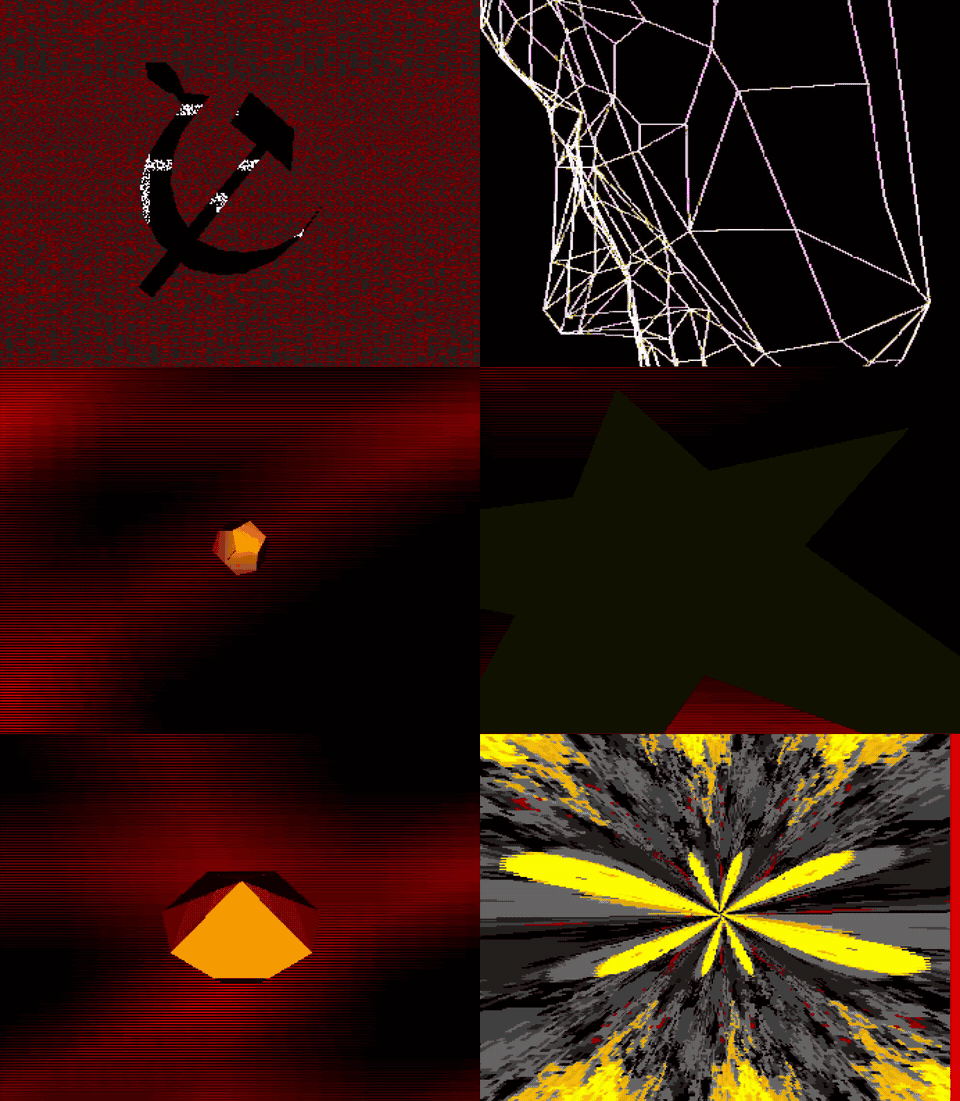
The typography closes into white shutters around a turning red pyramid. A word, a mask and a three-dimensional object therefore share one transition. The demo repeatedly obtains pace from such collisions rather than from long isolated showcases of a single routine.
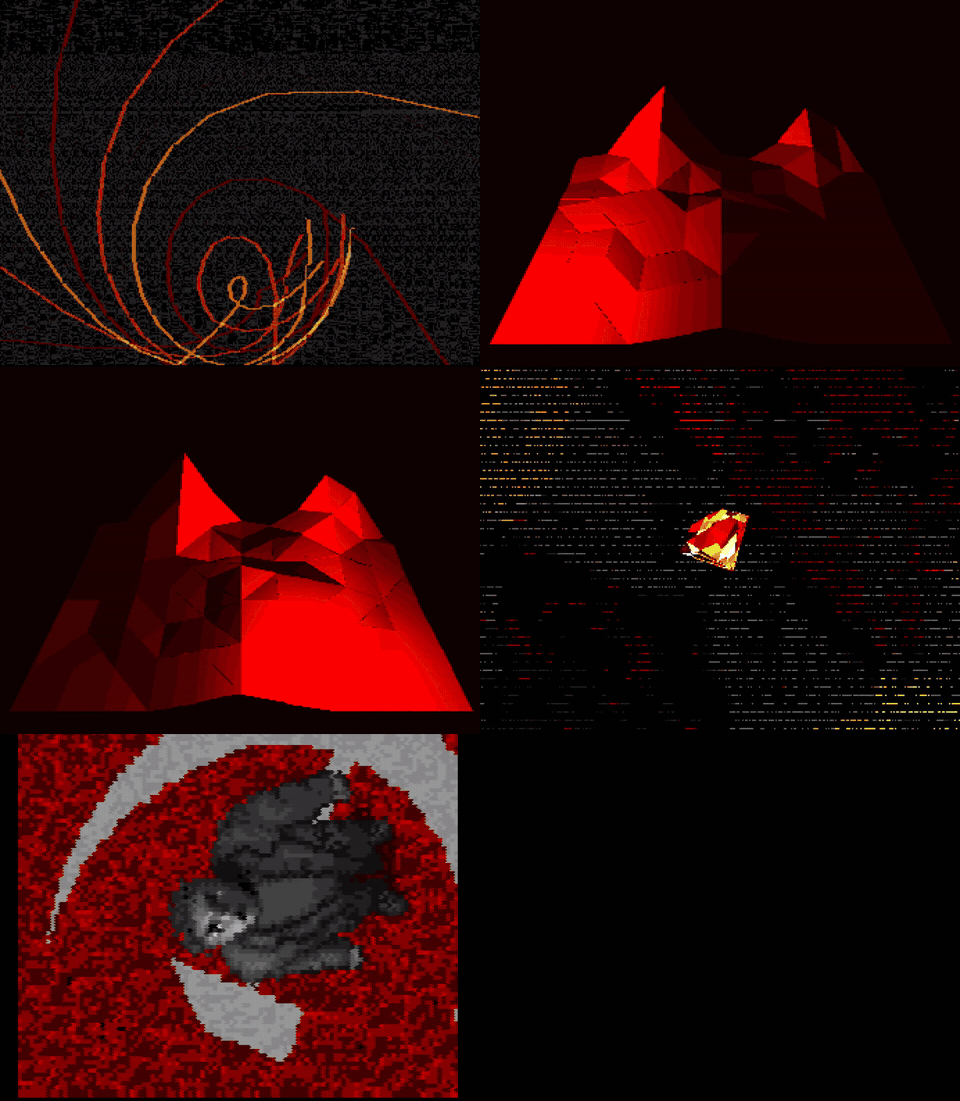
The red low-polygon terrain is continuously redrawn from a moving view. It is followed by a prepared portrait within a circular red field. The executable evidence supports real-time polygon drawing for the terrain; it does not support calling the portrait real-time rendering. The distinction is visible and is kept here.
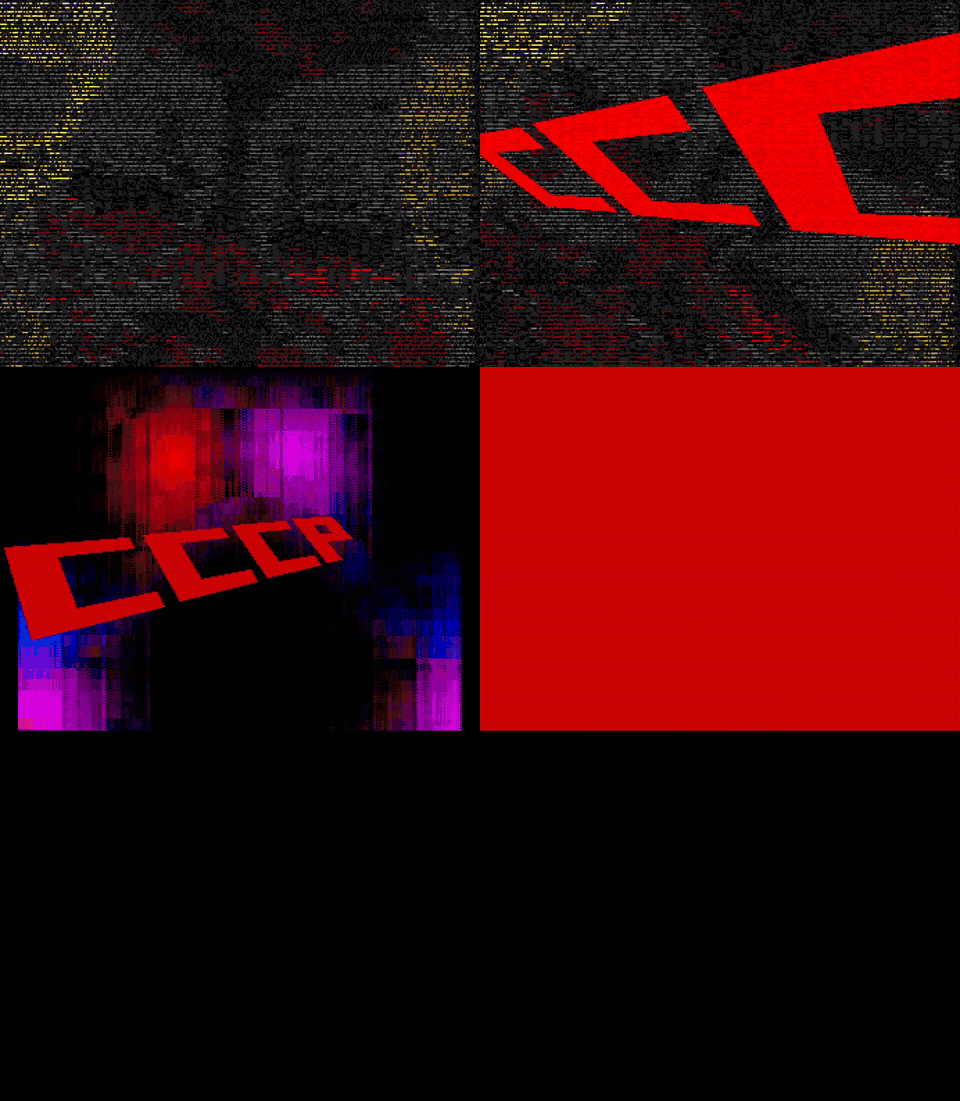
A graph-like zigzag, a thin spatial spiral and a radiation emblem arrive in rapid succession. These are different drawing problems—flat filled regions, projected lines and a rotating symbol—but a restricted palette and persistent screen noise bind them into one visual language.
The Outer File Is Only a Loader
The preserved files hash as follows:
1a3f024d98d427542167d80153c8d8347c2e28ce271449a6eec5ddd0ad7dcbe5  cccp.zip
57486505098a1968f03ba2c9cc275836eab84f980fc1bb5a24838c9f59d92c13  CCCP.EXE
1ac9fa2b3c20b493f78609a3b5b4785e82e0532195f4301c72bcb8cbd51634d9  JulietCaseCCCP.lha
The Aminet LHA and the Assembly ZIP are different carriers, but they contain the exact same 591,872-byte executable. The SHA-256 identity removes any need to choose a supposedly more authentic executable between them.
The outer Amiga hunk is intentionally misleading if inspected only at file
format level. It exposes one code hunk of $2c0, or 704 bytes, followed by
HUNK_OVERLAY. The visible loading message names TITANICS-Cruncher.
Titanics uses the overlay facility as a streaming container rather than as a
normal programme overlay.
The loader allocates a $1400-byte, or 5,120-byte, input window. When its
pointer reaches the end, it asks dos.library for the next window and
continues decoding. It never needs to hold a second full compressed copy in
memory. That is why the phrase “decrunches while loading” is literal here.
The recovered bitstream decoder has four useful command families:
- a short literal run of one to eight bytes;
- a two-byte match with an 8-bit distance;
- three- or four-byte matches with 9- or 10-bit distances;
- a variable match with a 12-bit distance, or a long literal run.
The decoder stops at the allocation length for the current hunk. Relocation groups follow each decoded segment. The loader applies those relocations, frees its 5 KiB input window and jumps to the first reconstructed code hunk. This is recovered control flow, not a guess based on the cruncher name.
Fifteen Internal Segments
The overlay directory describes 15 logical segments:
index  bytes    memory
 0     507012   general
 1     296656   chip
 2     524288   general, BSS
 3      12288   general
 4     130568   chip
 5      37332   general
 6      10268   general
 7      43104   general
 8      86768   general
 9      52224   general
10     131072   general
11      17936   general
12       8968   general
13      65536   general
14     593072   chip, BSS
Together they describe 2,517,092 bytes of address space. Segments 2 and 14 are zero-filled BSS and therefore consume no compressed payload. The initialized segments total 1,399,732 bytes before relocation; the complete outer file, including loader, compression and relocation streams, is 591,872 bytes.
The memory flags are also informative. Segments 1, 4 and 14 explicitly request chip memory and total 1,020,296 bytes, just under one MiB. The large code and working segments may live in fast memory. This is a deliberate split: displayable and DMA-visible data is reserved in chip RAM, while the CPU-heavy programme is allowed outside it.
Segment 0 is both controller and effect code. Three later segments begin with
the S401 signature. Their headers each declare a 131,072-byte destination
and compressed bodies of 37,320, 10,256 and 43,092 bytes. S401 identifies
StoneCracker 4.01 data. The main segment contains the matching signature test
and depacker, so these are second-level assets expanded by the demo after the
Titanics executable has already been reconstructed.
This two-tier layout explains the launch without inventing a disk loader: Titanics reconstructs the executable's hunks while AmigaDOS loads it; the running demo then expands selected StoneCracker blocks into its own 128 KiB destinations.
Hardware Ownership
The first reconstructed instructions take direct control of the Amiga custom chips. The code saves the old interrupt and copper state, clears interrupt and DMA enables, establishes its own copper pointer and display window, then enables the channels it needs. It later restores the saved system state on exit.
Direct references recovered from the main segment include:
DMACONat$dff096;INTENAandINTREQat$dff09aand$dff09c;COP1LCHandCOPJMP1at$dff080and$dff088;- bitplane pointers from
$dff0e0upward; BPLCON3at$dff106;- colour registers from
$dff180upward; - CIA register access through the
$bfdxxxand$bfexxxranges.
This is not an operating-system animation programme drawing into a window. The production owns the raster, copper list, palette, bitplane pointers, interrupt cadence and replay timing for the duration of the show.
The use of BPLCON3 is specifically AGA-relevant. One recovered palette
routine selects banks through $dff106 and writes complete runs of colour
registers. Elsewhere three arrays of channel values are added, masked and
repacked into 12-bit colour words before being written through bank-selected
palette slots. The many fades and colour ruptures are therefore driven palette
work, not merely a fixed bitmap cycling beneath one global tint.
A Script of Small Parts
The main controller keeps a pointer to a table of callable entries. It invokes
one entry, advances the pointer by four bytes and repeats until its ordinal
reaches $6f. That is 111 dispatch positions, not 111 independent visual
scenes: entries can initialise, draw, wait, alter a palette or bridge to the
next larger part.
This distinction matches the runtime. CCCP rarely allows an effect to settle
into a long demonstration. A radial burst can be followed by a word, a
polygon shutter and a checkerboard within seconds. Treating every change as a
separate “effect” would exaggerate the count and miss the actual construction:
a long scripted chain of small operations shares buffers, palette machinery
and transition code.
The five S401 comparisons found inside segment 0 are code references to the
same depacker signature, not five additional packed assets. Only the three
standalone segments contain complete StoneCracker headers and bodies. This is
one example of why raw string counts are not accepted as structure without
checking their instruction context.
What the Images Prove
The reconstructed code proves direct custom-chip control, copper and palette programming, bitplane setup, a scripted call chain, two levels of compression and explicit chip-memory allocation. The runtime proves continuous projected lines, filled polygonal solids, a changing terrain, palette motion and many hard graphic transitions.
It does not by itself prove that every portrait or photographic element is calculated. Several such elements behave as prepared images inside real-time compositions, and they are described that way here. Likewise, the GIFs do not establish which of Juliet or Case wrote an individual uncredited routine. The surviving public credit divides code only at production level.
Why It Still Feels Unusual
Many 1994 demos organise themselves around clean effect presentation:
introduce a routine, hold it long enough to admire, then transition. CCCP
uses capable routines but refuses that neutral showroom. The checkerboard is
contaminated by the folded object. The typography becomes a mask. The
wireframe face arrives out of a radial print texture. Prepared political
imagery is placed beside abstract projection rather than isolated in a
slideshow.
The limited red-black-white core does more than provide a theme. It lets incompatible source material survive rapid cuts without the demo falling into an effect catalogue. Yellow, purple and grey are used as shocks against that base instead of establishing unrelated scene palettes.
Its technical organisation is similarly economical. One large controller owns the hardware and sequences many small calls. Nearly one MiB is reserved explicitly for chip-visible data, while other work can use fast RAM. Titanics streams the executable into place with a 5 KiB window; StoneCracker then expands three 128 KiB blocks only when the running programme needs them.
That combination is why fifth place is not the interesting fact. CCCP is a
coherent 1994 AGA production whose aggressive visual surface is supported by
recoverable engineering: banked palette work, direct raster ownership, a
long scripted dispatch chain and carefully layered memory and compression.
The politics are imagery; the enduring subject is how code, type, noise and
geometry are made to attack the same screen.