Analysis model: gpt-5.5 xhigh
Compost by Orange - Technical Dissection
Compost is Orange's MS-DOS demo for The Party 1996. It ranked 7th in the
demo competition and sits in a very different corner of the same late-1996
Orange period as COB and Huge Crowd: less renderer brag text, more graphic
design, sampled/collaged still art, palette-heavy transitions, and a large
external data file.
The useful technical shape is a custom 386 protected-mode DOS program with
VCPI/DPMI/A20 setup strings, an external DATA.DAT art/resource pack, an
external S3M module, direct VGA DAC/retrace work, and many embedded graphic
resources in PCX and RIX3-like formats. The visual personality is the point:
Orange logo material, "mad professor haplo" cards, silhouette panels, star and
eye motifs, orange-cube text panels, and a final red/orange credit crowd.
Sources
- Pouet production page: https://www.pouet.net/prod.php?which=392
- Original Scene.org archive: https://files.scene.org/view/demos/groups/orange/compost.zip
- Public video reference linked from Pouet: https://www.youtube.com/watch?v=_JXQ1xMUsnU
Pouet metadata:
title:          Compost
group:          Orange
type:           demo
platform:       MS-Dos
release party:  The Party 1996
ranked:         7th
release date:   December 1996
Examined Files
Archive hash:
87e8ff5095debe1be4b24269650cc7b4ebc5955cfa2acb2302c0e1eb6d9e4ef5 compost.zip
Extracted file hashes:
1e638a604d4c2af9e84a95d54b1498ed4d7bbba4be7fc5c300718e98b43d16cd  COMPOST.EXE
8b081f6bca20abe24c43b19b539b73c8eafd404c76860153e883b63ab98a5d34  DATA.DAT
a5d7ff033108256e4a59a5fba158a4ed0e770ea6269e928d5dc996fa6df01899  FILE_ID.DIZ
2bc2f03e86bc718270ee7ab95eff09bdef58c315356be41555e23677e99f659f  MOD.S3M
FILE_ID.DIZ is minimal:
Compost / Orange
   TP6 Demo
The file split matters. Unlike a tight 64K intro, Compost is openly a
multi-file demo: a 291 KB executable, a 1.47 MB data file, and a 403 KB S3M
module. That immediately explains why the production can lean on full-screen
designed panels instead of deriving everything from procedural geometry.
Visual Evidence
The Pouet screenshot is a 320x200 GIF:
50ed86cbd55e3c7c68e4c13810d96e1ca28e774a75b09f9ca97febfdacb96b0e pouet.gif
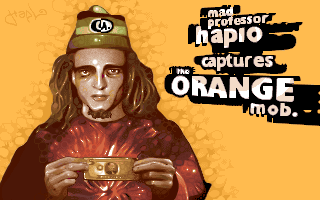
The public MP4 linked from Pouet is a 900x720 video. The stills and GIFs below are direct full-frame video extracts downscaled to 450x360 for the article. There is no cropdetect, padding, viewport correction, browser screenshot, lightbox screenshot, or guessed DOSBox canvas size in the asset path.
sha256: e15e7a7e1ebc305e17c9d480a33fff57c226ab6a04ec8c224e7beac2063ddd4a
video:  h264, 900x720, 60 fps
length: 185.32 seconds
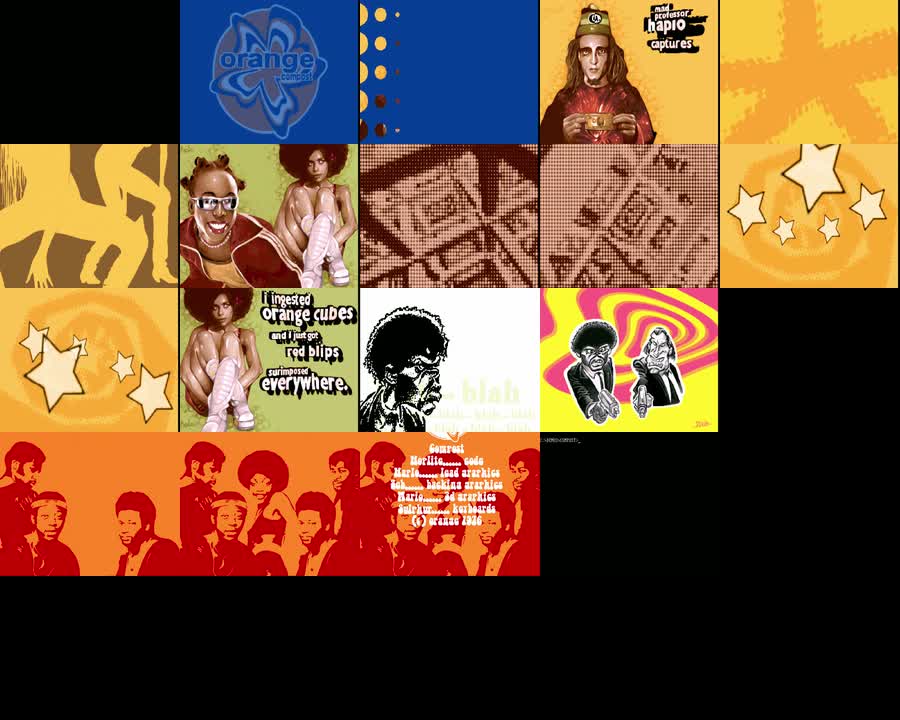
The contact sheet shows the runtime grammar: black lead-in, blue Orange/Compost logo, dot fields, Haplo cards, yellow silhouette panels, orange-cube slogan panels, rasterized print-like panels, star fields, eye/blab graphics, and a late red/orange credit crowd.
Public-Video Timeline Mechanics
The long public video is best read as a directed graphic timeline rather than a
sequence of isolated effects. The important motion is often in the transition
layer: palette fades, image warps, dot wipes, full-screen graphic replacement,
and timed text/sticker reveals. That matters because DATA.DAT contains the
stored panels, but the executable is still doing more than a slideshow.
The early sequence is a good example. It starts with a flat blue/yellow face
plate, dissolves into the Orange/Compost identity, distorts that logo, lets it
fade back into the blue field, then brings in the Haplo figure through a
right-side dot wipe before the mad professor haplo captures sticker text is
assembled.

The movement in that GIF is not a polygon or texture-mapping claim. It is
stored graphic material being manipulated by a presentation engine: whole-screen
cards, palette intensity changes, logo displacement/fade treatment, and a
masked dot/column reveal. The decoded PCX/RIX resources explain the source
plates; the VGA DAC/retrace and A000h evidence later in the article explains
the timing and framebuffer path used to present them.
Logo And Opening
The opening identity is a blue field with the Orange logo and a small
compost label. It is a graphic card, not a technical warm-up screen.

The same visual is also present in decoded resources from DATA.DAT, which
means the public-video frame is not hiding a procedural effect here. The demo
uses stored art as a compositional layer and then animates around or between
those layers.
The opening transition clip above is the stronger evidence: the logo is not just shown, it is faded, warped, and removed as part of a timed graphic composition. This is the recurring Compost mechanism: resource plates provide the image identity, while code supplies the palette, wipe, displacement, and sequencing.
Haplo And Collage Panels
The "mad professor haplo captures" card is the clearest example of the demo's print/collage design style. The motion is mostly in presentation and transition, so a still is enough for the article-level point.

The decoded DATA.DAT PCX contact sheet reinforces that this is not just a
single title picture. There are related silhouettes, Haplo card variations,
photographic/illustrated figures, and text compositions in the data file.

I found 14 strong PCX resources in DATA.DAT. Each validates as a 320x200
8-bit PCX:
0x000000  0x002210  0x003696  0x004f21
0x00a967  0x00cbbc  0x06974e  0x06eb7d
0x074b41  0x0c2c5b  0x11aa1a  0x147f33
0x14c550  0x170f7e
That resource map is a better explanation of Compost than trying to treat it
like a polygon-showcase intro. Its strongest sections are directed art panels
with palette and motion treatment, not naked math effects.
Stars, Eyes, And RIX3 Resources
The star panels are animated enough to deserve a short clip. The movement is simple, but it shows how the stored art is reused as a rhythm element rather than left as a static slide.


DATA.DAT also contains five RIX3 resources. A simple 10-byte-header,
768-byte VGA-palette, chunky-pixel decoder produced the following contact sheet:

The offsets and dimensions:
0x07b1f6  320x200
0x08af00  320x200
0x0ae951  320x256
0x12ff1f  128x128
0x134229  320x200
This set includes the orange-cube panel, Orange/Compost logo, yellow/blue face, star, and eye motif. The public video's eye and star material therefore maps cleanly back to decoded data-file resources.
Orange Cubes
The orange-cube panel is one of the more memorable frames because it combines the literal group color language with a deliberately absurd slogan.

From a code perspective, this matters mostly as a resource-boundary clue. The same panel exists in the RIX3 set, while variants of the related figure/text material exist in the PCX set. The demo is sequencing and transforming a curated graphic package; it is not drawing this scene from vector primitives.
Credits
The late credit section is the one visual part where a clip communicates more than a still. The red/orange crowd image and white credit stack sit inside a small animated rhythm, matching the demo's graphic-design-first structure.

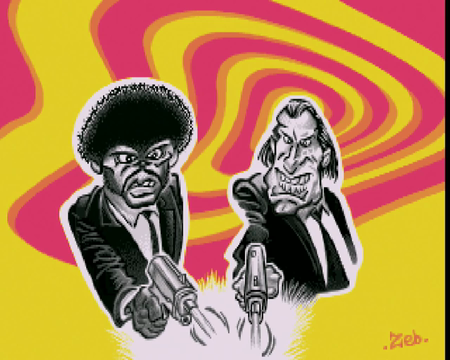
The credit frame identifies the visible production roles:
code      cornerstone
graphics  dee dee
music     mad arthur
          dune
          starlight
I am not reproducing or expanding old personal contact details here; the public analysis only needs the production identity and technical evidence.
Executable Shape
COMPOST.EXE is a 291,236-byte DOS MZ executable. Its header is a normal MZ
carrier with a sizeable body:
signature:              MZ
file size:              291236 bytes
header paragraphs:      0x0020
relocations:            0x0014
CS:IP:                  0000:03d9
SS:SP:                  46fb:1c00
minalloc/maxalloc:      0x01c1 / 0xffff
The startup strings show the real runtime boundary:
386 or better not detected!!!
Not enough low memory!!!
System is already in V86 mode, and no VCPI or DPMI found!!!
Not enough extended memory!!!
Couldn't enable A20 gate!!!
Extended memory allocation failure. (weird eh???)
DPMI host is not 32bit!!!
Ran out of DPMI descriptors!!!
Couldn't set DPMI descriptors as needed!!!
Couldn't enter 32bit protected mode!!!
Incompatible VCPI PIC mappings!!!
There is no PMODE/W, DOS/4G, or similar named banner in the executable. The safe classification is therefore narrower: custom or statically-linked 386 protected-mode support using VCPI/DPMI-style paths, A20 setup, and extended memory checks.
The entry area backs that up. Around 0x03ff the loader installs descriptor
tables, flips CR0 bit 0, and far-jumps into protected-mode code:
0x03f7: int    0x67
0x03ff: lgdtw  0x0c66
0x0404: lidtw  0x0c60
0x0411: mov    eax, cr0
0x0414: or     al, 1
0x0416: mov    cr0, eax
0x0419: ljmp   0x0020:0x021e
0x041e: mov    ax, 0x0030
0x0421: ltr    ax
The executable also contains int 31h and int 67h call sites in the low
runtime area, matching the DPMI/VCPI strings.
Resource Loading Boundary
The executable names data.dat twice:
0x001c29  data.dat
0x034fa5  tnldata.dat
0x034fa8  data.dat
The tnldata.dat spelling looks like a development leftover near the second
data.dat occurrence, not a shipped file. The archive contains only
DATA.DAT, and that file is where the decoded art resources live.
There is also an SCRM marker at executable offset 0x27545. Together with
the external MOD.S3M, that makes the music path explicit enough for this
pass: the production ships an S3M module and embeds or links Scream Tracker
player-related material. I did not recover the full player routine map in this
pass, so the article stops at the format/runtime boundary rather than inventing
a mixer reconstruction.
VGA And Timing Evidence
The binary has a lot of direct VGA I/O:
mov dx, 03dah / retrace-status style sequences: 121 hits
mov dx, 03c8h / DAC-index style sequences:       208 hits
literal A000h segment references:                40 hits
The timer/retrace helper around 0x2abb7 is a useful example. It programs PIT
channel 0, waits on the VGA vertical-retrace bit at 3DAh, reads the counter,
then restores a derived timer value:
0x2abb7: cli
0x2abb8: mov    al, 0x30
0x2abba: out    0x43, al
0x2abbc: mov    edx, 0x03da
0x2abc5: in     al, dx
0x2abc6: test   al, 0x08
0x2abc8: je     0x2abc5
0x2abca: xor    al, al
0x2abcc: out    0x40, al
0x2abce: out    0x40, al
0x2abd0: in     al, dx
0x2abd1: test   al, 0x08
0x2abd3: jne    0x2abd0
0x2abd5: in     al, dx
0x2abd6: test   al, 0x08
0x2abd8: je     0x2abd5
0x2abda: in     al, 0x40
That is not an effect renderer, but it proves the demo is actively measuring or synchronizing against VGA retrace/PIT timing rather than just blasting a fixed delay loop.
The palette path is similarly direct. The byte sequence at 0x31c78 writes
the DAC index through 3C8h, increments to the DAC data port, and emits three
zero bytes before entering a retrace wait:
0x31c78: mov    dx, 0x03c8
0x31c7b: mov    al, 0x00
0x31c7d: out    dx, al
0x31c7e: inc    dx
0x31c7f: rep outsb
0x31c81: mov    al, 0x00
0x31c83: out    dx, al
0x31c84: out    dx, al
0x31c85: out    dx, al
0x31c88: mov    dx, 0x03da
There are many more copies of this pattern family, which fits what the runtime shows: fades, palette accents, and graphic-card transitions rather than one continuous 3D scene.
Runtime-To-Code Concordance
This pass ties the public-video scenes to concrete renderer families instead of leaving them as resource-only observations.
The face/logo/Haplo transition maps to the code around 0x31c40. That block
clears and prepares a work buffer through [0x3097a], uploads a 765-byte DAC
palette from 0x30346, then copies a full 320x200 dword frame from
[0x3097a]+0x2300 to A0000h with ecx = 0x3e80. The same cluster blends two
palette sources at 0x2fd3d and 0x30043 into the live DAC table using factors
at [0x29fac] and [0x29fb0]; the helper at 0x31eb2 multiplies each channel
by those factors, shifts back to 6-bit VGA range, and clamps to 0x3f. That is
the code shape behind the clip's logo/facial plate fading and color treatment.
The dot/column reveal and centered Haplo/card presentation map to the cluster
around 0x33180. It builds an 80x80 radial mask at [0x310ec], then the
loops around 0x33300 compare that mask against the threshold at [0x32008]
while copying 0x28-by-0x28 blocks across five bands. Later copy loops move
0x28 dwords per row for 200 rows into A0000h + 0xa0, which is a centered
panel transfer rather than a free-running 3D renderer. That explains why the
video reads as graphic plates being revealed through a programmed aperture.
The star/eye/cube/credit transition family maps to the code around 0x346f2.
There a byte-index table is expanded into five-byte-wide runs from five lookup
tables, either directly into A0000h or into an offscreen buffer. The overlay
path at 0x3484a then walks 0xfa00 bytes, compares a mask from [0x327ec]
against the threshold at [0x33450], and copies only the surviving offscreen
pixels. The update routine decreases that threshold, advances offsets by
0xa00, wraps at 0x5dc00, and increments the shared fine/scene counters
[0x2931e] and [0x2931f]. That is the mechanical basis for the broad
masked-field wipes over the stored star, face, cube, and credit plates.
The timing pattern repeats in these scene families. The executable has local
timer/retrace setup around 0x3207c, 0x3377d, and 0x34a34; calibrators near
0x320f7, 0x337f7, and 0x34a6c; and ISR-like paths that poll 3DAh,
adjust the PIT reload, call a saved callback, and send the PIC EOI. The
keyboard path also appears inside the visual loops through port 60h, with
escape handling and a scan-0x39 diagnostic/marker-color branch. So the video
timing is driven by retrace/PIT-paced scene loops, not by blind sleeps.
What This Pass Proves
The recovered evidence supports these conclusions:
Compostis a multi-file Orange demo, not a 64K intro.- The runtime uses a 386 protected-mode setup with VCPI/DPMI/A20/extended-memory handling, but no named extender banner was found.
DATA.DATis a real art resource pack with at least 14 decodable 320x200 PCX resources and five decodable RIX3 resources.- The visible logo, orange-cube, star, eye, silhouette, and Haplo material maps directly to decoded resources or public-video full-frame evidence.
- The face/logo/Haplo GIF shows the actual transition layer: palette fades, logo displacement, a dot/column wipe, and timed sticker/text reveal on top of stored graphic plates.
- The code now ties those visible families to concrete routines: the
0x31c40full-frame/palette-blend compositor, the0x33180radial-mask/card reveal, and the0x346f2five-byte table compositor with0xfa00masked overlays. - The executable performs direct VGA DAC,
A000h,3DAh, PIT,int 31h, andint 67hwork. - The public-video GIFs in this article are direct time slices of the MP4 frames, downscaled only for page weight.
The remaining unknown is the complete top-level call graph and authorial scene names. This pass does identify the loader/resource/VGA/timing structure and now ties the major visible transition families to specific code clusters, but it does not pretend to name every helper routine.