Analysis model: gpt-5.5 xhigh
Cybernetic by The Black Lotus - A Demo That Changes Its Mind
The Swedish breakthrough at The Gathering 1995
Cybernetic is a full Amiga AGA demo by the Swedish group The Black Lotus,
released on 15 April 1995 and placed third in the Amiga demo competition at
The Gathering 1995. Demozoo credits Equalizer, Offa, Rubberduck, Sagittarius,
Xtal and Yfcon for code; Fishbone and Snorpax Tudor for graphics; and
Sagittarius for music. Xtal's own note on the production page narrows his
guest contribution to the Gouraud code.
This is early TBL before the monumental unity of the group's later work. That is not a defect to explain away. Cybernetic's character comes from watching a large team try several incompatible visual languages in one production: astronomical simulation, red editorial graphics, abstract fire, deliberately naive landscapes, sampled faces and a framed 3D object show.
The analysis is based on the original party archive, its readme, executable and 2.4 MB data file; a separately preserved corrected archive; loader disassembly; and an uninterrupted, silent 780.1-second run of the April party build. No online video was used to reconstruct the route.
- Cybernetic at Demozoo
- The Black Lotus at Demozoo
- The Black Lotus at Pouet
- The Gathering 1995 results
- Original party archive at scene.org
- Later preserved corrected archive
From paper logo to impossible astronomy

The opening TBL logo looks drawn and cut from rough paper. It is modest, almost homemade, and occupies a shallow textured plane. Cybernetic immediately abandons that materiality for a starfield. Points first collect as a loose cloud and then rush past the viewer, giving the production its first strong change of scale.
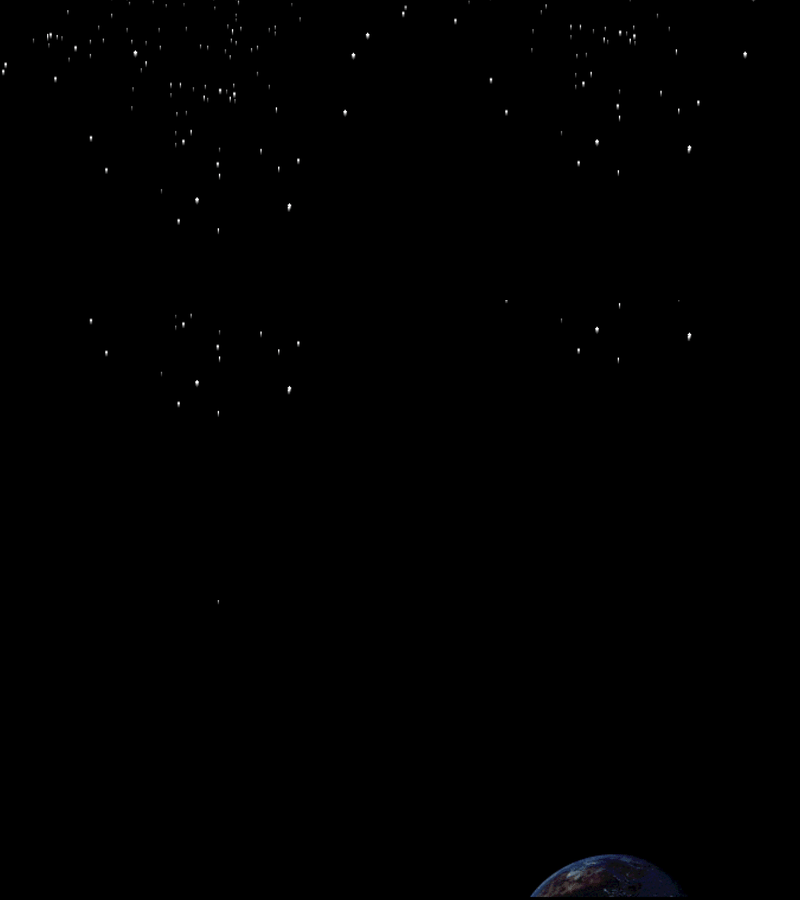
Earth arrives as a photographic globe under green monospaced labels. Planet: Earth, LifeForms: and Local Date: turn a familiar image into an
instrument display. The counters race beyond useful measurement. White
linear intrusions eventually cross the planet and the colour drains towards
red. It is not a scientific visualization; it is a compact 1995 image of
systems accelerating beyond human time.
The title, starfield and planet form Cybernetic's most coherent miniature. Texture gives way to points, points establish depth, and depth gives meaning to the floating planet. The demo then deliberately breaks that continuity.
Credits as moving graphic design
The red credit movement does not simply list names over black. Huge cropped words move behind smaller functional credits: art, code and music become pieces of the composition. The narrow horizontal window and dark burgundy palette make the sequence resemble print design passing through a scanner.
Its value is pacing as much as typography. After the expansive planet, the demo compresses itself into a band. It also tells the viewer that the coming parts are collective work rather than the expression of one coder-artist pair. The credits are placed before the main catalogue of effects, not saved as an apology at the end.

A dark spacecraft then rotates against white radial light. The craft remains more silhouette than carefully illuminated model, so the bright background does most of the spatial work. Its edges sometimes disappear into the central flare. That makes the object feel graphic and mechanical at once: a logo given depth rather than a vehicle placed in a world.
Effects that refuse a house style

The next movement is an orange vortex assembled from chunky luminous cells. It curls, expands and sheds its outline. Cybernetic is strongest here when motion makes the low-resolution material seem intentional. A still frame can look blunt; continuous deformation supplies volume.
The production follows it with an emphatically synthetic striped sphere and then a tiny flat-colour desert. The desert has pyramids, a central mountain and a white sun, all inside a black surround. Its almost childlike economy is striking after the fire field. The effect is not trying to pass as a more expensive renderer. It uses distance between the small picture and the large screen as part of the image.

Cybernetic repeatedly changes the implied size of its screen. Sometimes the display is a limitless star space; sometimes it is a designed panel; here it is a little window. This is the demo's real connective device. The imagery does not share one palette or rendering technique, but it keeps renegotiating the boundary of the frame.
The face inside the interface

Purple and orange contour lines lead into the strangest long section: a digitized face inside a green interface. Circular black masks pass over the eyes and mouth while the portrait changes size and position. A pale mechanical border below it suggests controls without offering an actual readable instrument.
The face is coarse enough to remain visibly sampled. Cybernetic does not hide that coarseness with a small presentation throughout; it enlarges the image until the pixels become skin. The result sits between surveillance terminal, video art and a face being reconstructed by a machine. This part justifies the demo's title better than the more conventional 3D that follows.

SPACECUT introduces a pale green solid inside a complete interface frame.
The vertical title, ornamental bars, purple controls and TBL signature make
the surrounding graphic almost as important as the object. Xtal identified
his guest work as Gouraud code, but the runtime alone cannot assign a
particular on-screen solid or routine to an individual coder. The defensible
observation is that this section presents shaded geometry as designed content,
not as a full-screen benchmark.
A landscape that becomes an ending
The final movement returns to landscape. Red and purple ground scrolls below a dark horizon while blocky light spreads across the lower half. The terrain is far less geometrically explicit than the earlier object section; it feels like a generated road dissolving into heat.

A blue waterfall finally opens between brown rock walls. A patterned floor moves towards it, briefly producing the clearest navigable place in the whole demo. Then the authored image gives way to black. In the original party build that black remained unchanged through the 780.1-second capture ceiling.
The route therefore ends on an unexpectedly literal scene after spending most of its time switching representational systems. The waterfall is not a grand summary. It is another answer to the question Cybernetic keeps asking: what kind of space is this screen now?
The April party build and the September correction
Two preserved versions need to be kept separate. The original Gathering archive hashes as:
a36d22ab25be71977a2f14b858925802e0d3a6dba921317c584244ae9114b338 g95_tbl.lha
Its principal files are:
1830bb8f717a3f5edc78a289320e0a30be00baf4d82d0d638b7164601ce0ed73  Cybernetic
e02326839a58fa986fc7c2495d502032d8f5ef7501b94d5ac3c29c244f505ab2  Cybernetic.data
a06cd24615dd6529b8346e49ac3aedbb48a457a5f8063f8d16567f64988d5c77  Cybernetic.ReadMe
The later amigascne archive hashes as:
785556985bd5f4418e76500e925d7bd6eb57dd79628202c9c428c3737c10b3b4 TBL-Cybernetic.lha
Its Cybernetic.data is byte-identical to the party file, but its executable
is 28 bytes larger and hashes differently:
5928a5021fa5c098754282490e41c4e3f7f800db653773740cd7756e554af82b Cybernetic.exe
The readmes expose user-visible changes. The April text says fast memory is “strongly advisable” and gives the left mouse button as the exit control. The September text instead advises disabling extra drives and gives the right mouse button. Both call the release a beta and require an AGA Amiga with a 68020 or better, 2 MB chip memory and roughly 3 MB of disk space.
In like-for-like silent emulator tests, the April build completed the visual route and remained black. The later executable completed the same broad route and returned cleanly to the shell. That observation does not prove every reason for the correction, but it does show why “the Cybernetic executable” is not a sufficiently precise artifact description.
With only 2 MB chip memory and no fast memory, both tested launchers printed their loading message and returned before the demo. With 8 MB fast memory, both ran. That is practical support for the party readme's advice in this emulated configuration, not a claim that exactly 8 MB was required on every real machine.
A small loader in front of a compressed program
Both executables begin as Amiga LoadSeg hunk files. Their initial code segment is only 704 bytes, followed by an overlay. The small segment is a loader: it opens the DOS library, prints:
"Cybernetic" From TBL is now loading...
It allocates working space, reads and allocates overlay segments, applies relocations and transfers control to the expanded program. Its inner routine uses a bitstream-driven LZ-style copy scheme, with literal bytes and back-references. The large overlay is therefore not an ordinary uncompressed HUNK program that can be mapped honestly from the first 704 bytes.
This architecture explains two visible startup facts. Cybernetic expects its data file in the current directory, and loading takes place before the hardware-controlled visual sequence appears. The loader is an operating-system shell around the compressed main production.
Thirty-nine exact containers
Cybernetic.data is 2,408,594 bytes long. It divides exactly into 39
consecutive blocks. Every block begins with a big-endian 32-bit total length,
including the length word itself; repeatedly advancing by that value lands
exactly at end-of-file with no remainder.
blocks  offsets                         lengths in bytes
 0- 4   00000000 .. 00024a83    54182, 2916, 1192, 91857, 182762
 5- 9   0005146d .. 000711ab    17230, 62372, 43422, 7342, 22660
10-14   00076a2f .. 00096851    53015, 11347, 9240, 56992, 10005
15-19   00098f66 .. 000ab279    18526, 41062, 2612, 12315, 14542
20-24   000aeb47 .. 0013e0cc    106394, 417475, 53928, 9344, 46590
25-29   001496ca .. 001a7ea5    40846, 29158, 20051, 296980, 2263
30-34   001a877c .. 001eaca0    16714, 223340, 8522, 23076, 4584
35-38   001ebe88 .. 0021727c    3689, 6006, 167445, 216598
Three containers, numbers 20, 31 and 38, carry a CPLX_TP3 identifier just
after the length and four zero bytes. Their embedded labels are blubb,
cybbe in mid-flite and summer makes me cry. These are direct file facts
and strongly identify three TP3 music objects. They do not justify assigning
each of the other 36 blocks to a visual scene without following the main
program's load calls.
The size-prefixed stream gives Cybernetic a flexible resource package rather than a directory of self-describing pictures. It also fits the runtime's abrupt changes: the sequencer can move between heterogeneous assets without requiring them to share one public file format.
Why the unevenness works
Cybernetic is less unified than the best-known TBL demos that followed it. The paper logo, planet terminal, red credits, fire object, tiny desert, digitized face, green 3D panel and waterfall could have been separate productions. Yet the demo understands that discontinuity and repeatedly turns it into a framing event.
What holds it together is not a fictional common renderer. It is the edit between full screen and window, image and interface, object and graphic design. The demo keeps making the viewer re-evaluate whether the monitor is a space, a page, an instrument or a picture frame. Its third place at The Gathering 1995 marks a Swedish group becoming ambitious enough to make a large, authored production before it had settled on one monumental voice.
Direct-run boundary
emulator        FS-UAE 3.2.35
machine         PAL Amiga 1200, 68020, AGA
memory          2 MiB chip, 8 MiB fast
program         original April 1995 party executable and data, unchanged
working dir     data file beside the executable
input           none
audio           disabled in the emulator
capture         FFV1 video only, 1024x768 at 10 fps
duration        780.1 seconds
authored route  approximately 8–414 seconds
terminal state  black and unchanged through the capture ceiling
published media eight continuous five-second GIFs
The capture has one video stream and no audio stream. The eight GIFs are continuous excerpts from the direct party-build run, not composites or contact sheets. There is no MP4, H.264 media or published soundtrack. The original archives, extracted binaries and full lossless capture remain private; public preservation copies are linked above.