Analysis model: gpt-5.5 xhigh
Deep by CNCD & Parallax - Technical Dissection
Scope
Deep is the Finnish Amiga AGA demo by CNCD and Parallax, released in
April 1995. It won the Amiga demo competition at The Gathering 1995.
Public credits name Bandog, Debug and Simply for code, Destop for direction
and graphics, and Legend and Yolk for music.
Useful public references:
- Pouet production: https://www.pouet.net/prod.php?which=9270
- Amiga Demoscene Archive: https://ada.untergrund.net/?i=627&p=demo
- Aminet release: https://aminet.net/demo/tg95/Deep.lha
- Scene.org mirror: https://files.scene.org/view/mirrors/amigascne/Groups/C/CarillonCyberiad/Deep.LHA
- Demozoo-linked full reference video: https://www.youtube.com/watch?v=92ctmGU7jig
The original release was obtained independently from Aminet and Scene.org. The two downloads are byte-identical. It was installed according to its own note, run silently, captured losslessly and inspected as Amiga HUNK executables. The visual account below comes from that run, not an online video.
Complete Silent Runtime
The preserved hard-disk release ran in FS-UAE 3.2.35 on an A1200 profile with 2 MiB chip memory and 8 MiB fast memory. Host audio used a dummy device, emulator audio output was disabled, and the capture contains video only. The final lossless recording is 203.2 seconds long. Authored output ends at approximately 139 seconds in that unconstrained emulator run; the remaining 64 seconds are continuously black, confirming that the last visible part was not cut off. Emulator wall time is not presented as original PAL duration.
Each animation below is a distinct continuous six-second excerpt at 400x300 and 12 fps. They are not sampled frames, a contact sheet or several copies of one animation.

The opening establishes Deep's visual grammar before the main 3D passages: a source image is folded into a continuously changing bilateral field. The centre line remains the visual anchor while bands expand, contract and change colour on both sides.

The face passage is not a rotation of one prepared frame. Features move through a live radial mapping: forehead, eyes and jaw are alternately pulled towards a pole, wrapped into rings and restored to a recognisable portrait.


The tunnel section combines two independently moving structures. The surrounding image is remapped into a rotating bore while a shaded, texture-bearing solid crosses the foreground. It is a composited effect sequence rather than a camera move over a single rendered still.

The dolphin scene deliberately retains the still artwork as a stable reference. A moving faceted form covers and distorts a different portion of the picture on every frame, making the transformation readable without discarding the image beneath it.
Additional Sequence Coverage
A later visual audit retrieved only the 450x360 H.264 video stream from the
full Demozoo-linked reference. No audio format was selected, downloaded or
decoded. The private 208.24-second inspection file has SHA-256
96ea137fdb75e19e02871a28831e508bff6468b3ba3b8faa27333e02202ca3ff;
it is not published. Its pacing is close to the complete 203.2-second direct
capture, and its order agrees with that run. The four additions below are
continuous four-second, 8 fps GIFs covering parts missed by the original five.

The animated opening itself supplies useful authorship evidence: DEBUG,
SIMPLY and BANDOG appear together over the production's moving angular
title construction. This agrees with A.D.A.'s code ledger rather than relying
on a group-name inference.

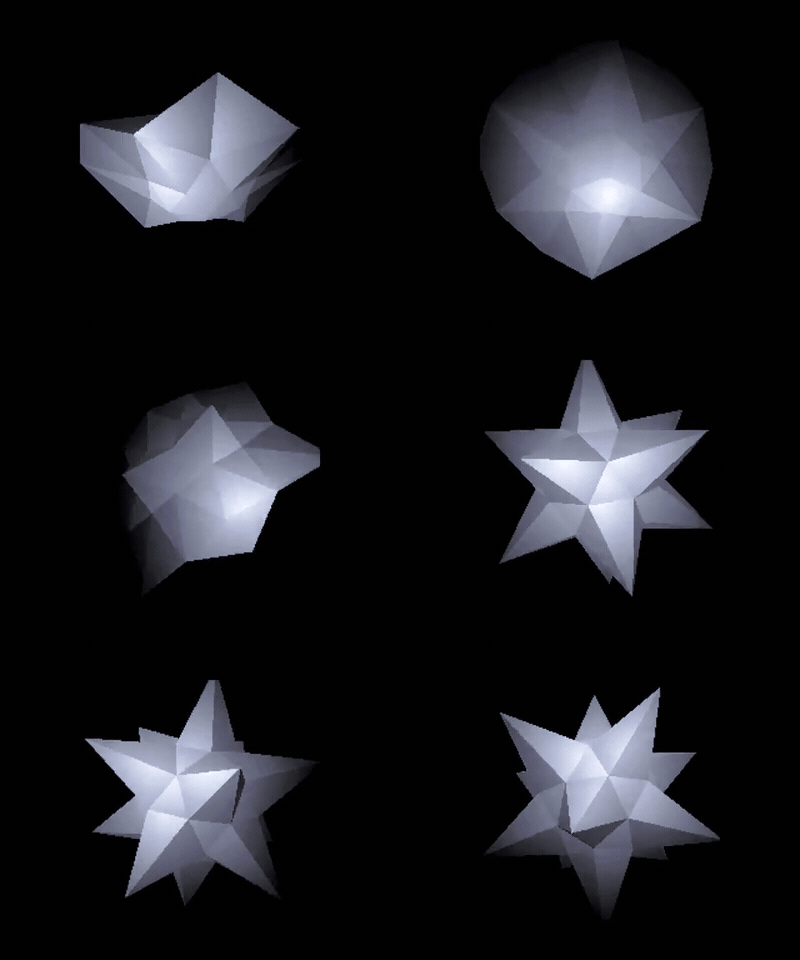

These clips extend the visible sequence after the dolphin image: a dark centre opens through a radial field, an untextured faceted solid changes silhouette, and the closing part moves through a heavily filtered textured landscape. The last passage is authored output from the second loader batch, not emulator garbage preceding the later black hold.
Complete Nordic Credit Check
A.D.A. credits Bandog, Debug and Simply with code, Destop with direction and graphics, and Legend and Yolk with music. Demozoo additionally records a code role for Legend. The opening animation independently confirms the three named coders. Individual Demozoo profiles locate Bandog, Debug, Simply, Destop, Legend and Yolk in Finland, so all explicitly credited makers pass the Nordic boundary individually.
A Loader and Twelve Executable Parts
The distribution is not one large executable with a movie appended. dEEP
is a 63,044-byte coordinator, accompanied by twelve independently loadable
Amiga executables:
| Part | File bytes | Code bytes | Explicit chip-data bytes |
|---|---|---|---|
keppi |
369,084 | 6,896 | 362,104 |
juutalaine |
120,480 | 2,848 | 4,624 |
portti |
104,716 | 1,744 | - |
letkus |
48,692 | 3,688 | 116 |
kansi |
47,840 | 1,116 | - |
susihukka |
109,460 | 106,620 | 2,228 |
rusina |
92,260 | 5,984 | 3,252 |
cncd |
7,336 | 1,952 | 116 |
parallax |
10,604 | 3,648 | 2,228 |
ooppera |
43,284 | 6,480 | 2,244 |
puhelin-neuvonta |
188,860 | 3,316 | 2,228 |
tarra |
350,164 | 5,720 | 344,360 |
The table is important for what it does not show. File size is not a measure
of code complexity: susihukka is mostly code, while keppi and tarra
place almost their entire payload in chip-addressable data. Other parts put
large asset banks in ordinary data hunks and allocate their working or
display memory separately.
The loader itself has five hunks: 4,224 bytes of code, 56,188 bytes of ordinary data, 1,584 bytes of chip data, 482,980 bytes of chip BSS and 786,432 bytes of ordinary BSS. The large zero-filled allocations are working space; they do not inflate the archived file.
Two Preloaded Batches
dEEP opens dos.library, graphics.library and intuition.library, then
loads the first six parts:
keppi juutalaine portti letkus kansi susihukka
It calls and unloads those segments before loading the second group:
rusina cncd parallax ooppera puhelin-neuvonta tarra
This is a practical production framework. The current group is available without loading from disk between every visual cut, but the demo does not keep all twelve sizeable payloads resident for its whole duration.
The repeated face, tunnel and image-transformation motifs therefore do not mean that the same animation has accidentally been shown several times. They are the production's deliberate visual vocabulary, revisited by different scheduled parts.
One Release, Three Storage Layouts
The loader's filename tables expose how the same binary handled its original
distribution and a hard-disk installation. It first tests plain names such
as keppi and rusina. The first batch has dEEP:keppi through
dEEP:susihukka as alternatives; the second has RAW#8:rusina through
RAW#8:tarra.
Two short loader routines probe each candidate with AmigaDOS, record which
form exists, and later pass the selected name to LoadSeg. The release note
asks the user to copy the files from both disks into one directory and start
dEEP; the plain-name path is exactly what makes that installation work.
The volume/device forms preserve the original two-source layout without
requiring a separate executable.
Shared Entry Contract and Backward Depacker
After LoadSeg, the loader converts the returned BCPL segment pointer to a
native address and calls the part entry directly. It supplies common state
and services in registers, including a shared data/decompression routine,
timing state, interrupt data and the graphics task pointer. A part can own
its inner loop without duplicating the entire takeover framework.
The shared routine at loader offset $75a is a backward LZ-style depacker.
It reads its bitstream from the end, emits literals backwards and resolves
matches from already expanded output. The embedded data carries the S404
identifier, and the same identifier occurs in most of the effect files.
That is direct evidence for a StoneCracker 4.04-era packing path, not a guess
made from archive size.
Centralising expansion also explains the loader's large BSS allocations. Packed banks can stay small on disk, expand into shared work areas, and then be handed to a specialised part.
Display Ownership and Timing
Before the show, the coordinator saves the system copper pointer, DMA state,
interrupt state and the current graphics task. It installs its own
vertical-blank path and addresses the custom-chip block at $dff000
directly. Common code writes the copper pointer at $dff080, strobes
$dff088, controls DMA at $dff096, and acknowledges interrupts through
$dff09c.
The loader passes explicit deadlines to successive parts. The first group uses values including 1,370, 1,640, 105, 545, 1,170 and 655; the second uses 650, 685, 645 and 2,621. These values belong to the demo's shared timing contract rather than browser or host time. A second vertical-blank routine also advances a fixed-point accumulator, allowing scheduled part code and the replay to share a stable hardware-derived cadence.
At the end, the loader runs a short final wait, calls the active part's exit, unloads both batches, restores the saved copper, DMA and interrupt state, releases the graphics task and closes its libraries. The hardware takeover is aggressive, but it has a real restoration path.
P61 Replay, Inspected Without Listening
Both keppi and tarra contain a P61A tag and the string
P61_TimerInterrupt. That identifies Player 6.1-family replay code in the
actual release and places music-bearing payloads at both ends of the
two-batch structure.
No soundtrack was monitored, played, extracted or embedded while preparing this analysis. Legend and Yolk's music credit comes from the public production records; the technical claim here is limited to the replay identifiers present in the binaries.
Archive Identity
The Aminet and Scene.org downloads produce the same SHA-256 value:
7d80bcf7a833dfaf390fc4dc730594417ed6a979f596ceb9811caeb9d0e9695f
The archive contains fourteen files totalling 1,556,400 bytes after
extraction: the loader, twelve parts and importante.txt. The captured
dEEP executable is 63,044 bytes and hashes as:
a5ae5622bba02ca7192fd521c0b1fe2e5c2360ebeaeb1f5919d1c33404c852f3
Independent mirrors agreeing on the complete container is unusually clean preservation evidence. The runtime, structural measurements and disassembly all refer to that exact payload.
What Deep Is Doing
Deep's coherence does not come from one endlessly reused renderer. It comes from a narrow framework that lets twelve effect programs share storage selection, unpacking, timing and hardware ownership. Large image banks, compact code-heavy parts and music-bearing bookends can all use the memory type that suits them.
That structure also clarifies the direction. The face, rotating bore, foreground solid, symmetrical warps and dolphin picture keep returning to the same idea: recognisable imagery is treated as material, bent without being made unreadable. The loader makes the cuts dependable; the individual parts make those cuts look like one deliberately strange experience.