Analysis model: gpt-5.5 xhigh
Ecargxus by The Phoney Coders - Technical Dissection
Ecargxus is an April 1992 MS-DOS demo by the Norwegian-led Phoney Coders,
released at The Gathering 1992. Release year: 1992.
This writeup covers the scene.org tpcdemo.zip archive, the monolithic
TPC.EXE MZ program, the three raw sidecar assets, and the inner VGA loops for
the title transfer, planar pixel access, moving letter/cube text system, vector
span filler, and final movie-font scroller.
Complete Direct Runtime
The original TPC.EXE was run in DOSBox-X 2026.01.02 with a normal 386 core,
fixed 30000 cycles, 16 MB RAM, XMS enabled, EMS disabled, and every sound
device disabled. The Roland question was answered N; no music was enabled,
heard, captured, or published. External X11/FFV1 capture recorded the VGA
output without relying on the emulator's mode-switch-sensitive recorder.
No later input was injected. The demo ran its complete authored route and
returned naturally to DOS with status 0. Capture zero is immediately before
the N answer, and the lossless video ends at 391.40 seconds after DOSBox-X
closes. Useful visual anchors are:
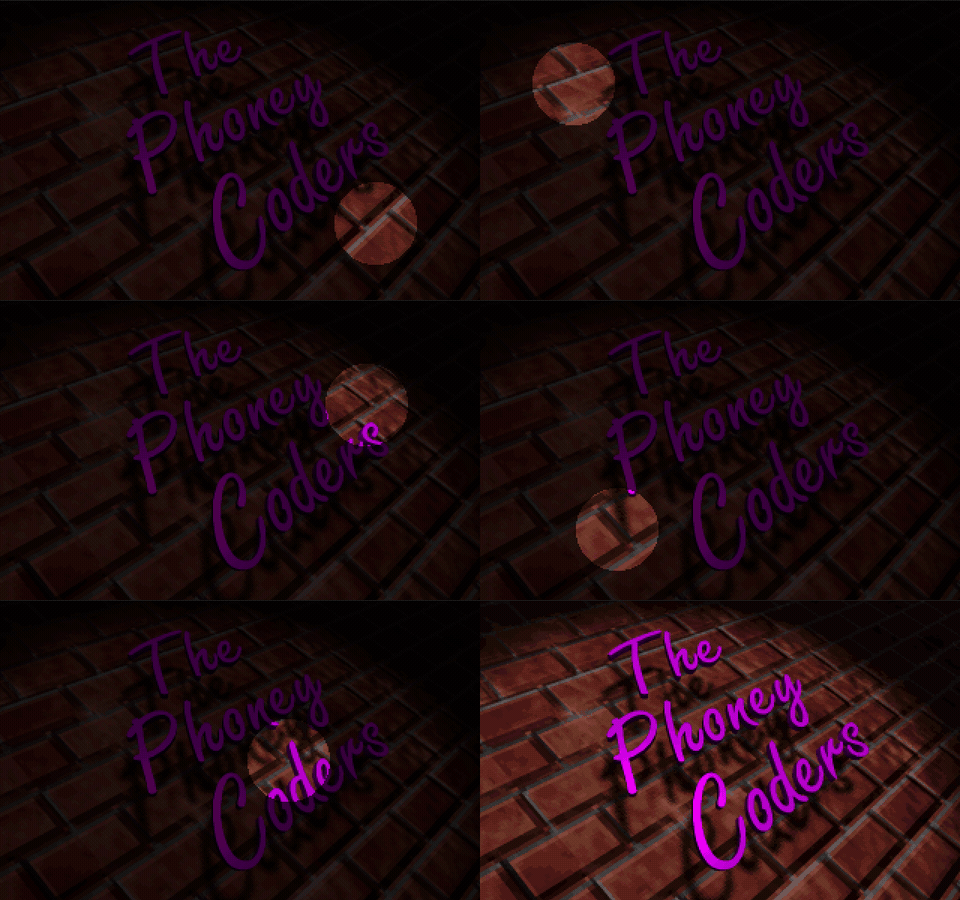
~00s    moving spotlight over the brick-wall Phoney Coders logo
~14s    metallic "PRESENTS" reveal
~20s    ECARGXUS title grid
~29s    first TPC wild-writer / moving-letter sequence
~75s    first filled-vector sequence
~104s   more wild-writer messages
~184s   mechanical engine animation and curved lower scroller
~242s   later filled-vector sequence
~286s   closing wild-writer message
~306s   large movie-style credits
391.40s natural DOS return
The six GIFs below are continuous excerpts from that one direct silent run, not animations assembled from public stills.


The public Demozoo sheet remains as an archival identity check, and the generated diagram remains a code-flow summary:


No audio, H.264, or MP4 derivative is published.
Runtime-To-Code Concordance
The complete route maps to the program structure like this:
brick spotlight / presents           early mode-13h copy and fade paths
Ecargxus title grid                  2EFFh planar setup + 2F9Ch title expander
wild-writer moving letters           WRITEPIC load + 15x10 dirty compositor
message and position stream          3909h parser + 3631h slot renderer
rotating filled objects              50FCh edge walkers + 5231h span filler
mechanical engine animation          animation/plane-copy picture paths
large closing credits                FILMFNT1/2 + 684Eh/6869h/68B5h
The opening direct motion comes after the top-level A715h setup path:
optional Roland prompt, PIC mask save, BIOS mode 13h, palette staging, raw
picture copies, and fixed-point palette fades. These screens are not produced
by the planar title engine yet; they belong to the early chunky/picture-copy
path and the generic retrace/palette helpers around 2D53h, 2D69h, 2D94h,
2DEDh, and 2E0Ah.
The Ecargxus title GIF corresponds to the planar transition. 2EFFh
reconfigures VGA away from ordinary chained addressing, clears all planes, and
sets CRTC state for 80-byte planar rows. 2F9Ch then expands source bytes into
four VGA planes by repeatedly writing plane masks 01h, 02h, 04h, and
08h while cancelling DI advancement between the first three movsb
instructions. A four-byte source group becomes one byte coordinate across four
planes. The subsequent CRTC start-address table at FD0Ah explains the
slide/reveal behavior of the title page.
The wild-writer GIF maps to the WRITEPIC.BIN phase. The file is read into
segment 22E6h, copied into A000h, and then the moving text/cube compositor
uses 15x10 cells. 35D4h draws transparent glyph pixels, 3604h and 3615h
copy/save rectangular blocks, and 3631h restores old screen contents before
saving the new background and drawing the next glyph. That is why the moving
letters can pass over the picture without forcing a full-screen redraw.
The text stream behind that phase is not a plain linear scroller. 3909h walks
two position tables, consumes a new character only every fourth call, handles
FDh/FEh/FFh control bytes, and shifts several slot-history arrays. The
direct motion shows a multi-slot trail driven by table positions and
dirty-rectangle save/restore, not a normal text print loop.
The vector GIF maps to the edge/span renderer. The code around 50FCh builds
per-scanline left/right extents in the table at 489Eh. 5231h then fills
spans in planar VGA using map masks for left and right edge bytes and
rep stosb for wide middles. The filled objects are not plotted pixel by
pixel; the CPU writes spans in eight-pixel chunks wherever possible.
The final credits GIF maps to the sidecar font banks. B230h loads
FILMFNT1.BIN into 22E6h and FILMFNT2.BIN into 43A3h; 2EFFh sets up
planar mode again; 684Eh advances the CRTC start by one planar row per frame;
6869h writes an eight-column stripe into both the current page and the wrap
page; and 68B5h draws ten characters per call from the active font bank. The
final scroller is therefore a stripe streamer plus CRTC motion, not a
full-character redraw each frame.
The direct run and generated pipeline map therefore agree on the same architecture: monolithic MZ setup, early chunky picture/palette phases, planar title transfer, sidecar picture loading, dirty-rectangle text/cube compositing, edge-table vector filling, mechanical animation, and movie-font stripe scrolling. The natural status-0 return also proves that the no-Roland branch reaches the full production rather than a shortened fallback.
Public Metadata And Sources
Sources used:
- Demozoo production record
- Demozoo group record
- Pouet production page
- Scene.org archive record
- Direct Scene.org archive
Demozoo lists the production as an MS-DOS demo released in April 1992 at The Gathering 1992, with Eedar credited for graphics and Twinriter credited for music. Pouet confirms the MS-DOS platform and April 1992 date. Public comments describe the visible effect family: spotlight/brick text, a floating text/cube section, 3D vector objects, a mechanical animation/sine-scroller section, and Roland-only music.
Scene.org preserves the ZIP under a thegathering91 directory, but the archive
path is not release-date evidence: the files, Demozoo, and Pouet agree on April
1992 and The Gathering 1992.
Archive Layout
Original archive:
tpcdemo.zip                  228984 bytes
DEMOSITE.COM                   1129 bytes
FILMFNT1.BIN                  64000 bytes
FILMFNT2.BIN                  16000 bytes
TPC.EXE                      449333 bytes
WRITEPIC.BIN                  45120 bytes
Important hashes:
05bc7d50000aad3654fe189417118004febd7b8c4eb43f2cfa67dc496014aa52  tpcdemo.zip
c2ad85db79effafee21bc21264ae6051c2a69e977e5f19b0426ae33fb0326292  DEMOSITE.COM
10223027374310021294b8d11e51845e4f2a8aa73211b09c0584a9fa7f236b6a  FILMFNT1.BIN
30dabd7f5228ae70de8fe20f74face83a09a954e85560923d085e24e42b403a1  FILMFNT2.BIN
5e90f5a486bba05a498875b444ec6fcefafe36f8a306f5a04c4a2f1dabb32d75  TPC.EXE
2d7391a803dba84c3dfc21bb3ee2d1f9649679548142caafc8bcb54978357972  WRITEPIC.BIN
TPC.EXE is not a PKLITE multipart chain like Even Better Than The Real Thing!. It is a normal large MZ executable with a 512-byte header and a single
448821-byte load image. Its entry point is 0000:A715.
physical file size:       449333 bytes
declared MZ image size:   449333 bytes
header size:                 512 bytes
load image size:          448821 bytes
relocation entries:            29
entry point:              0000:A715
stack:                    0B83:0400
min alloc:                0000
max alloc:                FFFF
The sidecar files are plain data banks:
WRITEPIC.BINis read into segment22E6hand copied to VGA during the letter-writer setup.FILMFNT1.BINis read into segment22E6hduring the final movie scroller.FILMFNT2.BINis read into segment43A3hduring the same final scroller.
That segment reuse matters: 22E6h is not one permanent asset identity. It is
a convenient large DOS memory window reused by different phases.
Embedded Credits And Contact Note
The embedded credit block names Phoenix for intro/vector/movie-scroll coding, Eedar for graphics/fonts, Twinriter for music and vector objects, and SHD for the animation part and logo work. It also thanks Metazor for mouse help and BitFreak for beta-testing.
The same embedded block contains an old BBS contact line. This writeup omits that contact detail and does not quote the private line.
The user-facing Roland prompts are still technically relevant:
Do you want Roland Sound ?
Please enter IRQ number for Roland Card...
Please enter IO base address...
Those strings match the entry-code behavior at A715h: Roland is optional,
but if enabled the demo asks for IRQ and base port before taking over VGA.
Top-Level Program Flow
TPC.EXE starts at load-image offset A715h.
A715  push cs
A716  pop  ds
A717  dx = 697Ch              ; Roland yes/no prompt
A71A  ah = 09h
A71C  int 21h
A720  int 16h                 ; read key
If the answer is not Y, the code jumps to the normal setup path at A76Eh.
If the answer is Y, it asks for IRQ 2 through 7, stores the numeric IRQ
at CS:0000, asks for base-port choice 1 through 4, maps that through a
small table at 69FDh, stores the selected word at CS:0001, and sets
CS:6999 = 1.
Then it saves and masks the PIC:
A76E  in   al,21h
A770  mov  cs:[6331h],al      ; save old interrupt mask
A774  mov  al,0FFh
A776  out  21h,al             ; mask all IRQs while setting up
A778  mov  ax,0013h
A77B  int  10h                ; VGA mode 13h
If CS:6999 is set, the code calls the Roland init routine at 068Ch. On
exit, the final cleanup calls 070Dh, restores the saved PIC mask from
6331h, restores text mode, and exits through DOS 4C00h.
The rest of the program is a long inlined part chain. There is no external loader and no child process boundary. The code repeatedly changes video mode, loads sidecar data, reprograms VGA planes, and advances into the next effect.
Common Retrace And Palette Helpers
Two near-identical helpers at 2D69h and 2D94h synchronize CRTC page changes
with vertical retrace. 2D69h disables interrupts around the wait; 2D94h
does not.
if BX != FFFFh:
    out 03D4h, 0Ch
    out 03D5h, BH             ; high display-start byte
    out 03D4h, 0Dh
    out 03D5h, BL             ; low display-start byte

while (in 03DAh & 08h) != 0:  ; wait until not in retrace
    pass
while (in 03DAh & 08h) == 0:  ; wait for retrace start
    pass
2D69h is the safer page-flip primitive when the program wants a clean CRTC
start write and does not want an interrupt to stretch the critical window.
2D94h is used in looser timing contexts such as ordinary delays and palette
fades.
The palette scaler at 2D53h is simple but important:
SI = 2A18h                    ; source palette/ramp table
DI = 2898h                    ; temporary palette buffer
CX = 0180h                    ; 384 bytes
repeat CX:
    AL = [SI++]
    AX = AL * BL
    AL = AH                   ; divide by 256 via high byte
    [DI++] = AL
BL is the brightness factor. The routine never divides explicitly; it uses
the high byte of the 8x8 multiply as a cheap fixed-point scale. The DAC upload
paths then stream the temporary table through 03C8h/03C9h with rep outsb.
2DEDh uploads 48 DAC entries from 2DBDh after a retrace wait:
DX = 03C8h
AL = 0
out DX,AL
DX = 03C9h
CX = 30h
rep outsb
The intro picture fade at 2E0Ah combines a full A000h clear, a raw picture
copy, and two palette ramps. It copies 1360h words from segment 1B99h to
VGA offset 6A40h, then repeatedly builds 48-entry DAC tables and uploads
them.
Planar VGA Setup
2EFFh switches the machine from ordinary mode-13-style chained addressing
into planar/unchained access.
; Sequencer memory mode: clear chain-4-ish bit, set odd/even disable.
out 03C4h, index 04h
al = in 03C5h
al = (al & F7h) | 04h
out 03C5h, al

; Graphics controller mode: clear odd/even.
out 03CEh, index 05h
al = in 03CFh
al &= EFh
out 03CFh, al

; Graphics misc: select graphics addressing behavior.
out 03CEh, index 06h
al = in 03CFh
al &= FDh
out 03CFh, al

; Enable all four planes and clear 64 KiB of CPU-visible A000h.
out 03C4h, 0F02h
ES = A000h
DI = 0
AX = 0
CX = 8000h
rep stosw
The final CRTC writes are the giveaway that the code expects byte/word address layout compatible with 80-byte rows:
CRTC 14h: clear bit 6
CRTC 17h: set bit 6
From that point, a logical 320-pixel row is addressed as 80 bytes in each
plane. Pixel x lives at byte x >> 2; the selected VGA plane is x & 3.
Pixel Plot And Pixel Read
2F4Bh is the canonical single-pixel writer:
input:
    CX = x
    DX = y
    BL = color

offset = y * 50h + (x >> 2)
mask   = 1 << (x & 3)

out 03C4h, 0200h | mask       ; sequencer map mask
ES = A000h
ES:[offset] = BL
The exact load-image code is:
2F50  ax = 0050h
2F53  mul dx                  ; AX = y * 80
2F56  shr cx,1
2F58  shr cx,1                ; CX = x >> 2
2F5A  add ax,cx
2F5C  di = ax
2F5F  cl &= 03h
2F62  ah = 1
2F64  shl ah,cl               ; AH = plane mask
2F66  al = 02h
2F68  dx = 03C4h
2F6B  out dx,ax
2F6C  es:[di] = bl
2F70h is the matching reader. It computes the same offset, writes the plane
number to graphics-controller index 04h at 03CEh, and reads one byte from
A000:offset.
offset = y * 50h + (x >> 2)
read_plane = x & 3
out 03CEh, 0400h | read_plane
AL = A000h:[offset]
These are not the fastest loops in the demo. They are the general-purpose point primitives used where individual pixels are needed. The heavy effects avoid calling this for every pixel.
Title Plane Expander
2F9Ch clears the visible planar page, expands a packed title/image source,
uploads a palette, and scrolls the CRTC start address through a table.
The core clear:
BX = 0000h
call 2D94h                    ; retrace wait, CRTC start 0
DI = 0
CX = 7D00h
out 03C4h, 0F02h              ; all four planes writable
AL = 0
rep stosb
Then it uses segment 0BC3h as the source, destination 3E80h, and source
offset 0007h. The inner loop writes four consecutive source bytes into the
same displayed byte address, one per plane:
repeat 3E80h times:
    out 03C4h, 0102h          ; plane 0
    movsb                     ; source -> A000:DI
    dec di

    out 03C4h, 0202h          ; plane 1
    movsb
    dec di

    out 03C4h, 0402h          ; plane 2
    movsb
    dec di

    out 03C4h, 0802h          ; plane 3
    movsb
The odd dec di after each movsb cancels the automatic DI++, so every
group of four source bytes maps to the same byte coordinate in four different
planes. Only after the fourth movsb does DI advance to the next logical
byte column. That is a compact chunky-to-planar or plane-interleaved transfer.
After the transfer, it streams 300h DAC bytes from FA08h, then walks the
word table at FD0Ah:
SI = FD0Ah
loop:
    BX = [SI]
    SI += 2
    if BX == FFFFh: break
    call 2D94h                ; write CRTC start = BX and wait retrace
Then it delays and walks the same table backwards. Visually, this is a CRTC reveal/slide over an already-expanded planar page.
WRITEPIC.BIN Load And Letter/Cube Text
The letter/cube text part starts by opening the filename at 3D54h, which is
WRITEPIC.BIN.
A904  ax = 3D00h              ; open read-only
A907  dx = 3D54h              ; "WRITEPIC.BIN"
A90A  int 21h
A90E  ds = 22E6h
A913  es = ds
A916  di = 0
A91A  cx = 7D00h
A91D  rep stosw               ; clear a 64 KiB staging segment
A920  ah = 3Fh
A922  cx = B040h              ; read 45120 bytes
A925  dx = 0
A927  int 21h
A92D  si = 0
A92F  di = 0
A931  cx = 7D00h
A934  rep movsw               ; staging -> A000h
So WRITEPIC.BIN is not a compressed format here. The program clears a full
staging area, reads the 44 KiB file into it, then copies a 64 KiB word count
to VGA. The tail beyond the file read remains zero because the staging segment
was cleared first.
The 15x10 Glyph Blitters
The writer uses 15x10 pixel or byte cells. The row stride is 140h bytes,
which is the normal 320-byte chunky row stride in the loaded picture stage.
35D4h is the masked glyph blitter:
if DI == 0:
    return

for row in 0..9:
    for col in 0..14:
        AL = [DS:SI++]
        if AL != 0:
            [ES:DI] = AL
        DI += 1
    DI += 0131h               ; 15 + 0131h = 0140h bytes per screen row
That zero test gives the glyphs transparency without a separate mask plane.
The other helpers are unmasked copy routines:
35F9h:
    for row in 0..CX-1:
        copy AX bytes from DS:SI to ES:DI
        DI += BX

3604h:
    copy 10 rows of 15 bytes
    DI += 0131h after each row

3615h:
    copy 10 rows of 15 bytes
    SI += 0131h after each row

3626h:
    for row in 0..CX-1:
        copy AX bytes
        SI += BX
The direction of the row skip distinguishes screen-to-buffer and
buffer-to-screen saves. 3615h walks a screen-shaped source; 3604h writes to
a screen-shaped destination.
The Compositor At 3631h
3631h is the moving letter compositor. It draws and restores multiple
letter slots, probably the visible floating text/cube system from the public
screenshots.
The routine starts in VGA memory:
ES = A000h
DI = [3035h]
SI = 3037h
AX = 000Ah
BX = 0136h
CX = 000Ah
call 35F9h
That first call restores a 10-row strip from the previous frame. It copies ten
bytes per row and jumps 0136h after each row, again making each row consume
10 + 0136h = 0140h bytes.
Then the code copies seven 15x10 blocks from internal buffers to current slot positions:
for slot in 3103h,3105h,...,3111h:
    DI = [slot]
    SI = slot_buffer
    CX = 7
    call 3604h
The repeated pattern after that is:
- Switch
DStoA000handEStoCS. - Save the old screen contents under a slot into a buffer with
3615h. - Switch back to
DS=CSandES=A000h. - Store the new slot destination.
- Draw the next glyph with the transparent
35D4hblitter.
That is the classic dirty-rectangle trick for small moving sprites. It avoids redrawing the whole screen: restore the old rectangle, save the new background, draw the masked glyph.
Text Stream Parser At 3909h
3909h advances the text/object stream and computes the next destination.
Two looping tables drive the position:
BX = [302Fh]                  ; pointer into y table at 0E77h
[302Fh] += 2
if [BX] == FFFFh:
    [302Fh] = 0E77h
    retry
row = [BX]
DI = row * 0140h

BX = [3031h]                  ; pointer into x table at 0BF3h
[3031h] += 4
if [BX] == FFFFh:
    [3031h] = 0BF3h
    retry
xoff = [BX]
DI += xoff
[3033h] = DI
Only every fourth call consumes a new character:
inc byte [1025h]
if [1025h] != 4:
    skip_new_character
[1025h] = 0
AL = *[2525h]++
The control bytes are:
FDh  end of stream, return BX=FFFFh
FFh  set mode flag at 1F62h and delay/count value at 1F68h
FEh  set flag 1F64h and choose blank/special glyph at 07A9h
20h  space, also glyph 07A9h
Normal letters are mapped through a fixed 15x10 font:
index = AL - 'A'
glyph = 1026h + index * 96h   ; 96h = 150 decimal = 15 * 10
After selecting the glyph, 3909h shifts several arrays:
30F3h <- 30F5h, 7 words
30D3h <- 30D7h, 14 words
30B3h <- 30B7h, 14 words
30A3h <- 30A4h, 7 bytes
30ABh <- 30ACh, 7 bytes
Those shifts are the trail/history mechanism for the multi-slot writer. The new glyph enters one end of the chain; previous glyph pointers and positions move down the slots.
The main loop at A958h repeatedly calls:
call 2D94h
if [1F64h] == 1:
    [3033h] = FA00h           ; sentinel/offscreen destination
if [1F62h] != 1:
    call 3631h                ; draw moving letter slots
    call 3909h                ; parse/advance stream
else:
    call 388Dh                ; row restore/scroll phase
if BX != FFFFh:
    repeat
That explains why the text effect is not just a normal scroller. It is a small state machine: table-driven positions, delayed character intake, transparent 15x10 glyphs, dirty-rectangle restoration, and special control bytes embedded in the text stream.
Vector Edge And Span Filler
The vector section uses a scanline edge table, not a naive filled-polygon loop.
The important block starts around 50FCh and reaches the span filler at
5231h.
Before filling, the code tracks vertical extent:
5167h = 00C7h                 ; min y starts near bottom
5172h = 0000h                 ; max y starts near top

for each edge:
    read x0,y0,x1,y1
    if y0 < 200: 5167h = y0
    if y0 >= 1234h: 5172h = y0 ; sentinel/object table convention
The edge walkers are Bresenham-like. They compare dx and dy, choose the
major axis, maintain an error accumulator in BP, and write x coordinates to
the edge table at 489Eh. Each scanline gets a left and right x word.
At 5231h, the renderer switches to A000h and fills spans:
ES = A000h
y0 = [5167h]
y1 = [5172h]
if y0 == y1: return

BP = y0 * 50h + [4309h]       ; base byte offset plus page/base adjustment
SI = 489Eh + y0 * 4           ; two words per scanline
For each scanline:
left  = [SI]
right = [SI+2] + 2
SI += 4
width = right - left
if width < 0:
    exit
Wide spans, width >= 8, use a left edge mask, a full middle fill, and a
right edge mask:
left_mask_index = (left ^ 7) & 7
left_mask = table[506Eh + left_mask_index]

middle_width = width - left_mask_index - 1
right_mask_index = right & 7

DI = BP + (left >> 3)
out 03C4h, 0200h | left_mask
A000h:[DI] = color

out 03C4h, 0FF02h
DI += 1
AL = color
CX = middle_width >> 3
rep stosb

right_mask = table[5078h + right_mask_index]
out 03C4h, 0200h | right_mask
A000h:[DI] = color
Narrow spans go through the table at 52E6h, which contains precomputed
two-byte masks for short ranges that can cross a byte boundary. The code
selects the correct mask pair, writes the left byte under BH, increments
DI, then writes the second byte under BL.
The most important optimization is that the filler operates in eight-pixel
chunks. The CPU does not write each pixel. It uses the VGA sequencer map mask
to activate selected planes for edge bytes, and uses rep stosb for the solid
middle of the span. On VGA this is the difference between a plausible 1992
filled-vector object and a pixel-at-a-time slideshow.
Final Movie-Font Scroller
The final scroller is the most self-contained subsystem. It starts at B230h
by loading the two font banks:
B230  open "FILMFNT1.BIN"
B23A  DS = 22E6h
B23F  AH = 3Fh
B241  CX = FA00h              ; 64000 bytes
B246  int 21h

B24E  open "FILMFNT2.BIN"
B258  DS = 43A3h
B25D  AH = 3Fh
B25F  CX = 3E80h              ; 16000 bytes
B264  int 21h
Then it calls 2EFFh for planar setup and uploads the small palette at
6364h.
CRTC Start Helper 684Eh
The movie scroller uses a display-start word at 684Ch. 684Eh writes that
word to the CRTC after shifting it down by two:
BX = [684Ch]
BX >>= 2
out 03D4h, 0Ch
out 03D5h, BH
out 03D4h, 0Dh
out 03D5h, BL
The caller increments [684Ch] by 0140h per frame. Because the helper later
shifts by two, the effective CRTC start advances by 0050h, exactly one
80-byte planar row. This is the vertical movie-scroll motion.
Eight-Column Stripe Writer 6869h
6869h draws one 8-column stripe of a movie-font character into two pages:
the current page at DI and a mirrored page at DI-3E80h.
DS = [6396h]                  ; 22E6h or 43A3h
CX = 8                        ; eight byte columns
DX = 03C4h

repeat 8:
    AX = 0102h                ; plane 0
    out DX,AX
    BL = [SI]
    ES:[DI] = BL
    ES:[DI-3E80h] = BL
    SI++

    AH <<= 1                  ; plane 1
    out DX,AX
    BL = [SI]
    ES:[DI] = BL
    ES:[DI-3E80h] = BL
    SI++

    AH <<= 1                  ; plane 2
    out DX,AX
    BL = [SI]
    ES:[DI] = BL
    ES:[DI-3E80h] = BL
    SI++

    AH <<= 1                  ; plane 3
    out DX,AX
    BL = [SI]
    ES:[DI] = BL
    ES:[DI-3E80h] = BL
    SI++

    DI++
This is another plane-interleaved expansion kernel. Four source bytes become
one screen byte location across four planes. Doing the mirrored write at
DI-3E80h keeps a second page prepared so the CRTC start can wrap cleanly.
Text Stream And Character Bank Selector 68B5h
68B5h draws ten characters per call. First it computes the insertion
position from the current scroll offset:
DI = ([684Ch] >> 2) + 3E80h - 00A0h
CX = 10
If [6398h] >= F000h, it draws blank/default stripes from A8C0h ten times,
then increments [6398h]. That is the lead-in/lead-out blanking path.
Otherwise each character goes through this lookup:
SI = [6394h]                  ; text pointer
AL = [SI++]
if AL == FFh:
    [6332h] = 1               ; end flag
    [63CAh] = 0100h           ; fade counter
    draw blanks

find AL in table at 6333h, max 31h entries
index = match_position

[6396h] = 22E6h               ; default font bank
if index > 27h:
    [6396h] = 43A3h
    index -= 28h

source = index * 0640h + ([6398h] << 5)
call 6869h
0640h is 1600 bytes per character. The per-frame vertical slice offset is
[6398h] << 5, or 32 bytes per stripe step. After drawing ten characters, the
phase advances:
[6398h]++
if [6398h] == 32h:
    [6398h] = FFFBh
    [6394h] += 0Ah            ; advance the visible 10-character window
So the final scroller is not drawing complete letters every frame. It streams
one stripe phase of a ten-character window, uses CRTC start motion for the
vertical slide, and only advances the text pointer after all 32h stripe
phases have passed.
Final Scroller Main Loop
The loop at B28Bh is:
repeat:
    call 684Eh                ; CRTC display start from [684Ch]

    ; wait for display-enable-ish status bit 0 100 times
    CX = 64h
    while CX--:
        wait until (in 03DAh & 01h) != 0

    call 2D69h                ; retrace-synchronized CRTC wait/write
    [684Ch] += 0140h
    if [684Ch] >= FA00h:
        [684Ch] = 0

    call 68B5h                ; draw ten-character movie stripe
    if [6332h] != 1:
        repeat
When the text-stream end marker is seen, a 200-frame fadeout runs:
CX = 00C8h
[6398h] = F001h
repeat CX:
    call 684Eh
    call 2D94h
    call 63CCh                ; DAC fade, subtracts 4 from [63CAh]
    [684Ch] += 0140h, wrap at FA00h
    call 68B5h
63CCh fades the 48-entry palette by multiplying each component by [63CAh]
and taking the high byte. It subtracts 4 from [63CAh] each call, so it is the
same fixed-point palette trick as the earlier intro fade, specialized for the
final scroller palette.
Why The Demo Feels More Advanced Than Its Archive Shape
The archive looks plain: one MZ file and three raw data files. The code is much less plain. The high-value tricks are all in the VGA write strategy:
- raw picture copies and palette fades for cheap full-screen transitions;
- CRTC display-start tables for reveal/slide motion without redrawing pixels;
- transparent 15x10 glyphs with dirty-rectangle save/restore;
- table-driven text stream control bytes instead of hard-coded text motion;
- edge-table polygon rasterization with plane-mask edge bytes and
rep stosbspan middles; - movie-font stripes that write four planes plus a wrap page every column.
The recurring design pattern is: prepare a small amount of state in system
memory, then write to VGA in the largest unit the effect can tolerate. For
1992 PC VGA, that is the right instinct. Ecargxus is not fancy because it
has an exotic loader. It is fancy because the inner loops are shaped around
what planar VGA can do quickly.