Analysis model: gpt-5.5 xhigh
End of the Misery by Sagazity - Technical Dissection
A Swedish Two-Disk Demo Hidden Below The Party's Famous Four
End of the Misery is a full Amiga OCS/ECS demo by the Swedish group
Sagazity, released on 29 December 1993. It placed eleventh in The Party 1993
Amiga demo competition.
That placing needs context. The first four entries were Origin, Full Moon,
Arte and 9 Fingers; all became landmarks. Sagazity received only 144
points in that field, but the demo's later reception is much stronger than the
placing suggests. Pouet records 20 positive votes, three neutral votes and no
negative votes. Several comments independently call it underrated and
remember watching it repeatedly.
This is not an intro, cracktro, slideshow or musicdisk. It is a two-disk track-loaded demo with a deliberate mid-show disk change and a complete authored ending.
The five credited contributors are individually documented in Sweden:
- Axy, later Phase: graphics.
- Blade: music.
- Butch: code.
- Rade, later Maxiphly: code.
- Vacum: music.
Public references:
- Demozoo production and credits: https://demozoo.org/productions/5791/
- Demozoo Sagazity history and member locations: https://demozoo.org/groups/6971/
- The Party 1993 results: https://demozoo.org/parties/92/results_file/23/
- Pouet production and reception: https://www.pouet.net/prod.php?which=57665
- Original disk A mirror: https://archive.scene.org/pub/mirrors/amigascne/Groups/S/Sagazity/Sagazity-EndOfTheMiseryA.adf
- Original disk B mirror: https://archive.scene.org/pub/mirrors/amigascne/Groups/S/Sagazity/Sagazity-EndOfTheMiseryB.adf
The two unchanged ADF images, the complete first-disk programme, the authored disk-change screen and the second-disk continuation were examined directly. Visual description, observed execution and recovered bytes are kept separate below.
Complete Direct Silent Run
Both original 901,120-byte ADF images were run under FS-UAE 3.2.35. The emulated machine was an Amiga 1200 with 2 MB chip RAM, using the AROS replacement ROM. The demo itself uses the OCS/ECS display path and does not depend on AGA imagery.
Host audio was disabled before the emulator started. No soundtrack or other audio was played.
Disk A boots, performs the long first programme, then explicitly tells the viewer to remove disk one and insert disk two. Disk B was placed into DF0 at that screen. The loader accepted it and continued without a reset. The second programme reached its final transition and returned through a machine reset. Booting disk B by itself correctly fails: it is data for the resident loader, not an independently bootable disk.
The GIFs below are continuous excerpts from those direct silent runs. They contain no interpolated frames, embedded video or audio. Motion-heavy scenes are sampled at eight or ten frames per second; that choice is per scene, not a site-wide fixed rate.
A Tiny Space Story

The opening borrows the grammar of a cinema serial rather than its specific imagery. A short blue prologue gives way to white perspective text receding into black. The deliberately awkward story describes a ship heading home through a distant universe. It is enough narrative to make the next image read as a location rather than a disconnected picture.

A large dithered planet crosses a dense star field. The image is not a single still being held on screen: the limb changes position continuously while smaller bodies and stars establish depth. The monochrome treatment also makes the later blue interface feel like a display inside the ship.
The transition is economical. There is no long title sequence between story and effect. Text establishes the premise; the planet supplies scale; a damage message then moves directly into the cockpit.
The Wireframe Cockpit

The longest self-contained effect is a wireframe landscape seen through a prepared cockpit surround. A regular mesh is displaced into hills and valleys and redrawn from a moving viewpoint. The lower instrument panel remains fixed, so the eye has a stable reference for the terrain's motion.
This is a useful piece of 1993 design. A bare mesh on black would demonstrate
the routine but provide little reason for it to exist. The cockpit converts
the same routine into navigation. Small numerical fields and the WARNING
label are decorative prepared graphics, while the changing mesh is the
real-time component. The article does not mislabel the whole composite as a
single generated 3D scene.
The wireframe eventually washes toward white. That is not merely a palette flash: it reads as the ship losing control. The following message says that the attempt failed, completing the short narrative arc.
Solids, Identity And The Deliberately Cheap Joke
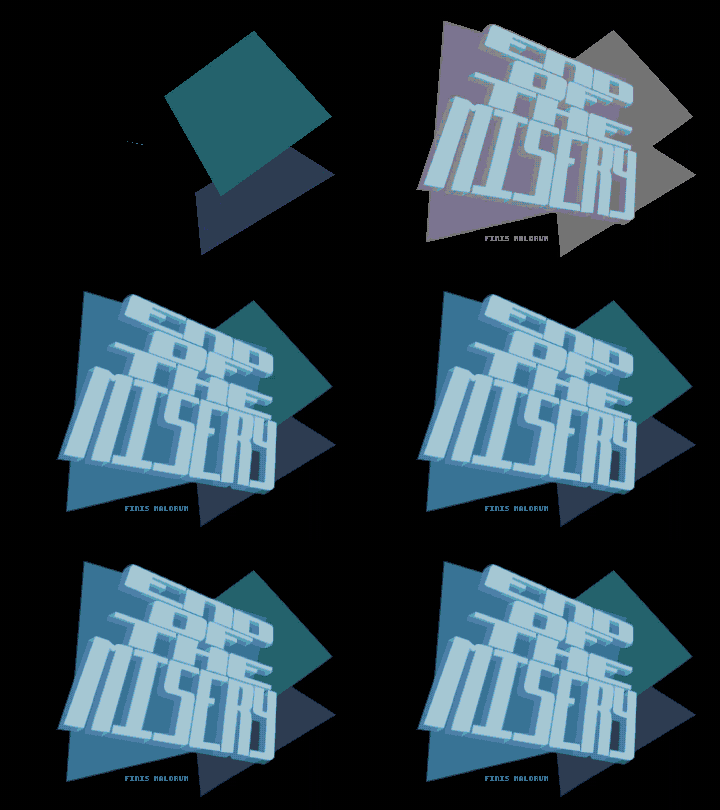
After the failure message, flat blue polygons assemble behind a large shaded
End of the Misery title. The title turns in depth while the backing planes
cross it at different angles. Sagazity is not trying to compete with the
smoothest filled 3D of the top four entries. It uses a few large surfaces as
moving typography.

A nested quadrilateral spiral follows. Each successive outline is rotated and scaled around the same centre, producing a tunnel from very little geometry. The lines change continuously; this is not a cycle of captured cards.
The same line object then becomes a framing device for the credits. Graphics, music, code and design are not presented on a static end board. Names arrive beside or inside the rotating outlines. The demo turns its cheapest reusable effect into a credit system.
The closing logo is assembled from moving letter fragments on a blue field.
The pieces overshoot, overlap and settle into SAGAZITY. It is intentionally
rougher than a clean bitmap reveal, but it gives the group's name actual
motion. A final production plate closes disk A's main sequence.
Disk Two Is A Continuation, Not A Second Boot
The first disk eventually displays a large floppy graphic and unambiguous instructions to discard disk one and insert disk two. The second image cannot boot alone, and that is correct.

After the physical swap, the resident loader continues with more line spirals and the remaining credits. The palette changes, but the construction is the same: nested outlines rotate behind names rather than serving as a separate effect showcase.

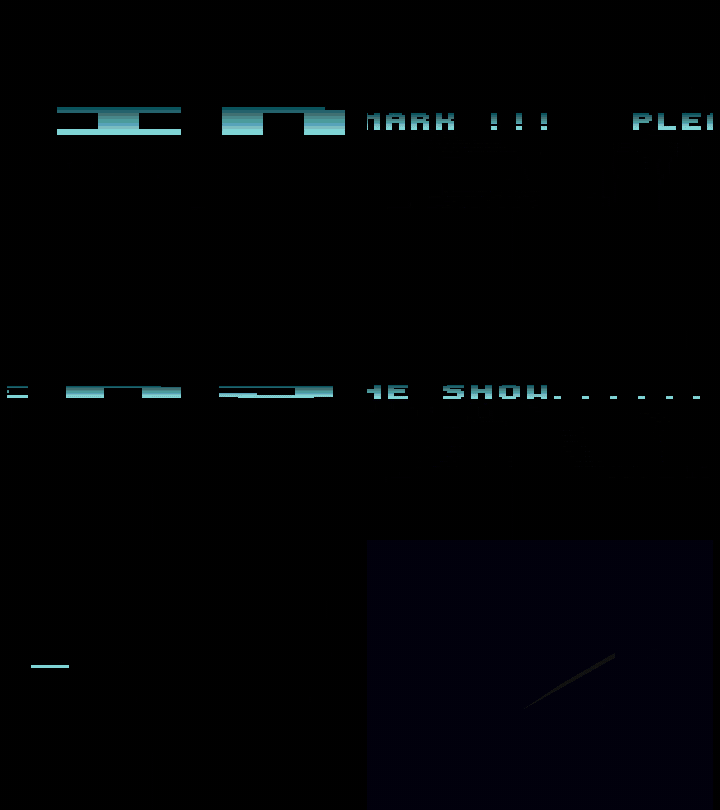
Large segmented numerals and letterforms then move across the screen. Their horizontal bands recall the title lettering and the cockpit displays. Disk two therefore feels related to disk one even though its pacing is shorter and more typographic. It finishes by breaking and rebuilding the group name.
This also explains a recurring comment that the two disks can feel like different productions. Disk A carries the miniature space story and its largest effect; disk B compresses the remaining credit and identity material into a much shorter graphic sequence.
The Boot Block Is A 46-Byte First-Stage Loader
The disk images hash as follows:
f466e12067de84808748554250b57412ccedb31f1fadd21904324790e3523e09  Sagazity-EndOfTheMiseryA.adf
451da5755d3ea75f31f0919d61de3eb5f372a778e851f8c814be33b41759b29b  Sagazity-EndOfTheMiseryB.adf
Disk A begins with the normal Amiga boot signature DOS\0, but it is not an
AmigaDOS volume in the ordinary sense. Its root block is invalid as a
filesystem root because the rest of the disk is arranged for the custom
loader.
The boot block copies 46 bytes from itself to address $00000f00 and jumps
there. The relocated stub fills a trackdisk I/O request with these exact
values:
io_Command = 2          ; CMD_READ
io_Length  = $00000a00  ; 2,560 bytes
io_Data    = $0001c000
io_Offset  = $00000400  ; immediately after the 1,024-byte boot block
It calls the Exec DoIO vector and jumps to $0001c000. In other words, the
boot block is only a safe bridge: relocate a tiny reader, fetch the next stage
without overwriting the boot code, and transfer control to it.
That sequence is recovered directly from the first 80 bytes of disk A. It is not inferred from the demo merely loading quickly.
Why Disk B Starts With EOM2
The first 49 bytes of disk B are plain ASCII:
EOM2 <---- Do NoT REMoVE!! iT'S ThE DiSK 2 iD!!!!
Disk A contains one matching EOM2 marker at byte offset 796,960. The
combination is strong evidence for the observed swap protocol: the resident
programme carries the expected identifier, and the second disk places that
identifier where a raw loader can test it immediately.
This is more precise than calling the second image corrupt or claiming that
FS-UAE failed to boot it. Its first four bytes are deliberately EOM2, not a
boot signature. It is a continuation disk with an identity sector.
The visible swap screen and the byte layout agree:
disk A boot block -> relocated CMD_READ stub -> resident loader
       |
       +-> first programme -> request disk two
                                  |
                                  +-> test EOM2 -> load continuation
A Raw Track-Oriented Layout
Both images have standard ADF size, but neither behaves like a collection of
AmigaDOS files. Large unused or padding regions are filled with the repeating
four-byte word SGZ!, an obvious Sagazity marker.
Disk A contains 13,484 occurrences of SGZ!; disk B contains 37,248. Several
whole late tracks consist almost entirely of that word. Other tracks have
very high entropy or large zero-filled regions. The distribution looks like
effects and assets placed at loader-known offsets, separated by marked spare
space, not files reached through directories.
Direct big-endian references to Amiga custom-chip registers also occur throughout the loaded regions. Disk A includes repeated references to:
DMACONat$dff096;INTENAat$dff09a;INTREQat$dff09c;COP1LCat$dff080;COPJMP1at$dff088;- CIA-A port A at
$bfe001.
Raw occurrence counts alone do not prove the purpose of every matching four-byte value, because graphics and compressed data can contain accidental patterns. They do, however, agree with the boot path and runtime: this is direct-hardware Amiga code controlling DMA, interrupts, copper execution and input rather than a sequence presented through the operating system.
What The Evidence Does And Does Not Prove
The direct run proves:
- both preserved images form one working production;
- disk A boots and owns the first programme;
- the authored disk-change instruction is reached;
- disk B is accepted in DF0 and the continuation executes;
- the planet, wireframe landscape, line spirals, solids and typography move continuously;
- the second programme completes and resets the machine.
The disk inspection proves:
- exact hashes and image sizes;
- the first-stage raw read and destination address;
- disk B's non-bootable
EOM2identity; - the matching marker stored on disk A;
- the marked raw layout and direct custom-chip references.
It does not prove a complete source-level map of every effect. In particular, the prepared planet artwork, cockpit surround, fonts and logos should not be called generated merely because they move inside a custom demo. The wireframe terrain and nested line geometry are visibly updated in real time; the surrounding art is treated as prepared material.
Why It Survived Its Eleventh Place
End of the Misery did not lose because it was bad. It entered a competition
whose top four became a compact history of late OCS and early AGA design. Its
own strengths are smaller and stranger:
- a miniature story gives old effects a purpose;
- the cockpit makes a wireframe mesh feel like navigation;
- the same nested-line routine becomes tunnel, ornament and credit frame;
- a real two-disk loader turns the media change into part of the show;
- typography is animated rather than deposited between effects.
The weak point noted by later viewers is also real. Disk B feels less coherent because the space narrative has ended and the remaining material is mostly identity and credits. That does not invalidate the production; it explains why a technically competent, memorable demo could sit far below four exceptional releases at the party.
The best description is therefore neither “forgotten masterpiece” nor “eleventh-place filler.” It is a good Swedish 1993 demo with a clean two-disk mechanism, one especially effective cockpit scene and enough visual personality to be remembered long after its score.