Analysis model: gpt-5.5 xhigh
Faktory by Virtual Dreams - Technical Dissection
A Finnish-Swedish AGA Demo From 1995
Faktory is a one-file Amiga AGA demo released by Virtual Dreams on
29 December 1995. It placed third in the Amiga demo competition at The Party
1995. Its reputation is not being reconstructed from a convenient download:
Pouet records 75 positive votes, eight neutral votes and no negative votes.
Contemporary placement and later reception both make it a substantial release.
The complete production credit is unusually compact:
- Alien: code, graphics and music.
- Probe: music.
- Sulevi: graphics.
Alien and Sulevi are Finnish; Probe is Swedish. The production record and the
demo's final image add no guest creator. Faktory is a full demo, not a
cracktro, intro, invitation, slideshow, musicdisk or game.
Public references:
- Demozoo production record, original download and credits: https://demozoo.org/productions/7615/
- Pouet production record and surviving reception: https://www.pouet.net/prod.php?which=1153
- Original The Party archive.
The original archive and executable were authenticated and inspected locally. The complete original executable was run from a minimal AmigaDOS hard-drive directory under FS-UAE 3.2.35, configured as an A1200 with 2 MiB chip RAM and 8 MiB fast RAM. Its audio system remained active for normal timing, but the host audio driver was a null output: no sound was played or recorded.
The four smaller direct-runtime GIFs named as such below come from that run. A separate complete video-only preservation stream was used to cross-check scene order and supply the wider supplementary GIFs. Its audio stream was neither obtained nor played. No video is embedded or published here.
The Opening Is A Sequence Of Labels

The first images behave like product marks rather than conventional demo
logos. FAIRLIGHT appears in widely spaced capitals; a narrow rust-coloured
strip resolves from blocks; virtual dreams is stamped across another strip;
and a battered metal frame finally holds the word Faktory.
The pixel mosaic is important. It does not simply wipe one finished picture onto another. Large square samples first make colour and brightness visible, then contract until typography becomes legible. The transition treats an image as material being refined on a production line. That gives the title a visual argument before the first calculated effect begins.
A Question Turns Into A Page Layout

“are you in control?” sits alone in black space. The next scene answers with a deliberately over-designed magazine page: a photographed figure, sprayed colour, a small boxed title and a square of animated relief texture.
The texture is not expanded to fill the screen. It occupies the place where a photograph or advertisement panel would sit. That restraint is the demo's main design method. Real-time material is repeatedly placed inside layouts made from typography, clipped photography and large areas of flat colour. The code does not disappear; it accepts art direction.

The direct run confirms that the square relief is continuous motion inside a fixed composition. It is not a slideshow frame inferred from a before-and- after pair. The cut-out figure, sprayed backdrop and stamped label remain still while the inset behaves like embossed liquid.
One Spiral Is Reframed Four Times

A coloured vortex first occupies one large panel. The same field then appears as four synchronized windows. This is one continuous phase, not five separate spiral effects. The multiplication changes how the motion reads: a tunnel in the single view becomes patterned surface in the four-up view.
That distinction matters in a short demo. Faktory gets variety by changing
scale, crop and repetition rather than by pretending every layout change is a
new routine. The repeated windows also connect the calculated spiral to the
contact-sheet and fashion-catalogue imagery used elsewhere.
“Control” Becomes A Visual Pun
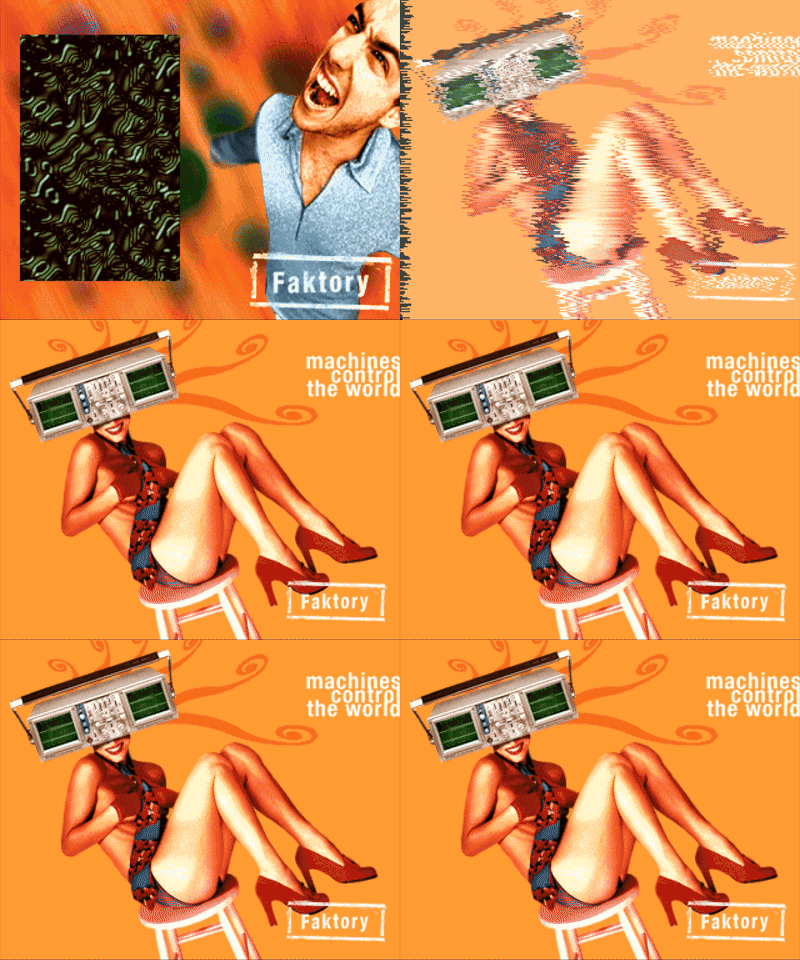
The question returns as “am i in control?” and is answered by a seated model whose head has been replaced by a circuit board. The picture then distorts along its edges while the caption reads “machines control the world.”
This is not a neutral background for an effect. The earlier question,
electronic replacement and edge distortion form a small sequence about
agency. Even the rectangular hardware echoes the demo's boxed effect
windows. Faktory keeps returning to the same vocabulary—frames, products,
faces and machines—so its collage has more structure than a folder of
unrelated scans.
Fluid Motion Survives Duplication

A cloudy field folds around dark circular centres. Its highlights stretch, merge and shear without the obvious grid of the preceding texture. As with the spiral, the demo switches between one large field and four smaller copies.
The four windows make synchronization visible. Their motion agrees, so this is a single generated image presented repeatedly, not four independent fluid simulations. Reframing it produces density at little conceptual cost: one window reads as a moving substance; four read as animated print.
“My Head Aches” Is A Hard Cut, Not An Explanation

The fluid page cuts to a cyan poster carrying the line “my head aches.” Another fashion layout follows, with a monochrome scene in a square window beside a standing figure. White flashes and abrupt colour changes make this section feel like a sequence of printed pages being exposed rather than a camera moving through space.
The phrase does not label a technical effect. It is punctuation. The demo uses short questions and statements at structural boundaries, allowing the images between them to remain ambiguous. This is why the typography cannot be separated from the runtime scenes when discussing the pacing.
The Spacecraft Uses Its Window For Scale

A small craft starts low and distant in a cloudy square, approaches the viewer and banks while four bright points remain attached to it. The square viewport and the standing figure outside it do not move. That stationary page makes the model's change in scale and orientation easier to read.
The effect therefore benefits from being bounded. Full-screen flight would have supplied more pixels but fewer size cues. Here the window behaves as a measuring frame.
The Final Machine Is Built From Screens

After “what are you looking at,” a small framed object enters over a rotating, warped face. It unfolds through several forms: box, hinged panels, monitor, eye display and a cluster of screen-like slabs. A metallic ball on a short arm stays attached as the body changes.
The eye is more than a texture-map flourish. The preceding question makes the monitor appear to look back. At the same time, the background continuously twists a photographed face into a circular surface. Viewer, display and displayed face exchange roles while the object keeps transforming.
This is the demo's longest continuous technical passage. Its value is not a count of separate objects. One articulated model changes topology and screen content while remaining recognizably the same machine.

The direct capture shows the casing, lower support and side arm retaining distinct orientations as the object turns. The screen continues to carry changing imagery, so the inset-window idea has escaped the static page and become the moving object itself.
The Ending Refuses A Conventional Credit Roll

The machine washes out to a narrow portrait labelled [no entry]. There is
no scrolling member list, greetings wall or second set of guest credits.
That austere stop is consistent with the rest of the production: another
fashion image is treated as a sign, and the demo ends on refusal rather than
explanation.
The lack of an in-demo roll is why the surviving production ledger must be kept distinct from visual interpretation. Demozoo credits Alien, Probe and Sulevi; the final sequence introduces no additional author. The model in the image is subject matter, not evidence of another production credit.
The Archive Contains Exactly One Payload
The Scene.org party archive is an LHA file containing one member:
45148242da37d3e4e5715096e842fc48b37090a1f183beae6481d36140dee82c  faktory.lha
15525d60b41ac545d0dd41f4d79c88e6254deef351f8f5f16272b83bf9b00712  faktory.exe
The archive is 862,131 bytes. Its only member, faktory.exe, expands to
916,720 bytes and is a valid AmigaOS LoadSeg executable. The member carries a
26 January 1996 timestamp, later than the documented party release. That is
an archive-member timestamp, not evidence for moving the demo out of 1995.
A 704-Byte Resident Hunk Opens The Real Program
The conventional LoadSeg portion is strikingly small. It contains one
704-byte code hunk followed by HUNK_END, HUNK_OVERLAY and HUNK_BREAK.
Everything after that boundary is the compressed overlay.
The resident code begins by branching over a small metadata area containing
the strings Overlaydos.library and Titanics suxx :-). Its control flow
then:
- opens the overlay DOS support library;
- writes the short message;
- seeks the already-open executable to file offset
$2f4; - allocates a 5,120-byte input buffer;
- reads the packed stream in 5,120-byte blocks;
- allocates, expands and relocates the program segments;
- closes the DOS resource and jumps to the first expanded segment.
This is not a flat executable with a generic packer wrapped around it. The small outer hunk is a loader for an AmigaDOS overlay file, and its own bitstream decoder is part of that loader.
Five Segment Descriptors State The Expanded Shape
The packed stream starts with the value four. The loader uses it as a
DBF count, so five segment descriptors follow. Their low 24 bits give the
allocation size minus eight; the rotated high byte supplies memory flags.
| Segment | Descriptor | Allocated bytes | Memory requested |
|---|---|---|---|
| 1 | $00062758 |
403,296 | cleared, general |
| 2 | $0014f838 |
1,374,272 | cleared, general |
| 3 | $00038000 |
229,384 | cleared, general |
| 4 | $020614d0 |
398,552 | cleared chip memory |
| 5 | $02028008 |
163,856 | cleared chip memory |
Together they request 2,569,360 bytes before the executable's normal runtime needs. The two explicitly chip-addressable segments account for 562,408 bytes. The table therefore preserves an architectural decision that file size alone hides: most expanded code and data may live in general memory, while display-facing material is separated into chip memory.
The Decoder Is A Small Back-Reference Machine
The expansion routine starts at resident offset $20e. It reads bits from
32-bit words and emits either literal runs or backward copies. Its branches
encode several length and distance forms:
- a literal-run form reads a short count followed by eight-bit bytes;
- one form copies two bytes from a seven-bit backward distance;
- longer forms derive both distance and copy length from variable-width bit fields;
- every path stops at the exact end address calculated for the destination segment.
After expansion, the loader walks relocation groups. It resolves a target segment through the BCPL-style segment list, converts the target to a byte address and adds that address at each recorded offset. Only then does it jump into the first segment.
The resident loader's SHA-256 is
bbcc5e5215834b70b13b45fe54cfeff9b061de378505a9490ebf6d0dd431bfac.
The overlay region's SHA-256 is
2852136c8f8b3961813299f09f61caa19d5935d353935581f842830e57376f6d.
Those boundaries are exact consequences of the hunk records, not signatures
guessed from entropy.
Why Faktory Still Reads As A Demo
Faktory is sometimes summarized as design, fashion scans and attitude.
That is accurate but incomplete. The runtime work is carefully assigned a
role:
- texture fields become panels and repeated print;
- distortions act on the photographed layouts rather than replacing them;
- short text screens turn technical transitions into questions;
- the final articulated machine gathers the demo's frames, eyes and electronic-body imagery into one object.
The executable tells a parallel story. A tiny conventional hunk uses the
operating system long enough to read and rebuild five larger segments, then
hands control to the demo. On screen, calculated motion is likewise loaded
into strict editorial frames. In both structure and appearance, Faktory
puts machinery inside design.