Analysis model: gpt-5.5 xhigh
Full Moon by Virtual Dreams / Fairlight - Technical Dissection
Scope
Full Moon is an Amiga AGA demo by Virtual Dreams / Fairlight, released at
The Party 1993. It placed second in the Amiga demo competition with 1,860
points, behind Complex's Origin and ahead of Sanity's Arte. The credits
name Dr. Skull for code; Alien, Jaco and KerBeros for graphics; and Alien,
Heatbeat and Jogeir for music.
Useful public references:
- Demozoo production: https://demozoo.org/productions/5783/
- Pouet production: https://www.pouet.net/prod.php?which=410
- A.D.A. entry: https://ada.untergrund.net/?p=demo&i=186
- Original one-file release: https://archive.scene.org/pub/mirrors/amigascne/Groups/V/Virtual_Dreams/VD-FullMoon
- The Party 1993 results: https://demozoo.org/parties/92/results_file/23/
Full Moon Part 1: https://demozoo.org/music/207924/Sainahi circles (short): https://demozoo.org/music/29023/Nearly there..: https://demozoo.org/music/29010/- Amiga ROM Kernel overlay documentation: https://developer.amigaos3.net/sites/default/files/downloads/2024-10/Amiga_ROM_Kernel_Reference_Manual_DOS.pdf
The unchanged release, its executable structure, three independently preserved soundtrack files, the WHDLoad installer and a complete direct silent run were examined. This is a full demo, not a cracktro or a video reconstruction.
Complete Direct Silent Run
The original VD-FullMoon executable was started directly from an emulated
hard disk under FS-UAE 3.2.35, configured as an Amiga 1200 with a 68020, 2 MB
chip RAM and 8 MB fast RAM. No patch or replacement data file was needed.
Audio output was disabled. The lossless 720-second FFV1 review capture has one
video stream and no audio stream.
The shell gives way to Alien's logo near 28 seconds. A monitor-framed credit and corridor sequence starts near 35 seconds; the main full-screen show begins around 104 seconds. After rapid fire, image, vector and distortion phases, the greetings scroller arrives near 316 seconds and continues until the authored ending around 614 seconds. The remaining capture is black. That long final scroller is part of the demo, not an emulator stall: its text keeps advancing and eventually reaches its own end.
Every GIF below is one continuous six-second, 10 fps excerpt from this direct run, cropped to the Amiga display and scaled to 400x320. They are eight different phases, not repeated crops, contact-sheet tiles or online-video frames.


The opening uses a screen within the screen. Doors and textured walls move through the Virtual Dreams monitor while its frame remains fixed. The main show then removes that frame and fills the display with a low, dark fire field whose bright forms grow upward rather than merely cycling a static palette.


The next passage cuts and offsets a pale image in large horizontal and vertical slabs. Hard-edged shaded objects then fly independently through a deep burgundy field. Both are fast transformations of the whole composition, not a small subject repeatedly repositioned over an unchanged background.

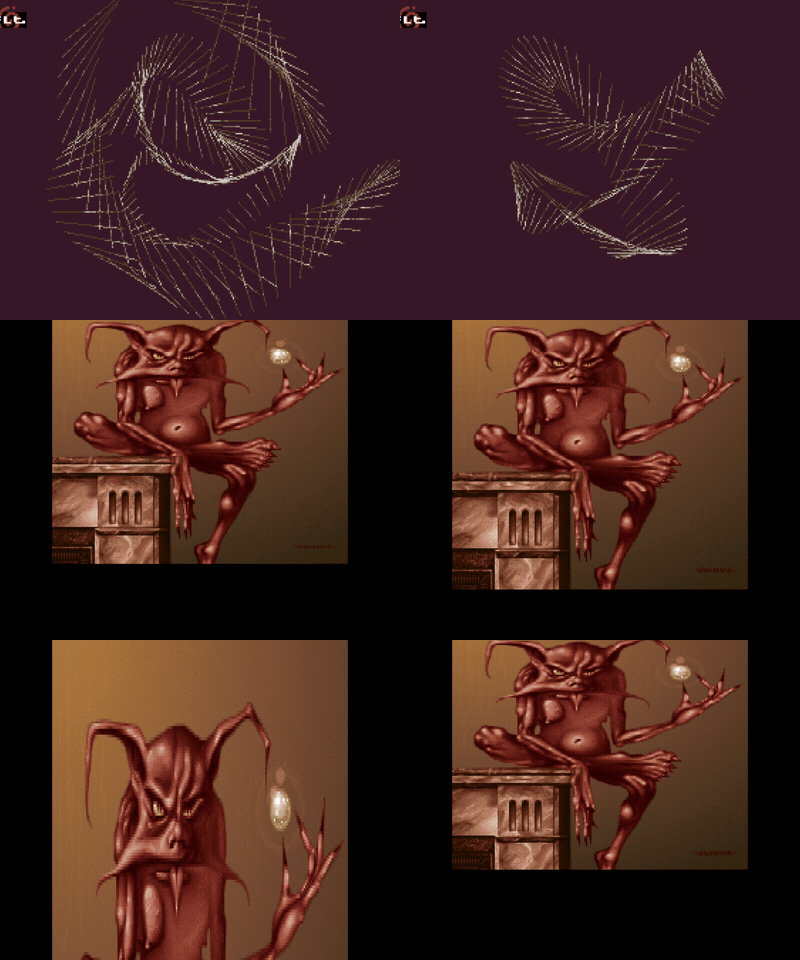
The wire object repeatedly resolves into a head and breaks back into radiating
lines. It leads into Jaco's creature picture, revealed through moving windows
before becoming a stable full image. Jaco's Yattering was also entered in
the graphics competition at the same party, where the official results place
it 35th.


The picture is pulled into a dense, colour-changing distortion before the final section. The greetings use very large white letters over a continuously changing multicolour field, with a second, smaller text layer travelling at a different scale. Nearly five minutes is an audacious amount of runtime for a scroller, but the two moving text systems and restless background stop it from being a static end screen.
The One-File Release
The original release is one 884,872-byte Amiga executable:
c52fe820787cde0341419d70d6012f8a8cfcf8dadf707f1ca9cd3c6c3980fd06 VD-FullMoon
There is no separate module, picture directory or script. Gzip at level 9
reduces it only to 857,371 bytes, and searches expose no M.K., FORM,
ILBM, PP20, XPKF, SQSH or 8SVX marker. The body is already densely
encoded; naming an internal picture or music format from a familiar-looking
screen would therefore be guesswork.
The later WHDLoad installer independently treats the demo as an AGA/68020 production requiring 1 MB chip and 1.6 MB fast memory. Its install script asks XFD to decrunch the original one-file release before installing it. This is useful confirmation of packing, but the installer is not evidence that the 1993 program depended on WHDLoad or XFD at runtime.
The Titanics-Family Streaming Wrapper
The file is a valid Amiga LoadSeg() executable with two root slots. Its
permanent code hunk is only 704 bytes at file offset $24. It contains the
Amiga overlay marker $ABCD, Overlaydos.library, and the visible message:
TITANICS-Cruncher decrunches while loading ...
HUNK_END occurs at $2e4, followed by HUNK_OVERLAY at $2e8 and then the
large encoded continuation. AmigaDOS overlay loading deliberately keeps the
executable open and supplies the root manager with the file handle, overlay
table and hunk table needed to fetch later nodes. A tiny resident root can
therefore decode the show progressively without keeping separate complete
packed and unpacked files in memory.
There is unusually strong comparative evidence for this identification. The
704-byte root in Stellar's Mindflow is byte-for-byte identical except for 46
bytes: Full Moon uses those bytes for the Titanics message while Mindflow
leaves them zero. The executable bodies are different, but their loader code
is the same. A separately preserved Titanics Cruncher 1.2 tool has a different
780-byte root, so the safe conclusion is Titanics-family wrapper, not an
unsupported exact version number.
This architecture explains both prominent release facts. Full Moon really
is a one-file demo, and its long succession of code, pictures and music can be
read and expanded as the show advances instead of existing as loose files on
disk.
Three Scores Form the Timeline
Demozoo records three pieces for the demo. The preserved files give a useful independent check on the unusually long run:
| Piece | Author | Positions | Patterns | Decoder duration |
|---|---|---|---|---|
Full Moon Part 1 |
Alien | 5 | 5 | 74.88 s |
Sainahi circles (short) |
Heatbeat | 66 | 24 | 213.00 s |
Nearly there.. |
Jogeir | 76 | 63 | 389.64 s |
Their combined decoder duration is 677.52 seconds, or 11:17.5. That agrees closely with the approximately 11:23 public presentation length once loader and transitions are included. The direct silent run also divides in the same way: a short framed introduction, a dense middle show, then a much longer greetings movement.
The first two preserved files identify their original format as Player 50A
and say they were converted with Pro-Wizard. They are therefore useful musical
preservations, not byte-exact dumps that can be assigned offsets inside the
packed executable. Jogeir's Nearly there.. is a conventional four-channel
ProTracker module with 8,142 non-empty events and 133,758 bytes of sample data.
Its internal text credits Jogeir Liljedahl, Noiseless and 1993. Demozoo notes
that this was his first Virtual Dreams production.
Why It Works as a 1993 Demo
Full Moon is less a catalogue of isolated algorithms than a deliberately
uneven three-act show. The framed opening is slow and atmospheric; the middle
compresses many short image and geometry transformations into a few minutes;
the ending spends almost as long on oversized greetings as everything before
it. The three separate scores make those changes of pace structural.
Technically, the release is economical: one dense file, a 704-byte streaming
root and enough visual material for more than ten minutes. Visually, it is
early AGA without pretending otherwise—wide palettes, large painted images,
rough-edged transformations and emphatic typography. Its second place makes
sense beside Origin: Full Moon's strength is not polish in every transition,
but the confidence to turn a compact one-file executable into a complete,
recognisable show.