Analysis model: GPT-5 (Codex), reasoning level not exposed
Hellraiser by The Megabusters - Technical Dissection
Hellraiser is The Megabusters' PC demo from The Party 1994. It was released
on 30 December 1994 and placed 8th in the PC Demo competition. Jaile and
Prinst are credited for code, Tee Ace for graphics, and Bart of Noise for the
music. The release NFO says the production took about two months, was written
entirely in assembler, and targeted a 486 Local Bus machine with roughly 450
KB of conventional memory.
The demo is remembered less as a list of isolated effects than as a directed show: a spy-film opening, horror typography, a moving maze, the patterned puzzle box, a deliberate Pirate TV interruption, a Phantasm section, and a long illustrated credit roll. Underneath that presentation is a compact real-mode operating layer, four soundtrack regions, and seventeen compressed child programs hidden inside one 2.1 MB executable.
Old contact, address, telephone, BBS, and email material in the NFO and final scroll is deliberately not reproduced here.
Sources Checked
- Demozoo production record: https://demozoo.org/productions/6974/
- Pouet production record: https://www.pouet.net/prod.php?which=5229
- The Party 1994 official results: https://files.scene.org/view/parties/1994/theparty94/results.txt
- Scene.org archive record: https://files.scene.org/view/parties/1994/theparty94/demo/hellrais.zip
- Archive.org Scene.org mirror used for recovery: https://archive.scene.org/pub/parties/1994/theparty94/demo/hellrais.zip
- Pouet-linked full-run video used for the silent motion excerpts: https://www.youtube.com/watch?v=zRK5UDaBkAY
Demozoo separately catalogues four Bart of Noise soundtrack pieces:
Hellraiser Intro, Hell Part Song, The Pirate Part, and Hellraiser Ending.
Original Package
The recovered 1,279,233-byte hellrais.zip has this SHA-256:
03b7b46ab1af9f01d76017c6ce55369cacbdde7c1992f3d477f13e8fa9bdc0a7 hellrais.zip
It contains the expected three files:
RAISER.EXE    2167462
MB.NFO           2850
FILE_ID.DIZ        402
Their hashes are:
a8ebda207d6df9b16e49dfda52a69155260a9756fa78be75663b96a603e62183  RAISER.EXE
1f11765f76213b1a193b5efb10f9460a46874308f86932c9738af9dce1e82851  MB.NFO
1c8870c14ea65d071af06cf46ab8b0ab822ad77e4013dd83f2a8d6789e4a38bc  FILE_ID.DIZ
The NFO explicitly warns that QEMM may crash and that the demo was not made for Windows. Its archive inventory and the recovered ZIP agree exactly.
The Small MZ Around A Large Overlay
RAISER.EXE begins as an ordinary segmented DOS MZ file, but the declared MZ
image ends after only 25,239 bytes. Everything after that is private material:
MZ header                         512 bytes
declared MZ image              25,239 bytes
appended private material    2,142,223 bytes
The header has 28 relocations, entry point 02EF:000C, and stack
0000:0400. The loader's startup strings identify raiser.exe as the file it
reopens and provide a strict Gravis Ultrasound diagnostic. They tell owners to
remove emulators, run ULTRINIT, and start the demo again; without a GUS the
only authored advice is to obtain one.
The loader relocates its working data to a small segment, installs a resident service behind INT 50h, and uses that service for timing, GUS transfers, keyboard state, cleanup, and child execution. This is why the individual parts are not normal standalone EXEs.
Four Soundtrack Regions
Four little-endian offsets sit together at loader data offsets 0149h through
0155h:
000C720C 000FF9A8 00134B9A 00182256
The controller adds the executable's shared overlay base to these values and passes the resulting file positions to INT 50h service 08h. It selects them between major groups of visual children, then calls services 09h and 0Ah to start or stop the corresponding playback state. The four-entry structure matches Demozoo's independently catalogued four-piece soundtrack rather than being an accidental run of plausible integers.
The Seventeen-Part Directory
The child directory starts in the loader data at 016Ah. Each variable-length
record contains:
- a paragraph allocation request;
- a 32-bit offset relative to shared packed base
000577C6h; - a relocation count;
- a far-entry offset;
- that many segment-fixup offsets.
The controller calls all seventeen records in this authored order:
016A 0198 01AC 01BE 01DA 01EA 01CE 01FE
0216 0224 0238 0246 0254 0262 0272
Record 0182 is the opening route and is called separately before that main
chain; record 0176 belongs to the alternate startup path. Counting those two
gives the full seventeen recovered children.
The exact packed starts and recovered byte counts are:
| Record | File start | Packed bytes | Recovered bytes | Fixups |
|---|---|---|---|---|
016A |
0577C6 |
22,581 | 40,776 | 2 |
0176 |
05CFFB |
29,172 | 41,209 | 2 |
0182 |
0641EF |
193,904 | 348,872 | 7 |
0198 |
09375F |
66,691 | 248,800 | 6 |
01AC |
0A3BE2 |
56,189 | 179,600 | 5 |
01BE |
0B175F |
14,155 | 38,872 | 4 |
01CE |
0B4EAA |
12,523 | 28,660 | 2 |
01DA |
0B7F95 |
48,048 | 145,568 | 4 |
01EA |
0C3B45 |
43,059 | 126,801 | 6 |
01FE |
0CE378 |
98,566 | 308,641 | 8 |
0216 |
0E647E |
29,513 | 129,252 | 3 |
0224 |
0ED7C7 |
70,864 | 235,905 | 6 |
0238 |
0FEC97 |
12,896 | 51,888 | 3 |
0246 |
101EF7 |
14,556 | 69,201 | 3 |
0254 |
1057D3 |
37,308 | 70,929 | 3 |
0262 |
10E98F |
33,053 | 125,825 | 4 |
0272 |
116AAC |
32,550 | 191,185 | 5 |
These boundaries come from the loader's own records. They are not guessed by scanning the overlay for instruction-like bytes.
The Stream Decoder
The unpacker at outer file offset 350Ah is small enough to describe exactly.
It reads one command byte at a time:
00hends the child;01hthrough7Fhrepeat the following byte that many times;80hthroughFFhcopy the followingcommand - 80hbytes literally.
Output crosses 4 KB boundaries by advancing ES by 0100h paragraphs and
resetting DI. After the zero terminator, the loader applies the record's
segment fixups, builds a far pointer from the recovered entry offset and the
new segment, and calls the child. On return it restores the allocation's
original memory-control data before releasing the block.
Every recovered child starts directly with 16-bit x86 code rather than an MZ header. The common opening sequence takes a parameter block from the resident system, restores DS/ES, enters VGA mode 13h, and calls INT 50h instead of DOS for shared services. The large differences between packed and recovered sizes come from repeated zeroes, tables, masks, and image fields compressing very well under this deliberately simple scheme.
Runtime And Timing Boundary
The exact archive was run silently under DOSBox-X 2026.01.02 and mainline
DOSBox 0.74-3 with emulated GUS at base 240h, DMA 3, IRQ 5, 16 MB RAM, a
486-class CPU, and dummy host audio. Both direct runs passed GUS detection and
displayed the authored Ultrasound opening, but their INT 50h soundtrack
position remained at its initial value under the dummy-audio route. The
opening child waits on service 0Bh before continuing, so claiming a complete
direct capture would be false.
The full visual route and times below were therefore checked against the video linked directly from Pouet. The published GIFs are continuous silent excerpts from that reference, not tiled screenshots and not output from the stalled local run. No H.264/MP4 file is published.
| Approximate reference time | Visible section |
|---|---|
00:00 |
Ultrasound opening and animated hand |
00:16 |
spy-film aperture and walking figure |
00:30 |
Megabusters presentation/title |
00:54 |
hands reveal the patterned box |
01:18 |
chained mask and horror typography |
01:38 |
low-poly object over the moving maze |
02:08 |
rotating patterned puzzle box |
03:06 |
Pirate TV interruption begins |
04:18 |
Phantasm section begins |
05:00 onward |
long illustrated credits and greetings |
Continuous Motion Evidence

The opening uses a familiar segmented aperture as a framing device, but the small walking figure and changing aperture turn it into a comic introduction rather than a static quotation.
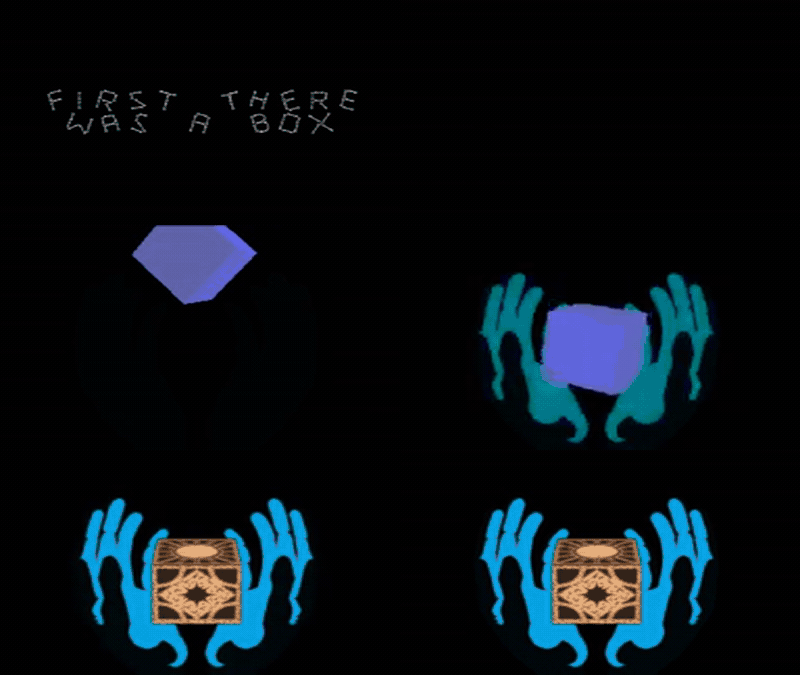
Flat blue hands close around the first patterned box. The strong silhouettes and sparse black field are typical of the demo's preference for staged graphic beats over an uninterrupted effect reel.

The chained mask continually deforms while the surrounding type and framing change. It is one of the clearest places where custom illustration and realtime distortion are treated as one scene.

A flat-shaded solid turns above a moving extruded maze. The object and ground use separate depth cues, making the scene read cleanly despite the low resolution and restrained palette.

The later box is a proper rotating mapped object. Its elaborate face pattern stays attached through the turn, making texture orientation much easier to judge in motion than in a still.
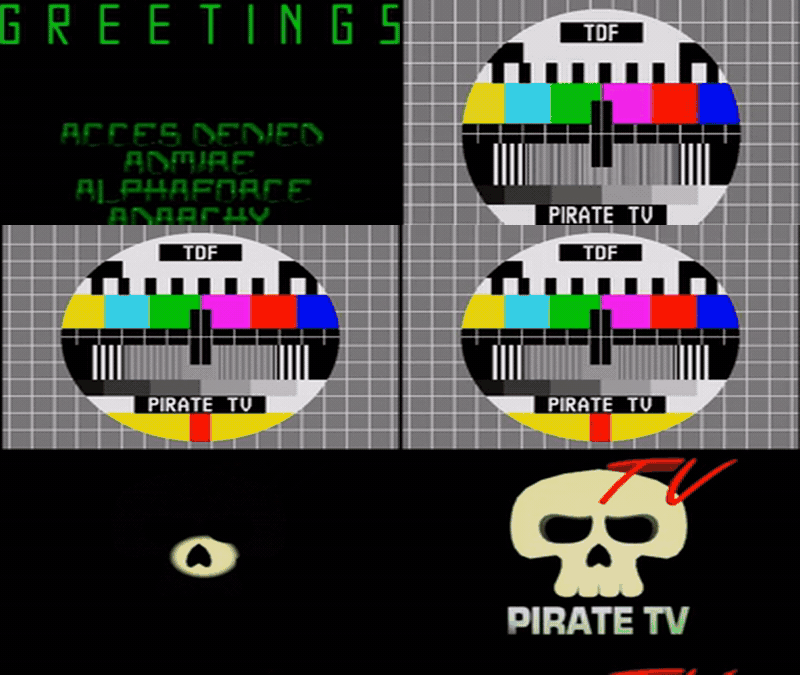
The Pirate TV passage deliberately interrupts the horror show with broadcast graphics and a new visual grammar. The cut is part of the demo's authored structure, not a capture discontinuity.

The Phantasm section returns to illustrated horror imagery and composited motion before the long credits take over.
What Hellraiser Actually Is
Hellraiser is a resident real-mode show controller plus seventeen transient
visual programs. The outer 25 KB MZ installs the INT 50h environment, owns GUS
and timing state, reopens its own 2.1 MB file, selects one of four soundtrack
regions, expands each child with a byte-run/literal codec, fixes its segment
references, and calls it in a temporary block.
That architecture explains both the demo's variety and its coherence. The parts can carry large private image and lookup fields without duplicating the hardware/player layer, while the controller can place deliberate interruptions and soundtrack changes between them. The technical system is modest and very 1994: real mode, mode 13h, a GUS-only resident API, and a custom overlay format. The memorable result comes from using that system to direct a show rather than merely enumerate effects.