Analysis model: gpt-5.5 xhigh
Illusion by Virtual Dreams / Fairlight - Technical Dissection
A Finnish Full Demo Between Pictures And Geometry
Illusion is a one-disk Amiga OCS/ECS demo by Virtual Dreams / Fairlight,
released on 29 May 1993. It placed second in the Amiga demo competition at The
Computer Crossroads 1993 in Gothenburg, behind Triton's Crystal Dream 2.
This is a full demo, not an intro, cracktro, invitation, slideshow or musicdisk. Its four credited authors are individually documented in Finland:
- Alien, Sami Arola of Pirkanmaa: code.
- Skull, Juha Lainema of Turku: code.
- Groo: music.
- Jaco, later Sulevi and Jarkko Salminen: graphics.
The production is compact but unusually coherent for its period. Jaco's painted opening image gives way to circles, crossing strips, text surfaces, a dot-filtered face and an extended extruded corridor. The same muted violet-grey world holds those very different techniques together.
Later reception is strong without turning the demo into a falsely inflated
canonical monument. Pouet records 35 positive votes, four neutral votes and no
negative votes. Contemporary Swedish public-domain listings called it
mycket bra, while later comments especially remember its design, music and
the corridor. That is a better description than a generic “classic”: it was a
well-liked 1993 trackmo whose visual argument has survived.
Public references:
- Demozoo production, date, placing and credits: https://demozoo.org/productions/26907/
- Demozoo Computer Crossroads 1993 results: https://demozoo.org/parties/428/
- Pouet production and later reception: https://www.pouet.net/prod.php?which=8084
- Demozoo Virtual Dreams history: https://demozoo.org/groups/609/
- Preserved ADF package: https://www.planetemu.net/rom/commodore-amiga-demos-various-adf/illusion-1993-05-29-virtual-dreams
- Public capture used for visual concordance: https://www.youtube.com/watch?v=8Oa2EAvnggY
The preserved ADF, its executable boot path, the loaded machine-code image and a video-only copy of the linked public capture were examined independently. No music or other audio was played.
Preserved Disk And An Honest Runtime Boundary
The original DMS mirror linked by Demozoo was unavailable during this pass. The disk was therefore recovered as a standard 901,120-byte ADF from the Planet Emulation Amiga demo set. It is a normal bootable AmigaDOS disk rather than a converted video or WHDLoad package.
Illusion (1993-05-29)(Virtual Dreams).zip
size      333,871 bytes
SHA-256   cfccda2af8722db899c0b018e58abeceb61538fd04b711edcf86cdfb86fcbae6

Illusion (1993-05-29)(Virtual Dreams).adf
size      901,120 bytes
SHA-256   99a56a6387438798a4ffcba5256c617a1743ed71620261f132e2559fc89073c5
A direct boot was attempted in FS-UAE 3.2.35 with audio output disabled. The available AROS replacement ROM did not reproduce the original Exec/boot environment: the A500-class run reset on an illegal instruction inside the replacement ROM, while an A1200-class test remained before the authored display. Neither is counted as a successful demo run. A licensed Commodore Kickstart was not available, so the direct test stops at that boundary.
The public recording was downloaded as a video-only stream: 604 by 480 pixels, 25 frames per second, 234.44 seconds, with no audio stream. Only the seven GIF excerpts below are published. They are continuous excerpts, not contact sheets or collections of unrelated stills.
The Painted Opening Is A Threshold

Jaco's opening picture places an armoured human, an organic figure, birds, machinery and vegetation in one landscape. The demo then removes almost all that detail. Flat circles grow past the display edges, overlap without outlines, and reduce the palette to dusty violet, green, blue and ochre.
That is not merely a fade from “art” to “code.” The circles establish the rules used later by the corridor: large simple silhouettes, restrained colour, and apparent depth created by overlap and scale rather than texture.
Thin diagonal bars subsequently cross and narrow until they become a small lattice. The transition is a visual reduction: picture to discs, discs to strips, strips to lines.
Credits Become Moving Surfaces

The phrase FOLLOWING LOVE PEACE AND VIRTUAL DREAMS moves across a green
isometric-cube field. It is followed by full-screen repetitions of the author
roles: Skull code, Jaco gfx and Groo music.
The credit screens matter because the words are not laid over a neutral background. Repetition turns names into texture. Letterforms become a field whose motion and spacing can be read before the individual words are read. This anticipates the later dot-filtered face, where a recognisable picture is also treated as a regular sampling field.
A Face Is Reconstructed As Density

The face does not arrive as a conventional bitmap reveal. A regular grid of small cells changes size or brightness according to the source image. Dense dark areas form hair, eyes and shadow; larger pale cells supply highlights. The source remains recognisable while the display keeps advertising its sampling lattice.
This is why the phase looks neither like a plain stipple picture nor like later texture mapping. The grid is stable enough to be perceived as a rendering mechanism, yet its local values carry an image.
The loaded code contains several loops that build regular word tables before entering raster-synchronised display loops. One measured setup writes 288 successive words separated by 44 and another writes 512 words separated by 64. Those strides are consistent with prepared lookup or address tables. The binary evidence does not identify either table as the face plotter, so that more specific attribution is deliberately withheld.
The Corridor Is One Object Explored For More Than A Minute

Two bright end faces define a chain of extruded sections. Their inner edges step toward a central neck, making the empty violet region read as depth. Instead of cutting away quickly after proving the routine, the demo changes the section widths, vanishing direction and apparent camera position.
The geometry is minimal. Each visible section is bounded by straight vertical edges and sloping top and bottom edges. Flat shades separate successive depths. There is no texture needed because the alternating silhouettes already explain which section lies in front of which.

The later configurations show why the long duration is justified. A narrow tunnel expands into broad opposing wedges; asymmetric sections make the centre drift; the bright faces nearly meet and then retreat. It behaves less like a fly-through of stored rooms than a parameterised extrusion being tested across its useful range.
The main program calls fourteen large phase routines in a fixed order. Several
of them wait directly on the custom-chip vertical-position register at
$dff006, using exact raster values such as $10, $36, $37, $d0 and
$ff. Others install a new copper-list pointer in COP1LC at $dff080 and
then loop for a bounded counter. The production is therefore paced by display
state and frame/raster waits, not by a modern wall-clock timeline.
The Last Vector Shapes Are A Coda, Not Another Show
After the long pale corridor, a few coloured solid fragments rotate in open space. Their purple, red and orange faces restore the opening palette but keep the corridor's flat-shaded geometry.
This brief phase is effective because it does not try to outgrow the corridor. It releases the strong bilateral composition, leaves more empty space, and acts as a visual full stop before the textual ending.
The Epilogue Turns Text Into Falling Geometry

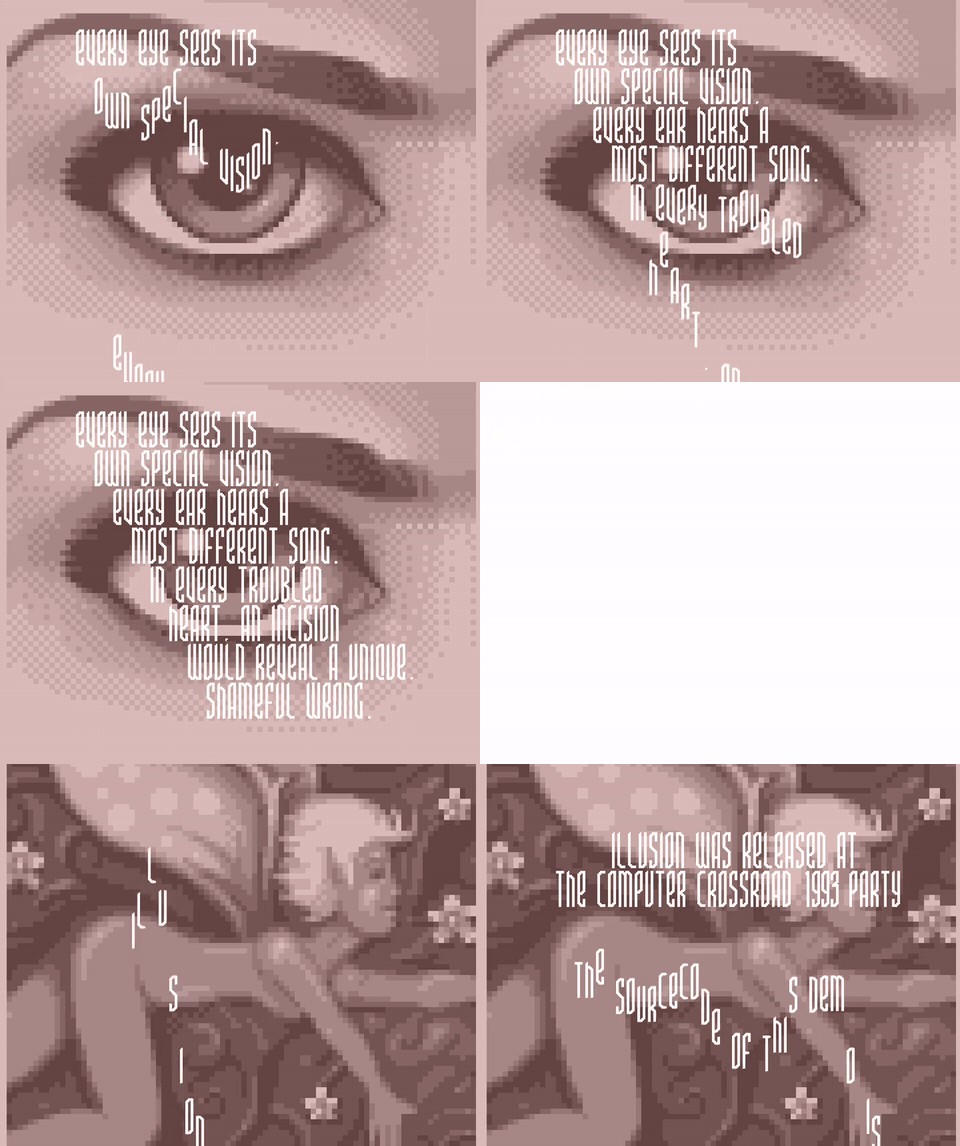
The ending returns to a raster image—first an eye, then organic background art—while narrow white text falls, bends and separates across it. The words include the production's release context, an offer to sell the source code, and a short poem.
The disk itself confirms those are authored screens rather than later video titles. Their strings occur in the loaded image, including:
ILLUSION WAS RELEASED AT
THE COMPUTER CROSSROAD 1993 PARTY

THE SOURCECODE OF THIS DEMO IS
FOR SALE, WRITE TO "JUHA LAINEMA"

THE NIGHTS STORM CHAINED THEE
THE BLADES LIGHTNING RUNNING FREE
The source-sale message is unusually valuable historical evidence. This demo does not present its technique as unknowable magic; it explicitly imagines the implementation as something another programmer might buy and study.
The Boot Block Performs One Huge AmigaDOS Read
The first 1,024 bytes form a valid DOS\0 boot block. Its active stub is only
78 bytes. It first copies 46 bytes of itself to $00000f00 so the disk read
cannot overwrite the executing instructions. The relocated code then fills
the supplied trackdisk I/O request:
io_Command   2          CMD_READ
io_Data      $00018000
io_Length    $000b8000  753,664 bytes
io_Offset    $00000400  immediately after the boot block
It calls Exec's DoIO through the library vector at -456(a6) and jumps to
$00080000.
This is not a custom MFM trackloader. It is a deliberately blunt bulk loader:
read 736 KiB of consecutive disk data into chip memory, then enter the image
at a fixed address. The disk offset corresponding to $80000 is $68400,
and that location begins with the observed main entry sequence.
The unused part of the boot sector contains a private warning that calls the disk a preview and says it is for Fairlight staff. That conflicts with its later public preservation but agrees with the on-screen source-sale message. It is reported as embedded disk evidence, not used to invent a separate release history.
The Main Entry Is A Literal Phase Score
The code at $80000 is unusually readable as a top-level score. After one
hardware and replay initialiser it calls a sequence of absolute routines:
$80000  initialise interrupts, DMA and replay
$80010  call $a6084
$80022  call $b497a
$8003a  call $97b80
$80058  call $9dc48
$8006a  call $9d89c
$80070  call $a63bc
$8008a  call $88fe4
$80096  call $979e8
$800a2  call $931d8
$800b2  call $aebb0
$800c2  call $bbbe2
$800d4  call $c2456
$800da  call $be306
$800ec  call $82318
The caller supplies different base pointers and two explicit counters—910 and 3,000—to two of those routines. Other phases carry their own bounded loops. The architecture is consequently neither one monolithic renderer nor a directory of manually selected parts. It is a fixed trackmo scheduler whose effect modules share the hardware and replay layer.
Some effect entries begin with a small data-shaped header:
000003e7 00000000
000003e8 00000001
54455854             "TEXT"
000003e9 <length>
On 68000 those words also decode as legal, if odd, instructions before control reaches the conventional body. Calling the header address is visible in the top-level code. The overlap is intentional data/code economy; labelling it as a known packer format would go beyond the evidence.
One Level-3 Interrupt Owns The Replay Clock
Initialisation clears interrupt requests and disables DMA through
INTENA, INTREQ and DMACON. It installs $80162 in vector $6c, the
level-3 interrupt vector, then enables the required interrupt and DMA bits.
The handler:
- saves every data and address register;
- acknowledges the interrupt;
- calls the replay routine at
$8040c; - restores all registers;
- returns with
RTE.
The music data at $55000 begins with the signature SNT!. The parser that
follows treats it like a 31-instrument tracker module: it walks 31 sample
headers, reads a song length at offset 256, follows the order table from
offset 258, builds pattern pointers, and derives sample addresses from the
module base.
This is firmer than identifying a tune from audible playback: no sound was played. It demonstrates that the soundtrack is a frame-clocked tracker replay integrated into the same vertical-blank interrupt that keeps the visual show moving.
Copper, Blitter And Self-Relocation Are Visible In The Code
The phase routines repeatedly address the Amiga custom register base
$dff000. Three recurring mechanisms stand out:
- new copper-list addresses are written to
$dff080; - blitter-busy bit 14 in
$dff002is polled before new blits; - exact vertical positions in
$dff006gate display changes.
One routine constructs a tiny copper list at $90, writes it to COP1LC,
then writes the combined blitter control word $01000000 at $dff040 and
uses bitmap pointers rooted at $20000. Another clears 13,632 bytes in
64-bit-sized iterations before copying a 256-byte table. These are direct
chipset display paths, not calls through Intuition or graphics.library.
The late routine at $be306 copies 4,173 longwords—16,692 bytes—to $28000
and jumps to the relocated copy. That is a controlled self-relocation step,
most likely to free or reuse the original address range for the final phase.
The exact visual boundary cannot be proven from the capture alone, so the
article does not assign it to a particular poem frame.
The Exit Is A Hardware Reset
After the final phase, the main program waits in nested delay loops, installs
a local trap-zero vector at $80, and executes TRAP #0. The handler clears
the Exec base at address 4, issues the 68000 RESET instruction and jumps
through the reset vector.
This is not a polite return to Workbench. The boot disk owns the machine from its bulk read to its hard reset. That closed lifecycle explains why the demo can use absolute memory, replace interrupt vectors, build copper lists in low memory and relocate a late effect without an operating-system cleanup path.
What Illusion Actually Achieves
Illusion does not win by presenting the longest list of 1993 routines. Its
achievement is editorial:
- a detailed painted world is reduced to circles and lines;
- names and faces become sampled surfaces;
- one simple extruded corridor is allowed to mutate at length;
- the palette binds bitmap, text and geometry together;
- the machine code is organised as an explicit effect score;
- a VBlank replay layer and direct copper/blitter control keep it coherent.
The title is exact. Flat discs become depth, repeated names become texture, dots become a face, and a few shaded edges become a corridor. The production keeps showing the mechanism while making the eye believe the space.