Analysis model: gpt-5.5 xhigh
INC World by International Network of Crackers - Technical Dissection
INC World is an early MS-DOS CGA cracktro credited to International Network
of Crackers, with code by Megaton Man. Demozoo lists it as released on 4
January 1989 and explicitly says that date is taken from the embedded comment
inside the binary. Pouet lists the release date as 1990, and the scene.org ZIP
member timestamp is also from March 1990. For this early-PC pass, I treat the
release year as 1989 by embedded production note, with the later 1990 metadata
recorded as archive/catalog evidence.
Release year: 1989 by embedded comment; Pouet and archive timestamp point to 1990.
This article keeps public scene handles and visible group credits, but does not reproduce private contact details.
Sources
- Demozoo production page: https://demozoo.org/productions/139005/
- Scene.org file page: https://files.scene.org/view/demos/compilations/lost_found_and_more/inc_world.zip
- Scene.org archive download: https://files.scene.org/get/demos/compilations/lost_found_and_more/inc_world.zip
- Pouet page: https://www.pouet.net/prod.php?which=67628
Runtime Timeline
Runtime frames below come from a local DOSBox-X 2026.01.02 capture:
machine:        cga
core/cycles:    normal, 4770
sound:          disabled
capture command: dx-capture /v INCWORLD.COM
video format:   MPEG-TS H.264, 320x200, 59.94 fps
duration:       17.389044 s
The captured run used no command-line speed argument. That means the program uses its default delay preset after the initial setup.
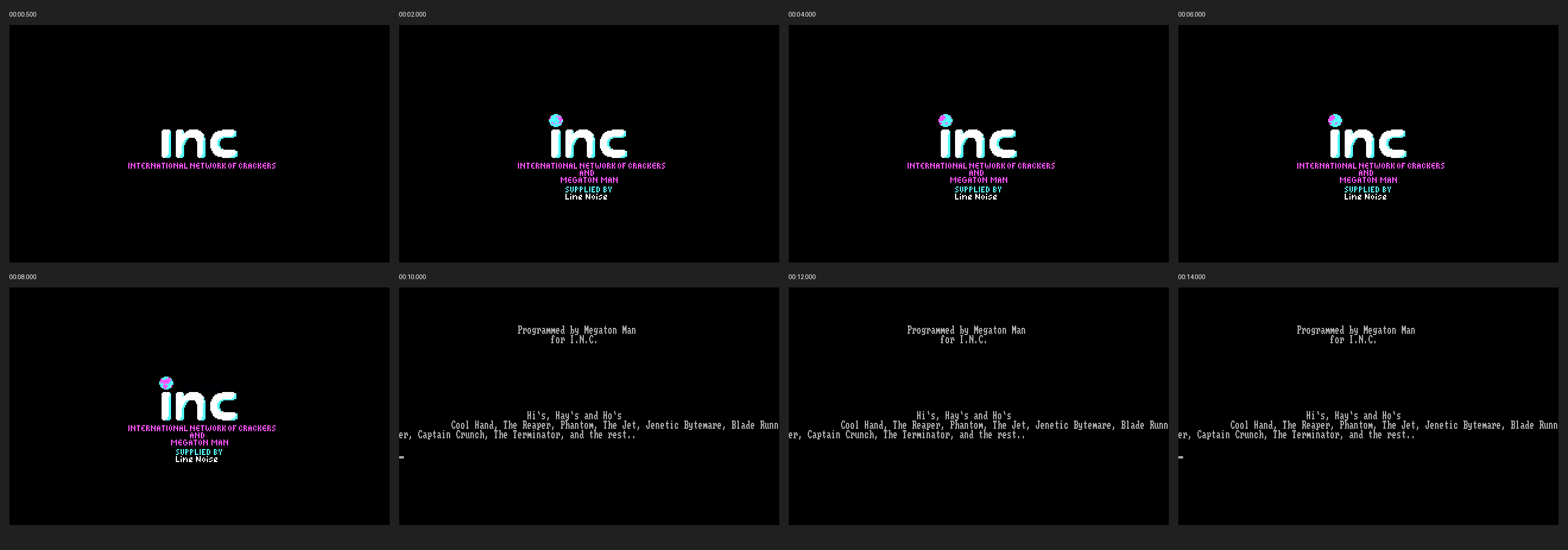

| Time | Still | What is happening |
|---|---|---|
00:00.500 |
 |
The initial CGA logo/title is visible. This is after the mode-4 setup and first unrolled text/logo draw calls. |
00:02.000 |
 |
The full centred title stack is visible: INC logo, group expansion, Megaton Man, and supplier credit. The small dot over the logo is part of the 13-frame sprite cycle. |
00:08.000 |
 |
The logo loop is still running, with the dot/sprite in a different phase. Keyboard polling happens once per loop; if no key is ready the animation repeats. |
After a keypress, the program switches to text mode and prints a short programmer/greetings page. The capture continues long enough to catch that final text page in the contact sheet.
The GIF above is assembled directly from the three 640x400 CGA runtime stills in the table. It is a sparse logo/sprite-phase loop; the final text-mode page is intentionally left in the contact sheet rather than mixed into the graphics mode preview.
Runtime-To-Code Concordance
The captured sequence maps directly to the program's code-as-bitmap design. The
static title and credits are not decoded from an image file at runtime; they are
drawn by large unrolled blocks of mov byte es:[si+offset],imm instructions.
The only sustained animation in the graphics-mode loop is the 13-frame ornament
around the INC logo, plus speed/key handling around that loop.
The 00:00.500 establishing frame appears after the entry path has set CGA
mode 4 and called the static renderers:
030F: call 043A       ; set CGA mode 04h
0312: call 1630       ; draw large static INC logo/text
0315: call 2024       ; draw first small credit chunk
0318: call 211B
031B: call 21F3
031E: call 2353
The large inc title comes from 1630h, a 2548-byte routine with roughly 384
direct ES: byte stores. The small credit lines are the same technique at a
smaller scale through 2024h, 211Bh, 21F3h, and 2353h. The capture shows
the result after those routines have written directly into B800h.
The 00:02.000 frame, with the full centered title stack visible, is the stable
state after those static renderers and before/within the first steady ornament
cycle. The small moving dot over the logo is handled by the 13 frame routines
called from 0361h:
0361: call 064Bh
0364: call 0442h
0367: call 0784h
...
03A3: call 13BEh
03A6: call 0442h
03A9: call 14F7h
03AC: call 0442h
Each of those 13 routines is 313 bytes and contains 52 direct CGA byte stores.
The first frame routine starts with ES = B800h and SI = [0186h], then writes
literal bytes at offsets such as +0000h, +0050h, +2000h, and +2050h:
064B: mov ax,0B800h
064E: mov es,ax
0650: mov si,[0186h]
0654: mov byte es:[si+1FB0h],00h
066C: mov byte es:[si],00h
067F: mov byte es:[si+2000h],00h
0685: mov byte es:[si+2001h],06h
Those offsets are exactly CGA mode-4 memory layout: +50h is the next same-bank
byte row, and +2000h is the alternate scanline bank. The ornament animation in
the GIF is therefore not a sprite blitter with masks or clipping. It is thirteen
fully unrolled, hand-positioned CGA byte patches.
The 00:08.000 frame shows the same loop in a later phase. The static title
stack is unchanged because the big renderers are not called again inside the
steady loop. Only the ornament frame and the delay/key state advance. If no key
is waiting, the BIOS keyboard poll at 03AFh jumps back to 0361h:
03AF: mov ah,01h
03B1: int 16h
03B3: jne key_ready
03B5: jmp 0361h
The speed controls in the article also belong to this loop. The delay routine
at 0442h counts down [018Dh], and command-line/default settings plus +,
-, and 0 keys change that count. There is no timer interrupt or retrace
pacing in the graphics loop; the motion rate is busy-wait driven.
The contact sheet includes the post-key text page. That is a different display
path: after a non-speed key, the program returns to text mode twice, prints the
$-terminated DOS string at 019Dh through INT 21h AH=09h, waits for a key,
and exits:
03EF: mov ax,0003h
03F2: int 10h
03F9: mov ah,09h
03FB: mov dx,019Dh
03FE: int 21h
0402: int 16h
0404: int 20h
So the runtime evidence is organized like this: one-time CGA mode setup, static unrolled title/credit renderers, a 13-frame unrolled ornament cycle paced by busy-wait delays, BIOS keyboard polling for speed/exit controls, and a final ordinary DOS text page. The frames and GIF are useful because they show the small animated phase over a screen that otherwise comes from literal CGA byte-store code.
Archive Inventory
inc_world.zip 3748 bytes
Archive SHA-256:
f9a2cd18d039f43de0936c6a9485edb8100c77dcc77f5de4835bc80dbd590f62 inc_world.zip
ZIP central directory:
INCWORLD.COM
  modified:          1990-03-26 21:31:32
  compressed size:   3626 bytes
  uncompressed size: 10279 bytes
  CRC32:             23eae731
Extracted file:
INCWORLD.COM  10279 bytes
SHA-256: ac190f519eeffeb13b453b8702d79047f023233cefcb22cd9d02f76c155b11b1
The file is a plain .COM program. It is not LZEXE/PKLITE packed.
Embedded Dating Evidence
The program starts with a near jump over a block of data:
0100: e9 0c 02 jmp 030Fh
The skipped region contains the filename BUB.EXE, the production note, and
the later DOS text strings. The key embedded comment begins at file offset
0011h, runtime address CS:0111:
<<<=== MEGamations ===>>> Produced by Megaton Man.Jan/4/89 for INC Cracking Group. All Done in 100%Assembly Language.
Demozoo's date follows that embedded comment. The scene.org archive timestamp and Pouet year are later. The most defensible article date is therefore:
content/prod note: Jan/4/89
archive ZIP member timestamp: 1990-03-26
Pouet catalog date: 1990
article release year: 1989 by embedded comment, with conflict noted
COM Memory Map
Important runtime addresses:
CS:0100  near jump over metadata/text
CS:0107  "BUB.EXE",0
CS:0111  MEGamations / Jan/4/89 comment
CS:0186  logo base offset word, initial 0BAFh
CS:0188  large text base offset word, initial 0DE0h
CS:018D  delay inner count word, initial FFFFh before defaults
CS:0193  small text base offset word, initial 1239h
CS:0197  delay repeat count word, initial 0032h before defaults
CS:019D  final DOS text string, `$` terminated
CS:030F  real program entry
CS:064B  first logo animation frame routine
CS:1630  large static INC text renderer
CS:2024  small credit text renderer
The CGA approximate coordinates for the important base offsets are:
offset 0BAFh -> byte column 31, x about 124, y 74
offset 0DE0h -> byte column 32, x about 128, y 88
offset 1239h -> byte column 25, x about 100, y 116
Those are byte columns in CGA 2bpp mode, so each byte covers four horizontal pixels.
Entry Flow
The real entry begins at 030Fh:
030F: call 043A       ; set CGA mode 04h
0312: call 1630       ; draw large static INC logo/text
0315: call 2024       ; draw first small credit chunk
0318: call 211B
031B: call 21F3
031E: call 2353
0321: call 0413       ; default speed preset
The first five drawing calls build the initial static screen. The call to
0413h changes delay variables to the default preset:
0413: mov word [018Dh],7FFFh
0419: mov word [0197h],0028h
041F: ret
Then the program checks the first command-line argument:
0324: mov ah,cs:[0082h]
0329: cmp ah,'0'
032E: call 042Dh if equal
0331: cmp ah,'1'
0336: call 0420h if equal
0339: cmp ah,'2'
033E: call 0413h if equal
0341: cmp ah,'3'
0346: call 0406h if equal
In a DOS .COM, CS:0080 is the command-tail length byte, CS:0081 is
usually the space after the program name, and CS:0082 is the first visible
argument character. The speed presets are:
argument  delay inner  delay repeats
0         0001h        0001h
1         2AAAh        0014h
2/default 7FFFh        0028h
3         FFFFh        0050h
The capture used the default 2/default path.
Delay Inner Loop
The delay subroutine at 0442h is tiny but controls the whole feel:
0442: push ax
0443: push cx
0444: mov  cx,0001h
0447: push cx
0448: mov  cx,[018Dh]
044C: nop
044D: loop 044Ch
044F: pop  cx
0450: loop 0447h
0452: pop  cx
0453: pop  ax
0454: ret
It looks like a nested loop, but the outer CX is loaded with 1, so each
delay call executes one inner countdown from [018Dh]. Earlier in the program,
[0197h] is used to repeat delay calls:
0349: mov cx,[0197h]
034D: call 0442h
0350: loop 034Dh
This gives the speed controls two levers:
[018Dh] = cost of one delay call
[0197h] = number of delay calls in the initial wait
Inside the animation loop, the program usually calls 0442h once between logo
frames.
During runtime, + and - adjust [018Dh]:
if key == '+': [018Dh] += 1000h
if key == '-': [018Dh] -= 1000h
if key == '0': [018Dh] = FFFFh
Those are direct delay-count changes, not a timer reprogramming trick.
Logo Animation Loop
The core animation loop starts at 0361h. It runs 13 logo-frame routines with
one delay between each:
0361: call 064Bh
0364: call 0442h
0367: call 0784h
036A: call 0442h
036D: call 08BDh
0370: call 0442h
0373: call 09F6h
0376: call 0442h
0379: call 0B2Fh
037C: call 0442h
037F: call 0C68h
0382: call 0442h
0385: call 0DA1h
0388: call 0442h
038B: call 0EDAh
038E: call 0442h
0391: call 1013h
0394: call 0442h
0397: call 114Ch
039A: call 0442h
039D: call 1285h
03A0: call 0442h
03A3: call 13BEh
03A6: call 0442h
03A9: call 14F7h
03AC: call 0442h
All 13 frame routines are the same size:
routine  length  direct ES byte stores
064Bh    313     52
0784h    313     52
08BDh    313     52
09F6h    313     52
0B2Fh    313     52
0C68h    313     52
0DA1h    313     52
0EDAh    313     52
1013h    313     52
114Ch    313     52
1285h    313     52
13BEh    313     52
14F7h    313     52
The routines draw the small animated dot/ornament around the inc logo. They
are not table-driven. Each frame is a hand-unrolled list of immediate byte
writes to CGA memory.
One Logo Frame Inner Loop
The first logo frame routine begins:
064B: mov ax,0B800h
064E: mov es,ax
0650: mov si,[0186h]
Then the "inner loop" is simply a sequence of literal stores:
0654: mov byte es:[si+1FB0h],00h
065A: mov byte es:[si+1FB1h],00h
0660: mov byte es:[si+1FB2h],00h
0666: mov byte es:[si+1FB3h],00h
066C: mov byte es:[si],00h
0670: mov byte es:[si+1],00h
0675: mov byte es:[si+2],00h
067A: mov byte es:[si+3],00h
067F: mov byte es:[si+2000h],00h
0685: mov byte es:[si+2001h],06h
068B: mov byte es:[si+2002h],50h
0691: mov byte es:[si+2003h],00h
The offsets reveal the CGA layout:
0, +1, +2, +3      adjacent bytes on one scanline
+50h              next same-bank scanline, because 80 bytes per row
+2000h            opposite CGA scanline bank
+2050h            opposite bank, next row
So each routine paints a small interleaved 2bpp sprite made from a handful of 4-byte rows. It clears old pixels and writes new pixels in one unrolled block. No loop counter, mask table, or clipping branch appears inside the frame routine.
Equivalent structure:
ES = B800h
SI = logo_base
for each hard-coded byte in this frame:
    ES:[SI + hardcoded_cga_offset] = hardcoded_pixel_byte
return
The performance tradeoff is obvious: it spends code size to avoid per-pixel logic. On an 8088/286-era PC, this is a sensible way to make a tiny title animation feel responsive.
Intro Sweep
Before entering the steady logo loop, the program runs a longer sweep at
045Ch. It repeatedly moves [0186h] by one CGA scanline:
045C: mov word [0186h],001Fh
0462: call 064Bh
0465: mov si,[0186h]
0469: add si,0050h
046C: mov [0186h],si
0470: call 0784h
0473: call 0442h
0476: add si,0050h
0479: mov [0186h],si
047D: call 08BDh
The same pattern repeats through all 13 frame routines, and then repeats for
several bands. 0050h is 80 decimal, one CGA byte row. Because CGA mode 4
uses interleaved banks, this is a same-bank two-scanline movement. That is why
the entry sweep feels like the ornament walks down through the title region.
Keyboard Poll And Exit
At the end of each 13-frame logo cycle:
03AF: mov ah,01h
03B1: int 16h
03B3: jne key_ready
03B5: jmp 0361h
If no key is pending, it repeats the logo loop. If a key is present:
03B7: xor ax,ax
03B9: int 16h
That consumes the key. Special controls are +, -, and 0; anything else
falls through to the exit/final text path.
The exit path clears/reinitializes text mode twice:
03EC: call 1630h
03EF: mov ax,0003h
03F2: int 10h
03F4: mov ax,0003h
03F7: int 10h
Then it prints the $-terminated DOS string at 019Dh:
03F9: mov ah,09h
03FB: mov dx,019Dh
03FE: int 21h
0400: xor ax,ax
0402: int 16h
0404: int 20h
The final text page is not drawn through CGA graphics. It is ordinary DOS text output after returning to mode 3.
Large Static Renderer
The big inc title is drawn by 1630h. Its first lines are:
1630: mov ax,0B800h
1633: mov es,ax
1635: mov si,[0188h]
1639: mov byte es:[si],3Fh
163D: mov byte es:[si+1],FCh
1642: mov byte es:[si+2],00h
1647: mov byte es:[si+3],3Fh
164C: mov byte es:[si+4],F0h
1651: mov byte es:[si+5],03h
1656: mov byte es:[si+6],FFh
165B: mov byte es:[si+7],FCh
This routine alone is 2548 bytes long and contains about 384 ES: byte-store
instructions. It is a hand-built CGA bitmap writer, not a font renderer.
The byte values make sense for 2bpp CGA:
FFh = four pixels of colour index 3
00h = four black pixels
3Fh = 00 11 11 11 bit pairs
FCh = 11 11 11 00 bit pairs
The routine writes both normal row offsets and +2000h odd/even bank offsets,
exactly as a hand-converted CGA bitmap would.
Smaller Text Renderers
The additional text chunks are also unrolled routines:
routine  role                       length  direct ES byte stores
2024h    first small credit chunk     247   42
211Bh    next small credit chunk      216   36
21F3h    next small credit chunk      352   60
2353h    next small credit chunk      284   48
246Fh    small/transition chunk       115   18
24E2h    small/transition chunk       421   72
2687h    small/transition chunk       353   60
27E8h    small/transition chunk       319   54
Example from 2024h:
2024: mov ax,0B800h
2027: mov es,ax
2029: mov si,[0193h]
202D: mov byte es:[si],88h
2031: mov byte es:[si+1],22h
2036: mov byte es:[si+2],A0h
203B: mov byte es:[si+3],A2h
2040: mov byte es:[si+4],82h
2045: mov byte es:[si+5],08h
204A: mov byte es:[si+6],20h
Again, it is all immediate pixel-byte stores.
CGA Pixel Format
Mode 4 is 320x200, two bits per pixel, four pixels per byte:
bits 7..6 -> pixel x+0
bits 5..4 -> pixel x+1
bits 3..2 -> pixel x+2
bits 1..0 -> pixel x+3
The memory layout is interleaved:
offset = (y & 1) * 2000h + (y >> 1) * 80 + (x >> 2)
The routines exploit that layout directly. A small sprite or glyph row is four
to sixteen immediate bytes. The next same-bank row is +50h; the corresponding
other-bank row is +2000h; the next row in the other bank is +2050h.
That is why the draw code looks repetitive:
mov byte es:[si+0000h],imm
mov byte es:[si+0001h],imm
...
mov byte es:[si+0050h],imm
...
mov byte es:[si+2000h],imm
...
mov byte es:[si+2050h],imm
For 1989, this is a straightforward but effective approach. The author avoids runtime bitmap decoding and avoids a general blitter; the image conversion has already happened offline or during manual assembly.
What It Does
In practical terms, INC World is:
- a CGA mode-4 setup;
- a hand-unrolled bitmap title renderer;
- a hand-unrolled 13-frame logo ornament animation;
- a busy-wait speed-control system;
- a keyboard polling loop with runtime speed adjustment;
- a final mode-3 DOS text page.
It is more advanced than the static 1988 one-screen cracktros in this series
because the visual work is not just a single framebuffer copy. It still does
not have a general engine. Its "engine" is code-as-bitmap: dozens or hundreds
of hard-coded mov byte es:[si+offset],imm instructions carefully arranged for
CGA's split-bank framebuffer.