Analysis model: gpt-5.5 xhigh
Logic by Pygmy Projects - Technical Dissection
A Finnish AGA Demo From Assembly 1995
Logic is a full Amiga AGA demo by Pygmy Projects, released at Assembly
1995 in Helsinki on 13 August. It placed second in the Amiga demo
competition, behind Complex's Deep.
This is not a cracktro, intro, invitation, slideshow, musicdisk or game. Its own final screen gives a short and unusually useful division of labour:
- Silver Eagle: environment mapping, reflection and Phong shading,
Shadecluster, field dots, player and demo main. - Flame: texture tunnel, texture city and ray tracing.
- Paralogic System: the three tunes
Low Voltage,ChromosomesandKardaaniakseli. - Janne Kiiskilä: special thanks, not a production role.
Flame, Paralogic System and Silver Eagle are individually documented in Finland. The special-thanks name is Finnish too: Janne Kiiskilä appears in contemporary Finnish Amiga-user records. The actual production credits do not contain an unverified guest hidden behind the group name.
Public references:
- Demozoo production record, date, placing, platform, filenames and credits: https://demozoo.org/productions/7468/
- Demozoo records for Flame, Paralogic System and Silver Eagle.
- Assembly 1995 competition results: https://demozoo.org/competitions/711/
- Pouet production record and later reception: https://www.pouet.net/prod.php?which=7823
- Original party archives: https://ftp.fau.de/aminet/demo/aga/logicc1.lha and https://ftp.fau.de/aminet/demo/aga/logicc2.lha
- Authors' compatibility patch: https://aminet.net/demo/aga/logicpch.lha
- Preserved complete patched directory: https://archive.scene.org/pub/mirrors/amigascne/Groups/P/Pygmy_Projects/PP-Logic.lha
- A contemporary Finnish Amiga-user index naming Janne Kiiskilä: https://suomenamigakayttajat.fi/lehti/online/31/osastot/toimitukselliset/aikaisemmat.html
The two party archives, the authors' later patch, the combined patched directory and every AmigaDOS executable were inspected locally. A video-only preservation stream was retrieved without an audio stream for visual timing and the final credit screen. No audio was downloaded or played, and no embedded video is published here.
The Wheel Is A Compressed Manifest

After the plain loader report, a dark blue wheel turns in place. Narrow
light wedges expose Coding, Design, Misc. Graphics, Musics and names
on a curved surface. The text is not a flat title card laid over a 3D
effect: it is the material being rotated.
This opening states the demo's method in miniature. Logic repeatedly
chooses one geometric system, gives it a strongly limited material, and
lets a long camera or object movement reveal how that system is built.
There is almost no decorative frame around the effects. Black space is the
frame.
The Tunnel Is About Orientation, Not Speed

Flame's texture tunnel is a grey, blocky volume rather than a conventional forward rush. The camera rolls, pitches and changes its relation to the walls, so the repeating texture acts as an orientation grid. At moments the passage reads as a corridor; after another turn it resembles a rotating architectural model.
The low-contrast material is important. Bright texture art would turn the scene into a surface showcase. Here the repeated blocks expose the projection and camera path. It is a technical opening that deliberately withholds colour before the orange sequence.
Recursive Geometry Manufactures Its Own Complexity
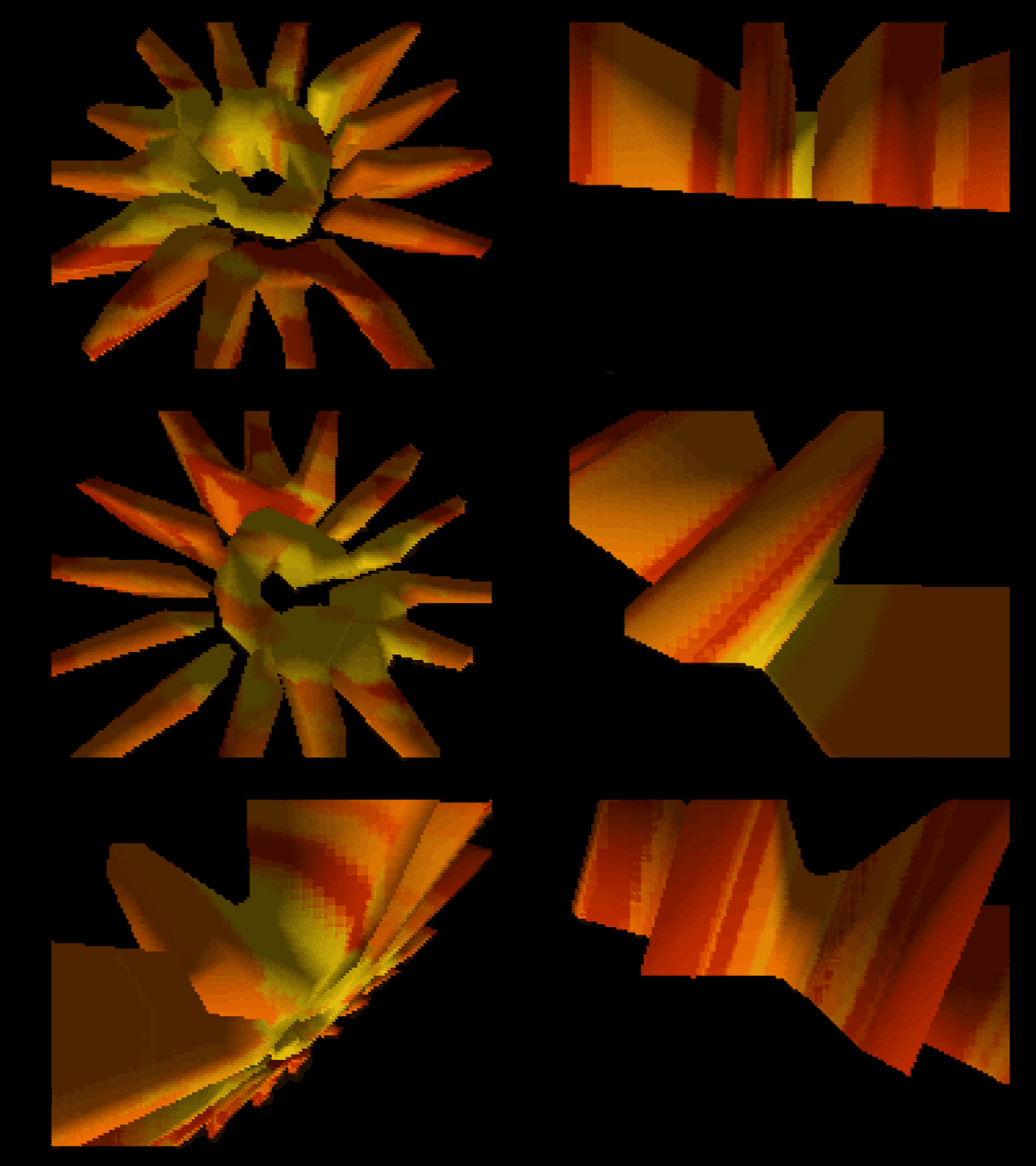
The next part builds an orange-yellow mass from a repeated branching form. Close views make it look like intersecting blades; wider views expose a roughly radial object. Because the same visual unit appears at several scales and angles, complexity comes from recursion and overlap rather than from a highly detailed authored mesh.
The camera repeatedly crosses the useful reading distance. Too close, the object is a field of clipped polygons. Farther away, the radial structure becomes legible. That oscillation is the scene: the demo does not merely spin one finished model for inspection.
A Toroid Becomes A Material Test

A gold toroid turns inside a thin polygonal rim. Its centre alternates between a deep cavity and a compressed layered disc as it rotates. The surface appears embossed because the reflection pattern changes faster than the silhouette.
This is the clearest demonstration of Silver Eagle's environment-mapping credit. Geometry, outer frame and gold palette remain stable while the apparent material changes continuously. The part is not a second version of the orange object: the earlier scene gets complexity from repeated form, while this one gets it from a surface response on a compact form.
Field Dots Turn Volume Into Weather

The blue field-dot part begins as an irregular cloud. Rotation exposes denser cores and thin outer layers, but no fixed opaque skin ever settles the object's boundary. Points continually pass in front of and behind one another, making depth visible without filled polygons.
This is where Logic most clearly changes its rendering vocabulary. The
subject remains a rotating 3D volume, yet its readability now depends on
density and parallax. Calling it another object would miss the important
change from surface to sampled space.
Shadecluster Uses Repetition As A Depth Cue

Shadecluster fills the view with related blue ring-like forms. Their
highlights and sizes vary as they cross the camera, producing a loose
cluster rather than one centred hero object.
This is not the field-dot scene with larger particles. Each unit has a shaded body and an internal opening. Occlusion between those bodies supplies the depth cue that point density supplied before. The sequence is busy, but its common material keeps it from becoming visual noise.
The Star Field Clears Space For Architecture
The following pale star-like bodies move through a black volume. Their long points frequently clip the frame and cross each other, making the camera feel embedded in the field rather than parked outside an object.
That passage acts as a hinge. The demo has moved from one centred form, to a cloud, to a cluster, to a navigable field. It can then introduce a city without the camera movement feeling like a new grammar.
The Texture City Is A Model You Fly Around

Flame's texture city uses simple blue window grids and mottled grey walls. It is visibly economical: the buildings are broad blocks, windows repeat and the black background supplies the night. What matters is the camera's route between slabs and the changing overlap of the skyline.
The scene does not attempt realism. Its textures are labels—blue means facade, yellow means window, grey means side wall—allowing a small palette to make the geometry readable. It is closer to an architectural visualisation than a picture of a city.
The Ray-Traced Terrain Is Deliberately Slow
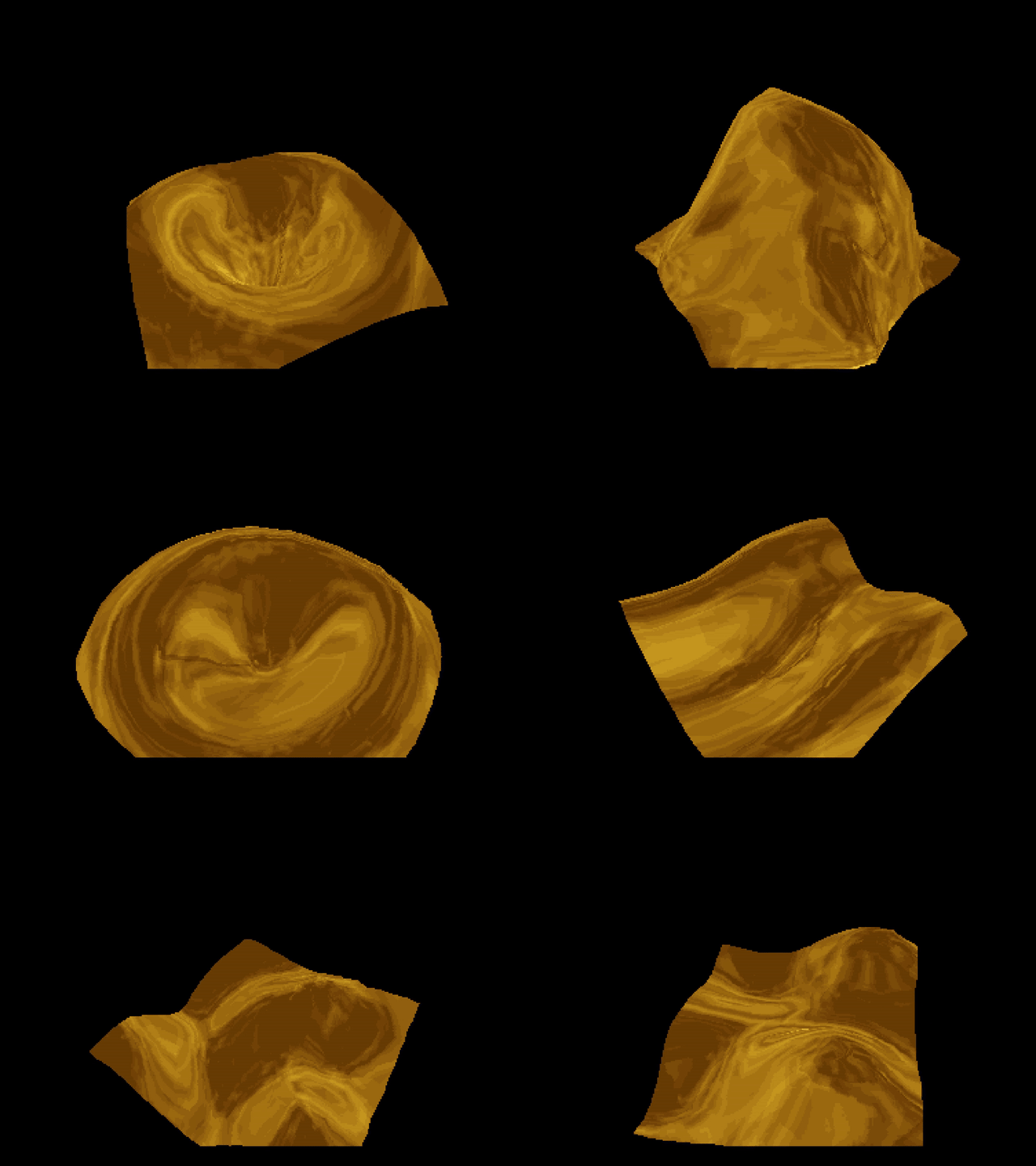
The last major object is a gold, height-field-like landscape. Broad folds and rounded peaks move under a wood-grain material while the camera circles at a measured pace. Unlike the earlier real-time scenes, its soft material and smooth highlights avoid the Amiga polygon look.
The executable and credit screen both assign ray tracing to Flame. The archive architecture supports that distinction: the demo stores this passage as its own executable rather than pretending that every visual was generated by one universal real-time engine.
Particles Write The Ending

Orange particles assemble Logic; blue particles then form 1995.
Stray points continue moving around the readable letterforms, so the words
look temporarily condensed out of the same kind of volume seen in the
field-dot part.
That makes the ending more than a logo effect. It resolves the demo's progression from surfaces to fields by turning a field into typography. The title is finally stable enough to read, but never becomes a flat bitmap.
The Final Screen Is The Authoritative Ledger

The final screen stays present until the left mouse button is pressed. It records:
Environment mapping (reflection, phong),
Shadecluster, Field dots,
Player and demo main                 Silver Eagle

Texture Tunnel, Texture City,
Raytracing                           Flame

Tunes "Low Voltage", "Chromosomes"
and "Kardaaniakseli"                 Paralogic System

Special thanks to Janne Kiiskilä
This ledger prevents a scene-counting mistake. The various poses of the orange object are not separate effects, and the gold toroid is not the same routine as the gold ray-traced terrain merely because their palettes match. The authors group the work by rendering method, not by every image the camera produces.
Two Party Volumes Form One Installed Directory
The two original archives have these SHA-256 hashes:
0044f899f48f6c433a45990c315c7af3ae831fbde1bc956a1b91a9ed61261129  logicc1.lha
006bccdaac6aa43790c4631e0442ee6cb48f2762ea33ed693746b8c4134b9d77  logicc2.lha
The readme says to unpack both into the same directory, rename
MUTANTTI.LIB to lowercase mutantti.library, and execute RUNLOGIC.
The script assigns that directory as LOGIC: and adds it to LIBS:. This
is a real installed program, not two floppy sides that independently boot.
The merged party release contains 28 files:
14 executables                 1,541,128 bytes
3 .SGT music bodies             763,912 bytes
3 .FAK companion files           20,516 bytes
acos.tdw, atan.tdw,
sc.tdw and vnorm.tdw            196,610 bytes
mutantti.lib                      4,096 bytes
spl.tab                          16,384 bytes
readme.txt and runlogic           2,972 bytes
The main program names its chain directly:
INTRO -> TUNNEL -> PYGMYSUN -> CAROLCO -> SHADECLU
      -> SHOWPIC -> TOROIDS -> NCUBE -> CITY -> GOLDMAT
      -> FIELDDOT -> ENDPART
It also names LOWVOLT.SGT, CHROMOS.SGT and KARDAANI.SGT in that
order. The separate LOGICLOW.EXE is the documented two-megabyte-chip-RAM
fallback; it omits sound rather than substituting a smaller soundtrack.
It Is A Chain Of Native LoadSeg Programs
All fourteen .EXE files validate as AmigaDOS LoadSeg programs. They are
not opaque packed blobs with invented part boundaries. Each exposes code,
data, BSS and relocation hunks to the operating system.
The layouts are varied because the parts need different resources:
ENDPART.EXEis only 5,740 bytes and contains four hunks.INTRO.EXEhas six hunks, including two 20,480-byte chip-data regions.FIELDDOT.EXEhas seven hunks and reserves 327,688 bytes of chip memory plus two large ordinary-memory regions.TUNNEL.EXEhas eight hunks, a 326,568-byte data body and a 565,420-byte BSS reservation.- The environment-mapped object programs share a larger twelve- or thirteen-segment framework with a 19,968-byte common code hunk and substantial reusable BSS regions.
This is the technical reason the visual sequence can change abruptly while
remaining one demo. LOGIC.EXE owns order, music and lifecycle; specialised
LoadSeg children own their effects. The operating system is the linker
between scenes.
mutantti.library Is A Private Runtime
The authors call mutantti.library a “groce modification” of
assassin.library, adapted specifically for this demo. The misspelling is
theirs; the architectural point is clear. RUNLOGIC adds the demo
directory to LIBS: because the 4,096-byte library is loaded as a normal
Amiga library even though it is private to this production.
That design explains both the clean part separation and the strict launch requirements. A shared service can coordinate parts, but every system-level assumption shared by that service also becomes a whole-demo compatibility boundary.
The Authors Patched The Party Release Themselves
The official patch archive has this SHA-256:
fd882bcc55aa18d95afc3cfb69bfec88971f5819a6b63c240ac4b7b453e30f64 logicpch.lha
Its instructions authenticate the target precisely: party files named
LOGICC1.LHA and LOGICC2.LHA, a 2,527-byte README.TXT, and a
48,292-byte LOGIC.EXE. All match the inspected originals.
Silver Eagle says the patch repairs copyback-cache and non-zero-VBR
operation; Flame adds that SetPatch should be run first to enable
copyback caches. A small player problem is fixed too. The changes are not
just a replacement launcher:
- six environment/object executables gain 80–132 bytes, normally in their first code hunk, with added relocation entries;
CITY.EXEandTUNNEL.EXEgain 40 bytes of first-hunk code and four bytes of BSS;INTRO.EXE's first code hunk grows by eight bytes and gains one relocation;- the main
LOGIC.EXEgrows from 48,292 to 51,688 bytes and from seven to eight segments; LOGICLOW.EXEgrows from 32,160 to 35,492 bytes and likewise gains an eighth segment;ENDPART.EXE,FIELDDOT.EXEandSHOWPIC.EXEremain byte-identical.
The untouched parts matter as much as the changed ones. This is a targeted repair of shared cache/VBR entry paths and the main/player layer, not a silent replacement of the visual algorithms.
The Strict Readme Explains The Compatibility Boundary
The party readme requires two megabytes of chip RAM, recommends fast RAM, and warns that the VBR must be zero—preferably after a clean boot without a startup sequence. It says missed requirements may crash or enter a flashing-colour loop, and that running out of memory is explicitly “revenged”.
The patched directory was therefore tested with two megabytes of chip RAM, eight megabytes of fast RAM, a 68030 and a replacement AROS ROM, with host audio disabled. It reached the authors' configuration report and printed the correct credits, memory and CPU information, but did not render the authored sequence. That blank result is a replacement-ROM compatibility limit, not visual evidence.
The complete 7:11 visual record used here reaches the persistent final credits and agrees with the executable order and embedded names. It was downloaded as a video-only stream. None of its H.264 data is part of this site; the published evidence is limited to the short GIF excerpts above.
Why Logic Feels Sparse
Pouet's later comments are mixed. Some praise the code, field dots and particle writing; others call the show boring, ugly or too long. Its second place establishes contemporary relevance, not universal approval.
The criticism is understandable. Most parts hold one subject against black
for a long time, the palette changes only occasionally, and transitions
often mean loading the next specialist executable. Logic does not hide
its object-show structure behind illustration or narrative.
Its strength is the precision of those changes. Tunnel orientation, recursive overlap, reflective material, point density, shaded occlusion, free-flight depth, textured architecture and ray-traced surface are different answers to the same question: how can a sparse object become legible in motion? The demo is austere and uneven, but its logic is real.