Analysis model: gpt-5.5 xhigh
Love by Virtual Dreams - Technical Dissection
Scope
Love is Virtual Dreams' Amiga AGA demo released on 25 June 1994. It won the
Amiga demo competition at South Sealand 1994. Pouet currently records 137
positive votes, six neutral votes and no negative votes, an unusually decisive
reputation for a production from the first generation of AGA demos.
This is also a Nordic production without any group-name inference. Demozoo locates Alien, Doctor Skull, Jaco/Sulevi and Matti Hänninen in Finland, and Jogeir Liljedahl in Ålesund, Norway.
Public references:
- Demozoo production: https://demozoo.org/productions/119665/
- Pouet production: https://www.pouet.net/prod.php?which=409
- A.D.A. production: https://ada.untergrund.net/?i=120&p=demo
- Original Scene.org party archive: https://files.scene.org/view/parties/1994/southsealand94/demo/vd-love.lha
- WHDLoad preservation install: https://whdload.de/demos/VirtualDreams_Love.html
- Demozoo-linked full reference video: https://www.youtube.com/watch?v=MyfxuIjdjfE
This is not an intro enlarged by reputation. The authored run lasts more than seven and a half minutes and moves through flat-shaded constructions, texture distortion, mapped objects, particles, organic image processing, ray-traced material and a long textual ending.
Complete Silent Viewing
The complete 455.86-second archival AVI preserved by Scene.org was examined without audio. It contains 352x288 MSMPEG-4 v3 video and an MP3 audio stream. For inspection, the video alone was converted to a 25 fps FFV1 working copy with no audio stream. Neither source video nor working copy is published here.
The original executable was tested separately on an A1200 configuration using
the open AROS replacement ROM. Its old overlaydos.library/Titanics loading
path does not produce a trustworthy run there. A standard Amiga hunk executable
rebuilt from the recovered internal segments reaches the engine but likewise
does not produce valid pictures under that replacement-ROM environment. A
marker written immediately before the transfer, but no marker after it,
confirms that this is not a missing startup command.
Those failed tests are not used as visual evidence. The GIFs below are continuous excerpts from the complete archival presentation. The page embeds no video, audio, MP4 or H.264 asset.

At about 28 seconds, the opening poem gives way to a large pixel-built LOVE,
then a loose
flat-shaded construction rotates through the same dusty pink field. The
geometry is deliberately chunky and the colour range narrow. It establishes
the visual grammar before the demo begins spending its memory on textures.

From roughly 63 seconds, the first sustained texture section treats a painted surface as elastic material. It folds inward, forms a horizontal throat and rolls into a tunnel. A narrow information strip remains fixed at the right edge, making the distortion easier to read than an unframed full-screen warp.

Around 91 seconds, the following part returns to sparse geometry. A few pale Gouraud-shaded pieces turn against an almost empty background while the lower-right label names the technique. The small object is not a concession: it leaves enough screen space for the shading changes and silhouette to remain legible.
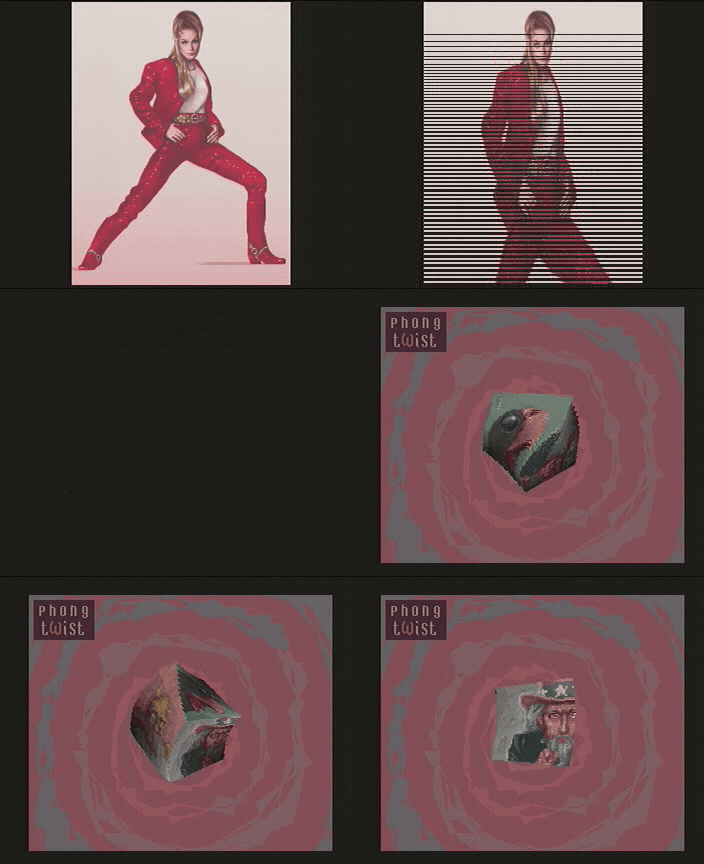
At roughly 127 seconds, phong twist combines a rotating mapped cube with
concentric colour waves.
The picture on the cube changes its apparent material as the faces turn, while
the background supplies motion on a different axis. This is a composed scene,
not a texture-map test placed on a blank screen.

Around 217 seconds, a cloud of bright points coheres into a figure and loosens again. The effect depends on temporal accumulation: a still frame can look like noise, but the continuous run makes the body emerge from the motion of the particles.

From roughly 252 seconds, a soft pink organic field follows. Repeated branching forms expand, curl and collapse into one another, halfway between a tunnel and magnified tissue. It is a strong change of texture after the hard particles and polygon edges.

From about 296 seconds, the final major image-processing passage uses
blue-green recursive landscapes.
Dark borders and changing windows interrupt the image instead of presenting a
single endless zoom. The sequence then yields to a seated figure, the extended
messages, credits and the final the end screen.
Additional Sequence Coverage
A later audit used the Demozoo-linked 579.56-second preservation upload to
fill five gaps in the original seven-GIF set. Only its 640x360 H.264 video
stream was retrieved; no audio format was selected, downloaded or decoded.
That private inspection file has SHA-256
9c565bab0339b6699df6106a289518ba6153c045c4f1dd6be91e56854568c333.
It is not published. Different capture pacing explains why its clock is longer
than the 455.86-second archival AVI, so timestamps are not mixed between them.
The additions below are continuous four-second, 8 fps GIFs.

The opening title is more than a static group logo. Its metallic lettering arrives over a moonlit landscape before the poem and pink construction sequence establish the production's recurring palette.

This passage bridges the mapped cube and the later painted-symbol sequence.
The small ray-traced love picture moves across a larger faded composition;
the nested picture planes are visible as separate motion layers.


The seated figure is the authored transition into the long ending, not a
detached slideshow image. The following scroll exposes the production ledger
over a rotating wire room, and the final logo continues moving after the end.
Old addresses and contact solicitations later in the scroll are deliberately
outside the published excerpts.
Credits and the Demo's Own Record
Demozoo's production record gives five credited makers:
- Doctor Skull: code.
- Alien: graphics.
- Jaco, also known as Sulevi: graphics.
- Matti Hänninen, also known as KerBeros: graphics.
- Jogeir Liljedahl: music.
The recovered end text is more specific: graphics packer and coding is
Doctor Skull, graphics is Jaco, music is Jogeir, design is Virtual Dreams,
2nd animation rendering is Matti Hänninen, and vector objects are Alien.
That is the complete maker ledger visible in the authored scroll. The
production page also identifies Jaco's picture 11 in the demo.
The internal scroll names the working tools as well as the people. Readable entries include Asm-One, Brilliance, Protracker, Skullpacker, Real 3D 2, 3D Studio, GuruPlayer 5.0 and Titanics. These are authorship notes recovered from the actual program data, not a modern guess based on the appearance of the effects.
Because this inspection was intentionally silent, no musical evaluation or
sync claim is inferred from the waveform. Demozoo identifies the soundtrack
as Jogeir's Physical Presence; that title is catalogue evidence.
The Original Party Archive
The Scene.org LHA is 1,640,390 bytes:
134f4347919e63295edec95dee135ca202ed60c1305e18b8bf7184d7be93f676  vd-love.lha
a2dbc373bce67cb4fb6d23ccde07e8779e03c1a79acda627e56b765d17b6c75e  love.exe
d06e24d41ff5e62a695cc983e42a33af0fe8c4c2f3b3229563dc751510c4c3b7  FLT-Lve2.Skl
The archive contains an Amiga startup sequence, the 810,256-byte love.exe,
the 828,135-byte FLT-Lve2.Skl data file, a system configuration and a short
release text. The text says that the demo requires AGA and gives Virtual
Dreams' contemporary Raisio address. The hard-drive note instructs the user to
make a LOVE assignment, which matches the literal
Love:FLT-Lve2.Skl pathname recovered from the engine.
FLT-Lve2.Skl begins with an S404 StoneCracker 4.04 header. Its first member
declares 124,316 unpacked bytes from a 102,392-byte packed block; substantial
data follows that member, so treating the entire 828,135-byte file as one
ordinary StoneCracker stream would silently discard most of the resource.
A 704-Byte Outer Executable
The Amiga hunk header describes only one conventional code hunk:
file offset $00001c  HUNK_CODE
declared code size    704 bytes
file offset $0002e4  HUNK_END
file offset $0002e8  HUNK_OVERLAY, zero-length marker
file offset $0002f0  HUNK_BREAK
file offset $0002f4  private overlay stream
That layout explains why a superficial executable parser badly understates the demo. The legal outer program is a 704-byte loader. Almost the entire file after it belongs to a private overlay format.
The loader opens dos.library, prints
TITANICS-Cruncher decrunches while loading ..., seeks to file offset $2f4
and allocates a 5,120-byte input buffer. It refills that buffer through DOS
Read() whenever its cursor reaches the end. This is a streaming unpacker,
not a wrapper that first copies the remaining 809 KB into another temporary
area.
Three Recovered Segments
The first longword of the private stream is 2, used as a last-segment index.
Three allocation descriptors follow:
| Segment | Descriptor | Unpacked bytes | Packed bytes | Memory | Relocations |
|---|---|---|---|---|---|
| 0 | $000099d0 |
39,376 | 25,060 | cleared general | 386 |
| 1 | $020bebb4 |
781,236 | 244,076 | cleared chip | 0 |
| 2 | $000c1a30 |
793,136 | 538,632 | cleared general | 27 |
The loader masks each descriptor to 24 bits for the payload size, adds eight
bytes for its private segment header and rotates the descriptor's high byte
into the Amiga AllocMem() flags. The value 2 on segment 1 is
MEMF_CHIP; all allocations also receive MEMF_CLEAR.
Together the recovered payloads contain 1,613,748 bytes. Their three packed
bitstreams occupy 807,768 bytes. Parsing the final relocation group lands
exactly at file offset $c5d10, the original file's final byte. There is no
unexplained tail.
The segment roles are structurally clear:
- segment 0 is the 68k engine and control data;
- segment 1 is the large chip-memory bank used where the custom chips require addressable graphics/audio data;
- segment 2 is a similarly large general-memory data bank.
The Private Bitstream Decoder
The decompressor reads a most-significant-bit-first control stream in 32-bit words. A sentinel bit is inserted when a new word is loaded, allowing the 68000 routine to detect exhaustion without keeping a separate bit count.
Its commands combine four useful cases:
- literal runs of one to eight bytes;
- a two-byte back-reference with an eight-bit distance;
- three- to five-byte matches with nine- or ten-bit distances;
- longer matches with twelve-bit distances, plus long literal runs.
The output boundary comes from the allocation descriptor, not an end marker in the compressed stream. After the requested bytes have been produced, the loader reads relocation records immediately from the same buffered file cursor.
This arrangement explains the compression balance. The 39 KB code segment shrinks moderately because instructions and tables repeat at short distances. The 781 KB chip bank shrinks to less than one third of its unpacked size, consistent with large planar and image structures. The third bank is less compressible but still saves more than 250 KB.
A Private Relocation Graph
Each relocation group stores a count, a target-segment index and byte offsets inside the current segment. The loader finds the target segment's allocated base, adds four to skip its private size header, and adds that address to every listed longword.
The recovered graph is:
segment 0 -> segment 0:  33 relocations
segment 0 -> segment 1:  47 relocations
segment 0 -> segment 2: 306 relocations
segment 1 -> anywhere:    0 relocations
segment 2 -> segment 1:   2 relocations
segment 2 -> segment 2:  25 relocations
total:                   413 relocations
The asymmetry is informative. The engine holds most cross-bank pointers, especially into segment 2. The chip bank is mostly pointer-free payload. Segment 2 has a small amount of self-linked structure and only two direct references into chip memory.
For verification, the recovered segments and those relocation groups were re-encoded as a normal three-hunk Amiga executable. Its hunk table preserves the chip-memory requirement and its relocation records preserve the graph. The resulting file is 1,615,524 bytes and has SHA-256:
0ec49e28acd62eb1d8d7fbdedd6c4bd4f334b12e4eaac5abcb5f1fdb13cd7948
This reconstruction is a structural test artifact, not a replacement release. It proves that the outer overlay can be losslessly expressed as ordinary Amiga code/data hunks without flattening pointers or guessing segment bases.
Why It Still Works
Love is technically substantial, but its lasting quality is not the number
of effects. It has a consistent editorial voice. Muted pink and brown fields,
small labels, fixed side strips and deliberately placed pictures bind together
techniques that otherwise have little in common.
The demo also understands contrast. Sparse polygons precede dense texture warps. Hard particles precede soft organic imagery. The recursive blue-green landscape arrives late enough to feel like a new colour world. Then the visual engine gives the ending room instead of treating credits as dead time.
At file level, a 704-byte outer hunk turns 807,768 packed bytes into three
memory-aware segments, applies 413 private relocations and transfers control
to a 1.6 MB show. At screen level, those separate banks do not feel like a
technical inventory. They feel like one production. That is why Love earned
its name and why its reputation is not merely nostalgia.