Analysis model: gpt-5.5 xhigh
Mind Riot by Andromeda - Technical Dissection
A Norwegian Design Classic From 1993
Mind Riot is Andromeda's one-file Amiga OCS/ECS demo, released on
13 January 1993. It is not an obscure release promoted into importance after
the fact. Pouet preserves 77 positive votes, seven neutral votes and no
negative votes, and its comments repeatedly identify the demo's unusually
clean design, transitions and high-resolution effects.
The complete ending gives the production ledger:
- Dr. Jekyll: main code and text.
- Mr. Hyde: additional code and the mirror part.
- Mr. Man: music.
- Duel: logos and fonts.
- Fairfax: decrunching picture.
- The Main: raytracing.
All six contributors are documented Norwegian sceners. The ending adds no
outside guest production credit. Its later member list and greetings are
clearly labelled as such rather than silently folded into authorship.
Mind Riot is a full demo, not an intro, cracktro, invitation, slideshow,
musicdisk or game.
Public references:
- Demozoo production record, original downloads and credits: https://demozoo.org/productions/9334/
- Pouet production record and surviving reception: https://www.pouet.net/prod.php?which=4392
- Original ADF and standalone executable.
The original ADF and executable were authenticated and inspected locally. A complete hardware-capture preservation stream was used to inspect visual timing and the full ending. Only its video-only stream was obtained. No audio was downloaded or played, and no embedded video is published here.
The Opening Makes Typography An Effect

Concentric circles contract and expand while isolated letters pass through their centre. The target is not merely a backdrop for a title: its changing diameter masks and reveals each letter, so the words are assembled over time. The title then becomes a pastel relief before diagonal bands wipe it away.
The demo's final notes say that all nine opening circles are redrawn fifty times per second in high-resolution interlace. That claim is valuable because the preservation stream cannot itself prove the original refresh rate. The result is visually restrained despite the workload. Andromeda uses the circles to establish a measured cadence, not to fill the screen with as many objects as possible.
Transparency Is Used For Legibility

A faceted solid turns inside a thin rectangular frame. Its faces overlap into new colours, but the edges remain readable because the palette is organised around intersections rather than painted as opaque surfaces.
The accompanying scroller calls it a five-bitplane, light-sourced transparent vector running in real time on a high-resolution screen. More importantly, it states the demo's design position: records mean little when quality is neglected. The object is therefore not presented as a benchmark counter. Its controlled palette, quiet border and narrow text band make a technical effect behave like a page layout.
Six Circles Become A Continuous Knot
Six outlines orbit and overlap inside the same purple field. At some moments they form a flower; at others they collapse into a thick ring. Nothing needs to be filled. Depth comes from ordering, brightness and the viewer's tendency to join successive positions into one flexible object.
The in-demo note distinguishes these six circles from the nine-circle opening. It also says that only the circle calculation in this part received special optimisation. This is one routine changing configuration, not a sequence of separately counted ring effects.
A Wireframe Records Its Own History

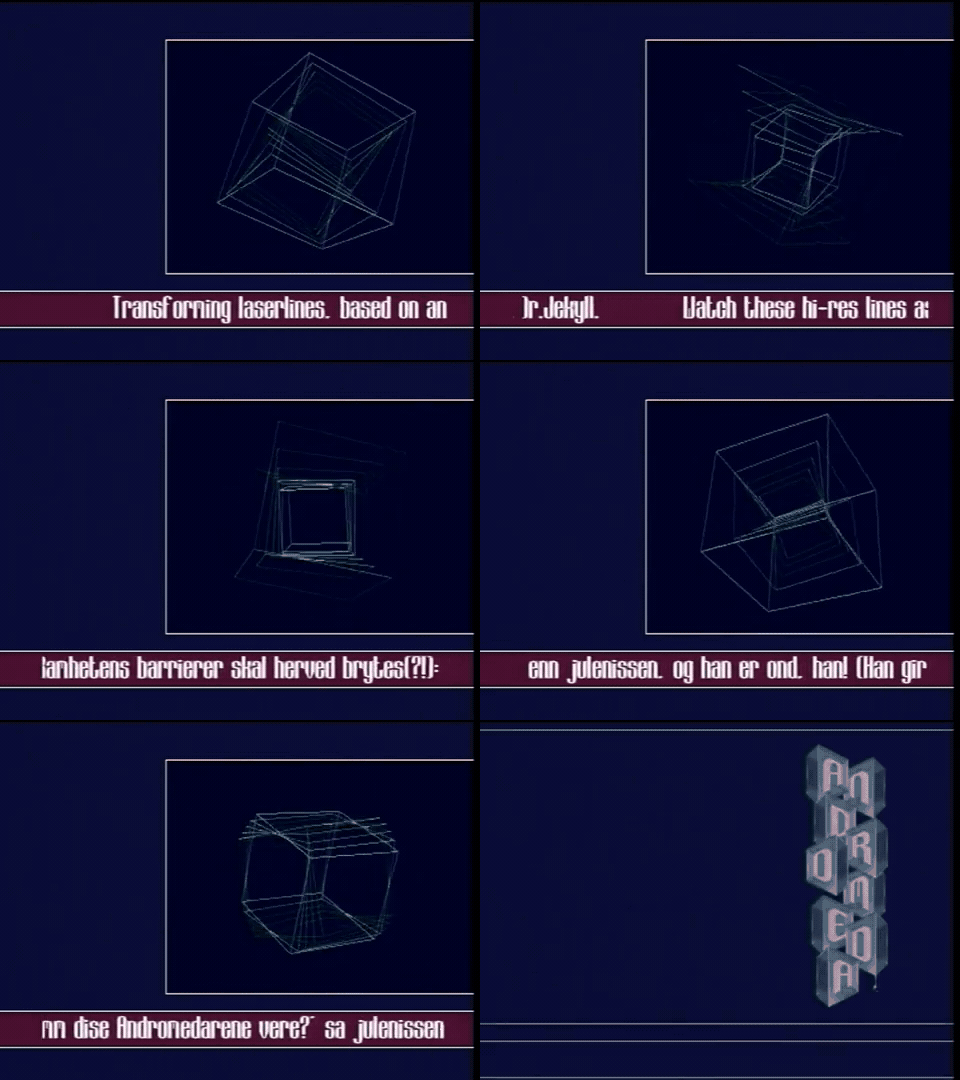
A sparse box repeatedly bends into new structures. Earlier outlines remain visible as dimmer traces, so rotation becomes a drawing of recent motion. A single current frame would look almost trivial; the accumulated frames turn it into a volume.
The lower text calls it a transforming line routine developed from an idea by Mr. Hyde. The important design choice is persistence. Instead of hiding the low edge count, Andromeda makes the gaps between successive poses carry the shape.
The Twister Is Also A Development Diary

A broad striped column bends beside a vertical Andromeda logo. Its silhouette changes continuously while the interior bands reveal local curvature. The text below is not generic greetings: Dr. Jekyll explains that the part began during the previous November and December, was interrupted by school, and was reborn after an earlier intro version.
That diary changes the part's function. The long display is not several similar scenes accidentally repeated; it is one continuously parameterised surface carrying the account of its own unfinished and restarted development.
Twelve HAM Frames Are Deliberately Precomputed

The Main's ring rotates in a framed window. It has shaded ribs, coloured inner surfaces and cast-looking depth that is unlike the calculated line and circle parts around it.
The demo identifies this plainly as twelve frames of raytracing in HAM. It also says the raytracing was added late and that The Main had only a couple of weeks to finish it. There is no attempt to pass a precomputed image sequence off as a real-time ray tracer. Runtime code presents and times the frames; their expensive image construction happened beforehand.
Mirror Turns A Plane Into A Hinge

Mr. Hyde's part begins with a flat blade rising from a shallow base. The blade tips and folds through the screen before the design changes to a cube whose faces carry pale rose patterns. The cube opens, closes and exposes different combinations of those panels.
The scroller explains that the tunnel-like construction had also been used in
Hyde's Mirror and that this was a new version made for Mind Riot. That
specific acknowledgement is better evidence than assigning every pose a new
effect name. The phase is a study of one hinged, panelled object moving
between plane, box and tunnel.
The Ending Is The Primary Production Record

The ending first documents requirements and tools, then supplies complete credits, the contemporary Andromeda member list, contact information and greetings. It says:
- the demo is AmigaDOS compatible;
- it needs at least one megabyte because of its graphics;
- all its data is compressed with StoneCracker;
- its music uses a modified NoisePacker replay routine.
Those statements agree with the disk and executable. They are also properly bounded: compatibility is the authors' claim about contemporary Amiga configurations, while the binary inspection below establishes the loader and data structure.
Private postal details are not reproduced. They add nothing to the technical or authorship record.
The Disk Really Does Launch One File
The preserved disk is a normal bootable DOS0 OFS volume named Mindriot.
Its startup sequence runs a 572-byte information program and then
Mindriot.exe. Apart from the system configuration and startup files, the
484,504-byte demo executable is the only production payload.
The separately archived executable is byte-for-byte identical to the file extracted from the ADF:
f8c0097337acddc1dfdb5aa0f6b030f852df501e140a326bb8ca487117b9469d  Andromeda-MindRiot.adf
eede69425a58f800b4479abdfa335195e9286edfeee406ab651a891f0d0b6060  Mindriot.exe
The small information program prints the one-megabyte requirement, the January 1993 date and the line “Andromeda - 1992 has only been an introduction!” before the main file takes over.
Three Hunks Form A Relocatable Shell
Mindriot.exe is a valid Amiga LoadSeg file with three code hunks:
| Hunk | Allocated and stored bytes | Memory class | Role |
|---|---|---|---|
| 0 | 8 | any | relocated jump to the takeover stub |
| 1 | 214,548 | chip | controller, two packed parts and takeover code |
| 2 | 269,800 | any | four packed parts |
The file contains ten 32-bit relocations. The first hunk is only an absolute jump whose target is fixed up to the end of hunk 1. That target begins cautiously: it checks the loaded memory placement and queries Exec before taking control of the chipset.
After selecting a suitable layout, it disables interrupts and DMA, copies
hunk 1 to absolute address $400, clears system state and jumps to $4ae.
The copied controller uses fixed stacks near $7fa00 and $7fc00, installs
its own vectors, and sequences the decompressed parts at fixed addresses.
This is why “AmigaDOS compatible” and “takes over the machine” are not contradictory. AmigaDOS loads and relocates a conventional file. The tiny outer shell then establishes the predictable low-memory environment the display code expects.
Six StoneCracker Members Are Exact Boundaries
Six S300 members occupy almost the entire two large hunks. Ancient 2.3.0
independently identifies every one as StoneCracker 3.00 and expands each to
its declared size:
| Member | File offset | Stored bytes | Expanded bytes | Expanded SHA-256 |
|---|---|---|---|---|
| 1 | $000440 |
169,820 | 333,824 | 94c83a42d8cd7dd59fc5b0d54cfba2d0d7643c6a5b67e87a8b1f60afa473005c |
| 2 | $029b9c |
43,328 | 98,304 | 7f7db614185f455ba916257f9793e1f0c38ca8d4b740825ba720109d37f3a85c |
| 3 | $0346ac |
190,580 | 231,424 | 4c406ba72c2c1a7c575230828f77356b77c971c58869cf39590a3f6c997035f9 |
| 4 | $062f20 |
41,448 | 113,260 | 0435823f0abf39babc606c515c9e01d9c85ffd04bb1649e4ee80c8dabb225f7c |
| 5 | $06d108 |
29,296 | 66,466 | 9abdc2af2ea703db232c92aa4dc4ef04c59d479c5d9cff520edb32ed77e2ad5a |
| 6 | $074378 |
8,476 | 28,416 | 2bbfa67ff238dc3c000114adba8e2d5e4be14ea2a2676ba0caaaf3d051d4e3b3 |
The first member ends exactly where the second begins. The third through
sixth members are likewise consecutive in hunk 2, and the sixth ends four
bytes before the file's final hunk terminator. These are structural members,
not accidental S300 strings found inside pictures.
Together they expand to 871,694 bytes, more than the demo could retain alongside the operating system in one megabyte. The controller solves that by using them as overlays. It expands parts into fixed, sometimes reused memory regions, calls them in sequence and waits for display completion before replacing their storage. “One file” therefore describes distribution, not one monolithic in-memory program.
The expanded members confirm the visual ledger. Member 3 contains the twelve-frame HAM raytracing text, member 4 the six-circle explanation, member 5 the mirror development note, and member 6 the final technical and credit scroll. Each begins with executable display code followed by the data needed for its phase.
A Fixed-Address Score Joins The Parts
The relocated controller is less than a kilobyte, but it exposes the overall
score. It invokes the StoneCracker decoder with explicit source and
destination registers, then transfers control through fixed entries including
$26700, $20900, $32e00, $30200, $43000, $34000 and $3b800.
Raster waits bracket the hand-offs, and $20900 and $30200 are deliberately
reused during later phases.
This structure matches the viewing experience. Mind Riot is not a loose
menu of independently launched files. A small resident conductor expands an
overlay, lets it own the display, synchronises the transition and prepares
the next overlay. The narrow scroller and framed purple field can remain
visually consistent even though the effect code and data underneath them are
being replaced.
Compatibility Evidence Has A Boundary
The untouched disk was also booted locally under an A500 profile with one megabyte of chip memory and host audio disabled. The available AROS replacement ROM reached the original information screen. A diagnostic copy that skipped that screen reached the shell but did not produce the authored display, so neither run was used as visual evidence.
That result is recorded rather than hidden. It tests a modern replacement-ROM configuration, not the Commodore ROM environment for which the authors made their compatibility claim. The original executable, complete preservation record and decoded data agree on the production structure without pretending that the local replacement-ROM attempt was successful.
The preservation stream used for the visual inspection contained video only. None of its H.264 data is retained on the site; the published motion evidence consists solely of the GIF excerpts above.
Why Mind Riot Still Works
Mind Riot is technically broad, but it does not look like a pile of
benchmarks. Circles become typography, transparent faces become palette
design, sparse lines become a history of motion, and a long twister becomes a
development diary. Even the precomputed raytracing identifies itself honestly
as twelve HAM frames.
The executable follows the same discipline. A conventional three-hunk shell enters through AmigaDOS, moves to a controlled low-memory environment and conducts six compressed overlays through reused addresses. Distribution, memory management and visual direction all serve the same goal: many different calculations presented as one calm, recognisable Andromeda design.