Analysis model: gpt-5.5 xhigh
Neural Assault by Rage - Technical Dissection
The Better Rage Demo To Start With
Neural Assault is Rage's one-disk Amiga OCS/ECS demo, released on 7 August
1993 and winner of the European Computer Conference 1993 Amiga demo
competition. It predates Maximum Overdrive II by a year and is the tighter
production: one disk, a semi-narrative middle, compact technical routines and
an unusually strong contemporary and later reception.
Verified Production Credits
The complete production ledger names Digimatic for code, Abaddon specifically for the shade-morph code, Foxx for graphics, and Fajser for music. Each linked individual record places its credited person in Sweden. This Abaddon is Rage's Swedish member, not either unrelated scener using the same handle.
Pouet records 30 positive, two neutral and no negative votes. Comments repeatedly remember the cinema framing, twister, Star Wars passage and Fajser's two modules rather than only its competition result. This is a full demo, not an intro, cracktro, invitation, slideshow or musicdisk.
Public references:
- Demozoo production, date, result and credits: https://demozoo.org/productions/26937/
- Demozoo Rage history and country records: https://demozoo.org/groups/2929/
- Pouet production and reception: https://www.pouet.net/prod.php?which=3603
- Preserved party release: https://files.scene.org/get/parties/1993/ecc93/amiga/demo/rage-na.zip
- WHDLoad preservation adapter and source: https://whdload.de/demos/Rage_NeuralAssault.html
- Public complete visual reference: https://www.youtube.com/watch?v=IyKc3Yvyy0w
The original DMS, its expanded disk, boot code, preserved adapter source and video-only public reference were examined separately. Host audio was disabled for emulation, and no audio stream was downloaded or played.
Direct Silent Run And Its Boundary
The original disk boots directly in FS-UAE 3.2.35 as an A500 with a 68000,
1 MiB chip memory and the AROS replacement ROM. The direct run reaches the
chipset self-report, illustrated Rage card, Spader Hunger title, cinema
audience, morphing Neural Assault title and opening credits without a patch
or modified release file.

The direct-runtime still preserves the audience silhouettes, central aisle and small projected figure as one readable composition.

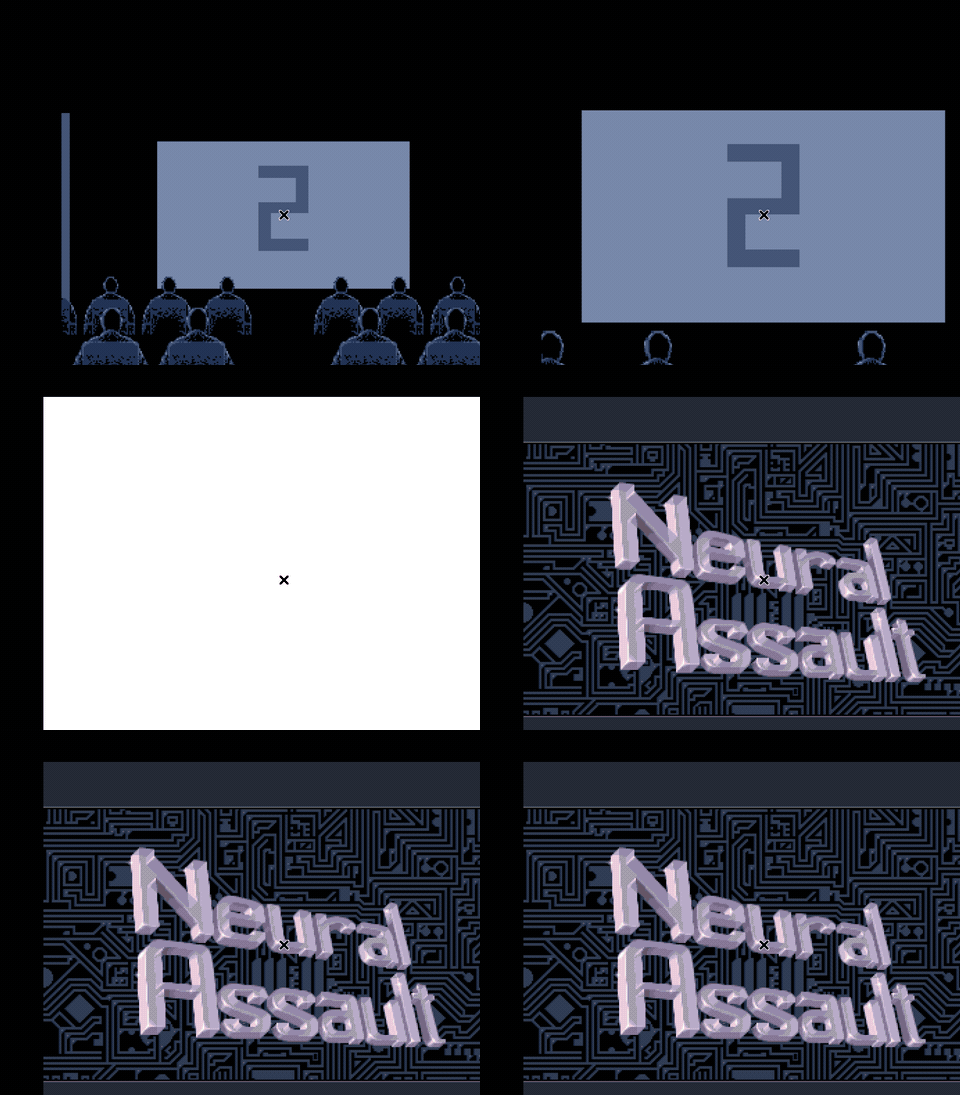
Those two GIFs are continuous six-second excerpts from that direct run. The host capture job ended at 79 seconds while the demo was still progressing; this was a capture-duration boundary, not a demo crash. A separate complete 472.26-second public capture was therefore acquired as a 1280x720, 50 fps video-only stream to inspect the later parts.
The five later GIFs below are continuous excerpts from that public reference, not relabelled emulator frames. Its H.264 carrier was transient research evidence only; the site publishes GIFs and no video file.
The Interface Is Part Of The Fiction
The opening alternates among three frames: an illustrated Rage card, an audience watching a screen, and a circuit-board panel enclosing the title and credits. These are not arbitrary separators. They establish an imagined machine and spectators before the effect sequence starts.
That framing lets the production jump between visual registers without pretending they occupy one continuous 3D world. An eye close-up, rotating mask, moving circuit-board objects, full-screen art and terse words all appear as things selected or displayed by the same apparatus.

The twister makes that relationship explicit. A striped vertical ribbon bends inside the dark interface rather than replacing it. The moving column is narrow, but its successive horizontal offsets produce a strongly dimensional silhouette while leaving room for the control-panel decoration.
Fractal Interruption, Then A Small Story

The red fractal section abandons the panel's small windows and grows a black branching boundary across a bright field. It is visually simple but well placed: after several framed effects, the expanding irregular edge feels like the display system itself has been invaded.

The still isolates the rotating station and BP emblem before the following cut changes the joke's subject.

The following narrative is why contemporary comments call the demo a semi-story. A Rage identity card, a rotating BP petrol-station emblem and a short Darth Vader episode are connected with cinematic cuts. It is playful rather than technically seamless, but it gives the pictures temporal meaning: they are no longer only logos and portraits displayed between routines.
The sequence also explains why screenshots undersell this demo. Its joke is in the order and replacement of images. One still can show Vader or the station, but not the edit that turns them into a miniature scene.
Flat Space Before The Shade Morph

The late geometric passage uses large flat regions, horizon bands and a small moving camera. Buildings and road-like strips are reduced to rectangles and wedges. It is closer to a graphic storyboard than a texture-mapped world, but the changing viewpoint is real animation, not a slideshow between prepared views.

The still catches the blue surface as both an open ring and a folded shaded volume, a useful midpoint in Abaddon's continuous morph.

Abaddon's credited shade morph follows. A compact blue form continuously changes outline and internal lighting against black. The sparse frame makes the interpolation readable: there is no texture or background detail to hide where one volume narrows, folds or becomes another.
The distinction in the credits matters. Demozoo assigns the main code to Digimatic and specifically names Abaddon for this routine. The article therefore does not blur every effect into one generic group credit.
The Disk Is A Track Stream, Not A Filesystem Demo
The preserved archive and disk hashes are:
01a66c44b2d9916a546fab921a5c0b34d01f4db64ce134e98888e0aa2683c7f0  rage-na.zip
986f2b02a3ebb00d5a8bd401f2c31edd81fa68b3133fc5e332796c5eaa25b1d0  Rage-NeuralAssault.dms
aa8c1f935cd062d0f50bc8989804809aec25b7bed58f84d83ce816cd1bf50896  Rage-NeuralAssault.adf
The DMS expands to a standard 901,120-byte disk image with all 80 tracks. Its
header reports DMS 1.11 Evaluation and HEAVY2 compression. Filesystem tools
cannot traverse a useful root directory because the demo addresses the disk
as numbered 11,264-byte tracks.
The density map supports that layout. Tracks 0 through 8 compress heavily, tracks 9 through 66 are mostly dense data, and tracks 67 through 79 are almost empty. The authored material occupies a continuous front portion rather than named AmigaDOS files scattered through a normal volume.
The Boot Block Relocates, Loads And Rebuilds
The first 1024 bytes are active boot code. They copy themselves from the boot
block to $7d000 and continue there. The relocated code performs two raw
device reads:
track 1:
    source offset  $2c00
    destination    $3a000
    length         $2c00

tracks 2..16:
    source offset  $5800
    destination    $50000
    length         $29400
$2c00 is 11,264 bytes, the exact raw logical size used for one Amiga disk
track. $29400 is fifteen such tracks, or 168,960 bytes.
After the reads, the boot code calls the track-one program at $3a000, saves
its returned adjustment value, disables interrupts and DMA, establishes
private supervisor and user stacks, and enters supervisor mode through a
trap. It then copies exactly the fifteen-track block from $50000 down to
$500 and jumps there.
This is a two-stage loader with an exact disk-to-memory plan. The track-one code gets a protected workspace of its own; the initial production body is read high, moved low after the machine takeover, then executed at a fixed address.
What The WHDLoad Adapter Proves
The 2006 preservation source is only 2,287 bytes, but it exposes the demo's
later loader contract. Its replacement routine receives a starting track in
d0, a track count in d1, multiplies both by $2c00, and calls
resload_DiskLoad on disk one.
At startup the adapter requests tracks 2 through 16 directly into $500 and
jumps there with a declared $80000 memory size. It patches three loader call
sites:
$00000ef4  later disk access -> replacement Loader
$000009c4  transition hook   -> Patch1
$000cfdaa  later disk access -> restart/Boot path
It also suppresses one original operation at $dc2 with an RTS. Version
1.1 reduced the requirement to 1,016 KiB of chip memory and removed one
reported snoop bug, while explicitly warning that later ones may remain.
These are preservation facts, not source-code authorship claims. They show
that the production keeps reusing a small (track, count) loading interface
and fixed addresses across later parts. They do not by themselves identify
the renderer behind every screen.
Nineteen PowerPacker Members And Two Complete Modules
The disk contains nineteen PP20 signatures, each immediately followed by
the standard 09 0a 0c 0d PowerPacker efficiency table. They begin across
tracks 17 through 55. This is stronger than finding the letters PP20
accidentally in image data: all nineteen have the correct decoder parameters
and appear in the dense authored region.
Two complete ProTracker modules are independently recoverable:
| Offset | Title | Song positions | Patterns | Samples | Computed size |
|---|---|---|---|---|---|
$0852c |
katakomb |
83 | 63 | 28 | 150,100 bytes |
$b0ea8 |
logedans |
6 | 5 | 11 | 28,844 bytes |
Their titles and internal credits identify Fajser/Rage, matching Demozoo's
soundtrack record. The contrast is substantial: katakomb is the large,
pattern-dense main score; logedans is a compact second module used for the
later mood.
Why It Holds Together
Neural Assault is not held together by one renderer. Its cohesion comes
from presentation: audience, cards, panel, abrupt words and story cuts make
independent routines feel like transmissions from the same machine.
The binary organisation supports that reading. A relocated boot block, a one-track loader, a fifteen-track initial body, repeated track-count calls, nineteen PowerPacker members and two very different modules form a sequence of replaceable parts. The demo's semi-story is not concealing a monolith; it is editorial glue for a compact disk-resident effect collection.