Analysis model: gpt-5.5 xhigh, sol high Last edited: 2026-08-25
No Lamers Allowed by Paranoids - Technical Dissection
Subject: No Lamers Allowed by Paranoids.
No Lamers Allowed is a 1991 MS-DOS VGA demo by Paranoids. The Hornet 1991
index lists it as nolamers.zip 148259 *** No Lamers Allowed by Paranoids.
Release year: 1991.
The demo is a 286-era mode-13h production with a packed MZ executable, a
separate encrypted GRAPHICS.DAT payload, Sound Blaster setup, interrupt-vector
tricks, a warning-screen reveal, decoded title artwork, a background point
plotter, and a one-pixel sine scroller that draws 24-pixel-tall character
columns over two background pictures.

The lead image is an untouched 640x400 frame at graphics-stream 00:40 from
the 2026-08-25 normal-exit run. Its text pixels are the 320-column loop at raw
release offset 06F2h; the white moving points are the separate 360-record
loop at 00D0h. The picture therefore matches the two inner loops discussed
below rather than merely resembling the effect.
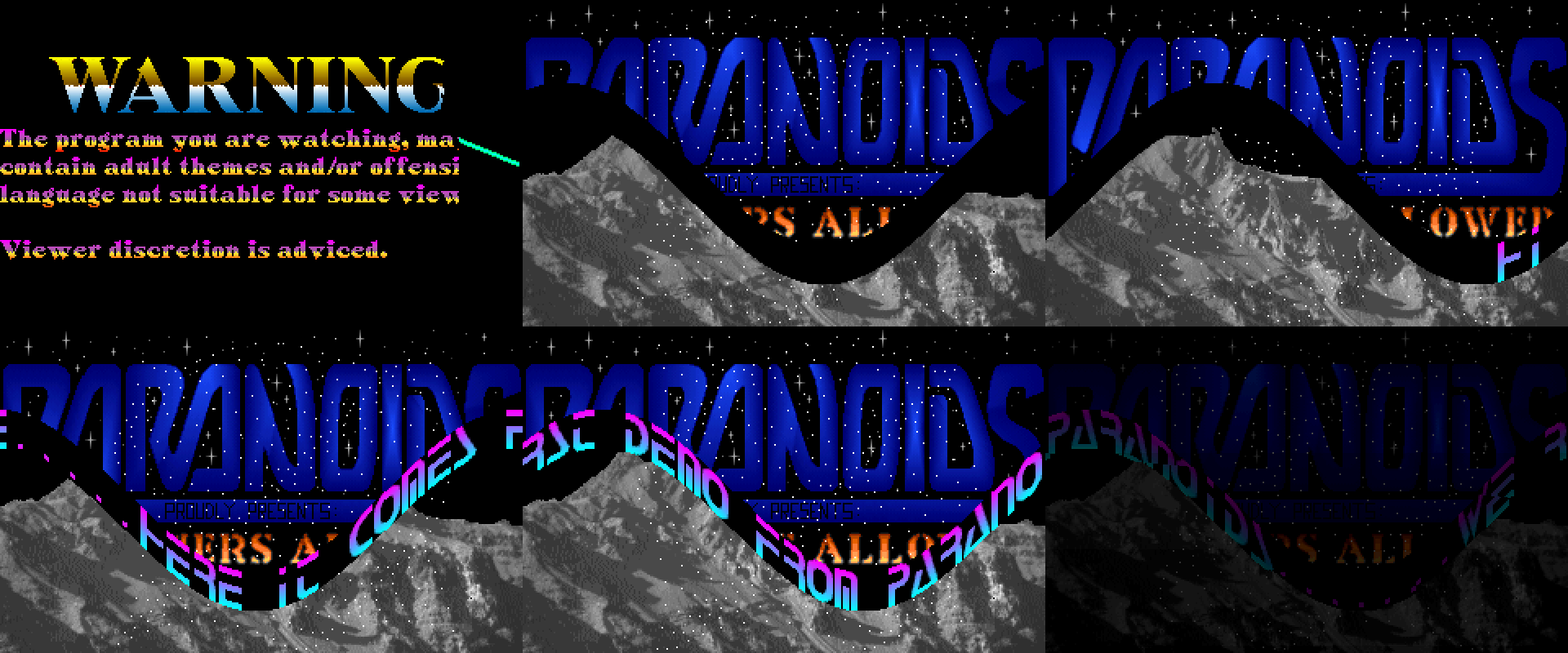
The six complete native frames are, left to right and top to bottom,
graphics-stream 00:10, 00:33, 00:36, 00:40, 00:50, and 00:52.
They show the cyan diagonal reveal, title/background and points, initial text
columns, mature sine band, later text/point state, and the final darkened fade
frame. None was cropped, padded, or resized.



The two decoded stills are reconstructed from the UNP-restored executable. The
warning screen is
the page at 184B:0000 with palette 184B:FA00. The Paranoids title page is
the page at 281B:0000 with palette 281B:FA00.
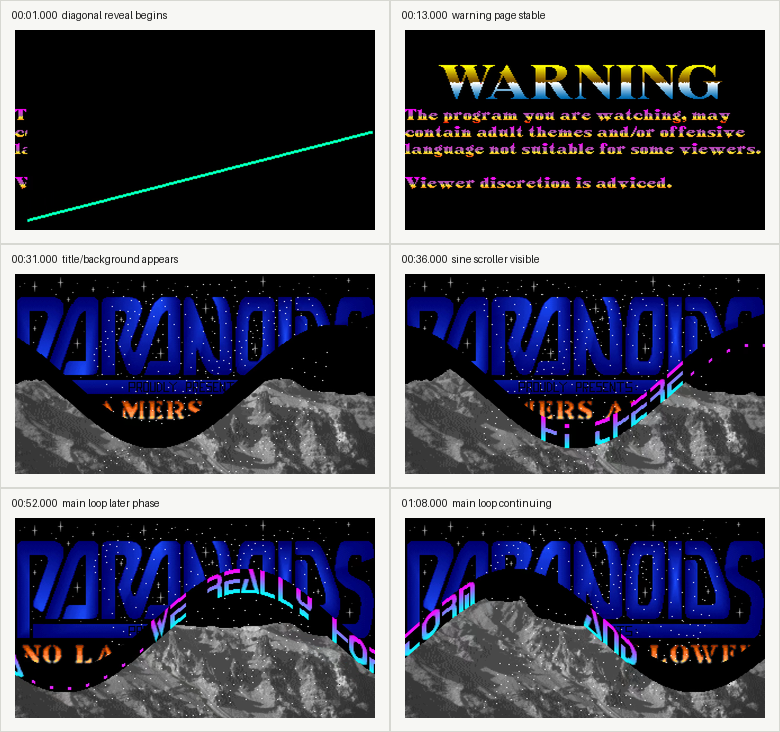
The timestamped frames are from a DOSBox-X 2026.01.02 runtime capture. The later scroller frames visibly contain historical scrolltext, but this article does not transcribe it.
The archive README and in-demo scrolltext contain historical personal contact details. Those details are intentionally omitted here.
Sources
- Hornet 1991 demo index
- Scene.org archive
- Scene.org file page
- Scene.org source archive page
- Demozoo production page
- Pouet production page
- NESDev forum discussion of the sine scroller
Archive
The examined archive is nolamers.zip from the Hornet mirror:
nolamers.zip 148259 bytes
ZIP contents:
README!.NOW       913 bytes   1991-12-28 01:07
GRAPHICS.DAT    98612 bytes   1991-12-26 13:34
NOLAMERS.EXE    48734 bytes   1991-12-27 22:45
Hashes:
7306ac875680e860f57f48b23bf0f235c61130a480bbc16408087e3d1287da92  nolamers.zip
a96f6790c35cd10b72c079a6b3a92ff6ca329eff3e9503c23f57b358a4fd2d77  README!.NOW
867a5a3838ba796932f8a3c5e6bd8ccd4e6bb2d2796c03fd9058e9aca095ddd1  GRAPHICS.DAT
7d1fc4fb24ad0c5ccc6ec21b166d9982db391badeac2e321c971bf2388d3d42b  NOLAMERS.EXE
a020e3c2fd71f661b3481385e7fa428e7d1d071efd55bcbd27def59a78d80028  nolamers-unpacked.exe
The separate source archive is:
paranoids-no_lamers_allowed_source.zip  45596 bytes
d343186eedd32c90a59c895cb52ac2b8de87291b6d053cb872ee2b1fbb6bba86
Important source files:
SCROLL.ASM    main startup, text parser, sine-scroller renderer, keyboard IRQ
PLOTTER.ASM   background point field
SUIHKU.ASM    diagonal warning/title sweep helper
MAKEFILE      TASM/TLINK/BGIObj build
ALKUKUVA.SPF  first warning picture plus palette
FRAC0         main background/title source page
FRAC1         secondary background source page
FONT.FNT      49152 bytes of glyph data plus 768-byte palette
TEKSTI.DAT    scrolltext payload
SINUS.DAT     320-word / 640-byte sine-shape table used by the scroller
The public EXE and the source archive do not describe exactly the same build
surface. The shipped EXE has the packed setup layer, GRAPHICS.DAT loader, and
Sound Blaster questions. The source archive gives the clearest view of the VGA
visual core after the data has been embedded by BGIObj. Where the two differ,
this note calls out whether the evidence comes from the release binary or the
source archive.
Runtime Capture
The current lifecycle evidence is a fresh run of the untouched packed release
under DOSBox-X 2024.03.01 commit 02f36ba, machine=svga_s3, normal 386
core, fixed 12,000 cycles, and 16 MiB. DOS sound devices were disabled and the
host used dummy audio. No audio was captured for publication, monitored, or
auditioned.
Scripted emulated-keyboard input answered Y, then 2, three seconds after
launch. Y keeps the fast-machine point layer. The second prompt is only a
Y/non-Y test, so 2 selects the release's no-Sound-Blaster branch; it is not
interpreted as base-address choice 2. Escape at launch second 35 releases the
BIOS warning-page gate, and a separately held two-second Escape at launch
second 55 reaches the custom IRQ1 latch in the main effect.
The first mode-13h stream is 640x400 native ZMBV, 3,646 frames at reported
average rate 2190197/31250 (about 70.0863 frames/s), and exactly
52.021576 seconds long. Timing zero below is its first graphics frame, about
three seconds after process launch. DOSBox-X then records a separate text-mode
command frame and exits with status zero, directly proving normal program
return.
Observed frame times:
00:10.000  cyan diagonal reveal line crosses the warning page
00:30.000  warning page is stable, waiting for its BIOS Escape
00:32.000  warning palette is darkening after that Escape
00:33.000  Paranoids title/background and pre-rolled white point field appear
00:36.000  first visible sine-scroller columns cross the title/background
00:40.000  mature 320-column text band and independent points are both active
00:50.000  later text, sine, and point phases use the same two inner loops
00:52.000  final fade is visibly dark while both renderers still advance
00:52.021576  mode-13h stream ends; text mode and normal DOS return follow
The older 75.678-second DOSBox-X 2026.01.02 run remains the source for the
existing motion GIF and timestamped PNG set. Its scheduled Escape did not exit,
so it is retained only as longer steady-loop evidence. The new run supersedes
its lifecycle boundary and supplies the exact normal-return evidence and
full-frame sequence above.
The short clip below is sliced directly from that older DOSBox-X source capture at its native 640x400 video geometry. It is included because the moving text wave is the visible proof of the source-level sine-scroller, background restore, and point-field interaction discussed later in the article.

Individual runtime frames:
- 00:01.000 reveal starts
- 00:13.000 warning stable
- 00:31.000 title/background appears
- 00:36.000 sine scroller visible
- 00:52.000 main loop later phase
- 01:08.000 main loop continuing



Public still references copied for comparison:



The demo itself says the public release date is 28.12.1991 in scrolltext.
The archive timestamps are 1991-12-26 through 1991-12-28, which matches that
claim.
Runtime-To-Code Concordance
The runtime media and decoded stills line up with three distinct renderer regions:
- The new direct sequence maps
00:10to the far diagonal helpers,00:33to the title composite plus the pre-rolled point field,00:36and00:40to release routines06F2hand00D0h, and00:52to the same two routines called inside exit fade1049h..1096h. The final text-mode command frame after the 52.021576-second graphics stream proves that this visual route reaches normal cleanup rather than a host timeout. no-lamers-allowed-runtime-00-01-000.png,00-13-000.png, and the decodedno-lamers-allowed-start-page.pngmap to the warning-page reveal. The source names this as thesuihke/removesuihkediagonal sweep: a Bresenham-style line walk copies eight vertically spaced source bytes per visited point, then uses palette entries253/254as the moving marker. In the restored binary this is the mode-13h stage that uploads palette184B:FA00, reads picture page184B:0000, and calls the two far helpers at478B:0A6Cand478B:0BC5.no-lamers-allowed-runtime-00-31-000.pngandno-lamers-allowed-title-page.pngmap to the title/background composite. This is the two-page selector loop around0EEAh: each destination word in A000h is chosen from either the281B:0000title page or the37EB:0000secondary background using the08F1threshold/mask table.no-lamers-allowed-runtime-sine-motion.gif,00-36-000.png,00-52-000.png, and01-08-000.pngmap to the source-levelscroll/plottermain loop, now also matched to exact release offsets06F2hand00D0h. The visible wavy text band isSCROLL.ASM: for each of 320 output columns it indexesmuoto, writes one 24-pixel glyph column, repairs four scanlines below fromFRAC1, repairs four scanlines above fromFRAC0, then advances independent text and sine phases. The sparse moving dots arePLOTTER.ASM: old marker pixels are erased only if they still contain color15, then restored from the currently selected background page.
The public Demozoo stills are useful visual references, but the motion and lifecycle claims in this article come from direct DOSBox-X captures and the matching source/release routines. That is why the GIF is stronger than a screenshot here: it shows the same column renderer repeatedly advancing through the sine table and scrolltext parser rather than merely showing one readable text frame.
Packing And MZ Layout
The distributed EXE is PKLITE-packed:
!PKLITE Copr. 1990-92 PKWARE Inc. All Rights Reserved
Original packed MZ:
file size        48734 bytes
header             112 bytes
load image       48622 bytes
relocations          1
entry            FFF0:0100
stack            0BE6:0200
UNP restores a much larger executable:
file size       296522 bytes
header            208 bytes
load image     296314 bytes
relocations        43
entry           0000:0B21
entry file off  0BF1h
stack           17FB:04FC
Address convention in this note:
code labels such as 06F2h   raw file offsets in the restored executable
data labels such as 8F1:D740 segment:offset values after relocation
The raw file contains a 0D0h-byte MZ header. To convert a relocated
segment:offset data reference to a raw file offset in the restored EXE:
raw_file_offset = 0D0h + segment * 16 + offset
For example:
184B:0000 -> raw 18580h  warning page
184B:FA00 -> raw 27F80h  warning palette
281B:0000 -> raw 28280h  Paranoids/title page
281B:FA00 -> raw 37C80h  title palette
One relocation trap matters here. The loader disassembly shows several
mov ax,0000h instructions. They are relocation targets, so runtime 0000:8D50
means "program load segment plus offset 8D50h", not physical address zero.
That is why the GRAPHICS.DAT XOR key can be recovered from the restored EXE
image.
Setup And Memory
The entry point begins by resizing the DOS memory block:
mov ah,4Ah
mov bx,61A8h
int 21h
If the resize fails it prints the "not enough free memory" message and exits. The README states a 540 KB free RAM requirement; the code path is consistent with a large conventional-memory block plus the loaded payload.
It then saves low interrupt-vector memory into its own segment and installs trap handlers. This is part of the demo's "reset does not work" joke: several BIOS/DOS interrupt vectors are redirected to the demo's own handler, and the exit path later restores saved vectors before returning to DOS.
The setup prompt at 0B4Ah asks:
Do you have 80286/12mhz or faster?
Use SoundBlaster?
SoundBlaster I/O addr. (1=210h, 2=220h, 3=230h, 4=240h)?
SoundBlaster IRQ (2,3,5 or 7)?
Defaults:
Sound Blaster base  220h if Enter is pressed
Sound Blaster IRQ   7 unless 1, 3, or 5 is selected
The README also states the hardware target: at least a 286/12 MHz with VGA, and it warns that ThunderBoard compatibility is not guaranteed.
GRAPHICS.DAT Loader And XOR Stream
The loader function starts at raw file offset 0921h. It is called with DX
pointing to the graphics.dat filename and BP holding a minimum allocation
size.
It opens the file, seeks to EOF to calculate the paragraph count, allocates a
block with INT 21h AH=48h, seeks back to the start, and reads the file in
8000h-byte chunks:
mov ah,3Dh
mov al,00h
int 21h          ; open

mov ah,42h
mov al,02h
int 21h          ; seek EOF

; length / 16 + 1, clamped to BP
mov ah,48h
int 21h          ; allocate

read_loop:
  mov ds,cs:[084Dh]
  mov ah,3Fh
  mov cx,8000h
  mov dx,0000h
  int 21h
Every chunk is decrypted in-place. The stream is:
plain_byte = cipher_byte xor EFh xor key_byte
key_byte   = program_image[8D50h + key_pos]
key_pos    = (key_pos + 1) mod 01B4h
The loop itself:
mov cx,ax          ; bytes actually read
mov ax,0000h       ; relocated program segment
mov es,ax
xor si,si

if cs:[0508] == 0:
    di = 8D50h
else:
    di = cs:[0508]
bx = 8D50h + 01B4h

decrypt:
  mov ah,es:[di]
  mov al,[si]
  xor al,0EFh
  xor al,ah
  mov [si],al
  inc si
  inc di
  if di == bx:
      di = 8D50h
  loop decrypt

cs:[0508] = di
The decrypted file begins with the music title x-zone and the marker
!Scream!, which matches the scrolltext's claim that the music was composed
with ProTracker/Scream-era tooling. Later bytes hold additional graphics and
text payloads.
Warning Screen Reveal
After setup, the code switches to mode 13h, uploads a 256-color palette from
184B:FA00, and reveals the warning page from 184B:0000.
Before uploading the palette, it patches six bytes near the end of the palette:
ES = 184Bh
BX = FA00h + 02F7h
ES:[BX+0] = 00h
ES:[BX+1] = 3Fh
ES:[BX+2] = 20h
ES:[BX+3] = 00h
ES:[BX+4] = 3Fh
ES:[BX+5] = 3Fh
INT 10h AX=1012h, BX=0, CX=100h, ES:DX=184B:FA00
The reveal loop calls two far routines in segment 478Bh:
478B:0A6C -> raw 483ECh
478B:0BC5 -> raw 48545h
The first routine is a line/tile copy helper. It receives the current source and destination coordinates through registers, calculates signed x/y deltas, chooses the major axis, and then walks the path with a Bresenham-style error term. At each step it copies eight vertically spaced bytes from the source page to the destination:
offsets copied:
0000h, 0140h, 0280h, 03C0h,
0500h, 0640h, 0780h, 08C0h
The second helper uses the same coordinate math but writes marker colors
FDh/FEh into a smaller vertical stack. In the visible sequence the entry code
alternates:
copy/plot helper
wait for vertical retrace on 03DAh
marker/helper
advance CX and SI
The outer loops walk CX by 8 and SI by 10 until the whole 320x200 warning
page has been revealed. It is a structured wipe, not just a plain rep movsw
screen copy.
Palette Fade
The fade at 0E17h repeatedly scales the current palette in place:
mov cx,0010h       ; 16 fade passes
DS = 184Bh
BX = FA00h

for each pass:
  for SI = 0..0300h:
      AL = [BX+SI]
      AX = AL * 0Eh
      AX >>= 4
      [BX+SI] = AL
  INT 10h AX=1012h, ES:DX = palette
  wait for 03DAh retrace
The multiplication by 0Eh followed by four shifts is approximately
component *= 14/16. Sixteen passes take the warning palette smoothly toward
black without needing a separate fade table.
The exit-side fade repeats the same idea against the later palette at
08F1:D740.
Title Composite Setup
The title page image is stored as a full mode-13h page at 281B:0000 with a
palette at 281B:FA00. A second page at 37EB:0000 is used as another
background layer, and a table/page region at 08F1 drives which source is used
for parts of the initial composite.
The code around 0EEAh builds A000 word by word:
BX = 0000h
SI = 0000h
ES = A000h

loop:
  DS = 08F1h
  AX = 37EBh
  CX = [SI]
  if CX >= BX:
      AX = 281Bh
  DS = AX
  AX = [BX]
  ES:[BX] = AX
  SI += 4
  if SI == 0280h:
      SI = 0
  BX += 2
  if BX != FA00h:
      loop
So the final visible buffer is selected word-by-word from two predecoded
sources. The 08F1 table is effectively a threshold/mask pattern that chooses
which background page contributes each word.
Exact Source-To-Release Match
The restored public release does more than contain code of the same general
shape as the source archive. The source's two principal visual procedures are
present instruction for instruction in the shipped load image. Offsets in this
table are raw restored-EXE file offsets, including its 0D0h-byte MZ header:
| Raw range | Release role | Source correspondence |
|---|---|---|
00D0h..0155h |
360-record point update, ending in RETF |
PLOTTER.ASM:plotter |
015Ah..01CBh |
point-array initializer, ending in RETF |
PLOTTER.ASM:alustaplotter |
05F9h..06F1h |
PIT/BIOS-tick frame timer | release-only wrapper |
06F2h..090Ch |
parser plus 320-column sine renderer, ending in RETF |
SCROLL.ASM:scroll |
0B4Ah..0BEBh |
CPU/sound questions and option flags | release-only setup |
0FEAh..1037h |
visible frame dispatcher and Escape test | release wrapper around both source routines |
1049h..1096h |
16-pass live-render exit fade | release wrapper around both source routines |
1098h..114Ah |
low-memory/vector restoration, mode 3, DOS exit | expanded release cleanup |
115Ch..117Dh |
raw IRQ1 Escape latch and keyboard acknowledge | source key_int body |
The linked visual-data segment is relocated as program segment plus 08F1h.
That gives exact release offsets for the source variables used in the hot
paths:
muoto       0000h   xcoord       03B2h   paikka       06E2h
oldpaikka   0A12h   alavari      0D42h   vaihe        1072h
ylavari     13A2h   reitti       16D2h   fontdata     1740h
pix phase   0280h   text speed   0282h   sine phase   0288h
text ptr    028Ch   x24 table    028Eh   glyph table  02B0h
scrolltext  DA40h
The shipped steady-state dispatcher is therefore concrete rather than source-inferred:
0FEA  start PIT/BIOS-tick measurement
      optional Sound Blaster service call
1001  call scroll at 06F2h                  ; always
      optional Sound Blaster service call
1014  if fast-machine flag [0958h] == 1:
101C      call plotter at 00D0h             ; 360 points
1020  update elapsed-time accumulator at 0618h
      wait until accumulator [0104h] >= threshold [095Bh]
1031  if IRQ1 Escape latch [107Eh] == 0: loop to 0FEAh
Setup initializes the threshold to 30, so the intended visible update floor is
roughly 30 ms even though the capture stream itself samples VGA at about 70 Hz.
The timer combines latched PIT count and BIOS tick changes using constants
FFFFh, 20BDh (8,381), D68Dh (54,925), 10,000, 5,000, and 1,000. This is
not a retrace-paced scroller. Answering no to the fast-machine question clears
[0958h] and removes only the point call; the 320-column text renderer remains
active. The no-sound flag [0959h] similarly bypasses the driver service calls
without changing either visual routine.
Source Build And Startup Flow
The source package builds a visual-core executable called scroll.exe, not the
exact packed public NOLAMERS.EXE. MAKEFILE links:
scroll.obj + picture.obj + pic1.obj + font.obj + teksti.obj + alkukuva.obj + suihku.obj
picture.obj, pic1.obj, font.obj, teksti.obj, and alkukuva.obj are
made with BGIObj. That means the source build bakes the raw assets into
segments instead of loading GRAPHICS.DAT at runtime:
FRAC0        -> far_data:pic
FRAC1        -> f_ardata:pic1
FONT.FNT     -> _data:fontdata
TEKSTI.DAT   -> _data:teksti
ALKUKUVA.SPF -> _alkukuva:alkukuva
The source start proc is valuable because it names the routines that the
binary disassembly only exposes as offsets:
call alustaplotter
call plotter 51 times before mode setup
save INT 08 and INT 09 vectors
install key_int on INT 09
mode 13h
upload ALKUKUVA palette, patch colors 253/254
run suihke/removesuihke diagonal reveal
wait for Escape on the warning page
fade ALKUKUVA palette down, 16 passes
mode 13h again
upload FONT.FNT palette
build composite background from FRAC0/FRAC1 using muoto
textplc = offset teksti
loop: call scroll; call plotter; repeat until esc_pressed
fade active palette, still calling scroll/plotter during fade
restore INT 08 and INT 09, reset PIT channel 0 to 65535
mode 03h, INT 21h AH=4Ch
The source contains an attempted high-frequency timer interrupt, but the block
is commented out and labelled as non-working. In the source build the visible
loop is therefore not driven by a custom timer ISR. The packed release binary
adds setup, sound, and polling-timer scaffolding around the exact compiled
plotter, scroll, and IRQ1 bodies mapped above.
Diagonal Sweep: SUIHKU.ASM
The warning reveal is the suihke/removesuihke pair. Inputs are ordinary
registers:
DS  source picture segment
ES  A000h screen segment
CX  start y
SI  start x
DX  end y
DI  end x
suihke first computes a Bresenham-style walk from (SI,CX) to (DI,DX).
It stores the straight increment, diagonal increment, short distance, and
error counters in the suihku_code segment:
stra_incr    one-pixel horizontal or vertical step
diag_incr    combined x/y step
stra_count   error increment for straight moves
diag_count   error adjustment for diagonal moves
The first phase copies eight vertical source pixels into the screen at every visited point:
screen[bx+0000] = source[bx+0000]
screen[bx+0320] = source[bx+0320]
screen[bx+0640] = source[bx+0640]
screen[bx+0960] = source[bx+0960]
screen[bx+1280] = source[bx+1280]
screen[bx+1600] = source[bx+1600]
screen[bx+1920] = source[bx+1920]
screen[bx+2240] = source[bx+2240]
That is why the line is not just a colored slash: it also reveals an eight-pixel-tall strip of the warning page as it travels.
The drawing phase uses palette entries 253 and 254 as the visible marker:
screen[bx+0000] = 253
screen[bx+0320] = 254
screen[bx+0640] = 253
The extra five rows are present as comments in the source. The shipped visual
is therefore a three-pixel vertical marker over an eight-pixel reveal band.
removesuihke recomputes the same line walk and clears those three marker
rows. start proc alternates suihke, a 03DAh vertical-retrace wait, and
removesuihke, then advances CX by eight and SI by ten to sweep the whole
page.
Background Point Plotter: PLOTTER.ASM
The point field is sparse. It does not redraw a star layer or a whole buffer.
alustaplotter builds per-point state arrays:
xcoord[408]     sine/table x phase, stored as words
paikka[408]     base screen position
oldpaikka[408]  previously plotted screen position
vaihe[408]      index into reitti
reitti[]        short path offsets, mostly 320-row steps plus small x shifts
The compiled release confirms the bounds exactly. Initializer 015Ah..01CBh
uses SI = 0,2,...,728 and stops when SI becomes 730, so it prepares 365
records. Draw routine 00D0h..0155h stops at 720 and therefore consumes only
records 0 through 359: 360 active points, five initialized-but-unused records,
and 43 untouched tail records in each 408-word array.
Each point update does this:
di = xcoord[si] + sinusplc + 32
if di >= 640: di -= 640
di = muoto[di]                    ; current sine boundary offset
old = oldpaikka[si]

if A000[old] == 15:
    if muoto_offset + 3840 > old:
        restore from far_data:pic
    else:
        restore from f_ardata:pic1
    A000[old] = restored pixel

phase_byte_offset = vaihe[si] + 2
route = word [reitti + phase_byte_offset]
if phase_byte_offset > 96:
    phase_byte_offset = 0
    route = reitti[0]
new = paikka[si] + route
oldpaikka[si] = new

if A000[new] < 80:
    A000[new] = 15
The interesting part is the erase test. A point is removed only if its old
screen byte is still 15, the plotter color. If the scroller or a later draw
has overwritten that pixel, the plotter leaves it alone. When it does erase,
it restores from the background page selected by the current sine boundary.
That is why the dots can move over the composite mountain/logo image without
leaving black holes.
The route order matters because the lookup occurs before the >96 reset.
reitti has 49 words at byte offsets 0 through 96. Its path starts with six
horizontal offsets 6..11, descends through 332,333,654,..., curls at a
maximum offset of 5,452, and returns through the mirrored row/column steps.
Every live point advances one word per call and wraps after entry 48.
alustaplotter seeds a 20-column grid. It derives row and column from SI/2,
uses ten-pixel x spacing, adds a base near 3,270, and folds row + column by
subtracting 25 while the result exceeds 12. The folded value is multiplied by
eight and stored as a byte offset, not a route-entry number. This deliberately
produces negative initial offsets for 191 of the 360 active records.
That looks unsafe until the linked layout is considered: ylavari[408], whose
words are all 15, sits immediately before reitti. A negative route lookup
therefore reads a constant word 15 from the tail of ylavari. Depending on the
seed, those 191 points spend 3, 7, 11, ... up to 47 calls using that short
offset before entering reitti[0]. The release calls plotter exactly 51 times
at 0C8Ah..0C93h before setting mode 13h. That pre-roll is long enough for
even the -96 seed to clear its 47-call negative-index phase and explains the
otherwise odd count more precisely than a generic “avoid first-frame jump.”
The adjacent alavari array is written by the initializer but not read by the
shipped point routine. The apparent out-of-bounds ylavari use, by contrast,
is a real consequence of the compiled address arithmetic and affects the
pre-roll. After pre-roll, the erase/restore ownership rule above is what keeps
the white points from punching black holes through either background page.
Sine Scroller: SCROLL.ASM
scroll proc is the classic inner loop. It is pure software rendering into
A000h; it is not a hardware split-screen trick. The source routine has no CRTC
start-address changes or per-scanline VGA register writes. A NESDev discussion
of the effect reached the same conclusion from DOSBox register logging: the
effect is feasible as a software update because only the text band and nearby
repair pixels are touched each frame.
Important source variables:
pixscrollattu   0..15 sub-character pixel phase
tekstinopeus    current pixel speed, default 2
tulevanopeus    speed to resume after a timed stop
pysahdyaika     timed-stop frame countdown
sinusplc        horizontal phase into muoto
fontplc         unused/old pointer variable
textplc         current byte in TEKSTI.DAT
kertaa24        0,24,48,...,384, one offset per glyph column phase
merkkitaulu     character-to-font offset table, 384 bytes per glyph
muoto           sine-shape table from SINUS.DAT
The text parser runs before the 320-column renderer:
if tekstinopeus == 0:
    pysahdyaika -= 1
    if pysahdyaika == 0:
        tekstinopeus = tulevanopeus

dx = pixscrollattu + tekstinopeus
if dx >= 16:
    dx -= 16
    textplc += 1

read byte at textplc
byte < 32   skip
&X          set speed to X - 'A'
&A Y Z      stop for (Y - ('A' - 1)) * 8 frames, then resume speed Z - 'A'
$           restart at TEKSTI.DAT
normal      render this character
For a normal character it chooses a column-major font address:
pixscrollattu = dx
si = fontdata + merkkitaulu[character]
si += kertaa24[dx]
FONT.FNT stores a 24-pixel-high glyph column as 24 consecutive bytes. Each
character consumes 16 * 24 = 384 bytes, matching the merkkitaulu stride.
The character byte directly indexes merkkitaulu; there is no subtract-32
step. kertaa24 contains seventeen words 0..384, but DX is normalized to
0..15 before this lookup, so the terminal 384 word is a spare boundary entry.
The hot loop is labelled uusirivi, but it is really one vertical glyph column
per screen x coordinate. In the release it occupies 079Dh..08ABh inside the
larger 06F2h..090Ch routine and runs 320 times:
bp = visible x, 0..319
cx = 2 * visible x
bx = sinusplc + cx
if bx >= 640: bx -= 640
bx = muoto[bx] + bp
SINUS.DAT contains exactly 320 words and every word is a multiple of 320.
Interpreted modulo 65,536, those offsets select base scanlines 51 through 150,
with 100 distinct row values. The most negative-looking source constants are
only 16-bit wrapped framebuffer offsets. Consequently the four repaired rows
above and the 24 text plus four repaired rows below stay within scanlines 47
through 177. There is no clipping branch in the hot loop because the authored
table proves those stores safe.
The source then writes the 24 glyph bytes as twelve word loads and twenty-four byte stores:
screen[bx+0000] = font[si+00]
screen[bx+0320] = font[si+01]
screen[bx+0640] = font[si+02]
screen[bx+0960] = font[si+03]
...
screen[bx+7040] = font[si+22]
screen[bx+7360] = font[si+23]
Those offsets are exactly one 320-byte scanline apart, so the glyph column is a 24-pixel-tall vertical strip. After the text write, the loop repairs the background around the strip:
from pic1 / FRAC1:
  screen[bx+7680] = pic1[bx+7680]
  screen[bx+8000] = pic1[bx+8000]
  screen[bx+8320] = pic1[bx+8320]
  screen[bx+8640] = pic1[bx+8640]

from pic / FRAC0:
  screen[bx-0320] = pic[bx-0320]
  screen[bx-0640] = pic[bx-0640]
  screen[bx-0960] = pic[bx-0960]
  screen[bx-1280] = pic[bx-1280]
So the per-column cost is twelve font-word loads, 24 text stores, and eight
repair loads/stores, with three data-segment selections around them
(FRAC1, FRAC0, then the linked data segment). Across one call that is 7,680
glyph-byte stores plus 2,560 repair-byte stores: exactly 10,240 screen writes,
not a full 64,000-byte page. The renderer also performs 320 sine-word lookups;
its speed comes from replacing per-pixel sine math and whole-screen restoration
with one table lookup and a straight unrolled vertical column.
At the end of each output column:
si += 24       ; next glyph column
cx += 2        ; next word in muoto
bp += 1        ; next screen x
dx += 1        ; next glyph phase
When dx reaches 16, the loop advances to the next scrolltext character,
skipping control bytes and $ restarts, then reloads si from merkkitaulu.
This is why the text can snake across the whole 320-pixel width while still
streaming through a normal 16-column font.
After all 320 columns:
sinusplc -= sinusnopeus * 2   ; sinusnopeus is 4, so subtract 8 bytes
if sinusplc < 0:
    sinusplc += 640
muoto is indexed as a word table, so the wrap value is 640 bytes for 320
columns. Advancing by eight bytes is four table entries per frame. The text's
sub-character phase and the sine table phase are therefore independent: one
controls which font column is being read, the other controls where the vertical
strip lands on screen.
Main Loop And Keyboard
In the source build, the final visible loop is direct:
textplc = offset teksti
repeat:
    call scroll
    call plotter
until esc_pressed != 0
The packed release's exact wrapper is now mapped in the source-to-release table
above. Its timer is polling code, not the source's commented-out experimental
timer ISR: every frame programs PIT channel 0 to mode 34h/divisor 65,536,
samples channel 0 and BIOS tick 0040:006Ch, and waits for the derived
millisecond accumulator to reach 30. It wraps the same source renderer with
optional sound service calls and the fast-machine point-field condition.
The two Escape gates use different ownership. The warning page waits through
BIOS INT 16h/AH=00h at raw 0DF5h, before the custom keyboard handler is
installed. After the warning fade, raw 0EC1h..0ECDh installs IRQ1 vector 09h
to the handler whose restored-file body is 115Ch..117Dh.
That handler reads port 60h, masks the break bit with 7Fh, and sets word
CS:107Eh when the remaining scan code is 01h. Both Escape make and break
can therefore latch exit. It toggles keyboard-controller port 61h, sends EOI
20h to PIC port 20h, and returns with IRET. The main loop checks the word
only after its renderer and timing wait, so exit is frame-boundary controlled.
The successful run used one ordinary Escape for the BIOS gate and a separate
held Escape for IRQ1; this avoids confusing a queued BIOS character with the
later raw scan-code path.
Exit Path
When Escape sets CS:107E, raw 1049h..1096h runs sixteen fade passes. Each
pass multiplies palette bytes by 14 and shifts right four, uploads 256 DAC
entries, then calls scroll and—when the fast-machine flag is set—plotter
again. The visible wave and points therefore continue moving while the final
frame darkens; the 00:52 tile in the direct sheet is evidence for that exact
ownership.
The byte loop has a small overrun: it starts at index zero, increments SI,
and continues while SI <= 0300h. It scales 769 bytes, indices 0000h..0300h,
although the BIOS upload consumes only the first 768 palette bytes. The byte
immediately after the palette is mutated once per pass but never sent as a DAC
component.
The release's vector handling is broader than the source build's short
INT-08h/09h description. Entry copies the complete 1,024-byte IVT from
physical 0000:0000 to its CS:0108h backup, temporarily redirects most low
vectors to its reset-joke handler, and later installs the real IRQ1 latch. On
normal exit, 112Dh..113Fh copies those saved 1,024 bytes back to physical
zero, restoring all 256 far vectors (512 words) in one REP MOVSB. It then
switches to BIOS text mode 03h and exits through:
mov ax,4C00h
int 21h
The explicit vector restoration is important because the demo deliberately redirects multiple interrupt vectors during the show. Without that cleanup, DOS would be left with broken keyboard/BIOS/reset behavior. The new 52.021576-second graphics run reaches this path, produces a separate DOS command frame, and returns with emulator status zero, so cleanup is now direct runtime evidence rather than source-only inference.
What The Demo Is Doing
The technical shape is:
PKLITE MZ -> UNP-restored code/data -> setup prompts
           -> GRAPHICS.DAT XOR/key payload
           -> warning page reveal and fade
           -> two-page title/background composite
           -> point plotter + one-pixel sine scroller
           -> Escape IRQ exit and vector restore
For a first group demo from late 1991, the hot paths are nicely targeted. The warning reveal avoids a plain full-screen copy, the point plotter preserves the background under each marker, and the scroller reduces the expensive work to table lookups plus vertical column writes. The main scroller's real cost is 320 columns times 24 font pixels per update, plus a few background repair pixels, which is reasonable for the advertised 286/12 MHz target.