Analysis model: gpt-5.5 xhigh
No! by NoooN - Technical Dissection
Scope
This is a static dissection of No! by NoooN, the second-place PC demo at The
Party 1994. The focus here is the executable layout, the custom runtime, the
resource archive, the dlz depacker, the top-level part script, and several
inner loops recovered from decompressed part modules.
Public references:
- Pouet production page: https://www.pouet.net/prod.php?which=1159
- Scene.org archive: https://files.scene.org/get/parties/1994/theparty94/demo/nooon.zip
- The Party 1994 results: https://archive.scene.org/pub/parties/1994/theparty94/info/results.txt
- Demozoo production page: https://demozoo.org/productions/714/
This is not a full source reconstruction. The released executable still contains many independent code/data modules, and the visual parts are loaded as compressed blobs. What is reconstructed below is the part scheduler, runtime ABI, memory/archive/decompression system, VGA upload paths, and representative inner-loop structure inside the decompressed effect modules.
Offset notation:
NO.EXE+0x...means a file offset in the unpacked executable.0289:xxxxmeans a far call target in the resident kernel segment. The corresponding unpacked-file offset is0x2a90 + xxxx.resNN+0x...means an offset inside decompressed resourceNN.- Register names are 16-bit real-mode unless an
Eregister is shown. This code is 386 real-mode code with many operand/address-size prefixes.
Examined Files
The public archive contains:
FILE_ID.DIZ       350 bytes
NO.EXE     1,502,680 bytes
NOOON.NFO     10,971 bytes
Hashes:
c4bb5975f53dc84ff25182a833cfa45f5c6de5d398afe73b224b0720fab53bd2  nooon.zip
3d5e588ee2605c072c30da6c85cd8222ff3fc21a2977c64a603afec113ae9c72  FILE_ID.DIZ
8016b912d90736a36be043825ed3e9735fe344bc371627308517f89e478975fb  NO.EXE
264b86a897971b0deea9c2a4d3c339eef767cca9e025156e31e86a7c8a3c665f  NOOON.NFO
The NFO credits are useful because they line up with the recovered modules:
- Music: Moby
- 3D parts: Barti
- System, bitmap effects, and linking: Karl
- Script and graphics: RA
- Replay routine: LCA of Infiny
The final release supports Gravis UltraSound, Sound Blaster, and silence. The NFO asks for a 386 minimum, recommends a 486DX/66 with VLB, requires HIMEM.SYS, and wants roughly 1.5 MB of free XMS with no EMM386/QEMM/CEMM/386MAX style manager. The code confirms the 1.5 MB number exactly.
Runtime Capture
A follow-up DOSBox-X 2026.01.02 capture on 19 June 2026 used the original
NO.EXE from the archive listed above. The GUS-enabled path stayed on the
detection text screen under this emulator setup, so the visual reference run
uses the working no-card/silence path: no ULTRASND variable, gus=false,
sbtype=none, nosound=true, xms=true, and ems=false. No keys were
injected. The internal mpegts-h264 capture ran for 118.227133 seconds.
Timestamps below are capture stream timestamps.
On 4 July 2026 I repeated that same no-card/silence capture path from a
freshly downloaded archive whose SHA-256 matched the hash above. The repeat run
captured 120.920211 seconds at a 720x400 H.264 container size. The timing is
close enough to the previous run that the existing still timestamps remain
valid, and the repeat stream supplies the GIF clips below.
The whole run is easier to read as a contact sheet before looking at individual frames:
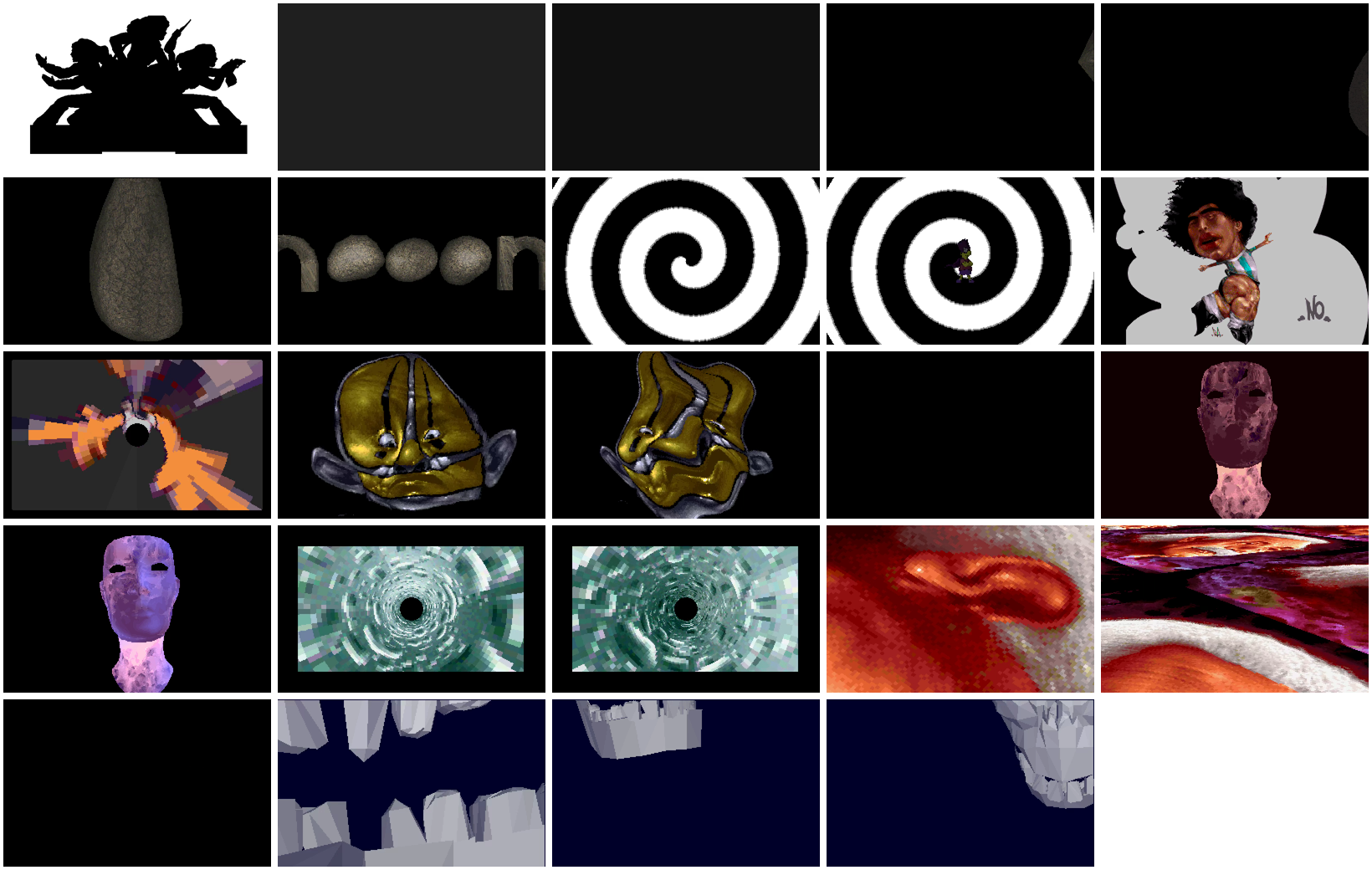
The contact sheet shows why still frames are not enough for this production.
No! is mostly a chain of short loaders/effect modules: logo reveals, spirals,
warped bitmap scenes, rotating objects, tunnel flights, floor/camera motion,
and late low-poly object scenes. The selected stills anchor the timeline, while
the GIFs document the motion that the static screenshots cannot show.
At 00:35.000, the stone nooon logo is established after the opening
credit images:

At 00:50.000, the Bart Simpson-style figure sits in the warped/rayed
composition:

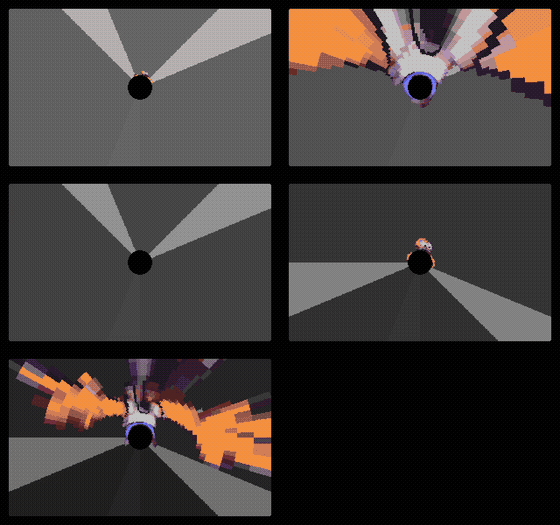
The 00:48..00:54 clip is the useful evidence for this module. The still at
00:50.000 shows the composition, but the GIF shows the radial fan being
actively swept and remapped around the figure. That motion lines up with the
resource/module structure later identified as ZOOMBART and WARP/CLOWN
style bitmap effects rather than a single static picture.
At 01:05.000, a gold object is rotating against black:


The 01:02..01:08 clip shows the object deformation/rotation that the still
only samples once. This is the runtime side of the 3D object parts in the
script: the object is not a flipped bitmap sequence in the top-level EXE, it is
a loaded effect module doing its own transform/raster work.
At 01:15.000, the purple head/face render is centered:

At 01:25.000, the green tunnel section is active:


The 01:20..01:27 clip is the clearest place to show temporal evidence. The
screen is a forward-moving tunnel, so the real effect is the repeated remap and
palette/texture motion toward the central hole. A single frame proves the look;
the GIF proves the tunnel renderer is the active module.
At 01:35.000, a textured floor/plane fills the lower frame:
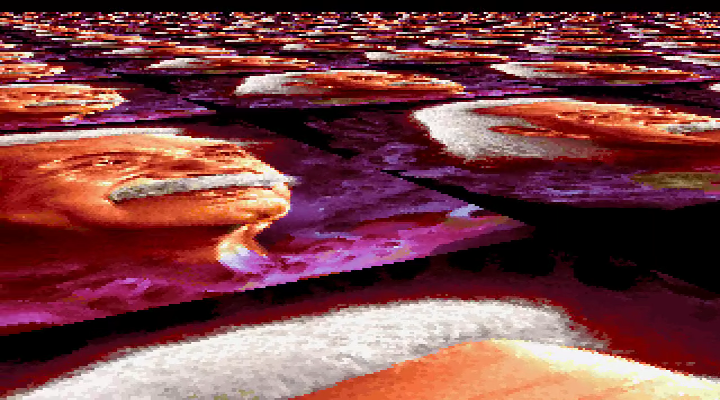

The 01:32..01:39 clip captures the camera/texture movement across the floor
plane. It is useful because the analysis below discusses generated span/remap
loops; this clip shows the visible output of that class of code better than a
single high-detail screenshot.
At 01:55.000, the late low-poly head/object scene is visible:

Packed EXE
NO.EXE is an MZ executable packed with PKLITE 1.12. The original header is
small and leaves almost the whole file as overlay data:
packed file size        1,502,680 bytes
MZ header size                160 bytes
packed image               21,615 bytes
overlay                 1,480,905 bytes
CS:IP                       fff0:0100
SS:SP                       0551:0200
relocations                       1
UNP 4.12 under DOSBox-X expands it cleanly:
processed with  : PKLITE V1.12 <L>
new file size   : 2016926
Expanded executable:
11b5b84891481f5c53fe12ac899a70a431e53b345cf4ff5ed5a11cee423e29e8  unpacked NO.EXE

unpacked file size      2,016,926 bytes
MZ header size                512 bytes
unpacked image            536,021 bytes
overlay                 1,480,905 bytes
CS:IP                       025b:0000
SS:SP                       82be:0800
relocations                      85
entry file offset           0x27b0
overlay start               0x82dd5
The PKLITE step is only the outer shell. The real demo still keeps its music, effect modules, images, object data, and tables in a custom archive at the end of the expanded executable.
Top-Level Script
The expanded entry point is a compact part script. It initializes the resident kernel, masks IRQ1, stores a flat physical pointer for VGA memory, starts the audio/timer layer, then loads effect resources by numeric ID:
NO.EXE+0x27d0:
    call 0289:0002          ; initialize kernel/runtime
    jb   init_error

    in   al,21h             ; mask keyboard IRQ while demo runs
    or   al,02h
    out  21h,al

    mov  eax,0000a000h
    shl  eax,4
    mov  [0080h],eax        ; flat A0000 base used by 32-bit loops

    call 0289:02fa
    mov  ax,1
    call 0289:0817

    call_part 02h
    call_part 05h
    call_part 11h
    call_part 0ch
    call_part 0fh
    call_part 0dh
    call_part 03h
    call_part 06h
    call_part 10h
    show_image 12h
    wait 015eh frames/ticks
    call_part 04h
    call_part 0eh
    mode_x_image 13h
    call_part 0ah
    call_part 0bh
    call_part 09h
    call_part 08h
    call_part 07h
The generic call_part wrapper is short:
NO.EXE+0x28b1:
    call 0289:036f          ; load resource AX, unpack if DLZ
    push eax                ; returned flat pointer
    call 0289:0139          ; far-call loaded blob
    pop  eax
    call 0289:0653          ; free loaded blob
    ret
So the demo is not one monolithic renderer. The executable body is a loader, kernel, and scheduler; most visual logic lives in compressed resources.
The explicit resource sequence in the script maps to recovered embedded build paths:
02  C:\NOOON\TP4\INTRO\INTRO.ASM
05  C:\NOOON\TP4\BLUB\BLUB.ASM
11  C:\NOOON\TP4\ZOOMBART\ZOOM.ASM
0c  C:\NOOON\TP4\TUNNEL\TUNNEL2.ASM
0f  C:\NOOON\TP4\WARP\CLOWN.ASM
0d  C:\NOOON\TP4\TUNNEL\TUNNEL3.ASM
03  C:\NOOON\TP4\3DROTO\ROTO.ASM
06  C:\NOOON\TP4\CRANE\CRANE.ASM
10  C:\NOOON\TP4\WORLD1\VIEW.ASM
12  64 KB image resource, palette plus chunky screen
04  C:\NOOON\TP4\ATOMS\ATOM.ASM
0e  C:\NOOON\TP4\VISAG\V1.ASM
13  82,688-byte Mode X image resource, palette plus planes
0a  C:\NOOON\TP4\TORNIKO\TORNI.ASM
0b  C:\NOOON\TP4\TUNNEL\TUNNEL.ASM
09  C:\NOOON\TP4\SIDA\SIDA.ASM
08  C:\NOOON\TP4\DOLPHINS\DAU.ASM
07  C:\NOOON\TP4\CREDITS\CREDITS.ASM
This ordering also explains why the executable has so many generic services: each part module is a self-contained real-mode program fragment that calls back into the resident kernel for memory, resources, palette upload, VBL wait, timer queries, and code registration.
Kernel Entry And Call Thunk
The resident runtime is addressed through segment 0289. Its initialization
entry at 0289:0002 saves the caller state, sets DS=ES=0, then calls several
internal setup routines:
0289:0002:
    mov  cs:[0000],ds
    pushad
    push ds/es/fs/gs
    call 0x3947            ; descriptor/protected bridge setup
    xor  ax,ax
    mov  ds,ax
    mov  es,ax
    call 0x2e7e            ; XMS detection/allocation/locking
    call 0x2f6a            ; memory pools
    call 0x3264            ; archive/file setup
    call 0x2afd            ; install int 80h service
    call 0x39c6
    call 0x353f            ; timer/PIT/IRQ setup
    ...
    clc
    retf
The shutdown path at 0289:0035 reverses those pieces: audio/timer shutdown,
INT 80h restoration, memory cleanup, XMS unlock/free, text-mode return.
The loaded-part call thunk at 0289:0139 is important. The caller passes a flat
offset in EAX. The thunk converts it to a real-mode far pointer, pushes a
kernel return address, then retfs into the loaded resource:
0289:0139:
    pushad
    push ds/es/fs/gs
    push ebx

    xor  ebx,ebx
    mov  bx,ds
    shl  ebx,4
    add  eax,ebx           ; caller-relative -> physical-ish

    mov  ebx,eax
    and  bx,000fh          ; offset within paragraph
    shl  eax,0ch           ; segment part
    mov  ax,bx             ; EAX now packs CS:IP for far return

    pop  ebx
    push cs
    push 0164h             ; kernel continuation after part returns
    push eax
    retf                   ; enter decompressed part
That mechanism lets the demo allocate a decompressed blob anywhere in its pool and execute it without copying it to a fixed code segment.
INT 80h Bridge
The kernel installs a private INT 80h vector at IVT offset 0x200.
Only calls with AH=ffh are handled locally:
0289:0097:
    cmp ah,0ffh
    jne chain_previous
    cmp al,0
    je  enter_flat_context
    cmp al,1
    je  leave_flat_context
    iret
AX=ff00h pushes a computed base onto a small stack and updates the low-memory
flat-bias variable at 0:2539. AX=ff01h pops the previous base. Every loaded
part begins and ends with those two calls:
mov ax,0ff00h
int 80h
; use kernel services and flat pointers
mov ax,0ff01h
int 80h
retf
That is the bridge that makes code resources feel like relocatable modules. A
module can keep local offsets in its own DS, while shared services compensate
using the current flat-bias value.
XMS And Memory Pools
The XMS setup exactly matches the NFO requirement. The runtime calls the XMS
multiplex API, asks for available memory, requires at least 0x05dc KB, then
allocates that amount:
0289:0e9a:
    mov ax,4310h
    int 2fh                 ; get XMS entry point
    mov [252f],bx
    mov [2531],es

0289:0ea8:
    mov ah,08h
    call far [252f]         ; query free XMS
    cmp ax,05dch            ; 1500 KB
    jae ok

0289:0eba:
    mov ah,09h
    mov dx,05dch            ; allocate 1500 KB
    call far [252f]
    mov [2533],dx           ; handle
Then it locks the XMS handle and stores a base adjusted relative to the real-mode data segment:
mov ah,0ch                  ; lock XMS block
mov dx,[2533]
call far [252f]
shl edx,16
mov dx,bx                   ; EDX = physical XMS address
mov ax,ds
shl eax,4
sub edx,eax
mov [2535],edx
Two internal pools are initialized:
pool A root [253d], size about 0x177000
pool B root [2545], size about 0x075800
Both pools use the same block format:
offset +0x00  signature "KMM"
offset +0x03  used flag, 0 free / 1 used
offset +0x04  previous block pointer
offset +0x08  next block pointer
offset +0x0c  payload size
offset +0x10  user payload
The allocator rounds requests to 16 bytes, walks the linked list, splits a free
block if the remainder can hold a new header, marks the chosen block used, and
returns block + 0x10:
0289:05ca:
    add edx,0fh
    and dl,0f0h             ; 16-byte alignment

scan:
    cmp byte [ebx+3],0
    jne next
    mov eax,[ebx+0ch]
    cmp eax,edx
    jb  next
    sub eax,edx
    sub eax,10h
    jg  split_block
use_whole_block:
    mov byte [ebx+3],1
    mov [ebx+0ch],edx
    lea eax,[ebx+10h]
    ret
The free path validates the KMM signature, clears the used flag, and coalesces
with adjacent free blocks. The resource loader and the visual parts use both
pools, which is why there are two near-identical load/decompress entry points.
Archive Format
After PKLITE expansion, the last dword of the executable is 0x430. That is the
size of the resource table area at EOF. The table starts at:
unpacked file length  0x1ec69e
table size            0x000430
table start           0x1ec26e
record count          (0x430 - 4) / 12 = 89
Each record is 12 bytes:
struct nooon_resource_record {
    uint32_t id;            // 1..89
    int32_t  eof_offset;    // signed offset from end of executable
    uint32_t packed_size;
};
Records are ordered by resource ID, but lookup does not scan by id; it assumes
dense IDs. For resource AX, the loader computes the table position from the
known record count:
0289:0393:
    movzx eax,ax
    mov   ecx,[2519]        ; record count
    inc   ecx
    sub   ecx,eax
    imul  ecx,ecx,-12
    sub   ecx,4
    call  seek_from_eof     ; AH=42h, AL=02h
    read  12 bytes to [251f]
Then it allocates packed_size, seeks to EOF + eof_offset, and reads the
payload:
mov edx,[2527]              ; packed_size
call [251d]                 ; selected allocator
mov [252b],eax              ; destination

mov ecx,[2523]              ; eof_offset
call seek_from_eof

mov edi,[252b]
mov ecx,[2527]
call read_file_to_flat_buffer
The resources used by the top-level script have these sizes:
id  packed   unpacked  role
02  0x00e5d      5247  INTRO.ASM
05  0x04b81     83091  BLUB.ASM
17  0x04551     27443  ZOOMBART/ZOOM.ASM
12  0x03e9a     26015  TUNNEL2.ASM
15  0x01394      7692  WARP/CLOWN.ASM
13  0x03d75     25350  TUNNEL3.ASM
03  0x07e8d     56804  3DROTO/ROTO.ASM
06  0x05b7b     90673  CRANE.ASM
16  0x05ede     86876  WORLD1/VIEW.ASM
18  0x0272e     64768  palette + 320x200 chunky image
04  0x038d4     60379  ATOMS/ATOM.ASM
14  0x047c5     79390  VISAG/V1.ASM
19  0x0a1b2     82688  palette + 4 x 320x256-ish Mode X planes
10  0x06106     97288  TORNIKO/TORNI.ASM
11  0x042a0     29512  TUNNEL/TUNNEL.ASM
09  0x04564     77774  SIDA/SIDA.ASM
08  0x04a49     79750  DOLPHINS/DAU.ASM
07  0x003d2      1376  CREDITS/CREDITS.ASM
There are also several large non-script resources. For example, resource 1
unpacks to 373,918 bytes and contains the module/music data, including the
visible Danny elfmania strings and the LCA player material.
DLZ Resource Depacker
Most resources begin with a short stub-like header:
b4 4c cd 21 9d 89 64 6c 7a ...
                  d  l  z
The resource post-loader checks bytes +6..+8 for dlz. If the marker is
present, the output length is reconstructed from bytes +0e..+10, and the
compressed bitstream begins at +11:
cmp word [esi+06h],6c64h    ; "dl"
jne raw_copy
cmp byte [esi+08h],7ah      ; "z"
jne raw_copy

movzx edx,byte [esi+0eh]
shl   edx,0eh
mov   dx,[esi+0fh]          ; output length
call  allocator
jmp   dlz_main
There are two entry points:
0289:0beeallocates output from one pool.0289:0c4dallocates output from the other pool.
The same bitstream core is shared. It keeps a 16-bit bit reservoir in BP and a
remaining-bit count in DL:
getbit:
    shr bp,1                ; CF = next bit, low bit first
    dec dl
    jne got_bit
    mov dl,10h
    mov bp,[esi]            ; reload next 16 bits
    lea esi,[esi+2]
got_bit:
The main loop is an LZ literal/back-reference decoder:
dlz_loop:
    getbit
    if CF=1:
        movsb               ; literal byte from input to output
        goto dlz_loop

    getbit
    al = *esi++             ; low offset byte
    bh = ffh
    bl = al                 ; EBX now a negative offset, usually -256..-1

    if CF=0:
        decode_short_offset_or_end
    else:
        decode_extended_offset_and_length
The copy operation itself is the classic overlap-safe LZ form:
copy_match:
    push esi
    lea  esi,[edi+ebx]      ; EBX is a signed negative distance
    rep  movsb             ; source is already-produced output
    pop  esi
    goto dlz_loop
The short-offset branch has three cases:
control 00, AL != ffh       copy 2 bytes from distance 256-AL
control 01                 extend high offset bits, copy 2 bytes
control 00, AL == ffh:
    next bit 1              no-op escape, return to main loop
    next bit 0              end of compressed stream
The extended branch builds more distance bits into BH, then decodes length by
a small prefix tree:
first successful length bit gives 3, 4, 5, or 6 bytes
then a two-bit tail gives 7 or 8 bytes
then a three-bit value gives 9..16 bytes
or a literal length byte gives 17..272 bytes
This is very compact, and the important optimization is not just the bit coding.
The back-reference copy does not special-case overlap; rep movsb naturally
handles repeated patterns because ESI advances through bytes that may have just
been emitted.
All 82 dlz resources in the archive unpacked to the lengths encoded in their
headers. Seven resources are raw 32-byte tables or a raw 66,304-byte data block.
VGA Helpers
The kernel exposes a few direct VGA helpers used by both the top-level script and the modules.
Palette upload:
0289:0bb3:
    mov dx,03c8h
    xor al,al
    out dx,al               ; start at DAC index 0
    inc dx                  ; 03c9h
    mov ecx,300h
    rep outsb               ; write 768 RGB6 bytes from DS:ESI
    retf
White and black palettes are just fixed loops to port 3c9h:
write_white:
    mov cx,300h
    mov al,3fh
    out dx,al
    loop write_white

write_black:
    xor al,al
    mov cx,300h
    out dx,al
    loop write_black
The full chunky image resource path is resource 18. The code relies on the
palette helper consuming exactly 0x300 bytes from ESI:
load resource 12h via 0289:0381
push eax
mov  esi,eax
call 0289:0bb3              ; uploads palette, leaves ESI += 768

mov  ax,0a000h
mov  es,ax
xor  edi,edi
mov  ecx,3e80h              ; 16,000 dwords
rep  movsd                  ; 64,000 screen bytes

pop  eax
free resource
The more interesting built-in picture path is resource 19. It switches VGA into a planar/unchained layout, copies a palette, then scatters image bytes into VGA planes:
out 03c4h,0604h             ; sequencer memory mode
out 03d4h,0014h             ; CRTC underline / dword mode control
out 03d4h,e317h             ; CRTC mode control

load resource 13h
mov [0084h],eax
call copy_mode_x_planes
The resource format is exactly 0x300 palette bytes followed by 0x14000 image
bytes:
resource 19 unpacked size = 82,688
palette                  =    768
plane payload             = 81,920 = 4 * 0x5000
Plane copy loop:
copy_mode_x_planes:
    ebp = [0084h] + 300h
    ax  = 1102h

plane:
    dx  = 03c4h
    out dx,ax               ; sequencer map mask
    edi = [0080h]           ; flat A0000
    esi = ebp
    cx  = 5000h

byte_loop:
    movsb                   ; write one byte to selected VGA plane
    add esi,3               ; deinterleave source stream
    loop byte_loop

    inc ebp                 ; next interleave phase
    shl ah,1                ; next plane mask
    jae plane
The slightly odd movsb plus add esi,3 is the key. It reads one byte, skips
three, then repeats for 0x5000 bytes. Advancing EBP between plane passes
selects the other interleave phases. That turns a 4-way interleaved resource
into VGA planes without first rearranging it in RAM.
Palette Fade Loop
The Mode X picture is faded in and out by scaling the 768-byte resource palette. The fade-in routine ramps each component from 63 down toward the target value:
fade_in_palette:
    esi = [0084h]           ; resource palette
    di  = 0088h             ; temporary 768-byte palette
    cx  = 0300h
    bx  = [038ah]           ; ramp, 0..255 by 4

component:
    ax = byte [esi++]
    ax -= 3fh
    imul bx
    al = ah                 ; fixed-point high byte
    al += 3fh
    stosb
    loop component

    wait_vbl
    esi = 0088h
    upload_palette
The fade-out routine removes the -63/+63 bias and scales the target palette
toward zero:
component:
    ax = byte [esi++]
    imul bx
    al = ah
    stosb
The scheduler increments [038a] by 4 until it reaches 256, waits for a timer
threshold, then decrements by 4 until negative. This is cheaper than using
division or per-component branches and gives a stable 64-step fade.
Part Module ABI
The decompressed modules all follow a pattern. They compute their own data
segment from CS, enter the INT 80h flat-context bridge, cache the kernel
service pointer at offset zero, and then call services through BP selectors.
Example from res11, the original tunnel module:
res11+0000:
    mov ax,cs
    add ax,005dh
    mov ds,ax
    mov es,ax
    mov cs:[05c8h],ax

    mov eax,0000a000h
    sub ax,cs:[05c8h]
    shl eax,4
    mov [5d4ah],eax         ; local flat A000 base

    mov ax,0ff00h
    int 80h
    mov [0000h],eax         ; kernel service entry
    ...
    mov ax,0ff01h
    int 80h
    retf
The BP service selectors are not all named, but behavior is clear from call
sites:
BP=0000/0001    allocate from the two pools
BP=0002         free
BP=0003         register/copy generated code
BP=0004/0005    convert flat pointers to callable/code segment forms
BP=0301/0302    timer queries
BP=0400/0401    load resource variants
BP=0500         vertical wait / frame wait
BP=0501         install timer callback
BP=0502         remove timer callback
BP=0504         upload palette
BP=0505/0506    palette/video state helpers
BP=0508         black palette helper
That ABI is why decompressed resources look like small independent programs. The parts do not need to know where the archive file, XMS block, or timer IRQ live.
Intro Resource: Planar Slices And Blur
res02 is INTRO.ASM. It loads image resources, clears the VGA aperture, and
uses Mode X plane masks to draw bands. Three near-identical routines select
planes 1, 2, and 4 through sequencer register 3c4h:
res02+011d:
    mov dx,03c4h
    mov ax,0102h            ; map mask plane 0
    out dx,ax
    esi = [image]
    bp  = [band_position]
    edi = a000_base + (01b0h - bp) * 50h + 8

line:
    mov cx,000ch
    rep movsw               ; 24 bytes
    movsb                   ; plus one byte
    add esi,37h
    add edi,37h
    dec bp
    jne line
The other two routines use map masks 0202h and 0402h, different starting
offsets, and slightly different line counts. This is a typical Mode X trick:
only the selected VGA plane receives writes, so the CPU writes a narrow byte
stream while VGA expands it into visible interleaved pixels.
The same intro resource also builds blurred image variants. The kernel allocates a large scratch block, then a smoothing loop copies borders and replaces the interior with a weighted 5-sample average:
res02+039c:
    copy 32 dwords          ; top/border
    mov bp,007eh            ; 126 lines

row:
    movsb                   ; left border
    mov cx,007eh
pixel:
    al = [esi] * 4
    al += [esi-1]
    al += [esi+1]
    al += [esi-80h]
    al += [esi+80h]
    al >>= 3
    inc esi
    stosb
    loop pixel
    movsb                   ; right border
    dec bp
    jne row

    copy 32 dwords          ; bottom/border
The arithmetic is integer and deliberately biased: center pixel weight 4, neighbors weight 1 each, total divisor 8. That is a fast blur/softening pass for 128-byte-wide image material.
Tunnel Resource: Tables And Bresenham Lines
res11 is TUNNEL.ASM. Its setup builds sine/path tables and line delta
tables:
res11+00bb:
    bl = 0
loop_256:
    si = bl << 7
    si = (si + 1000h) & 3ffch
    eax = table[si+093eh] * 0fh
    eax >>= 16
    word [5944h + ebx*2] = ax

    si = (bl << 7) & 3ffch
    eax = table[si+093eh] * 0fh
    eax >>= 16
    word [5b44h + ebx*2] = ax
    inc bl
    jne loop_256
Then it derives per-segment deltas from those tables:
res11+0265:
    bp = [0920h] >> 8
    esi = 00a6h
loop:
    di = table_534[esi] >> 8
    bx = (bp + di) & 0ffh
    x  = word [5944h + bx*2]
    dx = x - previous_x
    word [0680h + esi*2] = dx

    y  = word [5b44h + bx*2]
    dy = y - previous_y
    word [07cch + esi*2] = dy
    dec esi
    cmp esi,10h
    ja loop
The draw core walks from one point to the next with eight sign/slope cases. This is basically a hand-expanded Bresenham line drawer for a 320-byte pitch:
res11+0361:
    ax = next_x - current_x
    bx = next_y - current_y
    if ax >= 0 and bx >= 0:
        if ax <= bx:
            ; major axis = y
            cx = bx
            repeat bx times:
                plot_or_step()
                screen += 320
                error += ax
                if error >= cx:
                    plot_or_step()
                    screen += 1
                    error -= cx
        else:
            ; major axis = x
            cx = ax
            repeat ax times:
                plot_or_step()
                screen += 1
                error += bx
                if error >= cx:
                    plot_or_step()
                    screen += 320
                    error -= cx
    ; the other seven branches use -1, +1, -320, +320 combinations
The code is longer than a generic line routine because each sign/slope branch is specialized. That removes per-pixel direction tests from the inner loop.
Tunnel2 Resource: Texture Slab Copy And Generated Calls
res12, TUNNEL2.ASM, uses a different tunnel style. One loop periodically
copies two 128-byte spans per row from a texture resource into a 64 KB virtual
screen:
res12+013c:
    add [0438h],8000h
    jnc no_update

    esi = texture + ([0434h] << 14) + 300h
    edi = virtual_screen
    bp  = 80h
row:
    ecx = 20h
    rep movsd              ; 128 bytes
    esi -= 80h
    ecx = 20h
    rep movsd              ; another 128 bytes mirrored/repeated
    dec bp
    jne row
The final copy to the displayed screen uses a list of generated code pointers:
res12+0314:
    copy central 300x180-ish rectangle from virtual to A000 buffer
    esi = 0eh
loop:
    bx = word [02bch + esi*2]
    bx += [0418h]
    bl = byte [5440h]
    bx &= 7f7fh

    fs = [042eh]            ; source segment
    di = 7da0h
    ds = [043eh]            ; destination/data segment
    call far [0004h + esi*4]

    inc esi
    cmp esi,00aeh
    jne loop
Those far calls are not imported library functions; earlier setup builds and fixes code pointers from resource data. The expensive per-column/perspective work is pushed into small generated spans so the active frame loop only indexes and calls.
Warp/Clown Resource: Runtime Span Code
res15, CLOWN.ASM, is particularly compact and clever. It allocates a 128 KB
buffer, copies the image after its palette into the upper half, and allocates a
small executable buffer for generated code.
The per-frame vertical loop runs 200 lines:
res15+0179:
    bp = 00c8h              ; 200 scanlines
line:
    cl = byte [0348h]
    dl = byte [0350h]
    si = byte [034ch] + 100h
    di = byte [0354h] + 100h

    es = current A000 segment/window
    fs = current source segment
    call far [0487h]        ; generated span routine

    a000_segment += 14h     ; 20 paragraphs = 320 bytes
    source_phase += ...
    update four fixed-point accumulators
    dec bp
    jne line
Before that, res15+0247 writes machine code into the generated-code buffer.
The loop stores instruction dwords such as 67 8a 59 ..., varies embedded
displacements, occasionally emits an extra instruction sequence, and terminates
the generated routine with CB (retf):
res15+0263:
    edi = generated_code
    cx  = 0100h
    ebx = 80478a64h
    ebp = 0020a326h

emit:
    stosd 00598a67h
    stosd 005e0267h
    stosd 007a8a67h
    stosd 007f0267h
    stosd ebx
    ebx += 01000000h
    btc ebx,15h
    jae no_extra
    stosd ebp
    ebp += 00020000h
no_extra:
    loop emit
    stosb 0cbh
This is a good example of the demo's style: instead of writing a generic perspective/warp inner loop with many address calculations, it generates a tailored copy routine and then calls it for every scanline.
The motion path is keyframed. When a hold counter expires, the module divides the difference between the current 12 dword state values and the next keyframe by the number of frames:
res15+0330:
    si = 0
loop_12_values:
    eax = dword [next_keyframe + si]
    eax -= dword [current_state + si]
    cdq
    idiv ebx                ; frame count
    dword [delta + si] = eax
    si += 4
    cmp si,30h
    jne loop_12_values
During the active frames, it just adds the precomputed deltas. Division is outside the scanline path.
Runtime-To-Code Concordance
The four runtime GIFs now have a direct place in the code map. They are not just illustrations; each one samples a loaded module or module family from the top-level script.
The 00:48..00:54 radial Bart/figure clip lines up with the script's
ZOOMBART/ZOOM.ASM and WARP/CLOWN.ASM neighborhood. The visible evidence is
bitmap material being continuously remapped around a figure, and the recovered
code evidence is the executable resource-module model plus the res15
generated span routine. The useful conclusion is bounded: this is a generated
scanline/remap effect driven by a loaded part, not a static picture page, but I
am not claiming every radial parameter belongs to res15 rather than the
adjacent zoom resource.
The 01:02..01:08 rotating gold-object clip maps to the 3D object section in
the script, especially the 3DROTO/ROTO.ASM, CRANE.ASM, and WORLD1/VIEW.ASM
run. The top-level executable proves these are loaded as separate decompressed
code resources via call_part, and the resource table gives the large unpacked
sizes expected for object/math renderers. This pass proves the module boundary
and scheduler position; a later pass still needs to annotate those larger 3D
resources at inner-loop level.
The 01:20..01:27 green tunnel clip maps most cleanly to the tunnel resources.
res11 builds sine/path tables and draws specialized Bresenham-style radial
line segments, while res12 uses texture slabs, a virtual screen, and generated
far-call span code for a different tunnel style. The GIF is useful because the
forward motion and central-hole remap are temporal; the still at 01:25.000
only proves one frame of the renderer.
The 01:32..01:39 textured floor/camera clip maps to the same broader
table/remap family as the tunnel and generated-span modules. The visible floor
motion is not explained by the built-in full-screen resource 18 path, which is
just palette plus 64,000 bytes copied to A000h; it requires an active part
module doing per-frame span or texture address work. The exact module could be
one of the still-unannotated larger object/scene resources, so the article keeps
that as a bounded family link rather than a fake function assignment.
Across all four clips, the common recovered machinery is the important point:
PKLITE only starts the program, the resident kernel loads a DLZ resource, the
0289:0139 thunk enters it as executable code, the module uses the INT 80h
flat-context bridge and BP-selected kernel services, and the frame reaches the
screen through the DAC/VGA helpers or direct A000h/Mode X writes. That is why
the video evidence belongs in the analysis instead of staying as decorative
screenshots.
Audio And Device Detection
The unpacked executable contains LCA player strings and both Sound Blaster and GUS detection text. Useful offsets in the unpacked image/overlay include:
NO.EXE+0x79250  LCA's Player V2.7 for NoooN
NO.EXE+0x80d86  Sound Blaster compatible search text
NO.EXE+0x80e4d  SB IRQ/DMA search text
NO.EXE+0x82cf7  Gravis UltraSound search text
NO.EXE+0x82d68  GUS detected message
The startup code calls audio/timer services before the first visual part, and
several kernel calls around 0289:0817, 0289:0868, and 0289:08af wrap the
player lifecycle. I did not fully reconstruct the LCA replay core in this pass;
the important structural point is that it is loaded and managed by the same
resident runtime rather than by each effect module.
What Each Major Layer Does
The demo is easiest to understand as four layers:
PKLITE wrapper
    Only shrinks the release executable.

Resident kernel
    XMS allocation, two heap pools, file/archive I/O, INT 80h bridge,
    timer/PIT/VBL services, VGA palette helpers, audio lifecycle.

Resource archive
    89 EOF-indexed records. Most are DLZ-packed modules, pictures, music,
    generated-code templates, path tables, textures, and object data.

Part modules
    Self-contained code blobs. Each enters the INT 80h bridge, uses the kernel
    ABI by BP selector, runs one visual sequence, then returns and is freed.
The fancy feeling comes from that module system. It lets the demo chain many different renderers without keeping all effect code resident. The price is a lot of infrastructure: XMS locking, a custom heap, a private executable-resource format, dynamic code entry, and generated span routines.
Reproduction Notes
Commands used for this pass:
unzip nooon.zip
dosbox-x -nogui -nomenu -fastlaunch -time-limit 20 \
  -c "mount c /tmp/nooon-no-unp" -c "c:" -c "unp no.exe" -c "exit"
Archive facts recovered from the unpacked executable:
expanded NO.EXE length  0x1ec69e
archive table start     0x1ec26e
archive table size      0x430
resource records        89
DLZ resources           82
raw resources           7
The dlz validator used during analysis unpacked every compressed resource and
matched all encoded output sizes. Several recovered resources include embedded
assembler paths and labels, which are how the module names above were assigned.
Remaining Unknowns
I did not fully annotate every 3D object renderer from the larger resources such
as BLUB.ASM, CRANE.ASM, WORLD1/VIEW.ASM, TORNIKO/TORNI.ASM,
SIDA.ASM, and DOLPHINS/DAU.ASM. The code is recoverable because the resource
depacker is now understood, but each of those modules is a separate renderer
with its own tables and sometimes generated helper code.
The analysis above should be enough to explain the demo's control structure and the main low-level tricks: PKLITE outside, custom EOF archive inside, DLZ literal/match compression, executable resource modules, INT 80h flat-context bridge, XMS-backed heaps, direct DAC/VGA loops, Mode X plane deinterleaving, table-driven tunnels, and runtime-generated span code.