Analysis model: gpt-5.5 xhigh
Req the Usual by Orange - Technical Dissection
Req the Usual is a July 1995 Orange 128K intro for MS-DOS/GUS. It is a
smaller and earlier-looking sibling to the better-known 1995 Orange line:
compact RNC-packed executable, protected-mode runtime, GUS target, hard
green/gray palette, masked picture/text motion, VGA retrace timing, and a
presentation style that treats the screen as an animated poster rather than as
a long sequence of unrelated effects.
The important technical shape is: a DOS MZ carrier with an RNC method-1 block
at file offset 0x20; a 488,204-byte expanded protected-mode image with the
usual 386/VCPI/DPMI/A20 startup diagnostics; embedded GUS/8-channel module
evidence; full-frame 64,000-byte copies to A0000h; custom VGA helpers for
CRTC, sequencer, graphics-controller, attribute-controller, DAC, and retrace;
and a late code island that blends masked text/picture material over a
complete framebuffer while periodically uploading 768-byte palettes.
Sources
- Pouet production page: https://www.pouet.net/prod.php?which=9670
- Scene.org archive: https://files.scene.org/view/demos/groups/orange/rekku.zip
- Public video reference linked from Pouet: https://youtu.be/Ve0HPJshq9Y
Pouet metadata:
title:        req the usual
group:        Orange
type:         128k
platform:     MS-Dos/gus
release date: July 1995
The archive INFOFILE identifies the intro as req the usual, credits
Hoplite for code and Der Piipo for graphics/music, and says it may not be sold
or put on a CD-ROM. Old personal contact details in that file are intentionally
not reproduced here.
FILE_ID.DIZ gives the compact BBS identity:
An orange intro
 from the super
brothers hoplite
   and der piipo

   req the usual
Examined Files
Archive hash:
c6a8515bedaeb8cf3ff8786455c3f972e475e373b42f002e7ae3094adf37fa05 rekku.zip
Extracted file hashes:
3390f74b9609318e23fa543b119cbc9a9178085582e180ace59c178640ec0698  REQ.EXE
f47f5c4afb788ab0f933c4cfdf94965024875e2bec3146008fc06868d6a50cd5  FILE_ID.DIZ
b09c774d4bf4e7597d509201d85d23346e58bdfc1b1348db137a28726a62a130  INFOFILE
The ZIP also contains a 9,746-byte extra .EXE member with an awkward encoded
filename. A normal extraction path failed on that member, but the production
files above extracted cleanly and are sufficient for this analysis.
Visual Evidence
The Pouet screenshot is a 240x180 GIF:
bbc0800efaf29bd2164732cfb1c37c102177e51172a79aa20a256c72aa645137 pouet.gif

The public MP4 linked from Pouet is a 960x720 H.264 video at 60 fps, 69.13 seconds long:
cac065a49bdb587c24ea4565746205044fd0331857beca9860e39559fcd27cbd source.mp4
The stills and GIFs below are direct source-frame extracts from that MP4, downscaled to 480x360 for the article. There is no cropdetect, padding, viewport correction, browser screenshot, lightbox screenshot, or guessed DOSBox canvas size in this asset path.

The intro opens with a sparse identity screen: small white text on black, followed by a green-tinted abstract blob/tunnel section.

The tunnel/blob is the first moment where motion matters. It is not just a still picture: the field pulses and crawls while the green palette keeps the shape legible.


The middle material combines a jagged background, face/hand-like picture fragments, and thin overlaid text. That matches the recovered masked blit path: picture bytes and a mask/text buffer are combined into the active framebuffer instead of being presented as a clean independent bitmap.

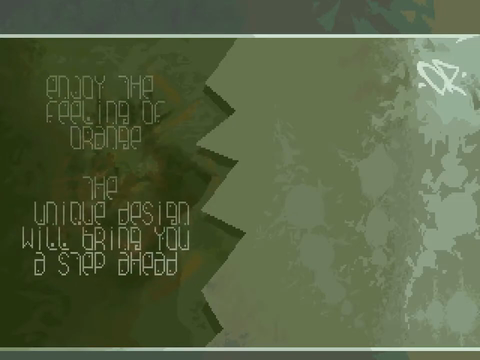
The later credits/greetings section is text-heavy. The strings are also present inside the expanded executable image, so this is not merely a video-side interpretation.

MZ/RNC Carrier
REQ.EXE is a 128,686-byte DOS MZ executable:
file size:             128686 bytes
MZ header paragraphs:       2
relocations:              252
CS:IP:               1f3b:000c
SS:SP:               7732:04de
minalloc/maxalloc:   5989 / ffff paragraphs
RNC marker:          file offset 0x20
The RNC header starts immediately after the 32-byte MZ header:
method:          RNC1
RNC offset:      0x20
packed size:     127891 bytes
unpacked size:   488204 bytes
header bytes:    41 ca 70 e4
Expanding the RNC block with the local RNC ProPack tool produced:
0acd8ae6926f53d94c5fcc1119e211f779194d9ca0b0c9cd0acc326bdc021410 RNC-expanded image
The expanded image starts with protected-mode startup/runtime material rather than another MZ executable. The visible diagnostics at the front include:
386 or better not detected!!!
Not enough low memory!!!
System is already in V86 mode, and no VCPI or DPMI found!!!
Not enough extended memory!!!
Couldn't enable A20 gate!!!
DPMI host is not 32bit!!!
Ran out of DPMI descriptors!!!
Couldn't set DPMI descriptors as needed!!!
Couldn't enter 32bit protected mode!!!
Incompatible VCPI PIC mappings!!!
Relevant scan hits in the expanded image:
int 31h calls:      0x650, 0x67a, 0x722, 0x72b, ...
int 67h calls:      0x1f7, 0x365, 0x9ab, 0x9f6, ...
ULTRASND string:    0x57f1b
GUS strings:        0x53505, 0x576d0
8CHN marker:        0x572bb
3DAh helper hits:   0x1b8c, 0x1ba2, 0x1bfa, ...
3C8h/DAC hits:      0x1c51, 0x525bb, 0x52839, ...
A000h references:   0x1a34, 0x51eab, 0x536b1, ...
That combination is enough to classify the payload as a protected-mode VGA/GUS intro image, not as a thin real-mode picture viewer.
Embedded Text Material
The expanded image carries the displayed text material as sparse fixed-width
strings around 0x51ed9 and 0x52000:
0x51ed9  ordinary us
0x51efe  original others
0x51f2a  super  brothers
0x51f46  hoplite
0x51f60  der piipo
0x52045  orange
0x520e5  orangemeda
0x5211c  nominees
0x52197  jeskola
0x521ad  nooon
The raw block around 0x52000 is laid out like screen text rather than a
normal null-terminated message table:
052000:                                enjoy the         feeling of
052040:      orange                               the           unique d
052080: esign    will bring you     a step ahead
0520c0:                   the infinite       orangemeda      sends greet
052100: ings   to the following     nominees
052140:                acme     complex  crypton darkzone  emf gollum hi
052180: rmu  impact  c   jamm  jeskola    karhu  klf nooon  plant  sonic
0521c0:   substance  surprise symptom  zuul desing  xes  acme     comple
This explains the visual style of the final section: the text is not a late HTML/video caption or an external note. It is part of the intro payload, then copied through an internal bitmap-font/mask renderer.
VGA Helper Layer
The helper area around 0x1b74 contains direct VGA register routines:
0x1b74: mov dx, 03d4h       ; CRTC start address high/low
        mov al, 0ch
        mov ah, bh
        out dx, ax
        inc al
        mov ah, bl
        out dx, ax

0x1bf5: mov dx, 03dah       ; wait for retrace high then low
        in  al, dx
        test al, 08h
        jz  0x1bfd
        in  al, dx
        test al, 08h
        jnz 0x1c02

0x1c47: mov dx, 03c8h       ; DAC index plus RGB byte stream
        out dx, al
        inc dx
        rep outsb
Other helpers flip chunky/planar-ish VGA settings through the sequencer and CRTC:
0x1c5b: mov dx, 03c4h
        mov ax, 0604h
        out dx, ax
        mov dx, 03d4h
        mov ax, 0014h
        out dx, ax
        mov ax, e317h
        out dx, ax

0x1c7e: mov dx, 03c4h
        mov ax, 0e04h
        out dx, ax
        mov dx, 03d4h
        mov ax, 4014h
        out dx, ax
        mov ax, a317h
        out dx, ax
The code also writes the graphics controller and attribute controller:
0x1cca: mov dx, 03ceh
        mov ax, 4005h
        out dx, ax
        mov dx, 03dah
        in  al, dx
        mov dx, 03c0h
        mov al, 30h
        out dx, al
        mov al, 61h
        out dx, al
So the later visual code is sitting on a small VGA control library, not on a plain BIOS-only mode call.
Picture, Mask, And Palette Loop
The most useful presentation island is around 0x525b0 to 0x52a97.
First it uploads a full 256-entry RGB palette:
0x525b0: mov esi, 113b4h
0x525b5: mov ecx, 300h
0x525ba: mov dx, 03c8h
0x525be: mov al, 0
0x525c0: out dx, al
0x525c1: inc dx
0x525c3: rep outsb
Then it preserves one palette table and converts another to grayscale by averaging each RGB triple:
0x525c5: mov esi, 30fdch
0x525ca: mov edi, 50cdch
0x525cf: mov ecx, 100h
...
0x525e4: add al, ah
0x525e6: shr al, 1
0x525e8: add al, bl
0x525ea: shr al, 1
0x525ec: mov [esi], al
0x525ee: mov [esi+1], al
0x525f1: mov [esi+2], al
The full framebuffer copy is direct and complete:
0x52618: mov esi, 412dch
0x5261d: mov edi, 0a0000h
0x52622: sub edi, [18h]
0x52628: mov ecx, 3e80h
0x5262d: rep movsd
0x3e80 dwords is exactly 64,000 bytes. This is the conventional 320x200
8-bit screen size, copied as a complete page.
The overlay pass then selects a moving source/destination window, samples four
phase variables through a 512-entry table, derives a brightness addend, and
walks a 0x9e by 0x54 region in two-byte steps:
0x5267d: mov eax, [5165ah]
0x52682: and eax, 1ffh
0x52687: mov eax, [109ach + eax*4]
...
0x52725: add edx, 400h
0x5272b: shr edx, 3
0x5272e: imul edx, [1097ch]
0x52738: and edx, 0e0h
...
0x5275a: mov ch, 54h
0x5275c: mov al, [ebx]       ; mask/text byte
0x5275e: cmp al, 0
0x52766: mov al, [esi]       ; picture/source byte
0x52768: cmp al, [51664h]
0x52774: add al, dl
0x5277d: mov ah, [ebx+1]
0x52789: mov ah, [esi+1]
0x52798: add ah, dl
0x527a2: mov [edi], ax
0x527b2: add edi, 98h
That loop is the key to the visual impression. It does not merely draw one
string over one bitmap. It combines a mask/text stream at 0x117f4, a
framebuffer/source page at 0x412dc, a moving window, a phase-table brightness
term, and a threshold byte at 0x51664. The final picture/text section looks
like unstable poster material because the code is literally merging picture
and mask bytes under changing phase and threshold state.
Retrace and palette updates are interleaved with the render loop:
0x527fe: mov dx, 03dah
0x52802: in  al, dx
0x52803: test al, 08h
0x52805: jz  0x52802
0x52807: in  al, dx
0x52808: test al, 08h
0x5280a: jnz 0x52807

0x5282e: mov esi, 113b4h
0x52833: mov ecx, 300h
0x52838: mov dx, 03c8h
0x52841: rep outsb
The late fade path blends two 768-byte palette tables with a 64-step weight:
0x528b3: mov ecx, 40h
0x528b9: mov esi, 30fdch
0x528be: mov ebx, 312dch
0x528c3: mov edi, 113b4h
0x528c8: mov ecx, 300h
0x528d3: imul eax, [0f74h]
0x528da: imul edx, [0f78h]
0x528e1: add eax, edx
0x528e3: shr eax, 6
0x528e6: mov [edi], al
After the fade, it still performs a complete A0000h copy:
0x529a5: mov esi, 0f7ch
0x529aa: mov edi, 0a0000h
0x529af: sub edi, [18h]
0x529b5: mov ecx, 3e80h
0x529ba: rep movsd
Text Renderer And Timeline State
The text blitter at 0x52c34 copies 8-byte-wide glyph slices into a larger
screen mask area. It treats space specially by pointing to a blank glyph region:
0x52c34: mov esi, 51006h
0x52c39: add esi, [50fdch]
0x52c3f: mov edi, 117f4h
0x52c44: add edi, 1190h
0x52c4a: mov cl, 09h
0x52c4c: mov ch, 12h
0x52c4e: mov al, [esi]
0x52c53: cmp eax, 20h
0x52c5c: sub eax, 61h
0x52c5f: shl eax, 3
0x52c62: add eax, 318dch
0x52c6c: movsd
0x52c6d: movsd
0x52c6e: add esi, 138h
0x52c74: add edi, 138h
The surrounding state routine advances a small timeline counter and phase variables:
[0x57230] increments every call and rolls at 3
[0x54f53] advances until 0x40, then [0x54f55] increments
[0x54f55] is clamped/rolled at 0x21
[0x5165e] += 3
[0x5165a] += 2
[0x1099c] += 2
[0x109a0] -= 3
[0x109a4] -= 5
[0x109a8] += 7
Those variables are exactly the sort of slow phase/timeline state expected by the visible run: drifting text windows, threshold changes, palette fades, and cyclic movement rather than a large number of separate scenes.
Video-To-Code Concordance
The public-video GIFs line up with two different renderer families in the expanded payload.
The green tunnel/blob GIF maps to the palette-and-page-copy side of the intro.
The visible section is dominated by a hard green/gray indexed palette, and the
code repeatedly uploads full 0x300-byte DAC tables through 03C8h/03C9h.
Before the later overlay work, the recovered path copies a complete 64,000-byte
page from 0x412dc to A0000h - [0x18] with ecx = 0x3e80. That matches the
GIF's full-screen field behavior: the motion is screen-wide and palette-heavy,
not a small sprite over a static background.
The face/text GIF maps to the masked overlay island at 0x5267d..0x527b2.
That loop combines a mask/text stream at 0x117f4, picture/source bytes from
the full-frame page at 0x412dc, a moving window, a phase-table brightness
term, and a threshold byte at [0x51664]. The public-video result is exactly
that kind of unstable poster composite: face/hand-like picture fragments
appear through a jagged mask while text rides over the same green-gray field.
The credit/greeting stills map to the embedded screen-text block and glyph
path. The strings around 0x51ed9..0x521c0 are the visible names and greetings,
and the blitter at 0x52c34 copies 8-byte-wide glyph slices into the mask area
that the later overlay loop consumes. The text is therefore not a video-side
caption; it is payload data rendered through the intro's own mask/glyph
pipeline.
The palette fades seen between these sections map to the late 64-step blend
path at 0x528b3, which mixes two 768-byte palette tables into the live table
at 0x113b4, then performs another full A0000h page copy at 0x529a5. The
video's green/gray fade language is consequently a code-level DAC strategy,
not merely a capture artifact or source-video color cast.
Audio Boundary
The expanded image contains both high-level GUS strings and tracker-format
markers. Around 0x57231, the code allocates a 64K work area and probes module
channel signatures:
0x57240: mov eax, 10000h
0x57245: call 0x1161
...
0x5729e: cmp dword [ebp+438h], 4e484336h  ; "6CHN"
0x572ae: mov byte [5285fh], 6
0x572b5: cmp dword [ebp+438h], 4e484338h  ; "8CHN"
0x572c5: mov byte [5285fh], 8
Combined with the ULTRASND hit at 0x57f1b, the Pouet platform tag, and the
archive identity, this supports the MS-DOS/GUS classification. This pass did
not fully map the player, so the article stops at the player/setup boundary
instead of claiming a full mixer analysis.
Summary
Req the Usual is not technically huge, but it has the Orange 1995 fingerprint:
small public executable, large protected-mode runtime after RNC expansion,
GUS-oriented module/player evidence, direct VGA register control, retrace/DAC
timing, full A0000h page copies, and a design that uses palette and mask
motion to make a small amount of picture/text material feel alive.
The recovered code explains the visual result cleanly. The green/gray look is not just an art choice seen in the video; it is backed by palette upload and palette-blend code. The animated text/picture section is not an external video artifact; the exact text, the glyph/mask blitter, and the phase/threshold overlay loop are inside the expanded payload. The public-video GIFs now map to the same recovered families: full-screen palette/page motion, masked picture/text overlay, glyph-fed credits, and 64-step DAC fades.