Analysis model: gpt-5.5 xhigh
Sequential by Andromeda - Technical Dissection
Scope
Sequential is Andromeda's 1994 Amiga OCS/ECS trackmo and the winner of the
Amiga demo competition at The Gathering 1994. It was announced more than two
years earlier as Scientific Norwegian; Demozoo records that HeadX spent his
entire Andromeda period working on it.
This is a Norwegian production in the literal credit-by-credit sense. Demozoo locates Archmage, Decker, Dr. Jekyll, Fairfax, HeadX, Interphace, Mr. Hyde, Mr. Man, Quest and View in Norway. The nationality is not inferred from the party or group name.
Useful public references:
- Demozoo production: https://demozoo.org/productions/125/
- Demozoo The Gathering 1994 results: https://demozoo.org/parties/40/#competition_163
- Pouet production: https://www.pouet.net/prod.php?which=403
- A.D.A. production: https://ada.untergrund.net/?i=5&p=demo
- WHDLoad preservation install: https://www.whdload.de/demos/Andromeda_Sequential.html
- Scene.org party disk: https://files.scene.org/view/parties/1994/thegathering94/amiga_demo/andromeda-sequential.dms
- Demozoo-linked silent visual reference: https://www.youtube.com/watch?v=c8DX2PjDj3E
Pouet's 125 positive, nine neutral and zero negative votes are unusually decisive for a thirty-two-year-old demo. More importantly, they fit the thing itself. This is not a famous logo attached to a thin production. It is nearly seven minutes of deliberately ordered effects followed by a long authored credit-and-story ending.
Complete Silent Viewing
The complete 705.08-second, 50 fps archival presentation linked by Demozoo was examined without audio. A silent 25 fps FFV1 working copy was used for frame-by-frame visual inspection. It has one video stream and no audio stream. The original Scene.org disk was separately retained and analysed at byte level.
The distinction matters: the available open replacement ROMs do not boot this custom trackloader correctly. Direct tests with FS-UAE and vAmigaWeb reach a blank or flat-colour screen. Current WHDLoad and the older JST substitute also fail to produce a trustworthy complete run in that environment. None of those failed executions is presented as visual evidence, and no emulator failure is mistaken for the demo's ending.
The archival run reaches a landscape picture at about 406 seconds, begins the complete credits near 420 seconds and continues into Andromeda's long comic story. The final text clears at roughly 690 seconds. This establishes the actual authored endpoint.
Every animation below is a continuous GIF excerpt from that complete
presentation. The two stills preserve authored artwork which does not benefit
from being padded into an animation. The page contains no embedded video, MP4
or H.264 asset. The public-reference working file used for this visual update
was video-only, 705.04 seconds long, and had SHA-256
6dea6e23a2019e7f84f20b930af3f82968ef00b5df086161d22e9142cc8c5469.

The opening quote holds long enough to reset the viewer's pace. Transparent bubbles then cross a dark blue field while green, reflected letterforms stretch, reverse and dissolve through them. The lettering is not merely introduced by the effect: its unstable reflection is the effect.

The famous roller-coaster is graphically austere: a striped ribbon, a blue field, a green ground and a narrow vertical side panel. Its force comes from the continuous camera path. The ribbon rises into walls, falls away, bends sideways and rolls around the viewer without changing into a different object.
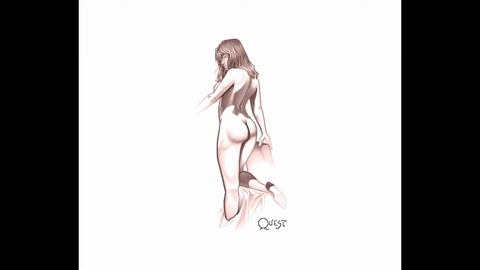
Quest's signed figure is given a full white field after the roller-coaster. It is an authored pause rather than an effect pretending to move, and a clean frame records its line work more honestly than a looping GIF would.

After Quest's figure, a checkerboard platform sits below fragments that separate, orbit and reassemble. The textured still background and small flat-shaded bodies make the motion readable without filling the screen with polygons.

The next family treats a red-and-white jointed body as a small physical
system. It bends into a U, throws black satellite balls outward, collapses
and recovers while the camera rotates around it. This is why a still image
undersells Sequential: the relationship between the pieces is the subject.

A pale cube opens into a black cross-shaped aperture. Blue facets rotate independently inside it, then close back toward a single object. The scene reuses the restrained purple stage and narrow top border, so a fairly abstract mechanism still belongs to the same show.
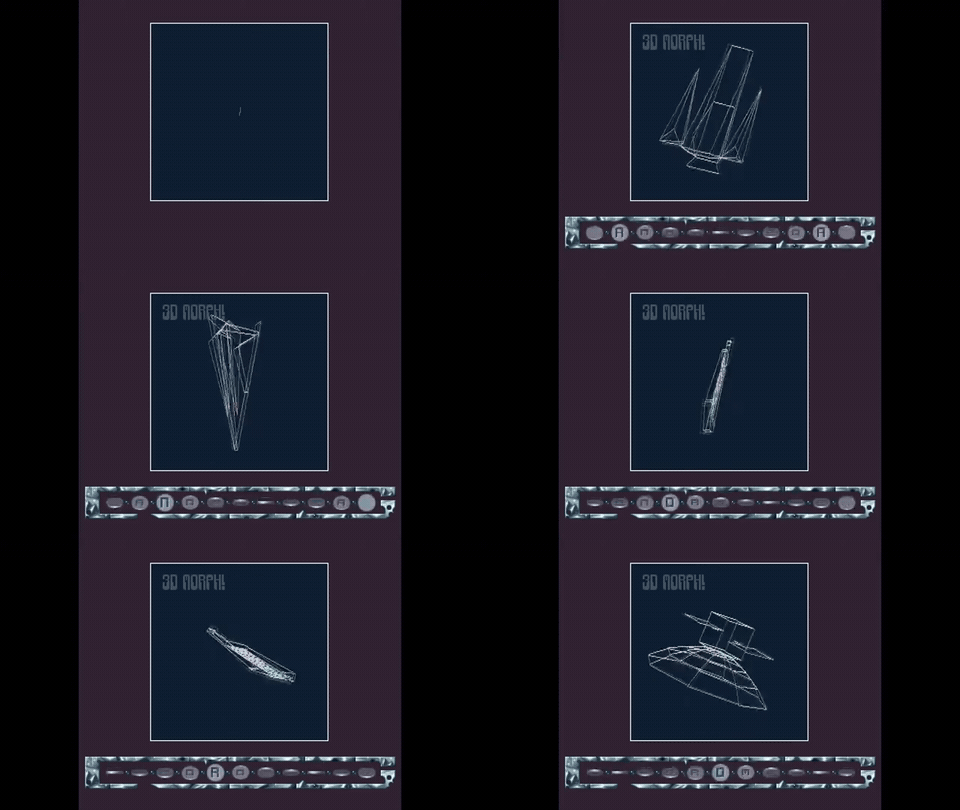
The later 3D MORPH panel turns a succession of wireframe objects through a
CAD-like viewport. Its fixed frame and icon strip make the changing topology
easy to compare: chairs, tools and abstract structures are variations inside
one interface, not unrelated screens.

Late in the demo, a sparse globe carries branching blue electrical lines. Highlights on the rim make it read as a volume even though most of the sphere is black. It is the final sustained real-time effect before View's landscape and the textual ending.

View's landscape supplies the last pictorial stop before the credits. The framing tree, distant valley and seated foreground figure create depth without real-time motion; retaining it as a still also makes the transition from the electrical globe to the long textual ending visible on the page.
Credits as Presented
The production and preservation records agree on the principal assignments:
- HeadX: main code.
- Dr. Jekyll: trackloader.
- Mr. Hyde: vector explosion and delta player.
- Mr. Man: music.
- Archmage: title graphics.
- Fairfax: logo and two pictures.
- Quest: the figure and logo.
- View: ray-traced graphics.
- Decker: additional graphics.
- Interphace: design assistance.
Demozoo catalogues three Mr. Man pieces in the production: Opening2,
Main2 and Orchestral2.fix. Because this inspection was intentionally
silent, the article does not invent musical judgements or sync events from
the waveform. The division into three pieces is catalog evidence, not a claim
derived by listening.
The Surviving Party Disk
The Scene.org party file is a DMS image:
2e181759a63f6cf358e0956d21fa126aec46e1fa7bf38698fc3a5cb597ccaabc  andromeda-sequential.dms
9e628d3553d7f475c685798e85aa874cfe2d7f9329eedf697e934151c0862f01  sequential.adf
The DMS file is 852,081 bytes. Its header records DMS 1.12 Evaluation,
creation on 2 April 1994, tracks 0 through 79, HEAVY2 compression and
901,120 unpacked bytes. xDMS verifies every track checksum and reconstructs a
standard-size double-density Amiga disk image.
The disk begins with DOS\0, a boot-block checksum and executable 68k code,
but it is not a normal collection of AmigaDOS files. A conventional root-block
reader rejects block 880. That is expected for a trackmo which gives most of
the medium to its own loader and data layout. Describing it as a corrupt OFS
disk would confuse an intentionally custom format with a damaged filesystem.
The 1,024-Byte Boot Block
The first 1,024 bytes are active boot code, not a filesystem preamble. The
entry at byte $10 begins by using Exec state, checks the machine, touches
expansion.library, takes control of the custom chips and establishes its own
memory areas. Paula, CIA and custom-register accesses appear directly in this
stage.
The boot block then hands control to a larger stage stored immediately after it. This is the first important structural boundary:
disk byte $000000  1,024-byte boot block
disk byte $000400  8,192-byte initial loader stage
disk byte $002400  remaining custom trackmo payload
The disk is therefore self-contained at a much lower level than a normal
LoadSeg() demo. Kickstart is needed to enter the boot code, but AmigaDOS does
not schedule the show and no executable filename is opened.
What the WHDLoad Adapter Reveals
The independent 1998 WHDLoad adapter is only 420 bytes, but its patches expose
the original loader's contract precisely. It asks WHDLoad to copy 8,192 bytes
from disk byte offset 1,024 into address $40000. It then:
- replaces the instruction at
$40010with aNOP; - installs a jump at
$40040so control can return through the adapter; - clears DMA and interrupt state through the custom registers;
- jumps to the original stage at
$40000.
When that original stage initializes, the adapter patches two internal loader
entry points, at offsets $0ee0 and $1b08 from the runtime loader base at
$80000. Both are redirected to a small translation routine. The adapter
places $80000 and $100000 in a two-longword handoff area at $42000
before entering the bootstrap; its callback later retrieves the first of
those values rather than assuming that the final loader remained at
$40000.
The translation is revealing. The original loader passes two word-sized
values. The adapter sign-extends them, shifts each left by nine and calls
resload_DiskLoad. A shift by nine is multiplication by 512, so the demo's
own interface speaks in sectors while WHDLoad speaks in byte offsets and byte
lengths.
This is not proof that every effect occupies one neat contiguous sector range; the loader may request many pieces over time. It does prove that the trackmo has an explicit sector-addressed streaming layer and that the preserved adapter leaves the original visual code in charge after replacing only disk access and exit handling.
A Trackmo Built Around Continuity
The runtime makes the storage architecture visible without exposing it. Scenes do not stop at an AmigaDOS loading screen or return to a menu. Instead:
- bubbles and liquid type establish the reflected visual motif;
- the roller-coaster turns a simple ribbon into a long camera event;
- the checkerboard platform introduces separated vector bodies;
- the jointed red object develops those bodies into a physical system;
- the black aperture and blue facets make construction itself visible;
- logos, wireframes, pictures and the lightning globe slow the pace toward the ending.
The narrow decorated borders recur across several otherwise unrelated effects. They work like punctuation: the engine can replace the main routine and data while the surrounding visual language tells the viewer it is still one production.
The changes of technique are substantial. The run includes reflected lettering, a continuous ribbon camera, flat-shaded and wireframe geometry, jointed motion, vector fragmentation, ray-traced stills and a long text system. The trackloader lets those parts arrive as a sequence rather than forcing all working material to coexist in the Amiga's one megabyte at once.
Why It Still Works
Sequential is often called one of the last great A500-style trackmos. That
description is useful if “last” means culmination rather than exhaustion. Its
effects are not uniformly unprecedented, and it does not pretend that more
polygons alone make a better demo. Its achievement is editorial.
The roller-coaster stays on screen long enough to become a journey. The physics objects are given enough empty space for their motion to read. Pictures arrive as pauses rather than decoration. Even the very long ending is deliberate: Andromeda gives the makers, greetings and story their own final act instead of compressing them into a flashing credit screen.
At disk level the same discipline appears as a 1,024-byte boot block, an
8,192-byte resident stage and sector-addressed streaming patched at only two
loader entry points by the later preservation adapter. At screen level it
appears as continuity. Sequential is not a pile of effects loaded from a
disk; it is a disk system designed to make separate effects feel sequential.