Analysis model: gpt-5.5 xhigh
Shoot by The Phoney Coders - Technical Dissection
Subject: Shoot by The Phoney Coders.
Shoot is a short July 1992 MS-DOS VGA demo by The Phoney Coders. It is not a
music demo and it is not a long multi-effect production; it is a compact
pre-rendered/sprite-style show built around a spaceship fly-through and a
raytraced end picture.
Release year: 1992.
The strongest technical evidence here is the runtime capture and the packed EXE
entry stub. The visible demo body remains behind a modified LZ-family packer:
the depacker is readable, but a stock unlzexe restore does not accept the
file. The effect-loop notes below therefore distinguish hard evidence from
inference.


Sources
- Hornet 1992 demo index
- Scene.org file page
- Scene.org archive download
- Demozoo production page
- Pouet production page
Demozoo lists the release as July 1992 on MS-DOS, with Phoenix credited for code/graphics and SHD for graphics. Pouet also lists July 1992, MS-DOS, demo, and carries the contemporary summary that it is VGA with no sound.
The NFO says the production was programmed in 100% assembly, credits Phoenix for programming, credits Phoenix and SHD for raytracing/bitmaps, says the spaceship roll-over and end picture were raytraced in Autodesk 3D Studio 2.0, and says there is no music because the demo is short. It also contains a generic historical contact invitation; no contact details are repeated here.
Archive
The examined archive is tpcshoot.zip from the Hornet 1992 mirror:
tpcshoot.zip 190173 bytes
ZIP contents:
demosite.com      1129 bytes   1992-10-26 05:23:20
tpcshoot.exe    193212 bytes   1992-07-05 17:50:36
tpcshoot.nfo      1685 bytes   1992-07-05 17:41:44
Hashes:
aed3ba14618370fba98e05472e26230a3525e88efe40817eeab7af1271c3dee9  tpcshoot.zip
c2ad85db79effafee21bc21264ae6051c2a69e977e5f19b0426ae33fb0326292  demosite.com
12fd0e45a777ca2bfc0bb93d61a897b423e60321badaa97e8cf2d4b8ca416411  tpcshoot.exe
92a513944660b893d410c5ae390043f45974a2353404de52f732bfbdbed95caf  tpcshoot.nfo
The demosite.com sidecar is the standard Hornet/DemoSite launcher stub and is
not part of the visible demo body. tpcshoot.exe is the production.
Runtime Capture
The run used DOSBox-X 2026.01.02, machine=svga_s3, cycles=12000, no sound,
and no keyboard input. The demo exited by itself. The captured MTS duration is
35.925333 seconds.
Observed frame times:
00:01.000  striped magenta/purple intro palette bands with small center text
00:02.000  black
00:04.000  huge red/pink intro text begins at the right edge
00:05.000  huge text pass, close-up letters
00:07.000  text pass continues across the screen
00:10.000  final part of the text pass
00:12.000  full white flash
00:13.000  overhead maze section begins; ship appears above HUD
00:16.000  maze/viewport and explosion sprites visible
00:20.000  maze mid-run; ship, walls, HUD, and shots visible
00:23.000  maze continues, ship near lower center
00:25.000  maze nearly clear except lower wall strip and ship
00:26.000  ship roll-over / angled 3D Studio render
00:27.000  close frontal ship shot
00:28.000  grey impact/flash frame
00:29.000  raytraced Phoney Coders logo begins to fade in
00:31.000  raytraced logo is near peak brightness
00:33.000  logo fading down
00:34.000  black
00:35.925  process exits
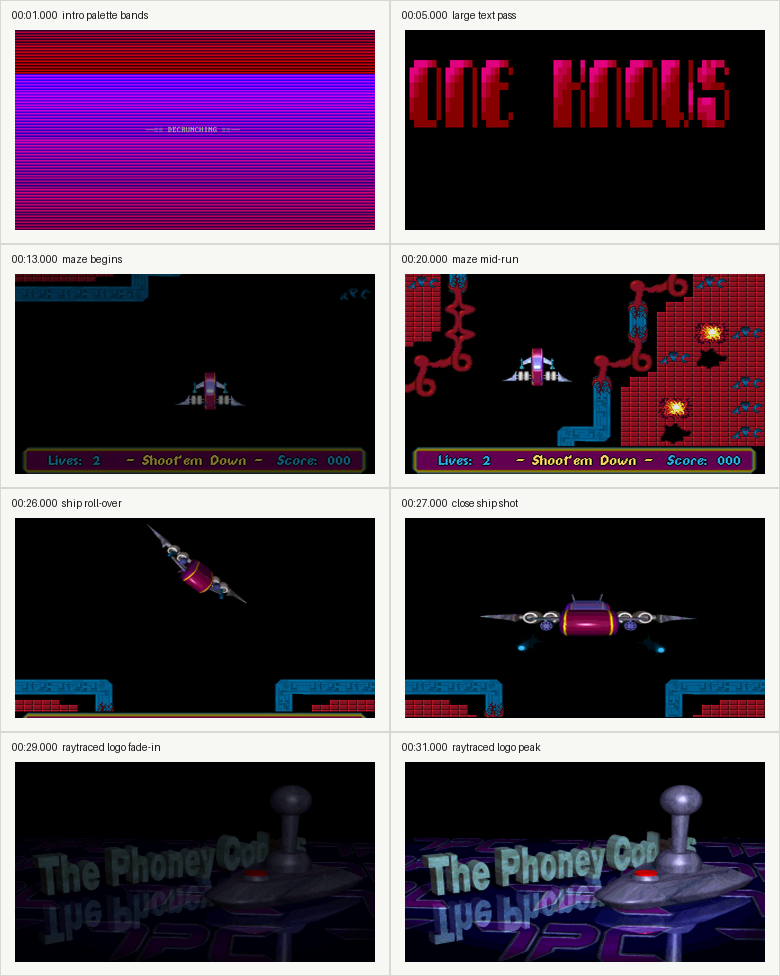
Individual runtime frames:
- 00:01.000 intro bands
- 00:05.000 huge text pass
- 00:13.000 maze begins
- 00:20.000 maze mid-run
- 00:26.000 ship roll-over
- 00:27.000 close ship shot
- 00:29.000 logo fade-in
- 00:31.000 logo peak


The sparse GIF above is a direct 720x400 sequence from those eight DOSBox-X frames. It is not a browser screenshot or resized lightbox capture; it just compresses the visible script order into one index-friendly loop.
The important way to read that sheet is as one scripted player, not as a pile of
unrelated stills. 00:01.000 and 00:05.000 are the intro/text phase,
00:13.000 through 00:25.000 are the maze/viewport phase, 00:26.000 and
00:27.000 are the raytraced ship renders, and 00:29.000 through 00:33.000
are the timed logo fade. That progression matches the binary's stated art
pipeline: pre-rendered intro material, a scripted maze scene, and raytraced end
assets. The capture therefore verifies the effect ordering rather than just
showing a few disconnected scenes.
Runtime-To-Code Concordance
This target has two confidence levels. The loader/depacker path is exact
static evidence from TPCSHOOT.EXE; the visible effect body is a bounded
reconstruction because the modified LZ-family stream was not restored into a
dumped show image during this pass. The runtime GIF and stills are therefore
used to verify chronology and asset classes, not to claim unrecovered function
addresses for every on-screen blit.
The hard executable path before anything visible is:
MZ header entry FFF0:0100 wraps to raw 0200h
0200h trampoline checks memory and moves the active depacker upward
copied depacker reads a bitstream from DS:SI into ES:DI
literal path writes lodsb/xor/stosb bytes
match path copies spans from already-expanded output
normalization path advances DS/ES across 64K segment boundaries
relocation loop patches far/segment references
final block restores SS:SP, pushes original CS:IP, clears registers, retf
That exact path explains the capture's quiet start: the show is not entered until after a relocated decompression pass, relocation fixups, and a far return into the restored program. It also explains why the article treats the later effect code cautiously: the visible body is behind the modified stream, while the stub itself is readable.
The observed runtime order still gives a strong scene-level concordance:
00:01-00:11  intro bands and giant red/pink text
00:12        full white flash
00:13-00:25  maze/HUD/ship/projectile section
00:26-00:28  pre-rendered ship roll and impact/flash
00:29-00:33  raytraced Phoney Coders logo fade
00:34-00:35  black and process exit
The intro frames are consistent with prepared bitmap material rather than character text. The huge letters are shaded, cropped, and move as if a wide source image or custom large-font strip is being windowed into the 320-pixel view. The static evidence supports a packed bitmap-heavy program; the NFO supports a short art-driven assembly demo; the capture shows no interactive text-mode or normal font phase.
The maze frames are also better read as a scripted player than as a game loop. The lower HUD remains stable while the playfield/ship/projectiles change above it. That points to either a copied playfield region plus separately preserved HUD strip, or precomposed frames with a repeated footer. The capture has no keyboard-controlled behavior and the demo exits on its own, so a deterministic sequence of bitmap/sprite updates is the safer model.
The ship and end-logo frames line up directly with the NFO's toolchain claim:
the spaceship roll-over and end picture were raytraced in 3D Studio 2.0. The
00:26.000 and 00:27.000 frames are not the same top-down sprite as the maze
section; they are rendered presentation frames. The 00:29.000 to 00:33.000
logo sequence is a timed fade of a raytraced bitmap, plausibly palette-driven
or short-frame-sequence driven. Without the restored body, the safe statement is
that the visible capture proves the fade choreography, not the exact fade
routine.
So the current evidence stack is:
exact:  wrapped MZ entry, relocated depacker, bitstream refill, literal/match
        paths, segment rollover, relocation table, far return
strong: no-sound 35.925333s runtime chronology, auto-exit, scripted scene order
bounded: intro/maze/ship/logo implementation model inferred from capture, NFO,
         bitmap-heavy file shape, and raytraced-art credits
missing: restored show-body dump and function-level blitter addresses
A future deeper pass should stop at the final depacker retf, dump the restored
image, then replace the bounded implementation model with named routines for
the intro bitmap pass, maze sprite compositor, ship-frame player, and end-logo
fade.
Packed MZ Layout
TPCSHOOT.EXE is a packed MZ executable:
declared file size  193212 bytes
actual file size    193212 bytes
header size            512 bytes
load image          192700 bytes
relocations              1
entry              FFF0:0100
stack              2F12:0200
minalloc           2ACEh paragraphs
maxalloc           FFFFh paragraphs
relocation table   001Ch
The entry point is the first important trap. Taken as a normal linear
calculation, FFF0:0100 points far beyond the file. DOS segment arithmetic is
16-bit, though:
(e_cparhdr + e_cs) & FFFFh = (0020h + FFF0h) & FFFFh = 0010h
entry raw offset = 0010h * 16 + 0100h = 0200h
So the real entry stub starts at raw file offset 0200h.
The only readable string in the packed image is the DOS failure message:
Not enough memory$
Everything else useful is compressed or rendered as pixels rather than stored as plain ASCII.
Why Stock unlzexe Fails
The entry stub is clearly in the LZEXE family, but it is not byte-identical to
the stock LZ09 or LZ91 signatures. A POSIX build of unlzexe was tried in
scratch space. After patching the tool to treat the wrapped CS=FFF0h entry as
DOS would, it still rejected the file as not stock LZEXE.
That does not mean the file is not LZ-derived. It means the packer has a
modified stub or extra obfuscation. The static depacker loop below is therefore
from the actual TPCSHOOT.EXE bytes, not from a guessed stock unpacker.
Entry Stub
The first block at 0200h performs memory setup and copies the active depacker
stub to a safer high-memory location:
mov ax,541Bh
mov dx,2F0Ch
add ax,0000h
cmp ax,[0002h]
jae not_enough_memory
sub ax,0020h
cli
mov ss,ax
sti
sub ax,0025h
mov es,ax
push ax
mov cx,0126h
xor di,di
push di
mov si,0144h
cld
rep movsw
retf
The important part is not the literal segment constants, which depend on the packed layout. The shape is:
1. verify there is enough memory for the expanded image
2. move stack and ES upward
3. copy 0126h words of unpacker code/data with REP MOVSW
4. far-return into the copied unpacker
That explains the odd header: the first on-disk entry is just a trampoline into the relocating depacker.
Depacker Inner Loop
The copied depacker sets up source and destination segments, then enters a bitstream decoder. The key state is:
DS:SI  compressed input stream
ES:DI  decompressed output stream
BP     bit reservoir
DX     bit count / refill counter
BX/CX  match length/span builder
The refill pattern appears throughout the loop:
shr bp,1
dec dx
jnz have_bit
lodsw
xchg ax,bp
mov dl,10h
have_bit:
rcl bx,1
That is the usual LZ-family idea: one bit is shifted out of the reservoir, and when the counter expires another 16-bit word is loaded from the compressed stream.
Literal Path
The short literal path is:
lodsb
xor al,dl
stosb
The xor al,dl is one of the reasons this does not look like a plain stock
LZEXE stream. DL is also the low byte of the refill counter. In practice the
literal is lightly obfuscated by the current bit-counter state before it is
written to the output.
Match Path
The match path builds a span and length through several cascaded bit tests and small tables embedded in the depacker body. The hot copy is:
push si
mov si,di
sub si,bx
cli
rep es:movsb
sti
pop si
Both source and destination are in the output segment. SI = DI - BX points
back into already-decompressed bytes, and CX is the match length. The ES:
segment override on movsb makes it a self-copy inside the output window. This
is the classic LZ sliding-window operation: literals seed the stream, matches
copy earlier byte runs forward.
Segment Rollover
Because this is a real-mode 16-bit program, DI and SI cannot simply grow
forever. The depacker has a normalization path:
lea bx,[di-2000h]
and di,000Fh
add di,2000h
mov cl,04h
shr bx,cl
mov ax,es
add ax,bx
mov es,ax

mov ax,ds
mov bx,si
and si,000Fh
shr bx,cl
add ax,bx
mov ds,ax
This folds large offsets back into a small offset plus a higher segment value. It lets the unpacker stream across more than one 64 KB real-mode segment while still using 16-bit registers.
Relocation And Far Return
After the compressed byte stream ends, the depacker applies a relocation table to the restored image. The core relocation loop is:
lodsw
inc ax
jz relocation_done
dec ax
jz next_relocation_segment
xchg ax,cx

reloc_loop:
  lodsw
  xchg ax,di
  add es:[di],bx
  loop reloc_loop

add dx,0FFFh
jmp next_relocation_segment
The final block restores the original program stack and far entry:
lodsw
add ax,bx
cli
mov ss,ax
lodsw
mov sp,ax
sti

lodsw
add bx,ax
push bx
lodsw
push ax

mov es,bp
mov ds,bp
xor ax,ax
xor bx,bx
xor cx,cx
xor dx,dx
xor bp,bp
xor si,si
xor di,di
retf
So the packed loader does not call the original program directly. It constructs
the original CS:IP on the stack, clears registers, and exits the stub through
a far return.
Visible Demo Structure
The restored show code was not dumped in this pass, so the following is a reconstruction model from the capture, NFO, and data shape rather than a line-by-line source claim.
The demo behaves like a scripted bitmap/sprite player:
intro palette/text section       00:01-00:11
full white flash                 00:12
overhead maze section            00:13-00:25
pre-rendered ship roll/close-up  00:26-00:28
raytraced end picture fade       00:29-00:33
black / exit                     00:34-00:35.925
There is no observed sound setup and no runtime audio output. This matches the NFO's "no music" explanation.
Intro Text Section
The intro has two visual layers:
00:01  a magenta/purple raster-like striped page
00:04  huge red/pink close-up letters over black
The large text pass is probably not a normal character-mode scroller. The letters are too large, shaded, and cropped. The practical implementation is likely a prepared bitmap strip or a custom large-font bitmap blitter:
for each frame:
    clear or reuse black background
    choose x offset into a wide text/bitmap source
    copy the visible 320-pixel window to A000h
    wait for a timing step
The one-second frames show large horizontal movement between samples, so the actual frame step is much finer than the sampled contact sheet.
Maze Section
The maze section is the core show:
stable lower HUD: lives / title / score
moving maze/viewport above it
ship sprite near lower center or screen center
small projectile/explosion sprites on the map
The ship does not behave like a full game object controlled by input in this capture. It follows a predetermined path. The likely frame pipeline is:
for each scripted frame:
    copy map/viewport or pre-rendered maze page into the playfield area
    preserve or redraw the HUD strip
    draw transparent ship sprite
    draw flame/projectile/explosion sprites
    wait for retrace/timer
The HUD's stability matters. It implies the playfield and HUD are separate regions, or the whole frame was pre-rendered with a repeated HUD footer. Given the compact 35.9-second runtime and the NFO's emphasis on raytraced assets, a scripted bitmap player is the most plausible model.
Ship Roll And End Picture
The NFO explicitly says the spaceship roll-over and end picture were raytraced in 3D Studio 2.0. The capture matches that:
00:26  angled ship render, no longer top-down gameplay sprite
00:27  close frontal ship render with blue exhaust pixels
00:28  grey impact/flash frame
00:29  raytraced Phoney Coders logo begins to appear
00:31  logo reaches readable brightness
00:33  logo fades down
This section is most likely a sequence of compressed full-screen or partial screen bitmaps. The end logo has gradual brightness changes, so the fade could be either palette-based or a short sequence of rendered/faded frames. Without the restored body, the safer claim is simply that the visible result is a timed fade of a raytraced bitmap.
What To Recreate
To recreate the demo faithfully, implement the show as a short scripted VGA player:
mode 13h / 320x200x256
intro raster page and large shaded bitmap text
white flash frame
maze viewport frames with a stable HUD strip
transparent ship/projectile/explosion sprites
pre-rendered ship roll-over frames
raytraced end-logo fade
exit to DOS after roughly 35.9 seconds at the tested speed
The only exact inner loop recovered here is the packed-loader loop. For exact
effect code, the next step would be to run the modified LZ depacker under a
real-mode debugger or emulator, stop at the final retf, and dump the restored
MZ image before the show body begins.