Analysis model: gpt-5.5 xhigh, sol high
Last edited: 2026-08-25
Sorcerian Cracktro by The Humble Guys - Technical Dissection
Sorcerian Cracktro is a 30 March 1990 MS-DOS cracktro by The Humble
Guys. Demozoo lists it as a The Humble Guys production released on that date,
with a Scene.org download and SORCER.NFO info file. Pouet lists the same
production as a 1990 MS-DOS 32K cracktro.
Release year: 1990.
Sources:
- Demozoo production page: https://demozoo.org/productions/187002/
- Demozoo The Humble Guys group page: https://demozoo.org/groups/7421/
- Pouet production page: https://www.pouet.net/prod.php?which=76177
- Scene.org file info: https://files.scene.org/view/demos/compilations/lost_found_and_more/cracktro/sorcerian_cracktro.zip
- Scene.org archive: https://files.scene.org/get/demos/compilations/lost_found_and_more/cracktro/sorcerian_cracktro.zip
This one is not the same simple BIOS text-card family as the January/February
1990 THG cracktros. The visible public frame is a sparse starfield with the
title Sorcerian, and the preserved COM is wrapped in a much more interesting
THG compressor. The carrier can now be followed through its high-memory
self-copy, generated probability table, range/LZ decoder, checksum, and far
jump into a byte-exact restored Turbo Pascal/BGI program. That restored body in
turn exposes the real 200-star update loop, its five speed bands, selective
old-point repair, palette schedule, and the exact THG.DAT title consumer.
The old release text and THG.DAT contain board/contact material. I do not
reproduce that material here. The structural notes below stop at the encoding
format and safe title/greeting strings.
Visual References
| Time | Image | Notes |
|---|---|---|
00:00.000 |
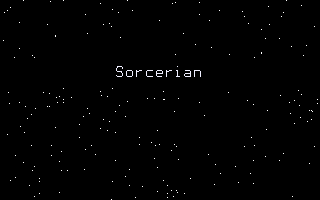 |
Public Pouet screenshot of the in-effect 320x200 starfield/title screen. Treat this as a visual state marker, not as measured animation time. |
| exit/prompt |  |
Public Demozoo/Scene.org still of the DOS prompt after the cracktro has printed its final THG line and returned. |
Generated carrier/data map:

A DOSBox-X 2026.01.02 dummy-video run confirmed that the program starts and
switches display state. The deeper pass no longer depends on that headless run
for the renderer: a scratch 16-bit emulation of the carrier reached its normal
far-jump handoff, and the checksum-accepted restored bytes were then
disassembled directly. The Pouet still above matches the recovered code's
320x200 VGA256 field, centered sidecar title, and sparse horizontal stars.
Archive Shape
The examined Scene.org ZIP is 25,182 bytes:
SORCER.COM  23,738 bytes  1990-03-27 20:16
SORCER.NFO   1,416 bytes  1990-03-30 09:57
THG.DAT        451 bytes  1990-03-30 10:08
SHA-256:
70d9a7f30144e63f349b590e5a0ac42cdb3f0256082ead951b713d2e83ad313b  sorcerian_cracktro.zip
435c1e7cddd5c919fc30cc1054ad48622818a1cfd23ab72293b79016c8232118  SORCER.COM
eec286ad6af056440ff6e836cd5266b8d6c274054f1d2cddf5e10b917ccaf20c  SORCER.NFO
749f55029079d372edcea735f5b3b417a44fbabfd3113465feaefa60c00ccb7f  THG.DAT
SORCER.NFO is plain CRLF text. The safe release metadata says the package is
for Sorcerian by Sierra On-Line, packaged by Fabulous Furlough, and that the
game appears to be unprotected. Later lines contain old contact details and are
intentionally not republished.
THG.DAT is binary/encoded data, not a plain text NFO.
COM Entry And High-Memory Move
SORCER.COM is a flat COM image. Runtime offset 0100h is file offset
0000h.
The first bytes:
0100  eb 13              jmp 0115h
0102  73 43 65 66 ...    embedded marker/data
0108  48 47 46 49 ...    "HGFINAL.COM",00
The marker is not executed. Code starts at 0115h:
0115  bb ff ff           mov bx,0ffffh
0118  b4 4a              mov ah,4ah
011a  cd 21              int 21h
011c  81 eb f0 1f        sub bx,1ff0h
0120  73 18              jae 013ah
0122  ba 2b 01           mov dx,012bh
0125  b9 0f 00           mov cx,000fh
0128  e9 79 01           jmp 02a4h
012b                    "Out of memory.",07
The INT 21h/AH=4Ah call deliberately requests an impossible paragraph count.
On DOS, that returns the largest available block size in BX. The code then
subtracts 1FF0h paragraphs. If the block is too small, it prints the
15-byte error string through DOS write-to-handle and exits with AX=4C08h.
If memory is large enough:
013a  8c d8              mov ax,ds
013c  a3 d2 02           mov [02d2h],ax
013f  05 00 10           add ax,1000h
0142  a3 58 01           mov [0158h],ax
0145  8e c0              mov es,ax
0147  e8 b4 01           call 02feh       ; ret stub
014a  b9 00 ff           mov cx,0ff00h
014d  fc                 cld
014e  be 00 01           mov si,0100h
0151  33 ff              xor di,di
0153  f3 a4              rep movsb
0155  ea db 00 00 00     jmp far high:00dbh
Two far pointers are patched before the copy. The word at 0158h becomes
PSP + 1000h, so the first EA far jump lands in the high copy at offset
00DBh. The word at 02D2h is the segment half of the later restored-runtime
far jump, so it becomes the original PSP/output segment. DS still points at
the original PSP segment until the high code changes it.
The count FF00h is larger than the physical file. DOS has loaded the whole COM
at PSP:0100h, and the copy pulls the file plus whatever follows in the COM
memory image. The compressed stream that matters is inside the file-backed part.
Generated Decode Table
The high-copy decoder begins at file/high offset 00DBh:
00db  0e                 push cs
00dc  1f                 pop ds
00dd  bb 10 00           mov bx,0010h
00e0  bf ff fe           mov di,0feffh
00e3  be 5a 00           mov si,005ah
00e6  33 c0              xor ax,ax
00e8  99                 cwd
00e9  b1 04              mov cl,04h
This sets DS=CS, so all later compressed-stream and table reads are from the
high copy.
The table-builder loop:
00eb  8a 2c              mov ch,[si]
00ed  d2 ed              shr ch,cl
00ef  80 cd f0           or ch,0f0h
00f2  02 eb              add ch,bl
00f4  75 02              jne 00f8h
00f6  42                 inc dx
00f7  aa                 stosb
00f8  40                 inc ax
00f9  80 f1 04           xor cl,04h
00fc  74 01              je 00ffh
00fe  46                 inc si
00ff  3a e0              cmp ah,al
0101  75 e8              jne 00ebh
0103  52                 push dx
0104  4b                 dec bx
0105  75 dc              jne 00e3h
What this does:
- It alternates between the high and low nibbles of the byte stream beginning
at high offset
005Ah. - Each nibble is ORed with
F0h, then biased byBL. - If the biased value wraps to zero,
DXis incremented. - The low byte of
AXis written to the table atES:DI. DIstarts atFEFFh, so the table wraps around the top of the high segment into0000h.- One
DXthreshold word is pushed perBXpass, for 16 pushed threshold words.
The odd-looking CMP AH,AL stop condition means a pass runs until the high and
low bytes of AX match after an increment. Starting at zero, that is 257
stores, not a tidy 256. This is one reason a naive "byte table" rewrite is easy
to get wrong.
The threshold words observed from the literal table-generation model are:
0000h, 0002h, 0008h, 0008h, 0008h, 000Eh, 0018h, 0018h,
0018h, 0018h, 0018h, 0018h, 0018h, 0013h, 0008h, 0008h
The first zero is not a bug in the disassembly. The later range loop can descend through empty buckets until it reaches a live threshold.
Bit Reader
The compressed input pointer is set here:
020f  bf 00 01           mov di,0100h
0212  be ff 01           mov si,01ffh
0215  33 db              xor bx,bx
0217  33 c9              xor cx,cx
0219  ba 01 00           mov dx,0001h
021c  8b ec              mov bp,sp
021e  8b 46 1e           mov ax,[bp+1eh]
0221  eb 1b              jmp 023eh
The bit reader is inlined twice. This is the core form:
023e  d0 24              shl byte [si],1
0240  73 f4              jae 0236h       ; carry clear -> bit 0
0242  75 df              jne 0223h       ; carry set and byte not empty -> bit 1
0244  46                 inc si          ; byte exhausted
0245  f9                 stc
0246  d0 14              rcl byte [si],1 ; seed next byte with carry 1
0248  73 ec              jae 0236h
024a  eb d7              jmp 0223h
This is not a normal LODSB bitstream. It destructively shifts the compressed
byte in memory. When a byte becomes zero after shifting, it advances SI and
uses STC plus RCL [SI],1 to inject a one-bit sentinel into the next byte.
That sentinel/refill convention is why patching bytes inside the apparent
"final code" region changes decompression: from 01FFh onward, code-looking
bytes are also compressed input.
Range Bucket Inner Loop
The symbol decoder uses BX, CX, DX, BP, and the stack thresholds:
0223  03 da              add bx,dx
0225  3b d8              cmp bx,ax
0227  72 11              jb 023ah
0229  2b d8              sub bx,ax
022b  03 c8              add cx,ax
022d  4d                 dec bp
022e  4d                 dec bp
022f  8b 46 1e           mov ax,[bp+1eh]
0232  d1 e3              shl bx,1
0234  d1 e2              shl dx,1
0236  3b d8              cmp bx,ax
0238  73 ef              jae 0229h
023a  d1 ea              shr dx,1
023c  74 0e              je 024ch
The important correction versus a simple bit decoder is that BX and DX are
only doubled after crossing a cumulative threshold. On a bit that does not cross
one, the code falls directly to SHR DX,1. Once DX shifts down to zero, the
symbol index is:
024c  03 d9              add bx,cx
024e  81 fb 01 00        cmp bx,0001h
0252  74 0d              je 0261h        ; copy token
0254  8a 87 ff fe        mov al,[bx-0101h]
0258  aa                 stosb
0259  81 ff ab 91        cmp di,91abh
025d  72 b6              jb 0215h
Literal token:
symbol index BX != 0001h
AL = table[BX - 0101h]
store AL to ES:DI
advance DI
Copy token:
0261  b8 02 00           mov ax,0002h
0264  e8 6d 00           call 02d4h      ; length
0267  8b c8              mov cx,ax
0269  03 c7              add ax,di
026b  72 31              jb 029eh
026d  3d ab 91           cmp ax,91abh
0270  77 2c              ja 029eh
0272  8b c1              mov ax,cx
0274  e8 5d 00           call 02d4h      ; distance
0277  56                 push si
0278  1e                 push ds
0279  8b f7              mov si,di
027b  2b f0              sub si,ax
027d  06                 push es
027e  1f                 pop ds
027f  f3 a4              rep movsb
0281  1f                 pop ds
0282  5e                 pop si
0283  81 ff ab 91        cmp di,91abh
0287  72 8c              jb 0215h
Copy token meaning:
length   = variable-code(seed=2)
distance = variable-code(seed=length)
source   = ES:(DI - distance)
copy CX bytes forward with REP MOVSB
The overlap is legal because REP MOVSB copies forward from the output segment,
so repeated runs can expand from the bytes they are currently producing. This
is the usual LZ back-reference trick, but the token selection is driven by the
range-bucket table, not by a byte-aligned flag stream.
Variable-Length Code Helper
Helper 02D4h consumes the same destructive bitstream:
02d4  ba 02 00           mov dx,0002h
02d7  d0 24              shl byte [si],1
02d9  73 10              jae 02ebh
02db  75 06              jne 02e3h
02dd  46                 inc si
02de  f9                 stc
02df  d0 14              rcl byte [si],1
02e1  73 08              jae 02ebh
02e3  d1 e2              shl dx,1
02e5  03 c2              add ax,dx
02e7  d1 e2              shl dx,1
02e9  eb ec              jmp 02d7h
02eb  d0 24              shl byte [si],1
02ed  73 0a              jae 02f9h
02ef  75 06              jne 02f7h
02f1  46                 inc si
02f2  f9                 stc
02f3  d0 14              rcl byte [si],1
02f5  73 02              jae 02f9h
02f7  03 c2              add ax,dx
02f9  d1 ea              shr dx,1
02fb  75 ee              jne 02ebh
02fd  c3                 ret
In higher-level terms:
DX starts at 2.
Prefix phase:
  while next bit is 1:
    DX <<= 1
    AX += DX
    DX <<= 1
Suffix phase:
  while DX != 0:
    if next bit is 1: AX += DX
    DX >>= 1
return AX
For length decoding, AX starts at 0002h. For distance decoding, AX starts
at the decoded length. That makes large copies more expensive to encode but
keeps the helper tiny.
Output Boundary And Checksum
The output is complete when DI reaches 91ABh. Because the output starts at
0100h, the intended restored body length is:
91ABh - 0100h = 90ABh bytes = 37,035 bytes
The carrier checks the restored body before jumping:
0289  16                 push ss
028a  1f                 pop ds
028b  be 00 01           mov si,0100h
028e  b9 ab 90           mov cx,90abh
0291  b4 00              mov ah,00h
0293  ac                 lodsb
0294  03 d0              add dx,ax
0296  e2 fb              loop 0293h
0298  81 ea 89 69        sub dx,6989h
029c  74 1e              je 02bch
Failure prints Bad copy. through DOS handle 2 and exits:
029e  ba b2 01           mov dx,01b2h
02a1  b9 0a 00           mov cx,000ah
02a4  0e                 push cs
02a5  1f                 pop ds
02a6  b4 40              mov ah,40h
02a8  bb 02 00           mov bx,0002h
02ab  cd 21              int 21h
02ad  b8 08 4c           mov ax,4c08h
02b0  cd 21              int 21h
02b2                    "Bad copy.",07
Success clears a few registers, discards 32 bytes of the threshold stack, calls
a RET stub, then far-jumps to the restored program at 0000:0100h:
02bc  33 db              xor bx,bx
02be  33 f6              xor si,si
02c0  33 ff              xor di,di
02c2  33 ed              xor bp,bp
02c4  83 c4 20           add sp,20h
02c7  b8 02 00           mov ax,0002h
02ca  e8 31 00           call 02feh      ; ret
02cd  33 c0              xor ax,ax
02cf  ea 00 01 xx xx     jmp far PSP:0100h
02d4                    variable-code helper
02fe  c3                 ret
The file bytes are EA 00 01 00 00, but the segment word at 02D2h was patched
near startup before the high copy. In the running high copy, the far pointer is
therefore original_PSP:0100h, i.e. the restored COM entry in the output
segment.
Byte-Exact Restored Program
Running only the carrier and DOS memory-resize service in a scratch 16-bit
emulator reaches that far jump after 2,813,258 emulated instructions. Dumping
PSP:0100h..91AAh at the handoff produces:
size       37,035 bytes (90ABh)
sum16      6989h
SHA-256    008d21a008bb436fe940985a342c29063e0f619e964b94009f8519a7c72dde7d
The length and sum are independent checks against the carrier. The first 16 restored bytes are:
8c da 01 16 0c 01 ff 2e 0a 01 00 00 e2 08 8d 7e
They are another relocation stage, not the visual loop:
0100  8c da              mov dx,ds
0102  01 16 0c 01        add [010Ch],dx
0106  ff 2e 0a 01        jmp far [010Ah]
010a  0000:08e2          ; becomes (PSP+08E2h):0000h
The target at PSP-linear 8E20h applies the restored program's relocation
table, resizes the DOS block again, establishes its final stack/data segments,
and transfers control to PSP-linear 0289h (restored file offset 0189h).
That is the Turbo Pascal main program. Offsets in the renderer sections below
are PSP-linear restored-runtime offsets; subtract 0100h for restored COM file
offsets. Compiled Graph-unit calls retain their logical far form, such as
44B:199Ch.
The restored image contains Borland's VGA256 BGI driver, its explicit
320x200 VGA/MCGA MODE 13H description, small and triplex BGI fonts, and the
Turbo Pascal runtime. The program registers the resident graphics material and
initializes BGI, so the large restored size is not 37 KB of custom effect code.
The effect itself is compact Pascal-generated control code calling the resident
BGI dispatcher.
The wrappers make the major calls identifiable without guessing from their
call sites. For example, logical 44B:1802h is the four-argument
SetRGBPalette wrapper:
44b:1802  push bp
          mov  bp,sp
          mov  ax,[bp+0Ch]       ; ColorNum, then AH |= 80h
          or   ah,80h
          mov  bx,[bp+0Ah]       ; red
          mov  cx,[bp+08h]       ; green
          mov  dx,[bp+06h]       ; blue
          mov  si,001Ah
          call far [0802h]       ; active BGI driver dispatcher
          pop  bp
          retf 0008h
Logical 44B:199Ch is the three-argument PutPixel wrapper. It loads AX=x,
BX=y, and DL=color, selects driver operation 30h, and calls the same
dispatcher. The renderer therefore owns pixels through BGI rather than through
an inline A000h store loop.
Star Record Construction
The coordinate store begins at DS:02B6h. Index i is multiplied by four;
x[i] is the word at 02B2h + 4*i and y[i] is the word at 02B4h + 4*i.
For indices 1 through 200 that is exactly 800 bytes, ending at 05D5h just
before the next state word at 05D6h.
Setup at restored offsets 07E2h..0854h is:
07e2  mov  word [029Eh],1
07ea  inc  word [029Eh]          ; loop continuation lands here
07ee  push 0140h
07f2  call far 079E:098Bh        ; Random(320)
07f7  mov  di,[029Eh]
07fb  shl  di,1
07fd  shl  di,1
07ff  mov  [di+02B2h],ax         ; x[i]
0803  push 00C8h
0807  call far 079E:098Bh        ; Random(200)
080c  mov  di,[029Eh]
0810  shl  di,1
0812  shl  di,1
0814  mov  [di+02B4h],ax         ; y[i]
...
084c  cmp  word [029Eh],00C8h
0852  jne  07EAh
There is an odd dead test between the two stores and loop tail: the low byte of
y[i] is searched in the zero-length Pascal string at CS:0133h, and 33 would
be added to y if found. An empty string never matches, so the active range
remains x=0..319, y=0..199.
The next loop calls PutPixel(x[i],y[i],FEh) for all 200 records. Color FEh
was first set to RGB (0,0,0). A following 64-step loop acts only on odd loop
indices, setting it to (1,1,1), (3,3,3), ... (63,63,63) and requesting a
35 ms delay after each update:
32 palette writes
32 * 35 ms = 1,120 ms requested star fade-in time
final star RGB = (63,63,63)
This is why the already-plotted color-FEh points emerge as the white/gray
field in the Pouet still without being redrawn during the fade.
Exact Five-Band Star Inner Loop
The steady loop polls Turbo Pascal KeyPressed, increments a frame/phase word,
and then visits five contiguous 40-record groups. The first group at restored
offsets 097Ah..0A09h is representative:
097a  mov  word [0288h],1
0982  inc  word [0288h]          ; next star
0986  mov  di,[0288h]
098a  shl  di,1
098c  shl  di,1
098e  push word [di+02B2h]       ; old x
0992  ...
099a  push word [di+02B4h]       ; old y
099e  xor  ax,ax
09a0  push ax                    ; color 0
09a1  call far 044B:199Ch        ; erase old point
09a6  ...
09ae  cmp  word [di+02B2h],3
09b3  jae  09C3h
09bd  mov  word [di+02B2h],013Fh ; wrap to 319
09c3  ...
09cb  mov  ax,[di+02B2h]
09cf  sub  ax,3
09da  mov  [di+02B2h],ax
09de  ...                         ; push new x and same y
09f6  push 00FEh
09fa  call far 044B:199Ch        ; draw new point
09ff  cmp  word [0288h],40
0a06  jmp  0982h                 ; until index 40
The following four loops repeat that ownership pattern with different index ranges, speeds, and wrap thresholds:
| Stars | Count | Subtract per frame | Wrap test | First post-wrap x |
|---|---|---|---|---|
1..40 |
40 | 3 | x < 3 |
316 |
41..80 |
40 | 2 | x < 3 |
317 |
81..120 |
40 | 1 | x < 3 |
318 |
121..160 |
40 | 4 | x < 7 |
315 |
161..200 |
40 | 5 | x < 7 |
314 |
Normalized, the complete renderer is:
for (;;) {
    if (KeyPressed()) break;
    phase++;

    move_band(  1,  40, 3, 3);
    move_band( 41,  80, 2, 3);
    move_band( 81, 120, 1, 3);
    move_band(121, 160, 4, 7);
    move_band(161, 200, 5, 7);

    update_title_palette_and_record();
}

void move_band(int first, int last, int speed, int threshold) {
    for (int i = first; i <= last; ++i) {
        PutPixel(x[i], y[i], 0);
        if (x[i] < threshold) x[i] = 319;
        x[i] -= speed;
        PutPixel(x[i], y[i], 254);
    }
}
One ordinary iteration therefore makes exactly 400 BGI PutPixel calls: 200
black repairs of positions owned by the preceding frame and 200 new color-254
plots. There is no full-page clear, back buffer, coordinate projection, depth,
or vertical motion. y remains the initially selected random row for the
star's entire lifetime. The five horizontal speeds and selective old-point
repair are the whole depth cue.
That repair is intentionally cheap, not composited. It assumes every old star lies over color 0; it does not save the pixel that was underneath. If an old star position crosses a color-1 title glyph, the black erase can punch out that glyph pixel. The title is normally drawn once per record rather than repaired every frame, so overlap damage can persist until the next record clear/redraw. Conversely, the 30-row title-band clear can remove stars in that rectangle for the remainder of its iteration; the next star visit plots their new positions again. These are direct consequences of two independent foreground owners sharing one page without a background buffer.
There is also no retrace wait or steady-frame delay around these five loops.
The only per-iteration gate is KeyPressed; animation rate is consequently
CPU/BGI dependent. The 35 ms calls belong to the one-time star fade, not the
steady star path.
Sidecar Record And Centered Title Loop
The restored consumer resolves the sidecar's structure exactly. 451 / 41 = 11, and the program opens THG.DAT as eleven fixed 41-byte records. Each
record begins with a Pascal-string length; it seeks by record number, reads one
record into DS:0666h, and subtracts four from bytes 1..length in place:
0934  mov  al,[0666h]            ; Pascal-string length
...
094d  mov  di,[029Eh]
0951  mov  al,[di+0666h]
0957  sub  ax,4
095e  mov  [di+0666h],al
0962  ...                        ; repeat through length
The decoded string is drawn at y=63. Logical 44B:1953h supplies its pixel
width; the caller divides that width by two and computes
x = 160 - width/2 before calling the BGI text output wrapper at
44B:18CAh. The second 41-byte record decodes to Sorcerian, so the centered
word in the Pouet image is directly owned by this path rather than inferred
from the screenshot.
The text scheduler is frame-counted but only advances on odd phase values. Its
per-record age word at DS:05D6h is incremented until it passes 150. At that
boundary the program:
sets solid fill style/color 0
clears rectangle (0,58)..(319,87)
resets record age to 1
increments the THG.DAT record number
wraps record 11 back to record 0
seeks, reads, and decodes the next 41-byte record
marks the new string for one centered redraw
Thus a record normally occupies about 302 steady-loop iterations: 151 eligible odd phases. That is an iteration count, not a fixed real time, because the steady loop has no frame synchronizer.
For age values below 60, the same odd-phase path programs palette entry 1 as
RGB (age,age,255). At the end of each eligible pass it programs entry 1 back
to (0,0,0). The title pixels themselves stay in the framebuffer until the
30-row bar clear; the pulse is palette-owned. Earlier setup also constructs
and moves a captured The Humble Guys image and programs palette entries
C9h..FBh, but those are lead-in choreography. The stable public frame is
owned by the 200-star loop plus this centered record path.
Why The Scratch Dump Patch Failed
I tried a scratch-only patch that replaced the final far jump with a DOS file
writer. That patch did not produce a valid dump because the bytes around
02CFh are also consumed as compressed bitstream bytes starting at 01FFh.
Changing those bytes changes the input stream before control reaches the final
jump.
That failure is useful evidence about the packer: the decoder code and the compressed stream overlap. The program relies on executing the decoder while destructively shifting bytes in nearby memory that may look like code in a flat disassembly.
THG.DAT Encoding
THG.DAT is 451 bytes and has no CRLF or Ctrl-Z text terminator. The restored
consumer proves that it is not merely a loose mixture of strings and binary
chunks: it is exactly eleven 41-byte typed-file records. Each record starts
with one Pascal-string length and encoded printable bytes; the remaining bytes
are ignored padding that makes the record stride 41.
The safe leading records decode if printable bytes are shifted down by four:
offset  length  encoded                  decoded
0000h   07h     Tviwirx                  Present
0029h   09h     Wsvgivmer                Sorcerian
0052h   11h     F}$Wmivve$Sr1Pmri        By Sierra On-Line
007Bh   13h     Psso$jsv$Qer}$Qsvi%      Look for Many More!
The transform for printable bytes is:
decoded_byte = encoded_byte - 04h
Example:
54h 'T' -> 50h 'P'
76h 'v' -> 72h 'r'
69h 'i' -> 65h 'e'
After those safe title/release strings, the file moves into board/friend/contact records. The same Caesar-shifted text rule still appears, but the public writeup deliberately stops short of listing those records.
The repeated binary chunk around many records:
99 31 f8 d7 66 64 69 91 e5 b4 92 fd ae 44 94 ca 61 c9 66 a4 c3
is not plain text, but it is no longer structurally mysterious. These bytes are record-tail padding: the restored loop decodes only the count-prefixed characters and advances through the file at the fixed 41-byte stride. They do not supply star coordinates, colors, or timing.
Recovered Runtime Boundary
The public Pouet screenshot now has code-level ownership: resident VGA256
BGI establishes the 320x200 mode, the restored main loop plots exactly 200
color-FEh points, and the sidecar record renderer centers Sorcerian at
y=63. The public Demozoo/Scene.org screenshot corresponds to the key-triggered
exit path, which leaves the star loop, invokes the BGI shutdown path, prints the
final one-line THG slogan, and returns to DOS.
The complete recovered boundary is:
carrier-visible code        0100h..02FEh
compressed stream starts    01FFh
restored output starts      ES:0100h
restored output ends        ES:91AAh inclusive
restored output size        90ABh bytes
checksum target             sum(output bytes) == 6989h modulo 10000h
restored SHA-256             008d21a008bb436fe940985a342c29063e0f619e964b94009f8519a7c72dde7d
restored relocation loader  PSP-linear 8E20h
restored Pascal main        PSP-linear 0289h
star records                200 * 4 bytes at DS:02B6h..05D5h
steady star calls/frame     200 erase + 200 plot
visual title sidecar        11 * 41-byte THG.DAT records; record 1 = "Sorcerian"
Relationship To Adjacent THG Releases
The earlier Knights Of Legend, White Death, and Bubble Bobble THG pages
are mostly BIOS text renderers. Sorcerian is a step up in packaging:
Knights / White Death  small MZ, static text card, direct BIOS draw stream
Bubble Bobble          small COM, XOR 45h decode, static BIOS text card
Sorcerian              23 KB COM, high-memory arithmetic/LZ unpacker,
                       37 KB restored Turbo Pascal/BGI body, exact 200-star
                       selective-repair loop, external typed THG.DAT records
So the preserved system has two distinct layers. The compact carrier uses DOS only for the initial memory probe and error messages, builds its own decode table, expands and validates a larger in-memory program, and gets out of the way. The restored Pascal/BGI layer then performs the visible work with exact record arrays and selective point repair rather than a whole-frame redraw.