Analysis model: gpt-5.5 xhigh Revision model: GPT-6 Astra (user-reported) Last edited: 2026-09-19
State of the Art by Spaceballs - Technical Dissection
Scope
State of the Art is Spaceballs' Norwegian Amiga OCS/ECS demo, released on
29 December 1992. Demozoo and Pouet identify it as the winner of The Party
1992 Amiga demo competition. This is a full demo, not a cracktro, slideshow or
later video conversion.
Useful public references:
- Demozoo production: https://demozoo.org/productions/2/
- Pouet production: https://www.pouet.net/prod.php?which=99
- Scene.org disk archive: https://files.scene.org/view/parties/1992/theparty92/amiga/demo/spb-sota.dms
The Scene.org DMS, restored disk, boot block, effect code, embedded modules and a complete direct silent run were examined. Every GIF below comes from that disk running locally. No third-party video was used for the runtime sequence.
Complete Direct Silent Run
The disk was run under FS-UAE 3.2.35 as a PAL Amiga 500 with a 68000 and 1 MB
of chip RAM. Host audio output was disabled. The lossless local capture is 390
seconds long and has no audio stream. It reaches the final PHEW! / SPACEBALLS / SIMPLY STATE OF THE ART card at about 4:18 and then holds it; the remaining
time documents a sustained final-card hold. Footage alone does not establish
the underlying termination condition.
The animations are continuous six-second, 10 fps excerpts from that direct run. Each is one 400x320 frame, not a tiled preview.


The loader is already a small directed show. Flat hands and bodies arrive in layers, oversized typography cuts through them, and a deliberately plain Spaceballs poster closes the introduction. The change to black at about 0:51 is a real boundary: the main module and the concentric-pattern dancer begin at about 0:55.


The main section does not play one stored movie under different palettes. The figure changes pose continuously while circles, dashes, blocks and silhouette masks are recombined around it. Some transitions retain the body motion while changing the entire surface treatment; others replace the figure and spatial layout together.

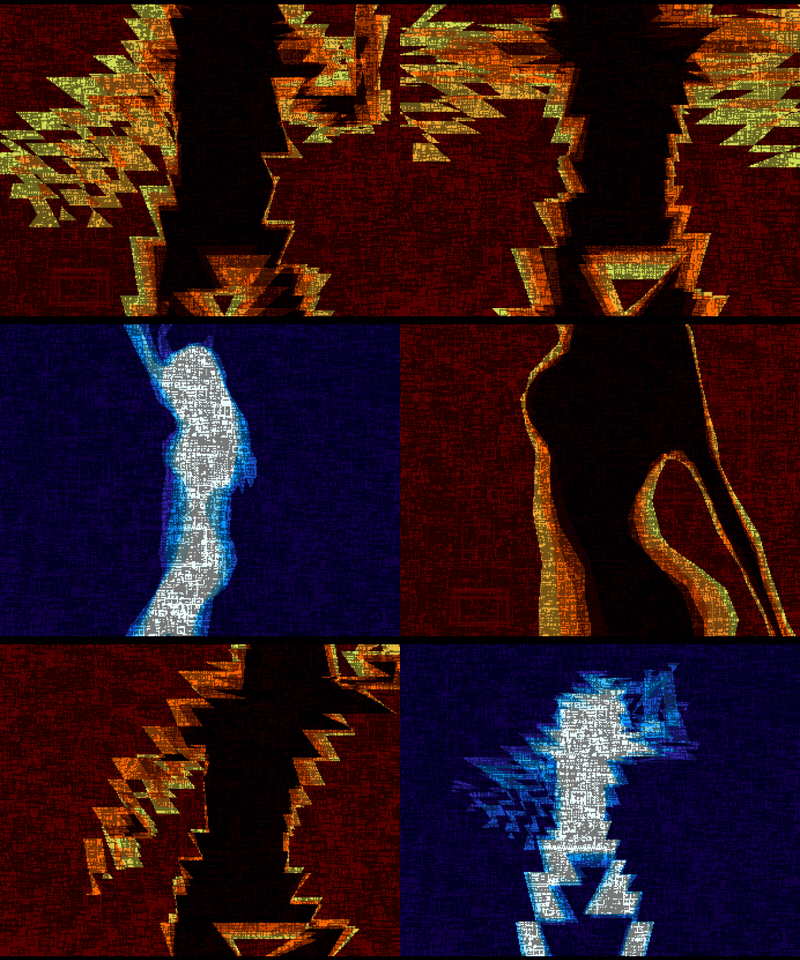
The middle passage combines moving pattern windows with the silhouette. The following hand animation layers recent filled contours: their overlap creates the dark interior and coloured fringes, with fine texture across the image. The apparent fragments are not evidence of a separate operation that cuts up and displaces one rendered body. The recovered mask-history selector and palette explain the layered appearance; the inner loops are described below.


Late sections reduce the figure to an animated edge, rebuild it over noisy textures, and return to high-contrast concentric patterns. The direct run shows a continuous visual grammar rather than a pile of unrelated demo parts: one body, repeatedly redrawn as mask, outline, texture boundary and negative space.
Examined Disk and the Patch Boundary
The Scene.org carrier is a DMS 1.11 archive made on 15 January 1993. It stores tracks 0 through 79 with HEAVY2 compression and restores to a standard 880 KB disk image:
1cc4568c4333508eee004ec020ded8f6859078848451d2a06de1a352d572edcc  spb-sota.dms
6c60b98bf206921ceea76c7b4be25ad95c8fd81088a493916921ef70ab0cab9f  spb-sota.adf
This is not described here as an untouched party-night master. Its boot block
plainly identifies itself as the 1MB CHIPMEM VERSION adapted by Xtal / Mora
Net On Tour. A second widely mirrored DMS carries a different Skid Row
compatibility boot. The two restored disks differ in 126 sectors, principally
where loader/effect compatibility changes live, but three important regions
are byte-identical:
loader module                 35,398 bytes
region preceding main module   8,742 bytes
main module                  230,652 bytes
The older comparison included disk $20000..$22225 as an 8,742-byte
region. Calling that entire region the replay/setup block was wrong: the
loader maps only $21000..$22225 to the replay prefix at RAM $1000.
The preceding 4,096 bytes belong to a different load. The cross-carrier
comparison above is retained as an earlier result; this revision rechecked
the hashed Scene.org carrier, not the second disk.
That distinction matters in practice. A 512 KB chip plus 512 KB slow-memory profile runs the introduction and then exits around 30 seconds. The declared 1 MB chip-memory configuration runs the complete show. Rather than hiding the failed first profile, it gives a reproducible explanation for the release's boot label and the hardware profile used for the GIFs.
The later Scene.org LHA is a one-file 020/AGA conversion and was not used for runtime media or as evidence for the original machine architecture.
Boot Block and Direct Disk Loader
The restored disk begins with DOS\0, but its root block is not a usable
AmigaDOS filesystem. The boot block's end-around checksum is valid:
sum of 256 big-endian boot-block longwords with end-around carry = FFFFFFFF
The first code disables custom-chip interrupts, clears the display, copies a compact loader into low memory and jumps into it. That loader installs a trap vector, programs a private copper list, selects the floppy through CIA B and drives the disk DMA registers directly. The show therefore does not open a directory and load named files. Code, modules, pictures and animation streams are addressed as regions of the disk.
The same release shape explains why a filesystem-only inspection misses most of the production. It also explains why later compatibility editions patch many small regions: this is a chain of hardware-owning parts and loaders, not one AmigaDOS executable with a single startup wrapper.
Opening Hands: Two Planes, Held Shapes and Contour Morphing

The opening hands are already polygon animation. The CPU reads compact contours, generates intermediate shapes, transforms their coordinates, and asks the blitter to draw parity edges and fill them. Two displayed planes provide four palette indices. Changing which plane is updated lets a moving shape cross a held silhouette without redrawing that silhouette every time.
This six-second excerpt is recording interval 0.5–6.5 seconds from the fresh silent FS-UAE 3.1.66 intro run described below. Its 300 frames retain 50 fps at 400×320. It shows the dark hands and subsequent figure; the earliest opening phase precedes this capture interval. The original overview GIF provides a separate excerpt of the hands.
Three pose streams, selected by the interrupt controller
The first-stage entry is $3f000, mapped from disk $400.
Its initial stream is embedded at $3fec6; subsequent disk loads
supply streams at $80000 and $83dfe. Each begins with a last
valid index and a table of long offsets relative to the stream base.
Their tables contain 66, 142 and 335 entries respectively.
The software-interrupt counter selects the sequence:
| Software calls | Source entries, zero-based | Drawing mode |
|---|---|---|
| 1–57 | Embedded stream, 0–56 | Both stored planes |
| 58–199 | $80000, 0–141 |
Second stored plane, alternate coordinates |
| 200–290 | $83dfe, 55–145 |
Both stored planes, normal coordinates |
| 291–479 | $83dfe, 146–334 |
First stored plane only |
| 480–481 | Exhausted | Select and clear, then return without filling |
At call 200, the initializer receives byte offset $dc, skipping
55 long offsets. The renderer decrements its remaining count before
drawing; the last valid record is still rendered when that count becomes
$ffff. Only the following call takes the exhausted return.
The VBlank handler requests a software interrupt on odd newly
incremented counts. Foreground waits for 961 VBlank entries, then
disables the two visual interrupt sources and jumps to $52000,
the title-word controller. The 481-call continuation assumes each
request is serviced before foreground proceeds; it does not prove the
ordering of a final pending request under every hardware schedule.
Unequal contours are resampled before they are blended
Literal polygons carry a tag, point count and byte (y,x) pairs.
Referenced polygons instead name two contours with backward/forward
word offsets and carry an interpolation numerator and denominator.
Routine $3f7cc puts the contour with fewer vertices first,
complementing the numerator when it swaps the endpoints.
The larger vertex count sets the output size. Integer division distributes the smaller contour's segments across those output vertices. Intermediate reference points use Q3 increments: signed division truncates the increment toward zero, then an arithmetic right shift returns integer coordinates. A second signed division blends that point toward the corresponding larger-contour vertex. This supports morphing between unequal outlines rather than simply pairing equally numbered vertices.
The generated scratch stream at $7df64 contains counts, plane
masks and word coordinates, ending with $7fff. Its largest
authored use is 334 bytes. Generated contours are drawn before the
literal contours in the same pose.
Normal lookup tables map coordinates with
floor(x*351/256) and floor(y*289/204).
The middle interval instead uses
floor(x*351/256)-15 and
min(floor(y*350/204)+8,289): a horizontal shift and vertical
expansion with a lower-edge clamp. The X table can contain negative
values, but the selected alternate-mode contours start at x=11 or
higher and remain within the destination. This is an authored-data
bound, not a general clipping routine.
Parity edges, two-plane fill and a two-pose display lag
The literal tag mask is (tag-$d0)>>1; referenced tags use
((tag|1)-$e4)>>1. The low two bits select stored planes.
The selected data uses single-plane masks, though the line helper
can launch into both planes when both bits are set.
Line setup $3fa74 uses 44-byte rows, A data $8000,
solid B data and full word masks. Helper $3fabe orders endpoints
by y, skips horizontal lines, calculates octant and error terms,
and adjusts the shallow-edge count when 2*dy <= dx.
Its single-dot line mode and $4a minterm toggle parity edges.
A descending exclusive fill then copies A to D with
BLTCON0/1=$09f0/$0012 and zero modulos.
Each allocation contains two consecutive 352×290 one-bit planes:
12,760 bytes per plane, 25,520 bytes per allocation. The three
allocation bases are $5a000, $603b0 and $66760.
Selection precedes clearing and drawing. The work sequence starts
$603b0 → $5a000 → $66760; normal display selection uses
the allocation drawn two software calls earlier. Thus the ordinary
display lag is two newly rendered poses.
During calls 58–199, only the second display pointer changes.
The first stays at $603b0, retaining the first-plane result
from call 55. Clearing, drawing and filling are restricted to the
second stored plane. This produces motion over an actual held shape.
After VBlank count 580, the normal selector continues changing both pointers, but only the first stored plane is cleared and filled. The later authored tags also select only that plane. The untouched second planes are all zero in each of the three allocations in the later saves. This interval therefore has one-bit moving geometry, even though two hardware planes remain enabled; it does not cycle three different retained background pictures.
All four saved states program BPLCON0=$2200,
BPLCON1=$0020, zero modulos and a nominal 44-byte row fetch.
The high fine-scroll nibble delays hardware plane 2 by two pixels;
plane 1 has zero delay. Combining the stored arrays at identical
x coordinates would omit that display offset.
Palette changes and exact stored pixels
The compatibility boot supplies $fff as the initial colour.
At software call 3, palette indices 0 and 2 become $102.
The VBlank-controlled fades then darken and recolour the overlapping
shapes using signed RGB-component interpolation. The initial ramp
uses divisor 31 with weights 0–32; with these source/target colours,
the last weight repeats the endpoint. A later transition targets
$103. The four subsequent target words are all $214:
multiple interpolation calls here do not imply different final hues.
At software call 202, colour 1 is copied into colour 2.
Independent geometry and command checks cover all 479 selected poses, 29,616 vertices and 26,343 line-blit launches. A separate replay executes the full original visual handlers with a scalar blitter, starting with zeroed mask memory. All 76,560 bytes across the three allocations match at each of four fresh saves, at VBlank counts 396, 584, 772 and 958. The continuation produces 479 fills; the two exhausted calls still perform their preceding selection and clear.
The source data, coordinate tables, counters and saved Copper state are checked separately. Music calls are excluded from these visual tests. The agreement establishes stored pixels and command order, not simultaneous disk/display DMA timing or an atomic screenshot of the saved CPU state.
Intro Typography: Four Pictures, One Repeated Sample

The large STATE / OF / THE / ART sequence uses four stored pictures.
Each appears at full size, then fades to black through its palette.
Between words, the next picture is unpacked into the other allocation. The same sample
accompanies each word, with increasing volume. A smaller, one-plane
credits image follows; its background brightens first, then its dark
lettering fades into that background before the poster transition.
The six-second clip is local recording interval 13.5–19.5 seconds from a fresh silent FS-UAE 3.1.66 run of the same compatibility carrier, configured as a PAL 68000 A500 with 1 MB chip RAM. Its 300 frames retain the 50 fps capture cadence at 400×320. Recording started after emulator launch, so these are capture timestamps, not demo time zero. Guest audio hardware remained active with dummy host output.
Three stored planes and alternating destinations
The controller is the side-21 payload, disk $1ce00..$1e3ff loaded
at $52000. The four packed title images begin at disk $18c00,
$1a0c8, $1abc8 and $1ae0c. The backward depacker at
$5273c produces 37,356 bytes from each: three 12,452-byte planes,
each 44 bytes by 283 rows. Direct decoding identifies the four words.
The destination alternates $6cb10 → $5a000 → $6cb10 → $5a000.
Pointer helper $5271a writes three high/low Copper pointer pairs,
adding $30a4 between planes. The display uses three planes, zero
fine scrolling and zero display modulos; its nominal fetch is 22 words
per row. These are bitmap switches and palette changes. This passage
does not need the main show's contour morphing and blitter fill loop.
A foreground fade consumes a VBlank flag
Level-3 entry $5239e increments the part counter, decrements a
nonzero hold counter, and sets a ready flag every second VBlank entry.
The foreground fade consumes that flag and clears it. A Boolean ready
flag can merge events while foreground work is busy; it is not a queue
guaranteeing a new displayed colour every two physical fields.
Each title fade at $521ae writes all eight colours through 23 steps.
For each RGB nibble it computes:
source + trunc_toward_zero((0 - source) * k / 22), k = 0..22
The signed division matters when a component decreases: it truncates
toward zero. The initial source colours are
001, dfe, bdc, 9ba, 798, 254, 032, 576.
At step 13 the routine also clears the four audio-DMA enables.
It resets its interpolation index after the final black step.
Between title words, the controller assigns a 25-VBlank hold counter
while unpacking the next image; the foreground only waits for any
remainder. Before the credits it instead assigns 15.
The sample setup is unrolled four times at $52058, $520a6,
$520f4 and $52142. Each programs Paula channels 0 and 1 with
the same $4d000 sample address, $1600 words of data, and period
$020b, then enables both channels. Their volumes are respectively
40, 48, 56 and 64. Thus the increasing emphasis comes from volume,
not four different samples. The 11,264 sample bytes are the raw
disk load $1e400..$20fff.
The credits reverse the fade direction
The embedded packed image at disk $1d796 expands to 12,760 bytes
at $5a000: one 352×290 plane. Its set bits form the background;
the cleared bits form the small credits. Copper list $528ea
selects this one-plane display. Routine $522ee raises colour 1
from black to $def using weights 0–7 divided by 7. After the
following disk loads and poster preparation, $5228a raises
colour 0 to the same value using weights 0–14 divided by 14.
The lettering therefore disappears into the pale background.
Original-code execution agrees with independent arithmetic for all
46 steps across the three fade routines and with 600 VBlank handler
entries under a controlled flag-consumption schedule. Fresh saved RAM
also matches both complete title allocations during THE, the
12,760-byte credits bitmap, and the corresponding intermediate palettes
and display registers. The title save has processed 173 VBlank entries
and completed fade step 6; its stored next index is 7. These checks
establish the decoded data and controller arithmetic without claiming
that the nearby screenshot is an atomic view of the saved CPU state.
The Dragon Poster: High-Resolution Bitmap and a Held Bottom Row
The Spaceballs dragon poster shown in the overview is a stored high-resolution picture. Its apparent arrival and disappearance are palette fades; the foreground also loads the first main part while the poster remains visible.
The side-70 controller maps disk $60400..$619ff to $3e000.
Its preparation entry depacks the image from $c0000 to $63784,
producing 81,920 bytes. These are four $5000-byte planes:
80 bytes per row over 256 rows, or a 640×256 four-bit image.
The original depacker output matches all 81,920 bytes in both fresh
poster saves.
The Copper stops advancing the bitmap at the bottom
Copper list $3e516 selects BPLCON0=$c200, four high-resolution
planes. DDFSTRT=$0038 and DDFSTOP=$00d0 give a nominal 80-byte
fetch per row. At the start of the field, both display modulos are zero.
The four reload pointers are $63780 + n*$5000: four bytes before
each decoded plane's origin. BPLCON1=$0011 is also programmed.
These offsets belong to the display setup; the decoded bitmap alone
does not specify exact on-screen column alignment.
Near the end of the Copper list, the $ffdf/$fffe guard followed
by $1b01/$fffe forms the vertical-counter wrap sequence.
The list then writes $ffb0, or −80, to both bitplane modulos.
That cancels the bytes fetched on each subsequent row, so the final
fetched row repeats through the remaining display area instead of
the pointers continuing through later memory. This is a display-DMA
addressing operation, with no CPU copy of the repeated rows.
The fresh saves have the expected four-plane high-resolution mode, fine-scroll word and late −80 modulos. All 220 bytes of the prepared Copper list match original-code setup and palette execution. The saved registers reflect the late list writes; treating them as the modulos for the entire field would give the wrong row layout.
Polled fades surround the disk load
After installing its state, the foreground clears master interrupt enable and polls the VBlank-request bit directly. The installed level-3 handler remains in the vector table, but the poster does not depend on that handler advancing a fade counter.
Reveal routine $3e2ea changes all sixteen palette entries from
$bde to their stored target colours in 21 steps, using weights
0–20 divided by 20. Its component arithmetic uses signed division
with truncation toward zero. Once the reveal finishes, $3e02a
loads side 71 to $50000 and sides 72–78 to $b0000.
The former is the first main controller; the latter contains the
packed pattern and pose data.
After the loader returns, DBRA with an initial value of 124
consumes 125 polled VBlank events. Exit routine $3e32a then
fades palette indices 1–15 to black in 17 steps, weights 0–16
divided by 16. Index 0 remains at its already-black target.
The foreground jumps directly to $50000.
Original execution agrees with independent arithmetic for all 38 fade steps. A separate foreground run, supplied with ready VBlank events and an immediate loader return, verifies the ordering and the 21/125/17 event counts. That test does not measure disk latency or prove an exact wall-clock duration: loading occurs between the reveal and the counted hold, and polled request bits can merge events.
Two Embedded ProTracker Modules
Both soundtracks are complete four-channel M.K. modules inside the disk.
Their boundaries can be computed from the 31 sample lengths, order table and
highest referenced pattern rather than guessed from the next string.
The loader module begins at disk offset 0x6e00:
title                         "?????"
song positions               3
patterns                     3
sample data             31,242 bytes
complete module         35,398 bytes
Its first sample-name fields say that it was tracked by Vinnie, agreeing with
the public credit. The main module begins at 0x22226:
title                         "condom_corruption"
song positions              45
patterns                    39
sample data            189,632 bytes
complete module        230,652 bytes
declared duration             3 min 24 sec
The module text credits Travolta / Spaceballs and says it was finished in autumn 1992. Private greetings in the sample-name area are not reproduced. The public Demozoo credit list names Lone Starr and Major Asshole for code, TMB Designs for graphics, Travolta for music, and Vinnie for the loader tune.
CIA-Timed Replay Engine
The main replay/setup prefix occupies disk offsets 0x21000 through
0x22225: 4,646 bytes. The caller at RAM $3f0c2..$3f0ce loads 36
track-sides starting at side 24, mapping disk $21000 to RAM $1000.
The main module consequently maps from disk $22226 to RAM $2226.
Interpreted at its intended runtime base, its startup performs a normal
ProTracker relocation pass:
runtime 0x1000   call timer setup, then module initialization
runtime 0x10c6   scan the 128-entry order table and find the last pattern
runtime 0x10ec   derive the sample-data base after pattern data
runtime 0x10fe   relocate all 31 sample pointers from their word lengths
runtime 0x1140   clear four Paula channel volumes and disable audio DMA
runtime 0x1160   music interrupt entry
runtime 0x2226   start of the main M.K. module
The timer setup installs the interrupt vector at address 0x78, programs CIA
B Timer A and enables its interrupt. It derives a latch of 0x376b from the
PAL clock constant 0x1b0f87 / 125, giving approximately 50 Hz at the
initial timer setting of 125 BPM. The interrupt acknowledges the CIA and custom-chip
request, updates all four Paula channels, processes a new row when the speed
counter expires, and otherwise applies ongoing effects.
The effect dispatcher contains the expected arpeggio, pitch slides, tone
portamento, vibrato, combined effects, sample offset, volume slide and E
extended-command paths. This is a real integrated replay engine, not merely an
M.K. signature beside opaque data.
Speed, tempo and the authored stop are separate controls
The 125 BPM value is only the timer's startup setting. Module initialization
sets six ticks per row, and the first row is decoded on replay call 6.
That row contains F03 and F85: three ticks per row and 133 BPM.
The handler at $1942 distinguishes F01..F1f, which change the
row speed, from F20..Fff, which rewrite the CIA timer latch through
$106e. F00 instead branches to $113a, clears the player-enable
byte, zeros all four channel volumes and disables audio DMA. It leaves
the CIA timer running; subsequent replay calls return without playing.
The module's route through its patterns is also non-linear. Its Dxx
break parameters are decimal-nibble row numbers: D32 selects row 32.
Reused pattern 13 is entered at rows 0, 32, 48 and 56 in different orders.
Pattern 38 puts E60 at row 0 and E62 at row 31, so its first
32 rows run three times before playback continues through rows 32–63.
One interaction needs this particular player's semantics. At order 27,
pattern 13 row 63 combines EE2 delay with D31. The break is
applied while the delay remains active; after it unwinds, the next
newly decoded row is order 28, pattern 14, row 32. Assuming that every
break immediately decodes its named row gives the wrong sequence.
Order, pattern and row numbers here are zero-based.
An independent flow model agrees with 11,151 complete original replay
calls and all 2,668 row reads, including the speed/tempo changes, breaks,
loop counters and delays. The final F00 is decoded at order 44,
pattern 29, row 63. Playback stops during that command; there is no
extra completed row to add after it.
The demo ends the music before the module stops itself
The module text declares 3:24, but uninterrupted execution reaches its own stop about 3:27.3 after the first decoded row. This calculation sums the authored tick periods as tempo changes; it does not multiply the order count by a fixed row duration. Initial timer startup precedes that origin by roughly 0.12 seconds. These are nominal music-clock durations, not measurements of video timestamps or audible onset.
The saved final card tells a different, more specific story. Its 318 bytes
of channel state, sample pointers and replay globals at $20e8..$2225
match original replay call 10,976, about 3:24.0 after the first row
on the same nominal clock. It has reached row 4 of the final pattern:
the cursor points to row 5, and the player-enable byte is
still set. The module's own F00 has not executed.
Instead, final-card code $4007c writes $4004 to INTENA, clearing
master interrupt enable as well as software-interrupt enable.
$40084 then clears all four audio-DMA enables. Saved custom-chip
state agrees with both actions. The subsequent card fade polls VBlank
status with interrupts disabled, then enters the permanent foreground
loop described below.
Thus the roughly 3:24 ending is an external shutdown by the demo, not proof of the module's uninterrupted length. The music's CIA clock and the visual controllers' VBlank/software counters must be kept separate. This one saved ending identifies an exact replay state; it does not establish that every run stops on that same music tick.
First Concentric Dancer: Stored Contours and Morphing
The first main-show dancer is a compact contour animation rendered into one bitplane. Two other bitplanes read different moving windows into a shared pattern bitmap. The palette makes the same pattern look green/purple outside the body and red/yellow inside it. No textured polygon rasterizer is needed for that colour change.

This fresh four-second excerpt is from FS-UAE 3.1.66, PAL A500/68000 with 1 MB chip RAM, bundled AROS and the unchanged compatibility disk identified above. It preserves the 49 fps source cadence (the GIF lasts 4.02 seconds), reduced to 400×320 with nearest neighbour scaling. Its source interval is 1.5–5.5 seconds in a short recording resumed within this stage; these are not demo-start timestamps. Host audio uses null output and the recording contains no audio stream. The earlier eight GIFs and their timestamps belong to the older complete capture.
Frame records and the interpolation loop
The first main code loads from disk $61a00 to RAM $50000. Its packed
background begins at disk $63000, expands to 40,960 bytes at $6cb10, and
ends immediately before the raw pose streams at RAM $b4080 and $b4230.
The two streams contain 26 and 210 frame entries. Their header words are
last-entry indices, so $0019 means 26 entries, not 25. Longword offsets
select variable-length frame records relative to each stream base.
A frame starts with a polygon count. A literal polygon has a tag below $e6,
a vertex count and unsigned (y,x) byte pairs. Tags $e6 and above instead
reference two literal contours, one backward and one forward, plus a byte
interpolation numerator and denominator. The CPU constructs these morphed
contours in word-coordinate scratch space before drawing the frame's literal
polygons. Across both streams there are 132 literal and 110 interpolated
polygon records; 24 interpolation records join contours with different
vertex counts.
That unequal-count case is the interesting inner loop. The larger contour sets the output vertex count. The smaller contour's segments are distributed over those output positions using integer interval boundaries. Intermediate reference points advance in eighth-pixel units: signed division truncates the step toward zero, then an arithmetic right shift converts the accumulated value back to coordinates. A second signed division moves that reference point toward the corresponding vertex of the larger contour by the authored fraction. Swapping the contour roles complements the numerator. This is contour morphing; the recovered data does not establish a skeleton or the artist's original motion-capture process.
The code rewrites instruction immediates during interpolation. A CPU test must honour those writes: stale translated instructions produced incorrect unequal-count results until the test invalidated the translation cache before each original instruction. No guest instructions were patched. The independent arithmetic then matched all 236 entries and 13,425 decoded/projected points.
Before line setup, two lookup tables scale coordinates:
x_screen = floor(x * 351 / 256)   // 356 precomputed words at $7d2e4
y_screen = floor(y * 289 / 204)   // 260 precomputed words at $7d604
This path has no general 3D projection or polygon clipping. Tag-derived scratch metadata does not choose a texture or drawing plane in this renderer.
Parity edges, exclusive fill and reuse
The line helper at $50aac orders endpoints top-to-bottom and rejects
horizontal edges. It uses the blitter's single-dot line mode and an XOR
boundary operation: with solid $ffff texture, minterm $4a reduces to
A XOR C. Crossing parity matters here; these are not ordinary OR outlines.
Its endpoint convention is specific. With dx = abs(x1-x0) and
dy = y1-y0, it decrements dy when 2*dy <= dx, then selects major and
minor distances. Initial error is 2*minor-major; the two increments are
2*minor-2*major and 2*minor. The launch size is 64*major+2, rather than
an assumed inclusive major+1 length. Destination addressing is
work_base + 80*y + (x >> 3), with the low x nibble supplying the bit shift.
The subsequent $09f0/$0012 blit performs descending exclusive fill in place:
290 rows, 22 words per row, and modulo 36. That is a 44-byte-wide rectangle
with an 80-byte row stride. It starts at the bottom-right word,
work_base + 289*80 + 42, and fills toward the beginning. The resulting
one-bit dancer supplies the palette-index low bit.
Three allocations begin at $5a000, $603b0 and $66760, separated by
25,520 bytes. The software interrupt selects a display pointer, draws into
the current work buffer, changes the work pointer and clears the newly
selected work rectangle using a destination-only zero blit. It clears the
44-byte row spans, not every byte of each allocation. Startup clearing is
also different: its three origins are 34 bytes into the allocations, whereas
routine clearing starts at the selected base.
The circles move through pointers and palette indices
The background is one 40,960-byte source, addressed with an 80-byte row
stride. $50372 advances table phases and patches Copper words for bitplanes
2 and 3. The first pattern advances its horizontal table by three words and
its vertical table by two words per call; the second advances its vertical
table by three words. The tables wrap after 500 and 477 words respectively.
For the first pattern, the coarse horizontal offset is 2*(x >> 4) bytes;
the fine-scroll value is ((~x) & 15) << 4. The row offset is 80*y.
The second pattern uses an immediate horizontal zero. Although a second
horizontal phase pointer exists, this reached code does not use its table
value. Nor does its calculated low scroll nibble get stored: the written
BPLCON1 low nibble remains zero. Treating the two windows as symmetric
horizontal/vertical oscillators would misdescribe the actual effect.
The saved Copper list enables three planes. With plane 1 as the dancer mask, setting that bit changes palette indices in pairs:
| Pattern bits | Outside body | Inside body |
|---|---|---|
| 00 | $000, black |
$000, black |
| 01 | $170, green |
$d00, red |
| 10 | $707, purple |
$d70, orange |
| 11 | $711, dark red |
$bb0, yellow |
The CPU therefore moves the circles by changing fetch origins and changes their apparent material through the dancer's palette bit. It does not copy the pattern into each filled polygon.
Black startup, then a separate body-colour reveal
The palette is also part of the buffer startup protocol. All eight Copper
colour words initially contain black. Renderer event 3 installs the first
palette: the outside-pattern indices 2, 4 and 6 become $170, $707 and
$711, while all four inside-body indices remain black. This first produces
a black silhouette against the moving pattern, rather than immediately
showing the red/yellow body colours listed above.
That delay hides the buffer warmup. Event 1 draws into the initial allocation, whose startup clear covered a different horizontal span. Event 2 draws into an allocation already cleared across the full active rectangle by event 1. At event 3, the Copper selector points to that completed second pose. The colour installation therefore exposes a mask with the normal clear/draw history, not the first allocation's inherited contents. This is a consequence of the recovered command ordering; no author comment is needed to establish which buffers and palette words it selects.
The VBlank controller subsequently changes only inside-body colours 3, 5
and 7 toward red $d00, orange $d70 and yellow $bb0. It calls the blend
routine while the pre-increment controller counter is 20 through 36:
serviced entries 21 through 37. Those 17 calls include both interpolation
endpoints, with coefficients 0 through 16. Outside-pattern colours remain
unchanged during this reveal.
The inner routine splits RGB12 into three nibbles and applies, independently,
component = start + trunc_toward_zero((target - start) * coefficient / 16)
It uses signed multiplication and division, not packed-colour addition.
That rounding matters when fading downward: for example, red 13 at coefficient
1 toward black remains 13 because -13/16 truncates to zero. A floor-based
implementation would darken it immediately.
At pre-increment counter 40 the shared coefficient resets to zero. The exit fade runs at counters 460 through 476, again including both endpoints, and fades palette entries 1–7 to black. Entry 0 stays black throughout. Thus the entrance recolours the body alone; the exit removes both body and surrounding pattern. These are serviced-controller counts, not independently measured wall-clock or beam deadlines.
Independent channel arithmetic matches all 13,056 source/target/coefficient cases. A replay of 479 original controller bodies, with each alternate software request serviced immediately for its original palette branch, matches the full predicted palette history and the saved palette after 54 controller entries. Geometry and bitmap execution are checked separately below; this palette schedule does not prove physical interrupt delivery time.
Interrupts, disk preload and what the checks establish
The level-3 handler updates pattern pointers on each serviced entry and requests the software interrupt on odd counts. The software handler performs buffer selection, contour rendering and clearing. Meanwhile the foreground loads the following part: the saved PC is in the disk loader, with two of its five requested asset sides decoded. This is concrete overlap between the current visual part and preparation of the next one.
The first stream switches to the second after 26 entries. After the second stream's 210 entries, the pose routine returns without further blits. The foreground's separate threshold of 240 serviced renderer entries is therefore not 240 distinct stored poses. Alternating interrupt requests alone do not prove that every requested render meets a physical display deadline.
The fresh save has 54 pattern-controller interrupts and 27 serviced renders.
Original startup plus 54 pointer updates reproduces both background addresses
($6f1d8, $6da10), all four phase pointers and $00d0 fine scrolling.
All 40,960 depacked source bytes match live RAM. The independent controller
calculation also agrees with 2,000 original-code calls through repeated wraps.
All 17,712 pose/lookup source bytes match the first-stage save, whose cursor
shows one entry consumed from the second stream.
The renderer test checks 13,344 ordered line-helper calls, 12,669 line launches and 236 fill launches. It compares the effective line error's low word; the unused high word and unused scratch-metadata high byte can contain register residue and are not claimed identical. These geometry tests verify original CPU arithmetic and register programming. The separate pixel replay below extends the check to the saved mask buffers. Copper fetch timing and an exact full-colour displayed-frame match remain unverified. The fresh clip establishes the visual stage; the save establishes code and data ownership.
Exact mask pixels and the one-pose display lag
The original line/fill commands also reproduce the three saved mask buffers, including the single-dot rule, the line-error sign, XOR boundary pixels and right-to-left exclusive-fill carry. All 38,280 active rectangle bytes match: three buffers × 290 rows × 44 bytes. This comparison succeeds even when the model starts those buffers at zero.
The complete allocations need their inherited data too. An earlier save catches the CPU inside the background depacker, after the three startup clears. Starting with those allocation contents and replaying 27 original render/clear sequences matches all 76,560 bytes across the three full 25,520-byte allocations. The gaps between active row spans and the allocation tails are preserved rather than silently assumed black. Repeating the already completed startup zero clears is idempotent; it does not create the inherited bytes used by this comparison.
At that saved boundary the roles are:
| Allocation | Contents after renderer event 27 | Role selected by the code |
|---|---|---|
$5a000 |
Active rectangle cleared | Next work buffer |
$603b0 |
Pose 26, first entry of the second stream | Newly rendered mask |
$66760 |
Pose 25, last entry of the first stream | Copper plane-1 pointer |
Pose numbers in this table are zero-based. The selector runs before drawing, so it points the Copper at the previously completed pose while the new one is being built. This is an authored one-pose lag in the selected buffer, not a claim that we have reconstructed the beam position or measured latency in milliseconds. The startup selector also leaves the initial work pointer unchanged; treating startup selection as an extra completed render would put the whole history one buffer out of phase.

This is the exact 352×290 active mask at $66760, decoded from saved RAM and
matched by the pixel replay. White means the dancer bit is set. It excludes
the two pattern planes, palette, border and display-fetch timing; it is not a
full-colour runtime screenshot. The surrounding moving circles in the clip
come from the other planes.
The line endpoint convention makes a visible difference. A host-only counterfactual which adds one extra major-axis step to each line changes 1,487 bytes / 11,587 bits in the final stored allocations. Those extra parity marks can change filled spans well beyond the edge pixel itself. The unchanged original commands match the save exactly. This is evidence for the recovered convention, not a defect in the demo or a guest-code patch.
The separate control replay executes all 27 software-handler bodies and matches the saved buffer pointers, pose cursor and writable interpolation fields. The bitmap model applies blits to completion in command order; it does not model DMA arbitration, the Copper beam or interrupt deadlines. Matching the completed stored buffers therefore strengthens the rasterizer analysis without establishing a cycle-exact display simulation.
These conclusions apply to the first concentric dancer. Later parts reuse fill and address-transform techniques, but require their own pose formats, controllers and runtime states to support equally detailed claims.
The Word-Slot Interlude: Bitmaps and an Unrolled Copy

The short three-row word passage between the first dancer and the later sections uses stored bitmap words. This nearby runtime image shows “COOL / CLASS / VOTE!”; the separately saved state has already advanced to “NICE / ALIEN / CODE”. They are successive combinations from this same interlude, not an asserted screenshot-to-memory match at one instant. The still comes from the unchanged disk under the same silent FS-UAE 3.1.66 configuration as the fresh captures above.
Twenty-one packed word images
The first dancer preloads side 79 to RAM $40000 and the following five
sides to $c0000. Its foreground calls $40000 to prepare this next part
while the dancer's interrupts still own the display; its eventual jump to
$401fa activates the word interlude. Here $40000 is another overlay,
sourced from disk $6ca00, distinct from the later textured dancer at the
same RAM address.
The preparation routine explicitly calls its backward depacker 21 times.
Each result is 3,864 bytes, placed consecutively from $e8000. Each word
image contains three 1,288-byte planes: 224 pixels × 46 rows × three bits.
All 81,144 decoded bytes match the runtime save. The original depacker checks
also verify descending byte writes and destination boundaries individually.
These assets include words such as DULL, ALIEN, MUSIC, NO, RIPPED, GFX, LOTSA, UGLY, CODE, NICE, COOL, CLASS and VOTE! A ten-row table contains three source pointers per row, reusing some images in multiple positions. The CPU selects a different pointer for each displayed word row.
A counter with extra carries changes the combinations
Every normal composition advances all three selection pointers by one table row—12 bytes. When the first pointer wraps, it additionally advances the second by one row and the third by two rows. Each pointer wraps within its own ten-entry column. The rows therefore keep changing their relative alignment, rather than reading one fixed three-word sentence per table row.
The VBlank handler performs an extra composition on each of its first five entries, then the regular divider requests one every five entries. On the fifth entry both paths run. The saved counter is 115: five startup updates plus 23 divided updates produce 28 compositions. An independent selection model agrees with all original controller updates through that state. The foreground waits for its separate counter to reach 150 after its preload returns; these serviced counts do not establish an exact wall-clock duration.
The inner copy has 966 instructions and no branch
Each selected 3,864-byte image is copied by $403ac..$40b37, a straight run of
966 identical MOVE.L (A0)+,(A1)+ instructions followed by RTS. There is no
per-longword loop branch in this copy. Three calls assemble the top, middle
and bottom word images into one 11,592-byte composition.
The Copper exposes them as three horizontal bands. Its waits begin at lines
$60, $8e and $bc, separated by 46 lines; $ea disables the planes after
the final band. Each band installs three pointers spaced by $508 (1,288
bytes). The selected three-bit pixels use an eight-colour palette, and the
composition routine alternates between two palette tables.
The work pointer starts at $5a000, changes to $5cd48 on the first
composition and to $5fa90 on the second. It then stays at $5fa90.
The selector initially points the Copper at the preceding buffer; subsequent
updates select and overwrite that same final buffer. The three addresses
therefore describe startup progression, with in-place updates after that.
Whether the CPU copies overlap any particular display fetch requires a
separate timing check; matching the stored result does not prove a deadline.
The original 115-handler replay and independent source concatenation match
all 23,184 bytes of the two buffers this code writes, plus the saved Copper
list and selection state. At the saved boundary the sources are $f3520,
$e8f18 and $ef8c0: NICE, ALIEN and CODE. The initial $5a000 region is not
written by this interlude and is not included in that buffer comparison.
This bitmap-copy path is distinct from the contour interpolation and blitter
fills used by the dancer sections.
Earlier Blue Trails: Five Planes, Four Motion Streams

The passage immediately after the word interlude builds colour from the ages of the dancer's outline. Five ordinary bitplanes select recent filled masks; their overlapping bits become a five-bit palette index. A thin fringe means that an older pose extends beyond the newer one. There is no RGB blending loop: the renderer produces one-bit geometry and the display combines it.
This four-second clip is interval 1.5–5.5 seconds of a fresh short silent FS-UAE 3.1.66 capture, resumed within this section. These are local recording times, not demo timestamps. The capture reports 52 frames per second; the 400×320 GIF has 201 stored frames and a total duration of 4,000 ms, with centisecond delay quantisation. It and the earlier saved state identify the same passage, but are different moments.
The history builds up, collapses and changes colour
The word interlude preloads three sides beginning at side 85:
$74e00..$78fff on disk becomes $45000..$491ff in RAM. This overlay's
$459a6 selects five display pointers from six contiguous mask buffers,
starting at $5a000 with a stride of $31d8 bytes. Each mask is 352×290
pixels, packed into 44-byte rows. After selecting the display history, the
routine advances to the next work buffer; $45b74 clears it and $455cc
draws the new pose there. Selection precedes the new draw.
The group counter starts at 40, rather than zero. History selection uses:
phase = (group_counter - 1 + (4 if group_counter <= 50 else 0)) % 22
At phase zero all five pointers select the same mask: every covered pixel
therefore has index 31. Phases 1–4 introduce one more older mask on each call,
beginning with plane 5 and expanding back toward plane 2. Later phases keep
four older masks behind the newest selected one. The next phase-zero collapse
removes that spread again. The early +4 adjusts the initial history phase;
it does not rewind the motion counter.
The palette builder $45486 permutes its ramps across the 31 nonzero indices.
It assigns ten interpolated colours from $300 toward $921, eleven from
$921 to $fa5, and ten copies of the second step along that latter ramp.
Interpolation divides signed component differences by 11 with truncation
toward zero. Index zero begins at $fff. At phase zero, $45988 complements
all 32 palette words, but only once the group counter is at least 55.
The visible low twelve bits consequently switch the warm palette and white
background to a cool palette and black background. The initial collapse at
counter 41 does not invert it; the checked history inverts at 67 and 89.
This is a five-plane display: the saved BPLCON0 is $5200, with
BPLCON1=BPLCON2=0. The later textured dancer has a separate sixth
half-brightness plane; that mechanism should not be projected back onto
this earlier section.
The pose schedule also controls when the close-up is possible
Four contour streams begin at $45e62, $47212, $47a9a and $48300.
The 27 eight-byte records at $453aa each select a stream and a starting
entry. $45332 ignores group counters below 52, then selects a record on
multiples of 11. Since the counter begins at 40 and increments before this
check, the first selection happens at 55.
Initially the renderer consumes entries 0–13 of the first stream. The first scheduled group starts at entry 15, skipping entry 14. Following groups take entries 0–10 and 11–21 of the second stream, then 22–32 of the first. Later records revisit ranges and change streams. These are authored cuts in the motion source; ordinary groups advance through eleven entries. Unlike the later textured section, this controller has no one-shot counter subtractions to extend groups.
Each consumed pose resets the normal coordinate-table pointers. The enlarged
pair is selected only when both the stream is $47212 and
22 <= group_counter % 88 < 44. It is not a zoom applied indiscriminately to
all four streams. For source coordinate v, the four lookup tables contain:
normal_x(v)   = floor(v * 351 / 256)
normal_y(v)   = floor(v * 289 / 204)
enlarged_x(v) = clamp(floor(v * 580 / 256) - 30,  0, 351)
enlarged_y(v) = clamp(floor(v * 450 / 204) - 100, 0, 289)
The coordinate clamp is part of these lookup values, not a general polygon clipper. All 356 entries in each table match the original setup and saved RAM.
The draw loop and the saved history
The software interrupt $452e2 keeps selecting and clearing during its first
three entries, while skipping the motion increment and draw. Seven
selector/clear pairs have already run at startup. From entry four it advances
the controller, selects the display planes, clears the next allocation and
renders there. The original drawing body emits parity edges through blitter
line commands, followed by a descending exclusive fill. The clear uses
BLTCON0/1=$0100/$0000; the fill uses $09f0/$0012. Both span the 44-byte,
290-row mask with zero row modulo and BLTSIZE=$4896.
At the fresh save, 54 software entries have produced 51 draws, leaving the
group counter at 40+51=91. The current stream is $45e62: entry 25 has
been consumed and entry 26 is next. Phase 2 selects $5a000 for the first
three display planes, then $69938 and $66760; $5d1d8 is the separate
new work allocation. These distinctions matter when matching a contour to
what is on screen.
Replaying the original startup and all 54 software bodies, with their blitter commands applied in order, matches all 76,560 bytes of the six mask buffers from initially zero mask memory. That replay emits 2,378 line blits and 51 fills. It also matches 1,840 bytes of renderer/state and 200 bytes of patched Copper data. Independent palette and pointer calculations reproduce all 61 selections, including startup, and the saved result. A separate 900-call controller check and all 352 stream/residue scale cases verify the scheduling rules; those extended cases are tests, not a claim about the scene's duration.
The foreground independently waits for 566 vertical-blank entries before jumping to the next part. These checks establish the stored pixels and control state at the sampled boundary; they do not simulate Copper beam timing or prove that every blit finishes within a physical display deadline.
Stepped Colour Fields: The Blitter Builds the Copper Palette

The next passage puts a black dancer and a differently aged silhouette over large changing colour steps. Its background is economical: two mask bitplanes supply four indices, while the Copper changes the colours across the display. The blitter's unusual job here is to assemble RGB words inside the Copper program, rather than paint a full colour background bitmap.
This direct FS-UAE 3.1.66 still was captured immediately before a fresh save.
The save identifies the overlay loaded from sides 101–102,
$8ae00..$8d9ff on disk, at RAM $50000..$52bff. It catches the CPU at
$50828, inside a contour line routine. The image and save are nearby
observations, not an atomic screenshot-to-memory match.
An 8 KB table replaces repeated colour arithmetic
Startup routine $519a0 creates 256 component ramps at $4d000. For each
4-bit starting and ending component, it stores sixteen words. Every word
keeps its result in bits 8–11:
ramp(start, end, k) = floor((16*start + (end-start)*k) / 16) << 8
k = 1..16
The endpoint rows are stored in descending order. A component pair therefore
selects table + start*512 + (15-end)*32. The initial value at k=0 is not
stored; the sixteenth word reaches the endpoint exactly. Unlike a direct
signed integer interpolation of each output, the generator retains fractional
bits while stepping, then extracts the component. All 8,192 generated bytes
match independent arithmetic and the live table.
Three related kernels combine red, green and blue ramps with one blit. They
put the green ramp in channel A, blue in B and red in C. BLTCON0/1 is
$4f16/$8000: A shifts right four bits, B shifts right eight, and C keeps
its nibble in bits 8–11. The $16 minterm selects positions with exactly one
set input. Since the three shifted nibbles occupy disjoint positions, this
assembles the RGB12 word. The unused low bits of each source word are zero,
so interword shift carry does not contaminate the following colour.
The destination modulo changes what the same operation produces:
| Routine | Output words | Destination step | Purpose |
|---|---|---|---|
$51850 |
16 | 2 bytes | Consecutive vertical interpolation samples |
$518f6 |
16 | 8 bytes | One column of a four-colour temporal table |
$517aa |
15 | 12 bytes | One colour register's values across a Copper band |
Each blit is one word wide. The steps include that word plus destination modulo 0, 6 or 10 respectively. The CPU chooses three source rows and a destination; the blitter fetches, shifts, combines and scatters the results.
Temporal ramps feed spatial ramps
Two controllers at $508ec and $509ae advance through separate tables of
four-colour keyframes. On a phase boundary they use four $518f6 blits to
build sixteen interleaved rows between adjacent keyframes. Subsequent calls
select rows 0–14 before rebuilding. Thus the final stored endpoint row is
not selected by the controller; the next segment starts with its first
interpolated step.
The selected quartets feed $513c4 and $51626. Each first creates two
vertical ramps with $51850, then uses pairs of their samples as the
endpoints for $517aa horizontal ramps. These update COLOR00 and
COLOR02 inside the Copper list. Startup separately fills COLOR01 through
$514f2 from zero endpoints, leaving the main silhouette black. The spatial
consumers reuse one vertical sample at adjacent bands, so this is a concrete
stepped layout rather than an assumption of uniform bilinear sampling.
There is also a deliberate ordering distinction: the software handler builds the Copper gradients before advancing either temporal controller. Consequently the new endpoint quartet belongs to the following build, not the Copper colours just written during that handler. Startup calls only the first controller, then copies its quartet into the second controller’s output fields. At the save, the controllers have run 97 and 96 times; the completed Copper build used their outputs from calls 96 and 95. Independent arithmetic checks 601 calls per controller, including both endpoint schedules wrapping, and reproduces all 510 changing Copper colour words plus the 255 static black words.
Copper loops reuse the horizontal colour sequence
The list contains seventeen 200-byte blocks. Each has fifteen consecutive
triplets of writes to COLOR00, COLOR01 and COLOR02. The horizontal
colour steps therefore come from the Copper executing successive writes;
they do not require fifteen bitmap colour planes.
Each block ends with a beam-position SKIP followed by a COPJMP1 strobe.
Until the threshold is reached the strobe repeats the current block; once the
SKIP bypasses it, the following pointer writes select the next block. This
instruction pattern is the same basic looping mechanism described in the
Amiga Hardware Reference Manual's Copper loop example.
The list changes its masked WAIT values around the vertical counter's high
bit and wrap; precise screen-column widths are not inferred solely from the
number of colour writes.
The saved display uses BPLCON0=$2200. Routine $506d4 selects two masks
three allocations apart in the six-buffer ring, then advances the work
allocation. At this save the selected planes are $5a000 and $63588,
while the work pointer is $5d1d8. Their four possible indices allow the
black figure, the separate older contour and the changing background to
share this small palette program.
Replaying original startup and the palette/pointer work of 96 software
interrupts matches all 3,456 bytes from $51c58 through $529d7, along
with the temporal tables, interpolation scratch and endpoint quartets. The
replay models the RGB-packing blits but deliberately omits contour drawing
and mask clearing. The save was taken mid-line. The following contour check handles that
partial draw separately; neither check models cycle-exact Copper scanout.
The two silhouettes and a partially drawn pose
The contour source is a separate five-side load, sides 103–107 into
$a0000. Its header is 210; this control path consumes entries 0–209 before
restarting. The first payload offset leaves room for 211 offset-table slots,
but slot 210 is not reached before that restart. $50362 resolves each entry
through its offset table, first expands referenced contour records into
word-coordinate scratch at $7df64, then renders those and the literal
byte-coordinate contours. The unequal-vertex morph loop uses Q3 intermediate
coordinates and writable instruction immediates, as in the first dancer's
renderer. Literal points are stored as (y,x) pairs; table lookups scale
them before the edge loop. Closed contours become XOR parity edges, followed
by the descending exclusive-fill operation at $50864.
The display selector runs before the clear and draw. With the source cursor
advancing and the six-slot ring filled, its first plane contains the previous completed pose and its
second plane contains the pose three render updates older than that.
At the saved 96th update these are source entries 94 and 91, using zero-based
entry numbers, in $5a000 and $63588. Entry 95 is being drawn separately
in $5d1d8. The second silhouette is therefore temporal geometry, not simply
a displaced copy of the current outline.
This save need not be rounded to an artificial frame boundary. Replaying 95
complete original software handlers reproduces the five allocations that the
96th update will leave alone. Then single-stepping the 96th handler reaches
the third visit to $50828 with all fifteen saved D0–D7/A0–A6 register
values matching. That point is before the next line's destination/size
writes have completed. The replay has issued 5,572 line blits and 95 fills;
the new mask is intentionally unfinished.
At that exact software boundary, all 76,560 bytes across the six mask allocations match, including the unfinished work mask. So do 1,352 bytes of renderer/state, the stream controls, scratch pointer and the previously verified 3,456-byte Copper region. Mask memory began at zero in this replay; repeated original clears and draws reproduce the saved contents without seeding any saved mask pixels. This establishes the command-ordered memory result, not cycle-exact DMA arbitration or the beam's current position.
Exhaustion requests the transition, after one more draw
The initializer stores header-1, or 209, in the remaining-entry counter.
With the advance gate set, 210 calls consume entries 0–209 and leave that
counter at $ffff. On the next call, $5031c resets the stream, sets the
foreground exit flag $5034e, and branches back into the renderer. It
therefore starts entry zero again before returning from the handler. The
foreground's $50078 wait observes the flag after interrupt processing and
then jumps to the preloaded part at $40000. This is a stream-exhaustion
transition, rather than a fixed vertical-blank timeout. It does not establish
which pose is the last one actually scanned out.
The input test at $50382 gates only the source cursor increment and
remaining-entry decrement. With POTINP word bit 10 clear, rendering still
uses the selected pose and buffer selection still runs; the colour
controllers also continue. Holding that gate can repeat a pose and delay
exhaustion. It is not a pause of the whole display routine.
Earlier Textured Loop: A Different Ordering of Pose Ages
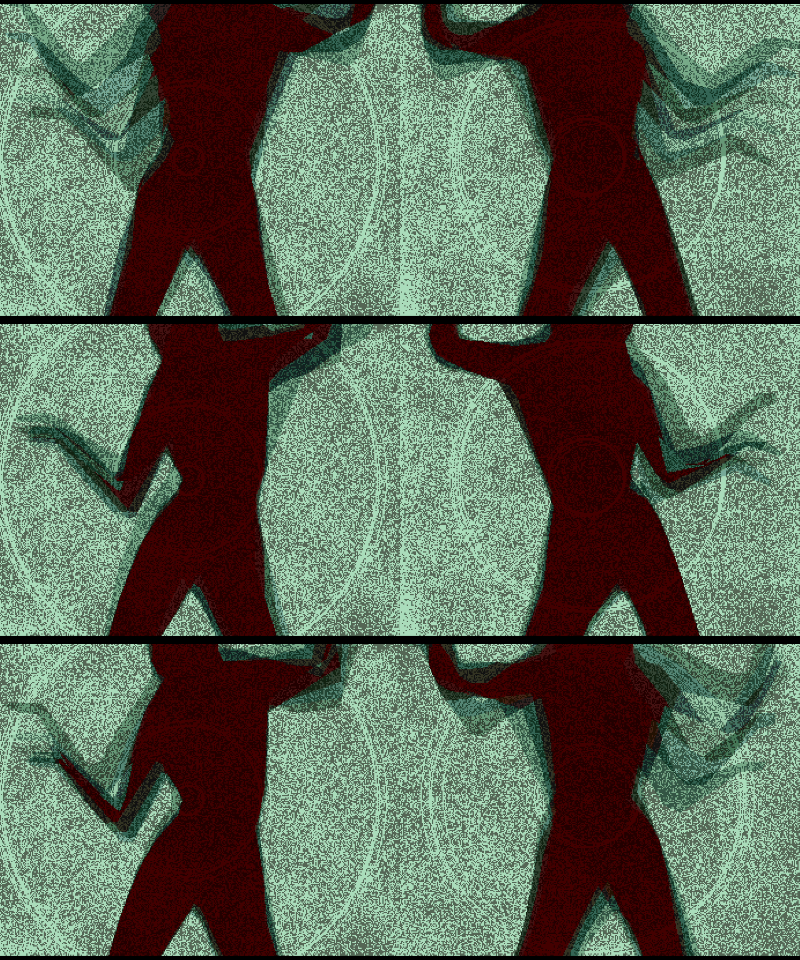
Before the later textured dancer described below, another short passage uses
five temporal mask planes and a sixth texture plane. It shares the basic
hardware technique, but its startup, motion loop, plane order and palette
are different. This is the single-side overlay from disk $94800..$95dff,
loaded at $40000, directly after the stepped colour-field part.
The clip comes from seconds 1.0–3.5 of a fresh four-second silent FS-UAE 3.1.66 recording resumed inside this section. The source reports 51 fps; the 400×320 GIF contains 125 stored frames over 2,510 ms after centisecond quantisation. Its capture times are local to that recording. The nearby saved state identifies the overlay independently.
Prefill six real poses, then repeat a short source loop
The stream at $40c1c has header value 23. Startup $40464 sets its cursor
to offset-table entry 7 and its remaining counter to header-9. Six explicit
selector/clear/renderer calls then draw entries 7–12 before the normal
software-interrupt loop begins. This prepares actual pose history at startup,
rather than merely clearing the six allocations.
The first traversal continues through entry 21. On exhaustion, $4048a
resets the cursor to entry zero and the remaining counter to header-2,
then re-enters the renderer. Subsequent traversals consume entries 0–21.
The first payload offset leaves room for 24 offset slots; this path does not
consume slots 22 or 23. Header value, table capacity and reached loop length
are separate counts. Foreground exit is independently controlled by 350
vertical-blank entries.
At the saved 29th software update, startup plus interrupt processing has produced 35 draws. The current loop has consumed entry 19; entry 20 is next. The original startup and all 29 complete software bodies reproduce all six mask buffers, 76,560 bytes, from zero mask memory. They emit 1,622 line blits and 35 fills. Another 1,454 bytes of renderer/state and 180 bytes of patched Copper data also match.
The oldest pose gets the second index bit
$40824 selects the current work allocation as plane 1, then takes offsets
+2,+3,+4,+5 around the six-slot ring for planes 2–5. Only after writing
those display pointers does it advance work to +1 for clearing and drawing.
Once filled, the selected masks are one, five, four, three and two render
updates behind the newest render, in plane order. The palette bits are not
assigned in simply newest-to-oldest order.
In the save, planes 1–5 select $66760, $5a000, $5d1d8, $603b0 and
$63588: source entries 18, 14, 15, 16 and 17 respectively. $69938 holds
the separate new entry 19. This ordering changes which colour indices arise
where neighbouring poses overlap, even though the geometry pipeline still
produces ordinary one-bit filled silhouettes.
A fixed palette and four raw texture windows
The palette builder $40358 uses a 31-index permutation with ramps from
$400 toward $254, then toward $adb. Its first ramp uses coefficients
0–9 divided by 11 and its second uses 0–10 divided by 11; ten remaining
indices share coefficient 2 of the second ramp. Index zero is $adb.
Independent component arithmetic reproduces every saved palette word.
Unlike the later passage's inversion controller, this software handler leaves
that palette fixed.
BPLCON0=$6200 selects six-plane Extra Half-Brite, with the sixth plane
halving the colour chosen by the five mask bits. The texture pointer updater
$4031e cycles an eight-state counter and uses floor(counter/2) to select
one of four windows at $6cb10, spaced by $31d8 bytes. Startup advances
this counter once, separately from its six pose draws; the 29 software
updates then leave it at 6, selecting the fourth window at $76098.
Here all 51,040 texture bytes match the earlier raw ten-side load starting
at disk $7d200. There is no short-read suffix to explain at this stage;
that complication belongs to the later nine-side replacement discussed below.
The fine texture changes by selecting stored bitplanes, while new contour
masks change the temporal colour index. The byte comparisons establish those
sources and the command-ordered saved result, not physical Copper/bitplane
fetch timing or an atomic match to a particular GIF frame.
The Returning Pattern: Reuse, Reordered Poses and Numeric Palette Negation
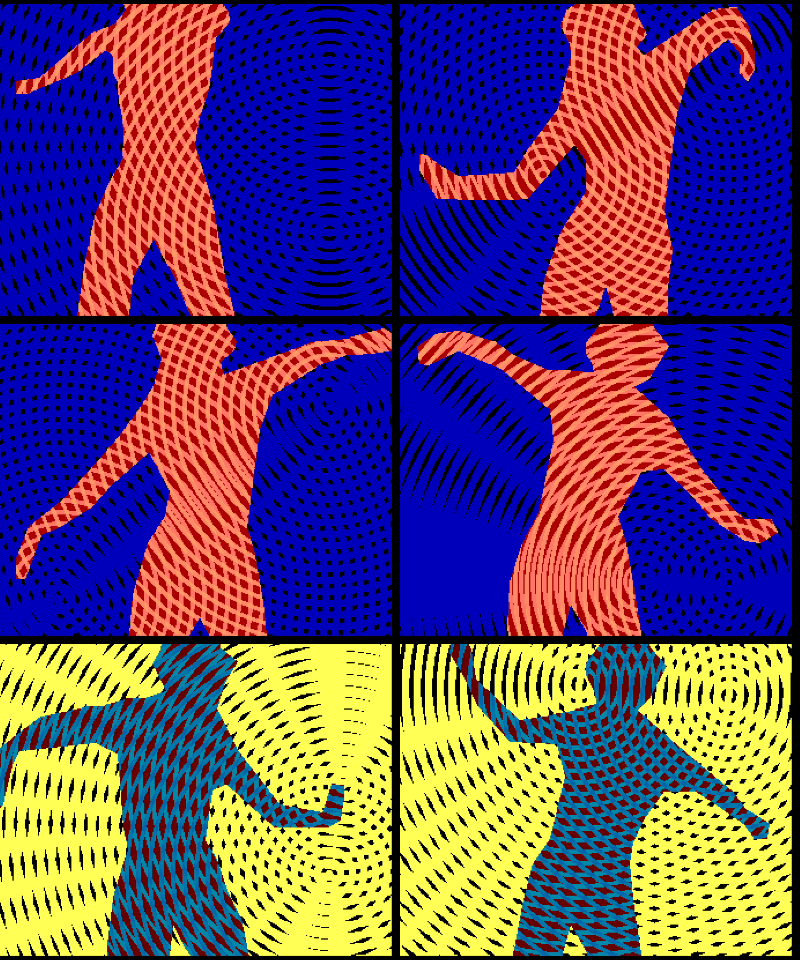
After the intervening word passage, the concentric pattern returns with
another pose schedule and abrupt colour changes. This is side 110,
$97400..$989ff on disk, loaded at $45000. Reusing the visual material
does not mean the earlier first-dancer controller is still running.
The four-second clip is interval 1.5–5.5 seconds of a fresh seven-second silent FS-UAE 3.1.66 recording. Its 192 frames retain the source's reported 48 fps cadence, with GIF delays quantised to centiseconds and a total duration of 4,000 ms. The clip and the saved state are separate moments in this part.
One old bitmap at a new address
Preparation entry $45000 calls the backward depacker $4545e, reading
the packed bitmap still at $b0000. All 16,512 packed bytes match the earlier
disk range $63000..$6707f. The output is 40,960 bytes at
$45ee2..$4fee1: byte for byte the same pattern used by the first concentric
dancer, now relocated from its earlier destination at $6cb10.
The three display planes are one filled dancer mask and two windows into
that bitmap. Background updater $4537a advances four phase pointers by
6, 4, 0 and 6 bytes, wrapping the horizontal tables over 1,000 bytes and the
vertical tables over 954. For the first window it converts the selected
horizontal value into a word offset and the selected vertical value into an
80-byte row offset. The complemented low nibble of that horizontal value
is placed in the high nibble of BPLCON1, delaying hardware plane 2 only.
Hardware planes 1 and 3 retain zero fine delay. The second window has a fixed horizontal offset and independently moving vertical
position. The apparent pattern interference comes from those two bitplanes
being combined as palette-index bits.
At the save, one setup call plus 99 vertical-blank calls have produced
100 background updates. The two pointers are $46344 and $46982, with
BPLCON1=$0070. Independent arithmetic agrees with 1,000 original updater
calls, including wraps, and reproduces those saved values. The packed source,
decoded bitmap and updated pointers are checked separately.
The display fetch and the drawing rectangle have different widths.
DDFSTRT=$0020 and DDFSTOP=$00d8 specify 24 nominal low-resolution fetch
words, or 48 bytes; both display modulos are 32, giving an 80-byte row
advance. Drawing touches 44 bytes per row with blitter modulo 36. The
selector at $45b9e subtracts four from the selected mask address before
installing it as hardware plane 1: the saved reload is $6675c, four bytes
before the $66760 allocation. The first concentric passage has the same
fetch width and row advance but reloads its mask at $66760 without that
subtraction. These fetch origins do not establish which extra words are
visible after display-window clipping and beam timing.
A different pose cut every eleven active draws
Controller $455b6 uses 44 eight-byte records starting at $4564a. Each
record selects a source stream and an entry within it. On multiples of eleven
active draws it installs the next record, resetting the stream cursor to that
chosen entry. Ordinary intervening draws advance through successive entries.
The first two software interrupts skip active work; the third begins the
active counter. The save has 50 software entries and 48 active draws.
This controller also changes all eight palette words when the active count
has remainder one modulo eleven. The instruction is NEG.W, not
NOT.W: the displayed RGB12 value becomes (-colour) & $fff. For example,
$06a becomes $f96, while $ff5 becomes $00b; zero stays zero.
Per-component inversion would give different results. Repeating the negation
restores the preceding palette exactly.
The first such operation happens while the startup palette is still black.
At active draw three, the handler copies the eight authored palette words
from $45ece into the Copper list. Later negations produce the visible
red/blue and cyan/yellow alternation. The bitmap itself is unchanged by
that switch.
The foreground waits for active count 376 after finishing its disk preload.
The 44-record table is longer than the selections needed to reach that
threshold. In particular, its final record selects stream $b4bc6 at entry
104, beyond that stream’s 101 physical offset slots; this record would be
selected at active count 484. An extended controller-prefix test can verify
that arithmetic without proving it is a valid rendered pose. It is not
evidence of an observed playback fault. Likewise, the separate fade branch
only becomes eligible at vertical-blank pre-counts 828–844: its existence
alone does not establish a visible fade before the foreground exits.
Three wide-stride masks, with a bounded pixel check
The mask allocations are again $5a000, $603b0 and $66760. Their
active rectangles contain 44 bytes on each of 290 rows, but successive rows
are 80 bytes apart. Selector $45b58 chooses the displayed allocation and
the next work allocation; drawing and the following clear use those distinct
roles. The pixel proof compares the three active rectangles, not every byte
in the allocation gaps and tails.
Original preparation, setup, 99 vertical-blank handlers and 50 software handlers reproduce all 38,280 active mask bytes from zero mask memory. The replay emits 1,996 line blits and 48 fills. It also matches 1,550 bytes of renderer/controller state, the stream fields, 60 bytes of Copper data and 32 bytes of phase/palette-source state. The drawing uses the recovered literal/referenced contour path and blitter parity-edge/exclusive-fill loop; no final bitmap was supplied to the replay.
Coordinate tables in this overlay live at $79270 and $79590. Its disk
loader uses $79ef0 as the raw disk buffer, so the older overlays' disk-buffer
address must not be carried over when interpreting these live tables. These
checks establish the original code's command-ordered memory result. They do
not model simultaneous disk, Copper and display DMA, or identify one GIF
frame as an atomic image of the saved state.
The Rotating Hand: History Restarts When the Source Changes
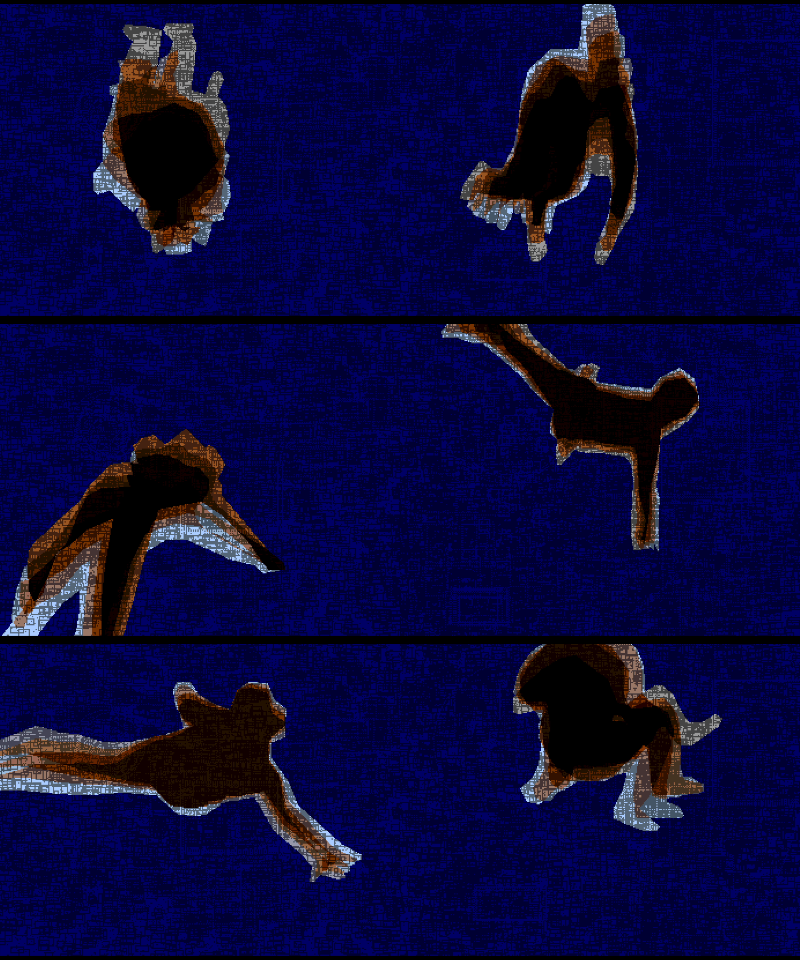
The rotating-hand passage obtains its shaded-looking rims from stored contours and their recent history. The renderer fills one-bit shapes; five mask planes combine their different ages into a palette index. Where all five overlap, index 31 is black. The changing fringes use orange and pale colours, while a sixth texture plane darkens selected pixels in Extra Half-Brite mode. That creates depth-like colour bands from temporal geometry.
This is the four-side overlay from disk $9cc00..$a23ff, loaded at
$50000. The four-second clip comes from local recording interval
1.5–5.5 seconds of a fresh silent FS-UAE 3.1.66 run. Its 200 frames preserve
the source's 50 fps cadence at 400×320. The nearby save catches foreground
polling at $50074, with 128 vertical-blank entries, 64 software entries
and 59 active draws.
History phase follows stream identity, not just time
The 32 records at $50376 select among five contour streams, changing the
chosen stream/starting entry every eleven active calls. $50606 also tracks
which stream was used previously. On each call it increments history phase
$50604; if the stream base has changed, it stores the new identity and
resets that phase to zero. A jump to another entry within the same stream
does not reset the history.
Some selected ranges run out before the next eleven-call boundary. The renderer then returns without reading another pose or launching a fill, but the selector and clear have already run. The new work mask is empty on that call; the history phase still advances. Thus an active controller call is not always a completed contour draw, and the exhausted range does not loop its last pose automatically. Extending the original renderer through 352 active calls produces 346 fills and six cleared, undrawn work masks, at active calls 87, 120, 175, 219, 252 and 307. The foreground exit threshold is 715 vertical-blank entries; 352 active calls is the nominal count when each alternate-entry software request is serviced. This continuation checks commands and memory effects, not the beam timing of six displayed frames. An independent check of all 32 records confirms that the remaining-counter guard stops short ranges before any out-of-range offset-table read.
The order of operations explains how this becomes visible. $50990 selects
the display planes before the renderer updates the phase. On the call
that changes stream, selection still uses the previous phase and completed
masks. The renderer then produces the first new-stream mask and resets the
phase. On the following call, phase zero makes all five display pointers
select that new mask. Its entire filled area therefore becomes index 31,
a black silhouette. Subsequent phases introduce one more older mask at a
time, beginning with plane 5; after four steps the full five-pose fringe
is present again.
Seven selector/clear pairs prepare the ring at startup without drawing. The first five software interrupts advance the texture but skip controller, selector, clear and renderer. Active draw one occurs on software entry six. This warmup differs from both the earlier six-pose prefill and the later textured dancer's first-three-entry shortcut.
At the save, phase 15 records the calls since the stream switch at active
44. The selected mask pointers are $69938, $66760, $63588, $603b0
and $5d1d8; the new work allocation is $5a000. These pointer roles,
phase updates and source consumption are checked separately from the pixels.
Fixed colour ramps and the newer texture load
$504b4 constructs a fixed 32-colour palette. Index zero is $006.
Its permuted ramps run from black toward $940 with coefficients 1–10
out of 11, then from $940 to $acf with coefficients 1–11; ten other
indices share the second step of the latter ramp. Component interpolation
uses signed division with truncation toward zero. All 32 resulting words
match independent arithmetic and the save.
The texture updater runs once at setup and on all 64 software entries,
including the five that skip drawing. Its eight-state counter is therefore
1 after 65 calls, selecting the first texture window at $6cb10.
BPLCON0=$6200 and BPLCON2=0 confirm the six-plane Extra Half-Brite
interpretation.
This is already using the newer nine-side texture read at disk $a2400.
The four 290-row windows span 51,040 bytes, while that read supplies 50,688.
The remaining 352 bytes match the earlier load, as detailed in the later
texture-provenance section below. Applying those two declared raw loads
reproduces all four windows in this save exactly.
Original setup and all 64 software bodies reproduce all 76,560 mask bytes from zero mask memory: 2,291 line blits and 59 fills. The replay also matches all 1,232 coordinate-table bytes, 1,534 bytes of renderer/state and 180 bytes of patched Copper data. The source contours, history selector, fixed palette and stored texture account for the saved result without supplying any final mask image to the test. Copper scanout timing and a same-instant match to an individual clip frame remain outside that proof.
Later Textured Dancer: Five Ages of the Mask

This later section turns recent dancer masks into the colour index itself. Five display planes select overlapping poses from a six-buffer ring; a sixth plane modulates their brightness with a changing texture. The moving fringes around the figure therefore contain different ages of the contour, not just one silhouette copied in several colours.
The four-second excerpt is capture interval 40.0–44.0 seconds in the fresh 320-second silent FS-UAE 3.1.66 recording. That recording starts during the colour-block head passage, not at demo zero. The GIF preserves its actual 50 fps cadence, with nearest-neighbour reduction to 400×320. The nearby saved state independently identifies the active code; the clip and save are not claimed to represent one atomic frame.
Six buffers, five mask planes and a brightness plane
This code is a different overlay: disk $aea00..$b83ff loads at
$40000..$499ff. Its original entry, interrupt bodies, sequencer and loaded
source region match the later saved state. Reusing RAM $40000 is not enough
to identify a part—the first main stage and intervening overlays must remain
separate.
The six mask allocations start at $5a000, each with a stride of $31d8
(12,760 bytes = 352×290 one-bit pixels). Unlike the first dancer's wider row
stride, these rows are contiguous 44-byte spans. Before drawing, $40bf4
patches five Copper plane pointers from this ring, advances to the next
allocation, and the caller clears and renders there. The newly drawn mask
will become a display candidate on a later selection.
The history does not appear all at once. Its phase is (group_counter-1) % 22.
At phase zero, all five plane pointers select the same mask. For phases 1–4,
one additional older mask enters each time: it starts at plane 5 and expands
back toward plane 2. Subsequent phases keep four older masks behind plane 1.
Because each plane contributes a different index bit, their intersections
produce a structured set of palette indices. This is hardware bitplane
composition, not CPU averaging of five RGB frames.
At the saved boundary the five selected addresses are $66760, $63588,
$603b0, $5d1d8 and $5a000; $69938 is the separate allocation just
used for the new draw. Seven startup selections/clears initialise the ring.
Replaying those selections and the following 28 active updates reproduces
all five saved pointers and the current work pointer exactly.
The sixth pointer cycles among four 290-row texture windows beginning at
$6cb10, also separated by 12,760 bytes. An eight-state counter selects
floor(counter/2), so each texture is held for two pattern-update calls.
The saved counter is 5 and its selected texture address is $72ec0.
Both the Copper list and saved hardware select $6200 in BPLCON0, with
BPLCON2=0: six-plane Extra Half-Brite. The first five bits choose one of
32 colours; a set sixth bit halves its RGB component intensities. Thus the
texture darkens the existing temporal colour composition, across both the
body and its surroundings. This mode's interpretation follows the
Amiga Hardware Reference Manual.
Where the texture bytes come from
The apparent noise animates by switching among stored bitmap windows; the
frame loop only changes a pointer. The raw texture data is loaded before this
overlay starts. Two recovered caller sequences specify reads to the same
RAM base $6cb10:
| Caller on disk | Requested source | Bytes loaded | RAM end, exclusive |
|---|---|---|---|
$74e88 |
Side 91, ten sides: $7d200..$8adff |
56,320 | $7a710 |
$9746c |
Side 118, nine sides: $a2400..$ae9ff |
50,688 | $79110 |
These are raw whole-side transfers, with eleven 512-byte sectors per side.
Executing the original caller instructions reproduces the destination, side
number and count in each row. The later nine-side source matches all 50,688
bytes at $6cb10..$7910f in the live save.
Four windows at the actual 12,760-byte pointer stride span 51,040 bytes,
ending at $79270. That is 352 bytes more than the later read supplies.
The first three windows are wholly in the new data. The fourth contains
12,408 new bytes followed by a 352-byte suffix, exactly eight 44-byte rows.
That suffix matches disk $89800..$8995f, which the earlier ten-side read
places at precisely the remaining RAM addresses $79110..$7926f.
Applying the earlier load and then the shorter later load in a host memory model reproduces every byte of all four live windows. This is stronger than finding a matching texture prefix, but it is still a load-span and content check, not a disk-DMA timing replay or a trace of every intervening writer. The matching suffix supports retention across the shorter read. Treating the new source as four complete consecutive 290-row images would cross its end into the next overlay's code and give the wrong final eight rows.
The inherited suffix contains one textured row followed by seven all-zero rows. In those seven rows of the fourth window, the sixth bitplane leaves the selected palette colour at full brightness. The memory result is exact; this check does not establish whether the boundary was intentional or constituted a visible defect in the running demo.
Palette permutation and the abrupt warm/cool switch
The 32-colour palette is tailored to those overlapping mask bits. Setup constructs two component-wise ramps, distributes them through an explicit permutation of indices 1–31, and assigns ten combinations the same intermediate colour. It is not a linear brightness ramp indexed simply by mask age.
When the history phase returns to zero, $40bbc complements colour words
1–31. Only their low RGB12 bits matter to the display. Colour 0 is handled
separately, alternating between $104 and $500. This explains the abrupt
cool/warm changes independently of the texture cycle. The five mask planes
collapse to one selected mask at that same phase boundary, coupling the
colour switch to a reset of the visible history. The phase uses the authored
group counter, whose adjustments below prevent treating every reset as a
fixed elapsed-time interval.
The close-up is a different coordinate lookup
The normal tables use floor(x*351/256) and floor(y*289/204). Two more
356-word tables create the enlarged framing:
x_large = clamp(floor(x*680/256) - 130, 0, 351)
y_large = clamp(floor(y*550/204) - 135, 0, 289)
The renderer changes table pointers at group-counter remainders 0 and 22 modulo 44. This changes the coordinates used to draw the contour; it does not resample a completed bitmap. Clamping each coordinate also differs from a general polygon-clipping algorithm. All four generated tables—2,848 bytes— match the saved lookup memory. The save uses the enlarged pair, agreeing with the close-up part of this visual sequence.
Rearranging motion without freezing the dancer
The pose controller has two streams and a 71-record schedule of
(stream, start_entry) pairs. Its normal selection boundary is every eleven
group-counter increments. The software handler skips its first three entries;
from the fourth it advances the controller, selects the pattern/history,
clears the new work area and consumes a pose entry.
The first ten active calls consume stream A entries 0–9. The next group starts at A11, skipping entry 10; the following group switches to B0–10. This is an authored arrangement of motion excerpts, not one uninterrupted stored animation.
Four special cases subtract two or three from the group counter and set one-shot flags. The pose cursor keeps advancing. Consequently three groups consume fourteen consecutive entries and another consumes thirteen, rather than repeatedly displaying a held pose. These extensions do not recur after the table wraps unless the flags are reset elsewhere; this controller does not reset them on wrap.
A different case, selecting record $4055a, subtracts three at the selection
boundary itself. That makes the next eleven-count boundary arrive after only
three calls: this record consumes A132–134, then the following one starts at
A143. Calling every counter subtraction a pause or an extended group would
get this case backwards.
An independent model matches 2,400 controlled original-code controller calls, including the wrap cases. That is a test continuation, not a claim that the normal runtime spends that long in this part: the foreground has its own exit threshold. At the actual save, 31 software entries mean 28 active calls; stream B entry 6 has been consumed and entry 7 is next. Twelve saved control fields and 36,010 bytes of source/controller data match. Separately, original setup and pointer routines reproduce the saved 32 palette words, history pointers, texture phase and coordinate tables.
The second stream changes the edge rule
The line helper at $40d26 treats stream B specially. When the active stream
base is $44874, it exchanges registers D1 and D3—the two endpoint y
coordinates—before ordering the edge top-to-bottom and setting up the
blitter. An input edge (x0,y0) → (x1,y1) therefore becomes
(x0,y1) → (x1,y0). The x coordinates stay where they were.
For example, (40,20) → (70,80) changes to (40,80) → (70,20) before
canonical endpoint ordering. This is the other diagonal of that edge's
bounding rectangle. Vertical edges retain the same geometric segment, and
horizontal edges still produce no line launch, but sloping edges change.
It is not a global mirror or merely the close-up scale table. Applying this
rule separately to each edge changes the parity boundary consumed by the
fill, so the earlier description as scaled contours alone was incomplete.
This documents the reached rendering rule without assuming why the source
stream was authored that way.
The rest of the reached line setup uses solid-texture single-dot XOR edges with the same shallow-edge adjustment described for the opening renderer, but with a 44-byte row stride. Descending exclusive fill then processes 290 rows of 22 words with zero modulo. Each ring slot is exactly that 12,760-byte rectangle; unlike the opening stage, there are no wider-row gaps to preserve inside these allocations.
Six complete masks matched, then composed
Replaying the original startup and 31 software-handler bodies produces
28 active draws after the three skipped entries. An independent scalar
blitter applies the original line, fill and clear commands in order. All
six complete allocations match saved RAM exactly: 76,560 bytes, starting
from zero without seeding any mask pixels from the save. The completed
renderer/state range $4080e..$40f0d also matches all 1,792 bytes, including
its rewritten interpolation immediates and current pointers.
The replay includes 975 line-helper calls, of which 753 launch lines, plus 28 fills. Independent endpoint arithmetic agrees with every effective line launch, including the stream-B exchange and shallow-edge adjustment. As in the opening checker, the line-error register comparison uses its meaningful low word. A host-only counterfactual that omits the stream-B exchange changes 11,448 bytes / 51,357 bits in the final masks. The unchanged original guest instructions reproduce the save.

This 352×290 image combines the five independently reproduced mask planes with the disk-backed texture and the palette/pointers produced by the original setup and selection code, applying Extra Half-Brite to its RGB components. Rebuilding the texture from the two load spans gives identical RGB pixels to the earlier saved-memory composition. The image therefore no longer depends on copying texture or palette bytes from the save as unexplained inputs. It is still a static composition: no claim is made that the nearby runtime screenshot captured the same instant or that Copper fetches and interrupt deadlines were simulated. The direct clip above supplies the motion evidence.
Crossing Polygon Bands: Two Bits per Frame, Four on Screen

This four-second, 50fps clip comes from the fresh silent FS-UAE 3.1.66 run of the same 1 MB CHIP compatibility disk. It shows the passage after the later textured dancer. The source capture starts after the saved state examined below; its purple/red palette is a later palette phase, not the green/blue palette in that save. The clip is continuous footage, reduced to 400×320 with nearest-neighbour scaling.
The moving bands use stored two-dimensional polygon coordinates. Each rendered frame has two bitplanes; the display combines two recent frames into four ordinary bitplanes and a sixteen-entry palette. Changing playback direction, reflecting the coordinate lookup and fading through white give the stored motion several presentations. This part does not require a recovered runtime 3D rotation or projection loop to explain its image.
The five-side payload at disk $b8400..$bf200 loads at $4c000. Its renderer
starts at $4c5ba; the four work allocations begin at $5a000, $603b0,
$66760 and $51bea. Each contains two consecutive 44-byte × 290-row planes,
25,520 bytes altogether. The plane stride is $31d8.
Polygon tags choose which of the two planes receives an edge
The source's polygon tag becomes a two-bit plane choice through
(tag - $d0) >> 1, stored at $4d214. The line helper at $4ca94 tests its
low two bits and emits the edge into the first plane, second plane, or both.
It retains the parity-edge and exclusive-fill approach, but a frame can now
carry more information than one silhouette bit. All 1,298 polygons across the
145 physically stored frames are literal coordinate records; this particular
dataset does not exercise the renderer family's referenced-contour morphing.
The fill at $4d1ca programs BLTCON0/1=$09f00012 and
BLTSIZE=$9116: 580 rows × 22 words, covering both planes consecutively.
Selection at $4c934 takes two such pairs from the four-allocation ring.
If its current slot has index i in the address order above, the displayed
pairs are (i+1) mod 4 and (i+2) mod 4; the next work slot is (i+3) mod 4.
The work cycle is therefore $5a000 → $51bea → $66760 → $603b0 → $5a000.
The software handler selects the display, updates the palette and counter,
draws into the current work allocation, then advances and clears the next
work allocation. The first software entry skips drawing. The third enables
four display planes with BPLCON0=$4200. At saved software entry 86, the
newly rendered source entry 84 is in $51bea; the displayed pairs are
$5a000/$5d1d8 and $603b0/$63588, containing entries 83 and 82.
The clear is working on $66760. Thus the visible colour index combines
two earlier two-bit frames, not two copies of the newest completed frame.
Reversing the source also changes the coordinate lookup
The header at $4d49c declares 144 selectable entries, numbered 0 through
143. Exhaustion negates the signed offset-table step. Usually it also moves
the existing cursor five entries in the new direction and shortens the
remaining range by five. One phase deliberately omits that adjustment:
| Renderer calls | Source indices | Coordinate lookup |
|---|---|---|
| 1–144 | 0–143 forward | Normal x, reversed y |
| 145–283 | 139–1 backward | Reversed x, normal y |
| 284–427 | 0–143 forward | Normal x, reversed y, using a second identical table pair |
The foreground waits for 408 software entries after preloading the next part. With prompt servicing of alternate-VBlank requests, that is 407 draws, inside the third row. A controlled 900-call prefix continuation checks the later cursor ranges separately; it is not a claim that the authored passage normally runs that long.
The ordinary lookup formulas are floor(x*351/256) and
floor(y*289/204). The reflected versions replace x with 256-x or y
with 204-y. Their generated arrays extend beyond those useful domains:
word decrements wrap, unsigned multiplication follows, and an overflowing
DIVU.W leaves its dividend unchanged before the low word is stored.
There are 209 such overflow entries across the generated tables. None is
selected: all 7,406 vertices in selectable frames have x in 0–255 and y in
0–204. This matters when reproducing the original arithmetic, but does not
establish a visible defect. Original CPU execution and independent arithmetic
agree on all 3,696 table bytes, including those unused tails.
White flashes separate three palettes
The palette dispatcher runs directly on odd VBlanks and through the requested
software interrupt on even ones. Under prompt service it therefore has one
opportunity per VBlank, while geometry updates every other VBlank. Each RGB
component uses signed division with truncation toward zero:
start + trunc((end-start)*weight/denominator).
| VBlank counter | Palette operation under that schedule |
|---|---|
| 1–10 | Black toward white, weights 0–9 divided by 10 |
| 11–21 | White to palette A, weights 0–10 divided by 10 |
| 281–291 | Palette A to white, weights 0–10 divided by 10 |
| 292–301 | White to palette B, weights 0–9 divided by 9 |
| 548–558 | Palette B to white, weights 0–10 divided by 10 |
| 559–568 | White to palette C, weights 0–9 divided by 9 |
VBlank 350 resets the two later fade counters before the last pair of windows. The second startup window supplies the exact white endpoint that the first window stops short of. Initially all sixteen indices receive the same grey, so the later spread into different palette colours reveals the geometry. At saved VBlank 172, all sixteen words exactly equal palette A. Independent arithmetic checks 816 scheduled opportunities and all three weight counters. A delayed software interrupt reads the newer VBlank counter; this check does not prove equivalent results under arbitrary interrupt latency.
Clearing with 410 MOVEM instructions, then a short blit
The clear at $4cb02 sets A6 to work+$598c, zeroes D0–D7 and A0–A5, then
executes 410 consecutive MOVEM.L instructions with opcode/mask
$48e6fffc. Each stores fourteen zero longwords while decrementing A6:
56 bytes per instruction, 22,960 bytes in total. There is no branch inside
that unrolled span.
The footprint is slightly larger than a simple prefix clear:
[work-36, work+22924). A following zero-source blit starts at work+$598c
and clears another 2,596 bytes: 59 rows × 22 words, BLTSIZE=$0ed6.
Together they clear the complete 25,520-byte allocation plus 36 bytes before
its base.
For the lowest allocation, that extra span is $51bc6..$51be9. It overlaps
the tail of physically stored frame 144 and its following padding byte.
Selectable frames 0–143 end at $51b5a, and none refers indirectly into the
terminal frame. The recovered cursor ranges exclude frame 144. The overclear
is real, but this bounded dependency check does not make it an observed
corruption of the motion being played.
The fresh save catches PC $4cdd2 inside this unrolled clear. Replaying whole
instructions up to that PC initially left sixteen differing bytes in the
allocation being cleared, although all fifteen D0–D7/A0–A6 registers and the
other three complete allocations already matched. Executing the entire next
instruction cleared too much.
FS-UAE's saved CPU trace resolves the boundary: eight word writes from the
current MOVEM had already reached RAM while the saved PC and A6 still
represented its start. Their addresses and zero values match the first four
predecrement longword stores. Applying exactly those recorded, independently
validated stores after the whole-instruction replay matches all 102,080
bytes across the four allocations. No saved bitmap bytes are copied in to
repair the result. This is an instruction-and-bus-write reconstruction of the
saved RAM, not a model of physical Copper scanout or DMA arbitration.
The Gold-Rimmed Dancer: Motion Differences Become the Outline

This fresh four-second, 50fps clip shows the passage following the polygon bands, from the same silent FS-UAE 3.1.66 run. The gold rim is made from filled poses at different ages. Where all five selected silhouettes overlap, their combined index is dark; where they disagree, the palette supplies brighter gold and brown. The sixth, Extra Half-Brite plane modulates both figure and background with the inherited four-window texture.
The code is disk $bf200..$c8c00 loaded at $40000. It reuses the contour
morphing, parity-line and exclusive-fill machinery, but gives the pose history
a different controller. Seven startup selections clear the six-mask ring;
none draws a pose. The first two software interrupts also skip geometry.
The active counter starts at 44, so software entry 3 draws at counter 45,
not 1. That starting phase is part of the effect's behaviour.
Five recent masks, with a restricted collapse window
The selector at $40bd2 first points all five mask planes to the latest
completed mask. In ordinary steady operation, it retains hardware plane 1
and replaces planes 2–5 with the preceding four ring entries. It then advances the work pointer, clears
that allocation and draws the new pose. Selection therefore precedes the
new render.
At the saved software entry 95, the displayed masks are $63588, $603b0,
$5d1d8, $5a000 and $69938: five consecutive completed poses. The next
pose is still being drawn into $66760. The active counter is 137, exactly
44 plus the 93 geometry calls begun so far.
A special path replaces the five-pose history with a gradual rebuild. It is
active while the counter is below 50, or while the next schedule-record
pointer lies in the inclusive range $4046a..$404b2. Here the phase is
(counter-1) mod 11. At phase zero all five planes remain on the same mask.
Phases 1–4 progressively fill the last one, two, three and four display slots
with older masks; later phases use the full history. This ties the collapse
to a particular passage of the motion schedule rather than every source
change or every eleven frames throughout the effect.
An independent formula matches the original selector in 21,840 cases, including every ring position and both sides of those counter and pointer boundaries. The saved five pointers also match. Those synthetic cases check the branch rules; the authored sequence is traced separately below.
The palette makes overlap dark and motion bright
The first palette has background $502. A permutation of indices 1–31
receives two RGB ramps: $402 → $db4 with weights 0–9 divided by 11, then
$db4 → $300 with weights 0–10 divided by 11. The final ten indices use
weight 2 of the second ramp. Components use signed division with truncation
toward zero.
The permutation is crucial. Index 31, where all five masks overlap, receives
$402, a dark red-brown. Index 19 receives $db4, the bright gold endpoint.
Other combinations receive intervening colours. This is a colouring of
motion differences, not a geometric normal or light calculation. Identical
masks collapse to just background and the dark all-five-bits colour; separate
poses open up the bright combinations again.
The alternative palette uses white as its background and ramps white to
black and back toward white. A byte toggle at $40ba2 alternates the two
palettes at selected history collapses. In the nominal trace, toggles occur
at counters 320, 331, …, 419: ten switches, returning to the gold palette.
The toggle happens one update after the relevant schedule selection, because
the record selection uses counter mod 11 == 0, while the collapse uses
(counter-1) mod 11 == 0.
Two motion streams, reordered groups and a held terminal pose
Two streams at $41174 and $4552a each have header 255 and 256 physical
offset slots. Startup begins at entry 2 of the first stream. At counter 55,
the first of 51 eight-byte schedule records selects entry 13; later records
select groups eleven entries apart. The second stream begins at counter 297.
Its middle passage deliberately rearranges group starts, including
23, 45, 34, 67, 56, 89, 78, 111, 100, 123. This is also the passage in
which history collapses and palette alternation are enabled.
At the end, selecting entry 255 is valid. When that stream is exhausted,
$4079a increments the remaining count and backs the cursor up one slot,
then re-enters the renderer. The terminal contour is redrawn into each fresh
work mask. It is not an exhausted return leaving a blank mask, as in some
other parts. The subsequent schedule records can select that same final
entry again.
The coordinate builder generates both normal tables and clamped enlarged
tables. However, the renderer prefix always installs the normal pair
$7d2e4/$7d604. The apparent close-up condition converges on $4084e
without assigning the enlarged pair. The presence of zoom tables therefore
does not establish a zoom in this passage. Original execution and independent
arithmetic match all 2,848 generated table bytes; the branch cases retain the
normal pair.
Matching the unfinished contour, then following the exit
The fresh save catches PC $40db2 inside the line helper. Replaying startup
and the interrupt sequence reaches the matching register state on the 42nd
visit to that instruction within the final software handler. All fifteen
D0–D7/A0–A6 registers agree, and all 76,560 bytes in the six masks match,
including the unfinished work mask. The replay has issued 4,658 line blits
and completed 92 fills at that boundary. Renderer state, the selected Copper
pointers and palette also match.
The four texture windows still reconstruct from the earlier raw loads: 50,688 bytes from the newer load plus the 352-byte retained suffix, exactly 51,040 bytes in total. On the ordinary display path, the texture pointer advances once per software entry, including the two entries that skip drawing; each window lasts two such updates. This is separate from the five-pose history.
A full original-code polygon/blitter continuation reaches software entry 520 with 518 completed fills and no cleared-but-undrawn geometry calls. This is the last normally serviced even-VBlank update before the foreground's exit threshold of 1,041 VBlanks, assuming the preload has completed and alternate requests are serviced promptly. It does not prove physical DMA deadlines.
At software entry 511, the pre-update active counter reaches 552. The code
switches to a different Copper list at $410e8 and begins a two-colour fade
toward white. This list displays the texture alone; the dancer disappears
from the display even though its contour renderer continues to run. By software entry 520 it has used weights 1–10 divided by 11,
ending at $ddd and $edd. The nominal path leaves before weight 11, so
calling this a completed fade to pure white would overstate what the counter
sequence establishes.
The alternate texture updater has an unexpected shared branch. On seven of
every eight calls, $4074a branches into the ordinary updater and writes the
old Copper list's pointer. Only the wrap-to-zero call updates the new list,
always to $6cb10. The first late call lands on that wrap, so the visible
ending holds the first texture window while its two colours brighten. This
is what the instructions do; the evidence does not establish whether the
shared branch was intentional. A fresh tail capture independently shows the
figure disappearing into the texture-only fade.
Black Contours over Stepped Colour Fields
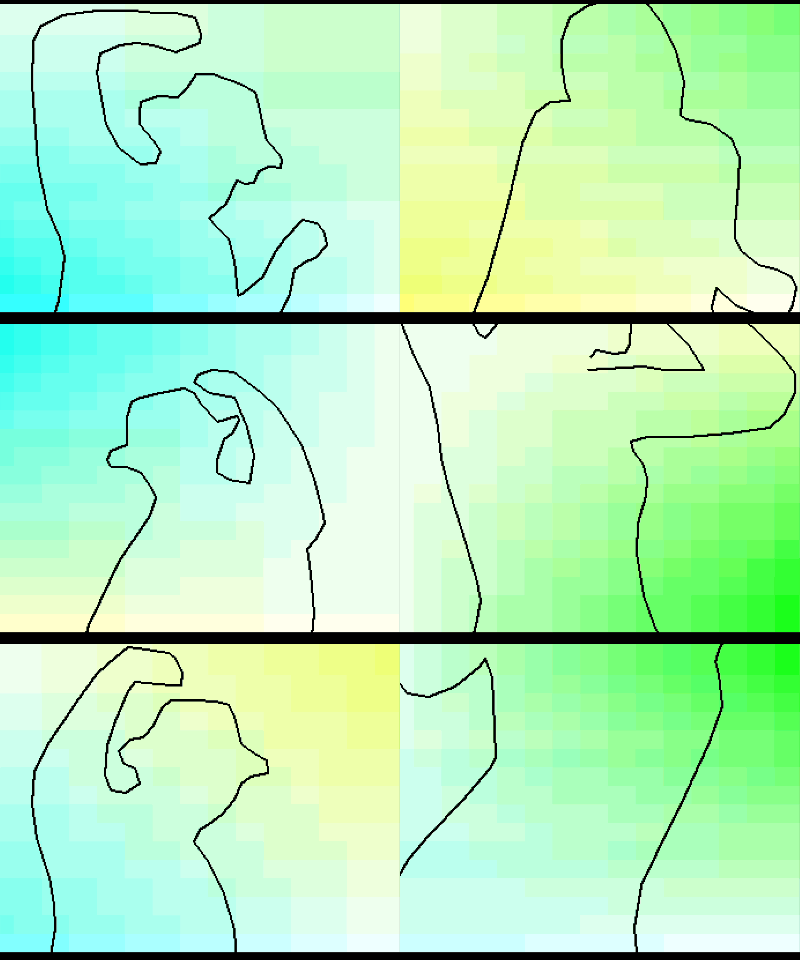
The next passage removes the filled body and leaves a moving black contour
over a changing field of coloured rectangles. This 4.02-second clip contains 196 frames captured at
49fps from the same fresh silent FS-UAE 3.1.66 run. The eight-side
payload at disk $c8c00..$d3c00 runs at $4f000.
The background reuses the earlier Copper-gradient technique, but only one colour field is active here. The figure changes more fundamentally: its line blitter writes ordinary solid edges with OR, and the nominal fill routine is an immediate return. Neither a filled silhouette nor a separate image-space edge detector is needed to produce these outlines.
Solid OR lines replace parity edges and fill
The active line routine at $4fb16 selects an octant, computes the major and
minor coordinate differences, and programs the line blitter's error term and
increments. BLTSIZE uses the major distance plus one, including both ends.
The horizontal starting bit is encoded in the high nibble of BLTCON0.
The low byte is $ea; with the solid B pattern $ffff, this combines the
new line bit with the existing destination by OR. Shared vertices stay set
when neighbouring edges meet. The octant modes omit the single-dot-per-row
flag used by the parity-edge renderer.
The original return path still calls $4fd9e, but that address contains only
RTS: there is no area-fill blit. The separate parity-line helper also
remains in the payload; its presence does not describe the reached drawing
path. In the 71-update replay, all 2,619 line commands use the OR minterm and
there are zero fill commands. Replacing only the host model's OR operation
with XOR changes 162 contour bits across the saved six allocations. The
original guest instructions remain unmodified in that comparison.
The selector at $4fcf4 uses a six-buffer ring, with each allocation holding
44 bytes × 290 rows. Before the next clear and render, it installs three
plane pointers: base, base+44, base+44. The second and third planes
therefore fetch the same contour one row ahead; they are not older poses.
There is also a horizontal displacement: the Copper writes
BPLCON1=$0001 at $5136a, matching the saved chip register. Its low
nibble delays the odd-numbered hardware planes 1 and 3 by one pixel relative
to plane 2, as specified by the hardware manual's playfield-register
summary.
Taking x relative to the undelayed plane, the interior index is
mask(x-1,y) + 2*mask(x,y+1) + 4*mask(x-1,y+1). All eight indices can
occur, and all seven nonzero colours are black. The contour is therefore the
union of three samples displaced in both axes. Colour zero supplies the
background. A static check of the reproduced selected contour finds all
eight indices and 669 black-pixel differences from the earlier, incorrect
row-only interpretation. That comparison excludes the first column and last
shifted row; it is not a cycle-exact scanout or screenshot-equality claim.
The offset is a real pointer displacement, not a clamped image operation:
the final shifted row reads the 44 bytes following the allocation. At the
saved selection, the pointers are $69938, $69964, $69964; that extra
row lies at $6cb10, the beginning of the inherited texture storage. No
claim about a visible border fault follows from the pointer arithmetic alone.
The work allocation has already advanced to $5a000, so its newly drawn
contour is distinct from the selected one.
One changing Copper colour, two unused field paths
The component-ramp lookup table is rebuilt at $4c000, with 8,192 bytes
covering all sixteen-by-sixteen endpoint pairs and sixteen interpolation
steps. As in the earlier colour-field part, source words occupy the red
nibble. The blitter combines three table streams using
BLTCON0/1=$4f168000: shifts move the green and blue components into their
positions while the Boolean operation packs the RGB word.
The active temporal controller at $4fe2a interpolates four corner colours.
It generates sixteen intermediate quartets per endpoint segment but selects
only the first fifteen before regenerating. Its eighteen segments therefore
make a 270-controller-call cycle. The background consumer at $508f2
interpolates vertically between the two left corners and the two right
corners, then horizontally between those results.
Seventeen Copper blocks each receive fifteen horizontal colour steps.
The vertical source sequence repeats sample 12 once: samples 0–12 followed
by 12–15. The horizontal blit writes fifteen words with destination modulo
10, landing on every third colour-data word. Only the COLOR00 member of
each COLOR00/COLOR01/COLOR02 triplet changes; the other two remain black.
COLOR03 through COLOR07 are also black. The result is 255 dynamic colour
words with 510 fixed black words in the repeated triplets, rather than the
earlier passage's two independently changing fields.
The payload still contains the second temporal controller and the other two field consumers, but the normal software handler does not call them. Its order is selection, background construction, pose-schedule update, temporal controller advance, buffer clear, then contour drawing. Thus the background uses the previous corner quartet. At the save the controller has run 72 times, including startup; the completed Copper build uses quartet 71.
The same masked WAIT, SKIP and COPJMP1 structure repeats each horizontal
colour sequence down its band. Exact screen-column widths and DMA deadlines
are not inferred from the count of colour writes. Independent RGB arithmetic
checks 601 temporal-controller calls, all 8,192 lookup bytes and every saved
dynamic colour word. A separate model of the original blitter shifts and
Boolean operation matches the complete 3,480-byte selected-pointer/Copper
region, not just the final corner colours.
Pose groups and horizontal reflection
The pose controller has six streams and a 71-record table at
$51118..$51350. Each record supplies a stream and starting entry for an
eleven-update group. One selected record, at $51220, subtracts eleven from
the group counter while still advancing the table pointer. At software call
374, the counter becomes 363, but the newly selected record is consumed
normally and the next group still starts eleven calls later. This renumbers
the counter; it neither repeats a record nor lengthens a pose group.
The alternate coordinate pair is a horizontal reflection, not a larger
scale. For byte-domain coordinates, normal x is floor(x*351/256); reflected x is
floor((256-x)*351/256). Both pairs use floor(y*289/204) for y. The code
selects the reflected pair for two particular streams, or for any stream
once the next-record pointer reaches $51248. This decision uses the
already advanced table pointer. Reflection becomes unconditional from call
418 in the nominal sequence: record 38 advances that pointer to $51248.
Integer rounding matters. Except at x=0, normal and reflected table entries for byte inputs sum to 350, not 351; x=255 becomes 349 normally and 1 reflected. Subtracting the rounded normal coordinate from 351 would therefore produce a different result. The generator also produces 99 overflowing unsigned-division tail entries beyond x=256. They match original CPU execution and saved RAM; the formulas above do not describe those tails as signed arithmetic or clamping. The direct byte-coordinate bound is not an independent proof of every synthesized morph coordinate.
If a stream exhausts, the renderer reinitializes the first stream and resumes consumption in that same call, setting a flag. It does not return an empty work mask. This is a different exhaustion policy from both the rotating hand and the gold-rimmed dancer. It is a separately tested branch, not an event observed in the nominal 692-call sequence: the scheduled groups replace each stream before it exhausts.
Saved-state agreement and its limits
The fresh save is in the foreground disk-ready wait at $4f394, after 143
VBlanks and 71 software updates. Original startup and interrupt execution,
with a scalar blitter model, reproduce all 76,560 bytes in the six
contour allocations. The component table, temporal controller state, corner
quartet and selected Copper region also match. The drawing check starts with
zeroed contour storage; it does not copy saved contour pixels as inputs.
A continuation of the complete original drawing and colour routines reaches 692 software updates, with 26,745 OR line blits, zero fills and 13,355 gradient blits. The rewound counter ends at 681. This reaches the last even VBlank before the foreground's threshold of 1,385, assuming prompt interrupt servicing and completed preload. Those later frames are a command-order continuation, not additional live-snapshot matches or a DMA timing proof.
The Op-Art Finale: Reused Pattern, Two Clocks and Shortening Pose Groups
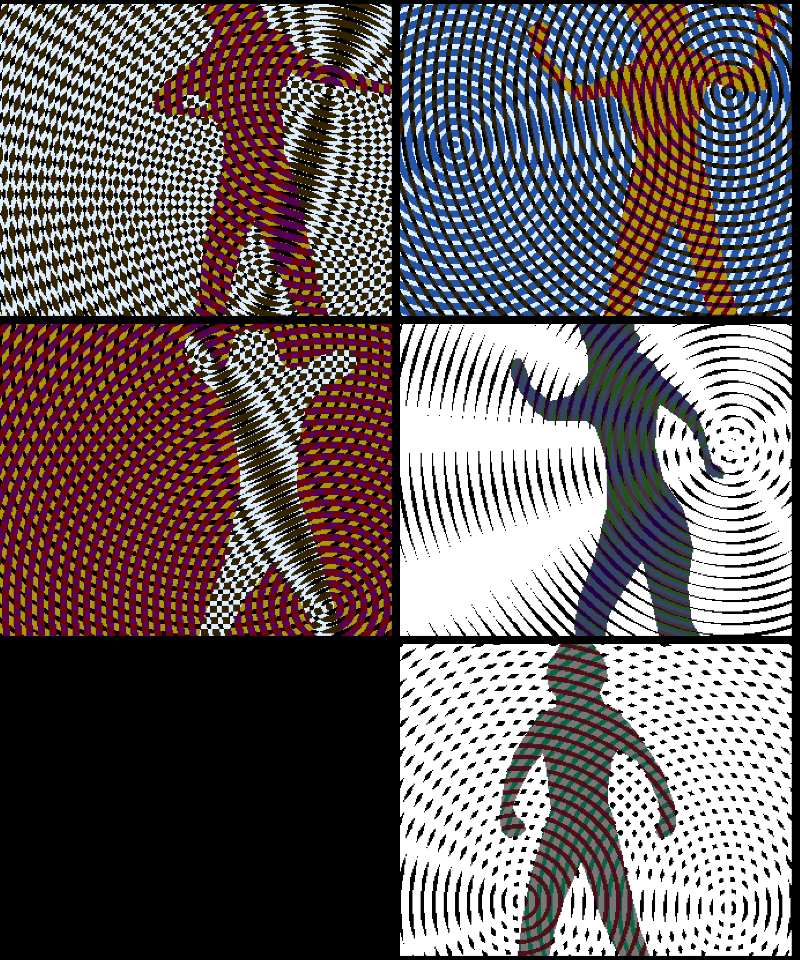
This five-second clip comes from a 50fps segment of the fresh silent FS-UAE 3.1.66 run. It includes the transition to authored two-field display blanking. The moving pattern continues underneath that blanking, while the silhouette advances at a slower cadence.
The finale combines the first main part's concentric bitmap with a different
pose schedule, coordinate map and palette controller. Its code is the
side-88 two-side load, disk $79000..$7bc00 at $40000; the three pose
streams arrive through sides 154–159 at $43000..$4b400. The predecessor
calls $40000 to unpack the pattern before the actual finale entry at
$40012 takes over the display.
Two moving windows into the original bitmap
The depacker reads the retained 16,512-byte packed span at $b0000, matching
disk $63000..$67080, and writes 40,960 bytes at $6cb10. Original CPU
execution produces the same bytes as both the live finale and the first
concentric-pattern background. This is reuse of the bitmap itself, not a
new per-frame generation of circles.
Routine $40286 advances four phase pointers by +6,+4,+0,+6 bytes,
wrapping the x table over 1,000 bytes and the y table over 954. One bitmap
window uses both x and y; the other fixes x at zero and uses its own y phase.
The first pointer is bitmap + 80*y + 2*(x>>4), while its fine-scroll nibble
is (~x)&15. The second is simply bitmap + 80*y2.
The Copper assignments matter: the silhouette is hardware plane 1, while
those two pattern windows are planes 2 and 3. The fine-scroll value is written
into the high nibble of BPLCON1, so it applies to even-numbered plane 2.
Plane 3 and the silhouette have zero fine delay. At the saved state, the
pattern pointers are $6cfc2 and $6d4c0, with BPLCON1=$0090.
Independent arithmetic agrees with 2,000 original updater calls; call 99,
one setup call plus 98 VBlanks, reproduces all saved phase pointers and
Copper words.
Three wide-stride masks, selected before the next draw
The silhouette returns to XOR parity edges followed by exclusive fill. Its
three work allocations begin at $5a000, $5faa0 and $65540, spaced
23,200 bytes apart. Each contains 290 rows with an 80-byte stride, but the
clear and fill touch only the first 44 bytes of each row. Their blitter
modulo is 36. These are not tightly packed 44-byte-row allocations like the
recent outline and trail parts.
The selector leaves the current work pointer in place while installing the
previous mask's display pointer and recording the next work allocation.
Drawing then finishes before the software handler copies that next pointer
into the current-work variable. The work order is
$5a000 → $65540 → $5faa0 → $5a000.
There is also a four-byte pre-offset on the selected mask pointer. At the
save, software call 49 has just drawn into $5a000, the next work allocation
is $65540, and the selected pointer is $5fa9c, four bytes before the
mask produced by call 48. Display fetch and draw rectangles must be kept
separate: DDFSTRT=$20, DDFSTOP=$d8 fetch 24 words per row, and both
bitplane modulos are 32, retaining the same 80-byte stride. The draw clear
uses 22 words plus modulo 36. A reconstruction that treats both as the same
44-byte display window loses that distinction.
The coordinate table also differs from the first part. It uses signed multiply/divide, recentres, then clamps:
x' = clamp(trunc((x-128)*350/256) + 206, 0, 351)
y' = clamp(trunc((y-102)*300/204) + 145, 0, 289)
Division truncates toward zero. Replacing it with floor changes negative-side samples. All 1,424 generated bytes match independent arithmetic and live RAM. There is one coordinate pair here, without the preceding part's reflection switch. Even byte-domain inputs reach the clamps: x saturates at 351 from input 235, and y at 289 from input 200.
At 98 VBlanks and 49 software calls, original-code replay reproduces all 38,280 actively drawn mask bytes across the three buffers, along with the renderer state, stream controls and 184-byte Copper region. The untouched 36-byte row gaps are excluded from that pixel claim. At this boundary the replay has issued 2,767 line blits and 49 fills. It starts the draw rectangles from zero and uses no saved mask pixels as inputs.
The pattern clock and pose clock diverge
Every VBlank moves the background. Initially, every second VBlank requests a software update, which selects, clears and renders a new pose. At VBlank 720 the request threshold changes from two to four, without resetting the request phase. Consequently the first slower update occurs at 722, not 720 or 724. With prompt servicing, the trace has 359 early updates and 249 later ones: 608 in total before the foreground's threshold of 1,716 VBlanks.
At the same VBlank-720 boundary, the Copper's BPLCON0 word alternates
between $0200 and $3200 according to counter bit 1. That means two fields
with no bitplanes followed by two fields with three planes. The palette's
colour zero remains visible during the no-plane fields. The background
pointer updater continues on every field, including those blanked fields.
This is separate from the slower contour update rate.
Pose grouping changes on a third set of controls. A 94-record table at
$407a4..$40a94 supplies a stream pointer and starting entry. A new record
is selected when the absolute software-call count is divisible by the
current group divisor:
| VBlank boundary | Group divisor |
|---|---|
| Startup | 11 |
| 720, and again 750 | 8 |
| 800 | 7 |
| 950 | 6 |
| 1100 | 5 |
| 1250 | 4 |
| 1400 | 3 |
| 1500 | 2 |
The software counter is never reset at these boundaries. For example, software call 360 at VBlank 722 immediately selects a new record because 360 is divisible by eight. Call 380 at VBlank 802 does not select one: its remainder under the new divisor seven is two. This is absolute-modulo scheduling, not a fresh countdown whenever the divisor changes.
The entire 94-record table is reached. Record 94 is selected at call 598,
VBlank 1674, and wraps the table pointer; call 608 has already reached record
5 of the next pass. All 608 scheduled source entries are in bounds. A forced
exhaustion test returns without drawing, but the nominal sequence never takes
that branch. The initializer's byte-offset argument and inclusive remaining
count differ from the scheduled records' entry-index argument and
header-start-1 count; treating those initializers as interchangeable would
miscount the source range.
Palette banks, packed additions and the white handoff
Before the late phase, remainder one of the group divisor cycles through four sixteen-byte palette banks. Their words are written in the order 1, 3, 5, 7, then 0, 2, 4, 6. With the silhouette in bit zero of the colour index, those odd and even entries separately colour the inside and outside of the figure.
After VBlank 720, the colour action changes. Entries 2, 4 and 6 become white.
The four odd entries receive packed-word additions $102, $231, $322
and $413, respectively, followed by AND.W #$0777. These are actual
word additions, including any carries before the mask, rather than a
component interpolation or a palette inversion. Independent arithmetic
matches all original palette writes through 1,716 VBlanks and 608 software
calls: 34 palette-bank loads including startup, then 65 packed-add updates.
From VBlank 1701, the fade captures the starting palette and drives entries
0, 1, 3, 5 and 7 toward white with weights 0–15 divided by 15. The other
three are already white. Packed-add updates stop once the fade has begun.
At 1716, all eight colours are exactly $fff, providing a uniform white
handoff to the final card.
The complete original polygon/blitter continuation through this sequence issues 31,536 line blits and 608 fills, with no cleared-but-undrawn pose calls. That continuation extends the instruction/command proof beyond the live 98-VBlank snapshot; it does not add a cycle-exact DMA or screen-timing claim. The nominal cadence assumes that software requests are serviced promptly.
The Final Card Really Does Stop the Foreground
The fresh ending save catches PC $400f0, whose original bytes are
6000fffe: an unconditional branch back to itself. The enclosing code matches
disk $79000 loaded at $40000. It waits for its effect counter to reach
$06b4, disables master interrupt delivery and audio DMA, depacks the card,
sets its two plane pointers to $5a000 and $5d020, and installs Copper
list $4113c. Fifteen polled vertical-blank fade iterations finish before
that permanent branch. The saved fade counter is zero and the master
interrupt-enable bit is clear.
The original depacker also reproduces all 24,640 bytes of the final card in
that ending save: two 12,320-byte planes. Its packed source starts at
$41a62. The separate polled fade uses fifteen weights, 0–14 divided by 14,
from white to the four target colours $000,$fff,$abe,$fff. Independent
signed component arithmetic matches every step and the saved final palette.
Thus this card fade reaches its endpoint before the permanent branch; it is
separate from the preceding sixteen-step fade of the op-art display to white.
This establishes the authored hold independently of prolonged footage. The Copper continues displaying the card while the foreground spins. A mouse poll and return exist immediately after the branch, but this reached path cannot fall through to them.
Runtime-to-Binary Concordance
- The 1 MB chip-memory boot label agrees with the successful tested profile; this is not a claim that every other possible configuration fails.
- The introduction and main show are separate in both presentation and disk layout; the visible black handoff occurs immediately before the main module sequence.
- The module text's 3:24 is not its independently computed uninterrupted duration. The saved final card retains an earlier replay state, with playback shut down by the visual controller before the authored F00.
- Direct blitter fill kernels explain the moving filled and cut-out silhouettes; scaling/address tables explain why the same body language can be re-surfaced without storing every final screen.
- The CIA-timed four-channel replayer supplies a stable musical tick while the visual parts take over the display and blitter independently.
- The older capture records the final card holding for more than two minutes; the fresh run independently reaches the same card.
What Makes State of the Art Distinct
The technical achievement is not simply "an Amiga can display a dancing woman." Spaceballs made a four-minute music video from a trackloaded chain of small hardware-owning parts, a CIA-driven ProTracker engine, compact motion data, blitter fills, texture/address transforms and very limited typography. The recurring figure gives all those separate routines one visual subject.
That is why the demo still reads clearly. It spends its machine budget on motion, rhythm and graphic contrast, then makes the implementation disappear behind a single idea. The disk dissection restores the machinery without reducing the result to a list of effects.