Analysis model: gpt-5.5 xhigh
Stateline by Complex - Graphic Design as the Demo Engine
A Finnish demo that looks forward
Stateline is a Finnish Amiga demo by Complex, released on 8 November 1992.
Zany wrote the code, Open Eyes made the graphics and design, and Stargazer
wrote the music. Open Eyes were the Finnish trio Alvin Radar, G-Lock and Jules
Nova; Stargazer is Antti Oksanen, and Zany was based in Turku.
Those credits matter because Stateline is not an effect catalogue wearing a theme afterwards. Open Eyes' layout is the production. Thin condensed type, pale blue-grey fields, dusty accent colours and deliberately light wireframes remain coherent from the title to the final screen. Zany's code gives that graphic system movement and changes its content without discarding it.
This analysis comes from the preserved DMS, its restored disk, the extracted raw payloads, the later WHDLoad patch source and one uninterrupted 660-second silent A500 run. The original disk was not modified, and no online video or remake was used for the visual route.
- Demozoo production and credits
- Pouet production
- Open Eyes at Demozoo
- WHDLoad install and technical notes
- Preserved DMS
Identity before spectacle

The opening calls this “an Inner Universe production” and dates it 1992 ANNO DOMINI. The lettering is narrow, widely spaced and arranged as a composition
rather than a conventional centred title. Even before the main effect,
Stateline is establishing rules for its own printed world.

A halftone face follows, paired with A TESTED COMPLEX PRODUCT. It feels like
a magazine advertisement or record sleeve, not a loading picture. The face,
label and empty space are equally important. In 1992 demo terms, the unusual
gesture is restraint: the image is not trying to fill every pixel or display
the maximum number of colours.
One frame, many structures
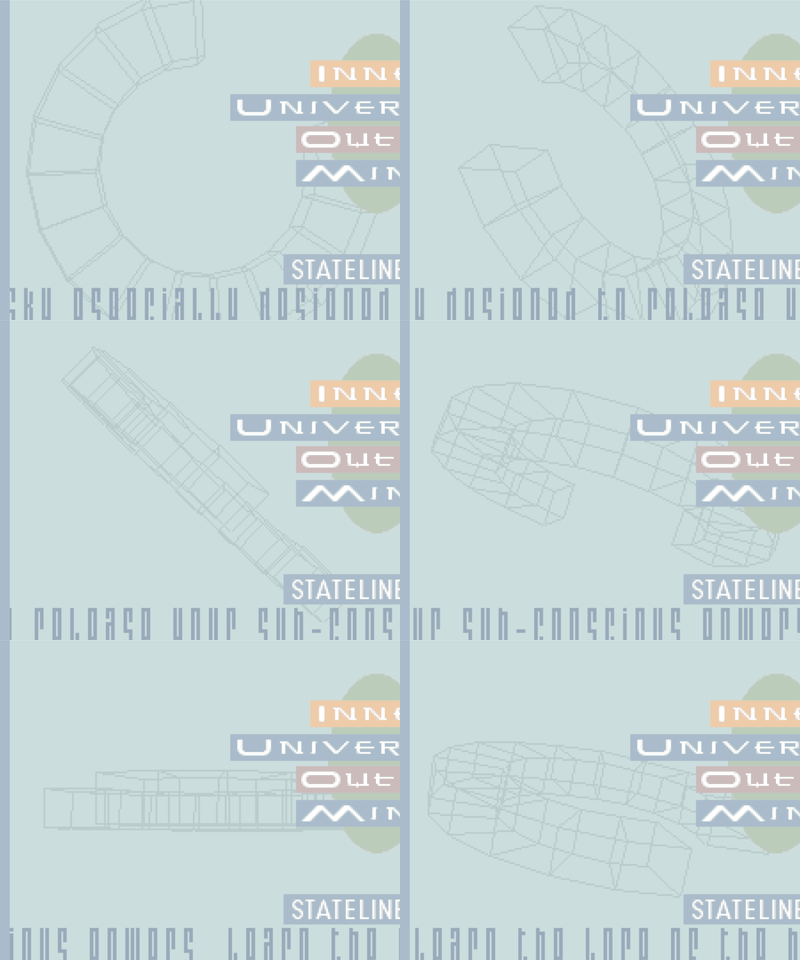
The long central part fixes a vertical COMPLEX banner on the left, stacks
INNER / UNIVERSE / OUT OF / MIND at the right, places STATELINE below it
and reserves the bottom edge for changing text. Wireframe structures rotate
and deform in the remaining field.
This is a useful reversal of the normal hierarchy. The 3D object does not own the screen while the typography decorates it. The page owns the screen, and the object is one kind of changing editorial material inside it.

The forms move between columns, open arcs, loops and elongated lattices. Their thin lines and low contrast make them appear diagrammatic: architectural studies or product-design drawings rather than chrome demo objects. A brighter palette or solid faces would make the geometry more forceful but would break the visual argument.
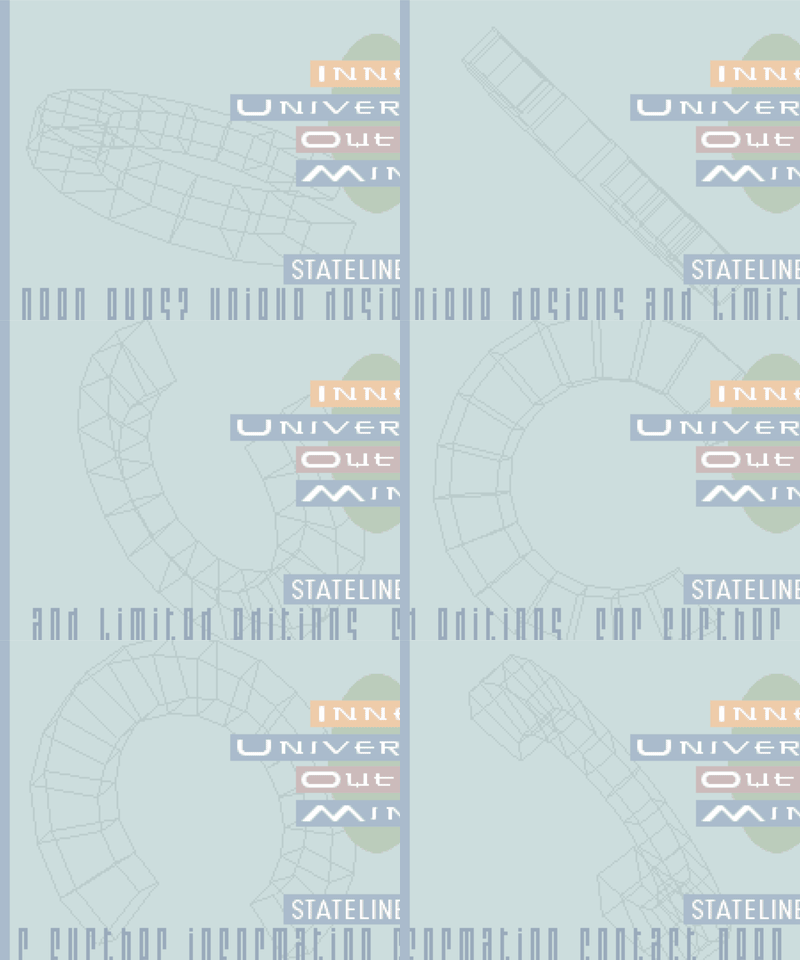
The bottom text changes pace and phrasing while the scaffold remains fixed. This gives a long section variation without pretending that every variation is a new effect. Stateline trusts a single visual language for minutes at a time.
Greetings remain inside the design

At roughly 277 seconds, the wireframe page gives way to greetings. The new screen is denser, but it keeps the same condensed lettering, pale field, muted red and blue accents, vertical Complex mark and small geometric ornaments. The group names are typeset content, not a generic scroller pasted onto the end of the demo.
The following contacts section makes the same choice. It uses a network of circles and lines as a quiet background while one contact appears at a time. The private historical addresses and phone numbers are not reproduced here. What matters visually is that even practical scene information receives the same art direction.
The end keeps moving

At about 390 seconds, THE END and THANKS FOR WATCHING STATELINE appear
above a compact credit line. Several outlined sun or star forms then travel
independently through the pale field. This is a real animated end state, not
a held still and not the demo restarting.
The uninterrupted capture continues for another 270 seconds with the end
animation active. Disassembly explains the duration. The end routine redraws
the moving forms, tests bit 6 of CIA-A port $bfe001, and branches back while
the left mouse button is unpressed:
loop:
    bsr.w   update_shapes
    ...
    btst    #6,$bfe001
    bne.w   loop
Only after a click does the original code leave the loop and take its reset path. The 2014 WHDLoad slave changes that reset to a clean return to DOS. No input was sent during this run, so the animation remained visible through the capture ceiling.
The disk is a sequence of raw payloads
The preserved files hash as:
9ff8a7c16a35ee2bcba228b0349ca1e8b248078d7dca1f5d61f0e0fc84c5d26d  Complex-Stateline.dms
a9f1a10c3033af9bb2514dbbb02f2ba8e460bf886ce7280fc3f3d68e0cea808a  Complex-Stateline.adf
The disk has a nominal AmigaDOS root named .oO COMPLEX Oo., but its visible
filesystem contains no ordinary demo files. The production data is stored in
raw contiguous disk regions and read by its own boot sequence.
The RawDIC imager source in the WHDLoad package divides the disk into six payloads:
| Payload | Start block | Blocks | Bytes | Runtime role |
|---|---|---|---|---|
SL_0 |
1 |
49 |
25,088 | Boot and sequencer |
SL_1 |
$32 |
$1f5 |
256,512 | Opening picture and replayer |
SL_2 |
$227 |
$d0 |
106,496 | Main wireframe page |
SL_3 |
$386 |
$b8 |
94,208 | Greetings |
SL_4 |
$43e |
$a4 |
83,968 | Contacts |
SL_5 |
$4e2 |
$e6 |
117,760 | Animated end |
This table matches the observed structure unusually well. The production is
not one monolithic executable and not a directory of named parts. Its boot
code loads a prepared picture/replayer area and then replaces presentation
stages at fixed addresses: the main part around $a000, greetings at
$24000, contacts again at $a000, and the end at $1f000.
That architecture helps explain the strong continuity. Separate code and data stages can replace one another while carrying forward a shared palette, typographic vocabulary and screen grammar. The coherence is authored, not an accident of everything sharing one loop.
Original hardware assumptions
The later WHDLoad conversion needs only 512 KiB of chip memory, with additional memory optional for preloading. Its patch source documents the work required to make the original comfortable in a modern hard-disk environment:
- three damaged base-register cases are repaired;
- five byte writes to custom-chip register
$dff043become safe word writes; - a missing blitter wait is added;
- interrupt acknowledgement and enable details are corrected;
- seven
BPLCON0colour-bit assumptions are made explicit; - the final reset becomes a clean exit.
These are later compatibility repairs, not defects observed in the direct plain-A500 run. The unmodified disk completed every stage correctly with a 68000, 512 KiB chip memory and 512 KiB slow memory. The patch source is valuable because it shows where 1992 code relied on the exact timing and register behaviour of its intended machine.
Why Stateline matters
Pouet's later comments repeatedly notice the design and relative lack of effect spectacle. That is the right distinction but the wrong hierarchy if “lack” is treated as failure. Stateline's technical decision is to protect a graphic identity across multiple loaded parts. Its main wireframes, greetings, contacts and end are different programs serving one piece of art direction.
The demo looks forward because it treats motion graphics as a designed publication rather than a row of benchmark results. The code is not absent; it is disciplined enough to keep the layout in charge.
Direct-run boundary
emulator        FS-UAE 3.2.35
machine         PAL Amiga 500, 68000, OCS/ECS
memory          512 KiB chip, 512 KiB slow, no fast memory
disk            restored original ADF, unmodified
audio           disabled in the emulator
capture         FFV1 video only, 1024x768 at 10 fps
duration        660.0 seconds
end animation   approximately 390 seconds through capture end
published media seven continuous six-second GIFs
The capture contains one lossless video stream and no audio stream. The seven published GIFs are continuous excerpts from that single run, not contact sheets. There is no MP4, H.264 media or published soundtrack. The working DMS, ADF, extracted payloads and full lossless capture remain private; the public preserved archive is linked above.