Analysis model: gpt-5.5 xhigh
BBS Hack's by The Brain Slayer - Technical Dissection
Scope
BBS Hack's is a small 1992 MS-DOS VGA intro by The Brain Slayer. The Hornet
1992 index lists tbs1.zip as BBS Hack's by The Brain Slayer. The visible
intro credits also name Sonic and TBS in the engine text, so this writeup treats
it as a Brain Slayer-family intro built on the same compact PC intro tooling as
nearby 1991/1992 Brain Slayer releases.
Release year: 1992.
Public references:
- Scene.org archive: https://files.scene.org/get/mirrors/hornet/demos/1992/tbs1.zip
- Scene.org 1992 Hornet index: https://files.scene.org/view/mirrors/hornet/demos/1992/00_index.txt
This is a binary and runtime pass over the released archive. Offsets written as
packed-load+... refer to the original packed MZ load image after its 32-byte
header. Offsets written as load+... refer to the UNP-restored executable load
image after its 48-byte header. The restored program sets DS=0106h, so data
offsets such as ds:2f99 live at flat file-load offset load+3ff9.
Old phone/contact material is intentionally omitted. The published screenshots stop before the contact-tail frame that contains private historical contact data.
Runtime Capture
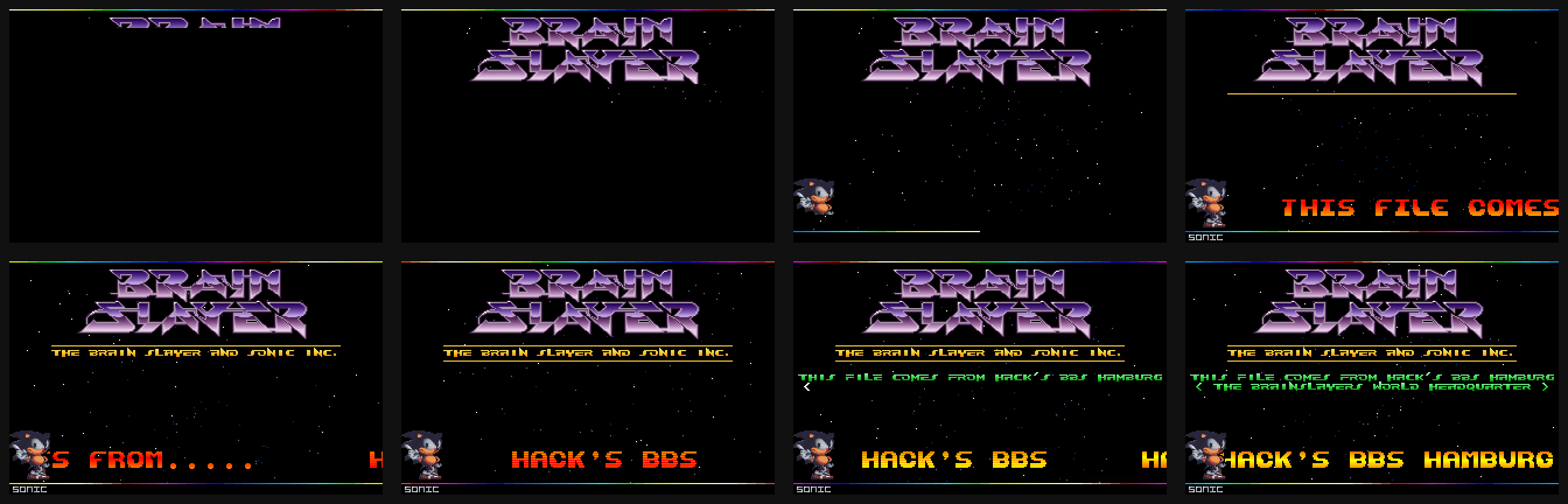
Capture environment:
Capture date: 2026-06-20, Europe/Helsinki
Emulator: DOSBox-X 2026.01.02 SDL2
Machine: svga_s3
CPU core/cycles: normal, 30000 cycles
Sound: muted; no active music path was observed in this intro
Command path: DOSBox-X video capture around TBS1.EXE
Timing zero: beginning of captured stream after the program launched
Published frames: selected stills from the useful public-safe runtime span
| Time | Frame | What is visible | Runtime meaning |
|---|---|---|---|
00:01.000 |
images/tbs1-bbs-hacks-runtime-00-01-000.png |
The first black/blue title lines are on screen. | The MZ wrapper has already unpacked, the restored entry has opened its own file, loaded the MAING resource, switched to mode 13h, and begun the reveal path. |
00:02.000 |
images/tbs1-bbs-hacks-runtime-00-02-000.png |
The Brain Slayer logo and central title area are mostly readable. | The 12-pass reveal copier is filling A000h from the decompressed full-screen buffer in expanding bands. |
00:04.000 |
images/tbs1-bbs-hacks-runtime-00-04-000.png |
The main picture is stable, with top/bottom lines and a mascot on the right. | Startup is over; the frame loop is running palette rotation, particle drawing, the bottom strip scroller, and overlay text. |
00:06.000 |
images/tbs1-bbs-hacks-runtime-00-06-000.png |
Rainbow color bands and small foreground points animate over the static page. | The two palette range rotators at load+0483 and the dirty-list point renderer at load+0ce9 are active. |
00:08.000 |
images/tbs1-bbs-hacks-runtime-00-08-000.png |
The BBS title line sits over a moving star/point field. | The text strip has scrolled several characters; script controls have selected a color ramp and advanced the two-column glyph phase. |
00:10.000 |
images/tbs1-bbs-hacks-runtime-00-10-000.png |
The bottom scroller and four-lane overlay have both visibly changed. | The scroll script has reached its 00 04 command, which arms the multi-line overlay state machine. |
00:12.000 |
images/tbs1-bbs-hacks-runtime-00-12-000.png |
The same composition continues with shifted colors and moving points. | This is the steady-state loop: erase old pixels, update positions, draw one particle pass, draw text, draw the second particle pass. |
00:14.000 |
images/tbs1-bbs-hacks-runtime-00-14-000.png |
More of the BBS text has passed through the strip. | The low scroll area is being shifted two pixels at a time by copying 16 scanlines inside A000h. |
The table is more useful if read as one frame graph rather than as isolated
screenshots. 00:01.000 and 00:02.000 are the reveal copier bringing the
full page into view in 16-line bands. 00:04.000 and 00:06.000 show the
palette-rotated steady state, where the logo stays fixed but the point layer
and color bands change. 00:10.000 is the point where the 00 04 script
command has armed the four-lane overlay state machine. 00:14.000 then shows
the low strip doing the separate two-pixel scroll path, which is why the bottom
text moves independently of the particle field.
The intro is visually simpler than the bigger Brain Slayer demos, but the loop is not a single bitmap display. It is a static decompressed page plus four lightweight runtime systems: palette rotation, a reveal copier, a dirty-list particle layer, and two text renderers.
Runtime-To-Code Concordance
The published frames are enough to follow the whole public-safe visual graph. The contact-tail frame is intentionally omitted, but the effect path before it is visible and matches the restored code.
Frame-to-code map:
00:01.000  first title lines     wrapper restored, self-file loader found MAING,
                                  mode 13h active, reveal path started
00:02.000  readable main logo    12-pass reveal at load+033d, kernels 036c/03bb
00:04.000  stable picture        MAING page fully copied, main worker active
00:06.000  rainbow/points        palette rotators 0483/0494 + point renderer 0ce9
00:08.000  scroller advanced     bottom strip scroller 0ee7 and glyph path 0fcd
00:10.000  four-lane overlay     script command 00 04 arms overlay at 0d6e
00:12.000  steady composition    dirty erase 0ccd, phase update 0c41, two point passes
00:14.000  low strip motion      two-byte A000 scroll over 16 scanlines
The first two frames correspond to startup and reveal, not to the steady loop.
The restored entry at load+0242 sets DS=0106h, decodes the late data span,
checks VGA with INT 10h AX=1A00h, sets mode 13h, opens the running EXE,
loads the appended MAING resource, stages its palette, clears A000h, and then
the reveal code at load+033D begins copying the decompressed page in
alternating 16-line bands. That is why the 00:01.000 frame is still sparse
while 00:02.000 is mostly readable.
The steady-state frames are driven by the far worker at load+0438. Its order
is important:
rotate palette range A
rotate palette range B
upload DAC
wait retrace
erase old dirty pixels
advance global point phases
draw point pass A
scroll bottom strip
draw four-lane overlay text if armed
draw point pass B with patched clip condition
write dirty-list sentinel
This explains why the logo/background can remain stable while colors, points,
and text move. The visible rainbow motion at 00:06.000 is mainly DAC staging
rotation, not a redrawn bitmap. load+0483 / load+0494 rotate RGB triples in
two palette ranges, and load+0549 pushes the active DAC entries each frame.
The small foreground points are the dirty-list particle system. load+0CCD
erases only the pixels stored in the previous frame's dirty list. load+0C41
advances global phase accumulators, and load+0CE9 projects six-byte point
records through the perspective table at 05B8h. The worker calls the same
renderer twice, but self-patches the branch byte at load+0D1E between
77h and 76h, giving complementary clipped passes without a second renderer.
The lower text visible by 00:08.000 and 00:14.000 is separate from the
four-lane overlay. load+0EE7 scrolls 16 scanlines of A000h left by two bytes,
restores the saved edge mask from 3F10h, and then the glyph path at
load+0FCD stamps two-pixel columns from the 16-row font. Script controls can
change the color ramp, delay the scroller, clear a text area, or arm the
overlay system.
The 00:10.000 frame is where the 00 04 script command has made the
four-lane overlay visible. The overlay state machine at load+0D6E fetches
blocks through the pointer table at 3FDEh, initializes up to four lanes, and
draws 8x8 characters directly to the main screen with a capped vertical color
ramp.
So the runtime evidence is not merely "a screenshot of the final page." It shows a complete progression: self-loading resource startup, banded reveal, steady palette/point/text composition, scroll-script control, and multi-lane overlay activation, with the old-contact tail deliberately omitted.
Examined Files
Archive contents:
tbs1.zip        12,991 bytes
TBS1.EXE        11,968 bytes   MS-DOS MZ executable with appended resource data
Hashes:
da22498bba35521a03fa3e60c3c38aacef9e8c31836d52d8e89ecd3a6994c95b  tbs1.zip
1d35a2db37abf5d8c9ca1ea063b3e44fa8d21db87c9c5f35da0b6bbdf0f009c5  TBS1.EXE, released packed executable
228b19d50a2f47ee57dbcdd63d78e48ffecc49bab1252f5ea92284e03e378dc2  TBS1.EXE, UNP-restored executable
Original MZ header:
Original file size:       11,968 bytes
Header-declared size:      7,412 bytes
Header size:                  32 bytes
Load image size:           7,380 bytes
Overlay/appended data:     4,556 bytes
Relocations:                   0
Entry CS:IP:           01b7:000e
Initial SS:SP:         0598:0080
Min/max allocation:    8683 / 8684 paragraphs
Entry file offset:          7070
Overlay field:             21504
UNP-restored MZ header:
Restored file size:        26,740 bytes
Header-declared size:      22,184 bytes
Header size:                  48 bytes
Load image size:          22,136 bytes
Overlay/appended data:     4,556 bytes
Relocations:                   5
Entry CS:IP:           0000:0242
Initial SS:SP:         1568:e000
Min/max allocation:    7761 / 8684 paragraphs
Entry file offset:           626
Overlay field:             21504
First relocations:       0006:0024, 000b:002a, 0005:002c, 0009:002f, 000a:0042
UNP preserves the 4556-byte overlay. The restored load image contains a single
MAING resource tag at flat load+3fd6, and the overlay begins at the same
logical resource boundary used by the loader.
Wrapper And Restored Entry
The released file is a wrapped-entry MZ rather than a plain compiled program.
UNP expands it into a normal relocatable real-mode executable whose actual
entry is load+0242.
The restored startup is concise:
load+0242  mov  sp,e000
load+0245  mov  ax,0106
load+0248  mov  ds,ax
load+024a  mov  [2dc8],es
load+024e  mov  es,ax
load+0250  call 009c        ; discover/open the running executable
load+0253  call 0b79        ; decode high data/script span in-place
load+025e  mov  ax,1a00
load+0261  int  10h         ; VGA display-combination check
load+0293  call 04d1        ; save current video mode
load+0296  mov  al,13h
load+0298  call 04dc        ; set mode 13h and clear 28000 words
The VGA probe uses BIOS function AX=1a00h. If BIOS does not report the display
combination interface, or if the returned adapter code is outside the accepted
range, the program prints a VGA error string through DOS AH=09h and exits.
The accepted path saves the old video mode, switches to 320x200x256, uploads an
initial black/full palette, and reads the main resource.
load+0b79 is an in-place XOR stream decoder:
load+0b79  mov  cx,45a6h
load+0b7c  mov  si,3ffch
load+0b7f  sub  cx,si       ; byte count = 05aah
load+0b81  mov  di,si
load+0b83  mov  bl,0aeh
load+0b86  lodsb
load+0b87  xor  al,bl
load+0b89  stosb
load+0b8a  inc  bl
load+0b8c  loop 0b86
That span covers the late data/script region rather than executable code. This is why raw string scanning shows mostly noise until after restoration: the script/resource metadata is partially concealed by a rolling one-byte key.
Self-File Resource Loader
The program opens its own executable instead of relying on a separate data file.
load+009c first reconstructs the executable path, opens it with DOS
AH=3Dh, seeks to the appended-data boundary, and records the absolute file
position in ds:2dcc/2dce.
The boundary calculation is classic MZ arithmetic:
load+00be  mov  cx,0004h
load+00c1  mov  dx,2dcch
load+00c4  mov  ah,3fh
load+00ca  int  21h             ; read original MZ page count / last page bytes
load+00ce  mov  cx,[2dcc]
load+00d2  mov  bx,0200h
load+00d7  mov  ax,[2dce]
load+00da  dec  ax
load+00db  mul  bx              ; (pages - 1) * 512
load+00dd  add  ax,cx           ; + last-page byte count
load+00df  adc  dx,0
load+00e2  mov  [2dce],dx
load+00e6  mov  [2dcc],ax
That computes the logical end of the packed MZ image. The 4556 bytes after that logical end are not DOS overlay code; they are the intro's resource stream.
The main resource call starts at load+02aa:
load+02aa  mov  ax,0568h
load+02ad  mov  [2faf],ax       ; target segment
load+02b0  lea  ax,[0000]
load+02b4  mov  [2fad],ax       ; target offset
load+02b7  mov  word [2fb3],32b5h
load+02bd  lea  si,[2f76]
load+02c1  call 0191            ; find/load resource record
load+0191 reads a compact resource descriptor, searches record headers until
the requested tag matches, seeks to the record payload, and dispatches the
resource reader/inflater. The visible result is a full 320x200 page plus a
256-color palette at ds:32b5. The palette is copied into the live DAC staging
area by load+04fe, then pushed to port 03c8h/03c9h by load+0549.
The error strings make the engine lineage clear:
FILE NOT FOUND!!! (TRY IT WITH A DOS > 3.2)
READ/SEEK-ERROR INSIDE THE INTROFILE!
NOT ENOUGH DOS-MEMORY !
INTERNAL-ERR: INCREASE MAX_SEG!
MAING
The code and messages match the small PC intro-engine pattern seen in nearby Brain Slayer intros: one self-opening executable, a named appended resource, and a DOS-file-backed block reader instead of a separate asset package.
Retrace Timing
The common wait helper uses VGA input-status port 03DAh, bit 3:
load+000c  mov  dx,03dah
load+0011  in   al,dx
load+0012  and  al,08h
load+0014  jne  0011       ; wait until not in vertical retrace
load+0016  mov  dx,03dah
load+0019  in   al,dx
load+001a  and  al,08h
load+001c  je   0019       ; wait for retrace to begin
load+0001 wraps this with a CX loop, and load+0021 is a shorter "wait
until retrace ends" helper. The reveal code calls the full wait after each
growing copy group, while the main frame worker calls it once per frame after
uploading the rotated DAC ranges.
This is conservative timing: the code is not racing the beam at scanline precision. It is just ensuring that visibly large A000 copies and palette updates happen on whole-frame boundaries.
Mode 13h And Palette Pipeline
The video helpers are small and explicit:
load+04d1  mov  ax,0f00h
load+04d5  int  10h
load+04d8  mov  [2f9f],al       ; old mode

load+04dc  mov  ah,00h
load+04de  int  10h             ; AL already contains mode 13h
load+04e1  mov  ax,0a000h
load+04e4  mov  es,ax
load+04eb  mov  cx,36b0h
load+04ee  rep  stosw           ; clear first 28000 words
The full clear later uses a byte count of FA00h, which is exactly 64000
bytes:
load+02e6  mov  ax,0a000h
load+02e9  mov  es,ax
load+02eb  xor  di,di
load+02ed  mov  cx,0fa00h
load+02f0  xor  al,al
load+02f2  rep  stosb
Palette upload is a 3-byte RGB pump:
load+0549  mov  cx,[2f99]       ; number of DAC entries
load+054f  lea  si,[2fb5]       ; staged RGB triples
load+0556  mov  dx,03c8h
load+0559  out  dx,al           ; start index 0
load+055a  inc  dx              ; 03c9h
load+055b  lodsb / out dx,al    ; R
load+055d  lodsb / out dx,al    ; G
load+055f  lodsb / out dx,al    ; B
load+0561  loop 055b
The fade-out at load+050e repeatedly calls the retrace wait, uploads the DAC,
then decrements every nonzero palette byte until all 0x300 RGB bytes are zero.
The inner fade pass is:
load+053a  lodsb
load+053b  or   al,al
load+053d  je   0544
load+053f  dec  ax
load+0540  or   al,al
load+0542  jne  0545
load+0544  inc  dx              ; count bytes that reached zero
load+0545  stosb
load+0546  loop 053a
This is bytewise RGB fading, not a table lookup or gamma-aware palette blend.
Opening Reveal
After loading the resource and clearing A000h, the program builds the first visible screen with a 12-pass reveal:
load+033d  xor  bp,bp
load+0343  mov  cx,000ch
load+0348  mov  bx,0010h
load+034b  test cx,0001h
load+034f  je   0356
load+0351  call 03bb            ; one direction
load+0356  call 036c            ; opposite direction
load+035b  add  bp,1400h
load+035f  loop 0346
load+0361  mov  bx,0008h
load+0364  call 036c
bp advances by 0x1400, which is 16 * 320. Each pass therefore starts 16
scanlines lower in the source/destination page. The two copy kernels have the
same shape but subtract the growing width from different sides.
load+036c copies expanding spans by moving the destination start backward:
load+0387  xor  dx,dx
load+0389  mov  cx,0014h        ; 20 span-width groups
load+038c  add  dx,0010h        ; width grows 16 bytes per group
load+0392  sub  di,dx           ; leftward reveal
load+0394  mov  cx,bx           ; 16 rows, or 8 in the final half pass
load+0399  mov  cx,dx
load+039b  shr  cx,1
load+039d  rep  movsw
load+039f  adc  cx,cx
load+03a1  rep  movsb           ; odd-byte cleanup if needed
load+03a5  add  di,0140h
load+03a9  add  si,0140h
load+03ae  loop 0396
load+03b0  call 000c            ; wait one retrace per grown group
load+03bb is the mirror image: it subtracts dx from the source pointer
instead of the destination pointer before the same row loop. The two kernels
alternate, creating the "opening from alternating bands" look visible in the
first two runtime frames. Because each row step is exactly 0x140, the code is
working directly in linear mode-13h scanlines.
Main Frame Loop
The top-level loop is controlled by raw keyboard port 60h, not BIOS
int 16h. It samples the first scancode and runs until the keyboard port
changes:
load+040a  in   al,60h
load+040c  mov  [2fa0],al
load+041b  mov  word [2f99],0050h
load+0421  call 0ec2            ; save a small scroll/background strip
load+0424  cli
load+0427  call far 0000:0438   ; frame worker
load+042e  in   al,60h
load+0430  cmp  al,[2fa0]
load+0434  je   0425
load+0436  sti
load+0437  ret
The far call is unusual-looking in a flat disassembly, but it is still calling
load+0438. It gives the worker a clean far-return boundary while interrupts
are disabled around the visible update.
The worker is the real frame graph:
load+043d  lea  bx,[2f80]
load+0441  call 0483            ; palette range rotator A
load+0444  lea  bx,[2f89]
load+0448  call 0483            ; palette range rotator B
load+044b  call 0549            ; upload active DAC entries
load+044e  call 000c            ; retrace wait
load+0451  call 0ccd            ; erase old dirty pixels
load+0454  call 0c41            ; advance particle/object coordinates
load+0457  mov  word [0178],0   ; reset dirty-list write pointer
load+045d  patch [0d1e]=77h
load+0463  call 0ce9            ; draw point layer, clip variant A
load+0466  call 0ee7            ; bottom text strip
load+0469  call 0d6e            ; four-lane overlay text
load+046c  patch [0d1e]=76h
load+0472  call 0ce9            ; draw point layer, clip variant B
load+0479  write ffff sentinel into dirty list
load+0482  retf
The self-patch at load+0d1e changes the first Y-clip branch inside the point
renderer between jbe (76h) and ja (77h). That turns one renderer into
two passes with complementary clipping. It is not a different routine; it is a
one-byte branch-condition swap.
Palette Range Rotation
load+0483 operates on two state records, ds:2f80 and ds:2f89. Each record
contains small countdowns plus offsets into the DAC staging table. The routine
first consumes a repeat counter:
load+0483  dec  byte [bx+2]
load+0486  je   048d
load+0488  call 0494
load+048b  jmp  0483
load+048d  mov  al,[bx+3]
load+0490  mov  [bx+2],al
load+0493  ret
load+0494 performs one actual RGB-triple rotation when the inner countdown
expires:
load+0494  dec  byte [bx]
load+0496  je   0499
load+0498  ret
load+0499  mov  al,[bx+1]
load+049c  mov  [bx],al
load+04a3  lea  si,[2fb5]
load+04a7  add  si,[bx+5]       ; range start, in bytes
load+04ab  mov  cx,0003h
load+04ae  lea  di,[2f92]
load+04b2  rep  movsb           ; save first RGB triple
load+04b5  mov  di,si
load+04b7  add  si,0003h
load+04ba  mov  cx,[bx+7]
load+04bd  sub  cx,[bx+5]
load+04c0  sub  cx,0003h
load+04c3  rep  movsb           ; shift remaining triples left
load+04c5  lea  si,[2f92]
load+04c9  mov  cx,0003h
load+04cc  rep  movsb           ; append saved triple
This explains the rainbow line motion in the capture: the bitmap pixels are not being redrawn for those color changes. The code rotates RGB entries in the palette staging area and uploads the DAC each frame.
Particle/Object Setup
The point layer is initialized by load+0b8f. It first builds a 4096-word
perspective/scale table at ds:05b8:
load+0b93  lea  di,[05b8]
load+0b97  mov  cx,1000h
load+0b9a  mov  si,effch
load+0b9f  xor  ax,ax
load+0ba1  mov  dx,fea2h
load+0ba4  mov  bx,02bch
load+0ba7  sub  bx,si
load+0ba9  idiv bx
load+0bab  stosw
load+0bad  inc  si
load+0baf  loop 0b9d
Then it fills the point records at ds:017a. Each record is six bytes:
word x
word y
word z/index
The random generator at load+0bf6 is a 32-bit shift/XOR state using constants
2b41h and 1d87h. The generator returns bounded values by multiplying the
new state by the requested range and taking the high word. Initialization uses
it as follows:
; x = (rand(64) - 32) * 32
load+0bb9  mov  ax,0040h
load+0bbc  call 0bf6
load+0bbf  sub  ax,0020h
load+0bc7  imul bx              ; bx = 20h
load+0bc9  stosw

; y = (rand(64) - 32) * 32
load+0bca  mov  ax,0040h
load+0bcd  call 0bf6
load+0bd0  sub  ax,0020h
load+0bd8  imul bx
load+0bda  stosw

; z/index = rand(500) * 16
load+0bdb  mov  ax,01f4h
load+0bde  call 0bf6
load+0be6  mul  bx              ; bx = 10h
load+0be8  stosw
That gives a small cloud of points in signed X/Y space with a separate depth or
phase term. The exact point count is stored in ds:05b2; the renderer uses the
same count every frame.
Particle/Object Update
load+0c41 is the per-frame updater. It accumulates three motion phase values
from ds:0004, ds:0006, and ds:0008 into ds:000a, ds:000c, and
ds:000e, then masks them to 11 bits:
load+0c41  mov  si,[0004]
load+0c45  mov  bx,[0006]
load+0c49  mov  bp,[0008]
load+0c4d  add  [000a],si
load+0c51  add  [000c],bx
load+0c55  add  [000e],bp
load+0c65  and  word [000a],07ffh
load+0c6b  and  word [000c],07ffh
load+0c71  and  word [000e],07ffh
The next instructions index tables around ds:25b8 and scale the results.
This is a compact fixed-point phase-table driver: the point cloud does not
store independent velocity for every particle. Instead, global phase accumulators
select table values that are then used to update projection centers and/or
depth offsets before the renderer runs.
The important consequence at runtime is that point motion is coherent. The foreground points swirl or breathe as a group, which fits the table-driven update better than a per-point random walk.
Dirty-List Erase
The point layer avoids clearing the whole screen. It records the exact A000 offsets it wrote in the previous frame, then erases only those pixels:
load+0ccd  mov  ax,0a000h
load+0cd2  mov  es,ax
load+0cd5  lea  si,[0010]
load+0cd9  lodsw
load+0cda  cmp  ax,ffffh
load+0cdd  je   0ce6
load+0cdf  mov  di,ax
load+0ce1  xor  al,al
load+0ce3  stosb
load+0ce4  jmp  0cd9
ds:0178 is the write pointer for the next dirty list. At the end of each
frame, the worker writes ffffh after the last recorded address. This is a
classic tiny-intro tradeoff: clearing 64000 bytes every frame would be wasteful
for a sparse star/particle overlay, so the intro pays two bytes of bookkeeping
per drawn point.
Particle Renderer
The renderer at load+0ce9 projects each six-byte point record and conditionally
writes one pixel:
load+0cf0  lea  si,[017a]
load+0cf4  mov  cx,[05b2]       ; point count
load+0cf9  mov  bx,[si+4]       ; z/index
load+0cfc  mov  bp,[bx+05b8]    ; perspective scale
load+0d00  mov  ax,[si+2]       ; y
load+0d05  imul bp
load+0d07  xchg ax,dx
load+0d08  add  ax,[05b4]       ; projected y
load+0d0d  mov  ax,[si]         ; x
load+0d11  imul bp
load+0d13  add  dx,[05b6]       ; projected x
load+0d18  add  si,0006h
The clip and color decision follow:
load+0d1b  cmp  ax,0063h        ; y must be above 99
load+0d1e  jbe/ja 0d69          ; self-patched branch condition
load+0d20  cmp  ax,00bdh        ; y <= 189
load+0d25  cmp  dx,0140h        ; x <= 320
load+0d2b  cmp  bx,07d0h
load+0d2f  jl   near_color
load+0d31  cmp  bx,1388h
load+0d35  jl   mid_color
load+0d37  mov  cl,01h
load+0d3b  mov  cl,03h
load+0d3f  mov  cl,02h
Screen address calculation is y * 320 + x, but it is done without a multiply:
load+0d41  mov  ah,al
load+0d43  xor  al,al           ; AX = y * 256
load+0d45  mov  di,ax
load+0d47  shr  ax,1
load+0d49  shr  ax,1            ; AX = y * 64
load+0d4b  add  di,ax           ; y * 320
load+0d4d  add  di,dx           ; + x
The write is guarded by the old pixel value:
load+0d51  mov  ah,es:[di]
load+0d54  cmp  ah,03h
load+0d57  ja   skip
load+0d59  mov  bx,[0178]
load+0d5d  mov  [bx+0010h],di   ; remember dirty address
load+0d61  add  bx,0002h
load+0d64  mov  [0178],bx
load+0d68  stosb                ; draw color 1, 2, or 3
That guard prevents the point layer from scribbling over high-color logo/text pixels. It only draws into background/low-color pixels, which is why the points feel integrated with the picture rather than destructively overlaid.
Bottom Strip Preservation
The main loop calls load+0ec2 before entering the per-frame far worker. It
copies a tiny 8x16 strip from A000h into ds:3f10:
load+0ec6  mov  ax,0a000h
load+0ec9  mov  ds,ax
load+0ecb  lea  di,[3f10]
load+0ecf  mov  si,0ca9ch
load+0ed2  mov  cx,0010h        ; 16 rows
load+0ed7  mov  cx,0004h
load+0eda  rep  movsw           ; 8 bytes per row
load+0edd  add  si,0140h
load+0ee2  loop 0ed5
The scroll routine later uses this saved mask/background at the left edge of the bottom strip. This is the same idea as the "save background" text effects in the Brain Slayer family, but here it is constrained to a small horizontal strip rather than a full sine-scroller surface.
Bottom Scroller
load+0ee7 drives the low text strip. First it honors a delay counter:
load+0ee7  cmp  word [3f08],0
load+0eec  je   0ef3
load+0eee  dec  word [3f08]
load+0ef2  ret
Then it scrolls 16 scanlines of A000h left by two bytes:
load+0ef6  mov  ax,0a000h
load+0ef9  mov  es,ax
load+0efb  mov  ds,ax
load+0efd  mov  si,0ca9eh
load+0f00  mov  di,0ca9ch
load+0f03  mov  cx,0010h
load+0f0b  mov  cx,0091h
load+0f0e  rep  movsw           ; 0x122 bytes per scanline
load+0f15  add  si,0140h
load+0f19  add  di,0140h
load+0f1d  loop 0f06
After the shift, it restores/overlays the saved 8-byte left-edge mask:
load+0f20  mov  di,0ca9ch
load+0f23  lea  si,[3f10]
load+0f27  mov  cx,0010h
load+0f2b  mov  cx,0008h
load+0f2e  lodsb
load+0f2f  or   al,al
load+0f31  je   0f36
load+0f33  stosb
load+0f36  inc  di
load+0f39  add  di,0138h
The script pointer lives in ds:3f06. A byte of ffh rewinds it to 4132h.
Zero introduces a control command:
00 01 n   select color-ramp pointer from table ds:3f90[n]
00 02 n   set delay counter to n * 16 frames
00 03     clear rectangular text area at A000:76c0 for 0x1a40 words
00 04     arm the four-lane overlay text state machine
ff        rewind script to ds:4132
A printable byte is rendered through the 16-row glyph path:
load+0fcd  sub  al,20h
load+0fd1  shl  ax,1
load+0fd3  shl  ax,1
load+0fd5  shl  ax,1
load+0fd7  shl  ax,1
load+0fd9  shl  ax,1            ; char * 32
load+0fdb  lea  si,[35b6]
load+0fdf  add  si,ax
load+0fe1  add  si,[3f0c]       ; even/odd source column phase
load+0fe5  mov  dx,[3f0a]       ; bit mask
load+0feb  mov  di,0cbbeh
Each row tests two neighboring bits and writes two pixels from the active color ramp:
load+0ff2  lodsb
load+0ff4  mov  ah,al
load+0ff6  test al,dl
load+0ffa  mov  bx,[3f0e]
load+0ffe  add  bx,cx
load+1000  mov  al,[bx]
load+1002  stosb
load+1008  mov  al,ah
load+100a  shr  dl,1
load+100c  test al,dl
load+1010  mov  bx,[3f0e]
load+1014  add  bx,cx
load+1016  mov  al,[bx]
load+1018  stosb
At the end of 16 rows, the mask shifts by two bits. When it underflows, it
resets to 80h, toggles ds:3f0c between the two stored source-column phases,
and advances the script pointer only after both phases have been consumed:
load+102c  mov  ax,[3f0a]
load+102f  shr  ax,1
load+1031  shr  ax,1
load+1033  jne  103a
load+1035  mov  ax,0080h
load+1042  mov  ax,[3f0c]
load+1045  inc  ax
load+1046  cmp  ax,0002h
load+104b  inc  word [3f06]
load+104f  xor  ax,ax
This is why the strip movement is fine-grained even though each script character is a packed glyph: the display advances two pixels per frame while the source character advances only after the two-column phase has completed.
Four-Lane Overlay Text
The scroll script command 00 04 enables a second text system at load+0d6e.
It is not the bottom strip. It draws larger text lanes directly onto the main
screen.
The state machine is gated by ds:3fca and two timers:
load+0d6e  cmp  word [3fca],ffffh
load+0d73  je   return
load+0d75  dec  word [3fc6]
load+0d79  je   continue
load+0d7c  mov  word [3fc6],0002h
load+0d8b  dec  word [3fc8]
load+0d91  mov  word [3fc8],001eh
load+0d97  call 0dfc            ; load next overlay block
load+0dfc fetches a pointer from the table at ds:3fde. A zero pointer marks
the overlay stream finished and sets 3fca=ffffh. A nonzero block initializes
four lanes:
load+0e1a  lodsw
load+0e1b  mov  [3fe8],ax
load+0e1e  mov  [3fee],ax
load+0e21  add  ax,0008h
load+0e24  mov  [3ff4],ax       ; lane y offsets
load+0e27  lodsw
load+0e28  mov  [3fe0],ax
load+0e2b  mov  [3fe6],ax
load+0e2e  mov  [3fec],ax
load+0e31  mov  [3ff2],ax       ; lane x starts
The active-lane bitmask is ds:3ffa. Up to four lanes are drawn by calling
load+0e5d with lane masks 1, 2, 4, and 8.
The 8x8 glyph blitter is straightforward but nicely tuned:
load+0e84  add  di,[3ff8]       ; base screen offset
load+0e88  sub  al,20h
load+0e8c  shl  ax,1
load+0e8e  shl  ax,1
load+0e90  shl  ax,1            ; char * 8
load+0e92  lea  si,[3d16]
load+0e96  add  si,ax
load+0e98  mov  cx,0008h        ; rows
load+0e9b  lodsb
load+0ea0  mov  cx,0008h        ; bits
load+0ea3  test bl,80h
load+0ea8  mov  al,dl
load+0eaa  stosb
load+0ead  inc  di
load+0eae  shl  bl,1
load+0eb3  add  di,0140h        ; next screen row
load+0eb7  cmp  dx,0088h
load+0ebd  inc  dx              ; vertical color ramp, capped
The overlay text is therefore character-cell based, not bitmap-picture based.
Its color changes down the glyph because DX increments after each row until it
reaches 88h.
How The Pieces Fit On Screen
The runtime can be reconstructed as this sequence:
- The packed MZ wrapper expands the real executable and transfers to
load+0242. - The restored program sets
DS=0106h, opens its own executable, finds the appendedMAINGresource, and decodes the late script/data span. - BIOS VGA detection passes, mode 13h is selected, and the first 64000-byte
screen is decompressed into segment
0568h. - The 256-color palette at
ds:32b5is copied into the live DAC staging area. - A000h is cleared, the point table is seeded, and the reveal kernels copy the decompressed screen into video memory in alternating 16-line bands.
- The steady loop rotates two palette ranges, uploads the DAC, waits for retrace, erases only dirty point pixels, advances the global point phases, draws one clipped point pass, scrolls the bottom strip, draws any active overlay lanes, draws the complementary clipped point pass, and records a new dirty-list sentinel.
- A keyboard-port change exits the loop, the palette fades toward black, and the saved BIOS video mode is restored.
The effect budget is tiny but coherent. The large graphics are paid for once by the appended resource. Motion is then mostly palette entries, one-pixel point updates, and a narrow scroll band, all cheap enough for a small 1992 real-mode intro.
Practical Reconstruction Notes
To reproduce the visible timing, use the capture timestamps rather than the raw frame count. The first useful public frame is already after setup and during the reveal.
The screen-space constants are stable:
Mode:             BIOS mode 13h, linear A000h
Full page:        320 * 200 = 64000 bytes
Reveal band step: 0x1400 = 16 scanlines
Reveal width step: 0x10 bytes per group
Point address:    y * 320 + x via y*256 + y*64
Scroll source:    A000:ca9e
Scroll dest:      A000:ca9c
Scroll rows:      16
Scroll copy:      0x91 words = 290 bytes per row
Glyph strip dest: A000:cbbe
The key thing to preserve is ordering. If the dirty-list erase runs after text or the point renderer ignores the old-pixel guard, the foreground points will damage the logo and scroller. If palette rotation is replaced by bitmap redraw, the runtime still resembles the intro, but it no longer explains why the real binary can keep the color motion cheap.