Analysis model: GPT-5 (Codex), reasoning level not exposed
Titano Cracktro by The Dream Team - Technical Dissection
Titano Cracktro is a 1990 MS-DOS cracktro by The Dream Team. Demozoo gives
the exact release date as 2 December 1990, while Pouet records the release as
December 1990. The Scene.org ZIP member timestamps also converge on late
November and 2 December 1990, so this article records 1990 as the release year.
Release year: 1990
This pass is based on the Scene.org archive, Pouet and Demozoo catalogue pages, static MZ/LZEXE inspection, visible packed-stream string fragments, decoded IFF/ILBM resource inspection, and a direct DOSBox-X runtime capture. No demo audio was made audible. The published MP4 is video-only.
Contact-material boundary: the included text sidecars and the later runtime scroller contain period phone / postal contact material. This article records those files as archive payloads, but does not reproduce their contact text. The public runtime excerpt stops before the contact scroller.
Sources
- Pouet production page: https://www.pouet.net/prod.php?which=84887
- Demozoo production page: https://demozoo.org/productions/274784/
- Scene.org file page: https://files.scene.org/view/demos/compilations/lost_found_and_more/cracktro/titano_cracktro.zip
Pouet lists the platform as MS-DOS, the type as cracktro, and the release date
as December 1990. Demozoo lists the production as Titano Cracktro by The
Dream Team, released 2 December 1990.
Archive And Payloads
Examined ZIP:
titano_cracktro.zip  47,555 bytes
SHA-256: 8867fc6ec9e91547cadf7156ef975e7cb9caa144c1a5368dc3a8c70724bde6c2
Archive contents:
| File | Size | Timestamp | SHA-256 | Role |
|---|---|---|---|---|
DATA.TDT |
65,424 | 1990-12-02 23:11 | 71f94e72cb5018b6b95702fa9a2555a63aba692a73cfa545c64efbd8601fbaa9 |
320x200 8-plane IFF/ILBM title/backdrop asset |
DREAM.TXT |
448 | 1990-11-17 02:04 | 95d79dbf908ad7ae12220df451a622ba5b817a6cd7010c0f6929cc0c5d44df80 |
Period text sidecar; contact material omitted |
INTRO.EXE |
9,881 | 1990-12-02 23:22 | 91f382e2d3386fa160cb0b275b67760567dbb844ce6a944c1a56844f29e2e2af |
LZEXE-compressed cracktro executable |
MESSAGE |
233 | 1990-11-17 04:28 | 566fb8b777b7eba4b3dfdbd40bc00e0e2d6f6bf91d36fcb33bf66428c0e467a1 |
Period text sidecar; contact material omitted |
TDT |
233 | 1990-11-17 04:28 | ac2dd04bcb868548278f17b0fe6a0b0a95f18e618f1cdaf47f9a208457117233 |
Period text sidecar; contact material omitted |
TDT.TXT |
482 | 1990-11-17 04:36 | ea860575bf407cb0932be47a67fc00ba302e2363cbc7fd87c0d84dce74b2ca86 |
Period text sidecar; contact material omitted |
The executable and the large DATA.TDT sidecar carry the useful technical
signal. The text files identify the release context, but are deliberately not
quoted because their useful historical content is mixed with old contact
details.
Direct Runtime Capture
The direct run used DOSBox-X 2026.01.02 on 21 July 2026 with machine=svga_s3,
cycles=fixed 8000, SDL dummy audio, nosound=true, Sound Blaster disabled,
GUS disabled, PC speaker disabled, and no MIDI device.
The raw DOSBox-X MPEG-TS capture is 29.051711 seconds long, 8,650,752 bytes, and contains DOSBox-X's internal AAC stream despite the muted configuration:
capture/titano_cracktro/headless-captures/intro_002.mts
duration: 29.051711 s
video:    H.264, 720x400
audio:    AAC stream present in raw capture
SHA-256:  f1b0841e55fea4b23392fa5c965f9faa266ca847b917d4c0843933e50deeb457
The site MP4 is a 9.2-second opening excerpt, transcoded from the video stream only and scaled to a square-pixel 4:3 frame:
videos/titano-cracktro-runtime-excerpt-silent.mp4
duration: 9.200000 s
video:    H.264, 720x540, 60 fps
audio:    no audio stream
size:     408,315 bytes
SHA-256:  cedc1c9aa3627bbe9881df1b823fa2fa88a5ef7cc048a2634de4d5a913bcc2e2
The full runtime continues past the opening into contact-bearing scroller text. The public cut stops in the game-title/release section before that material.
Selected direct frames:

At 00:01, the intro has loaded the static The Dream Team chassis: large
chrome TDT letters, red horizontal bars, lower control panel, and small flag
elements.
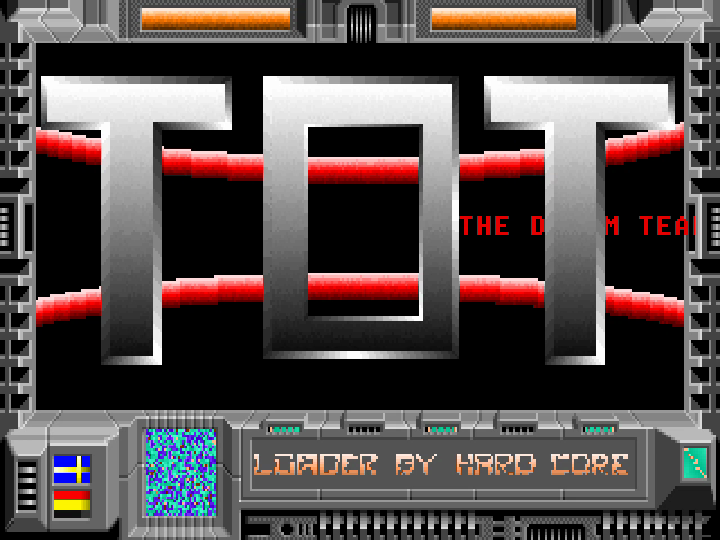
At 00:04, the lower fixed label reads as a loader credit while the red
foreground scroller is in the early group-title phase.
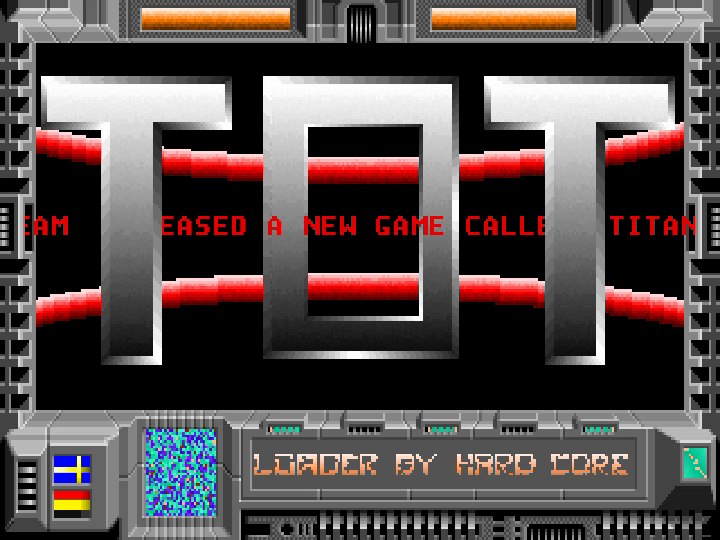
At 00:08, the scroller has reached the release/game-title material. Later
frames are not used publicly because the contact sequence begins shortly after
this safe opening.
Decoded DATA.TDT ILBM
DATA.TDT is an Amiga-style IFF/ILBM file, not an anonymous raw bitmap:
FORM type:       ILBM
declared FORM:   40,416 bytes
file size:       65,424 bytes
trailing bytes:  25,000 after the declared FORM
BMHD:            320x200, 8 planes, ByteRun1 compression
aspect:          5:6, which maps naturally to a 320x240 / 4:3 display
CMAP:            256 RGB entries
BODY:            35,767 bytes
Chunk layout:
| Offset | Chunk | Size | Meaning |
|---|---|---|---|
000Ch |
BMHD |
20 | 320x200 8-plane bitmap header |
0028h |
CMAP |
768 | 256-colour palette |
0330h |
DPPS |
110 | Deluxe Paint private screen metadata |
03A6h..0496h |
CRNG x 16 |
8 each | Colour-range metadata |
04A6h |
TINY |
3,449 | Thumbnail / preview chunk |
1228h |
BODY |
35,767 | ByteRun1-compressed planar bitmap body |
Decoded and square-pixel scaled:
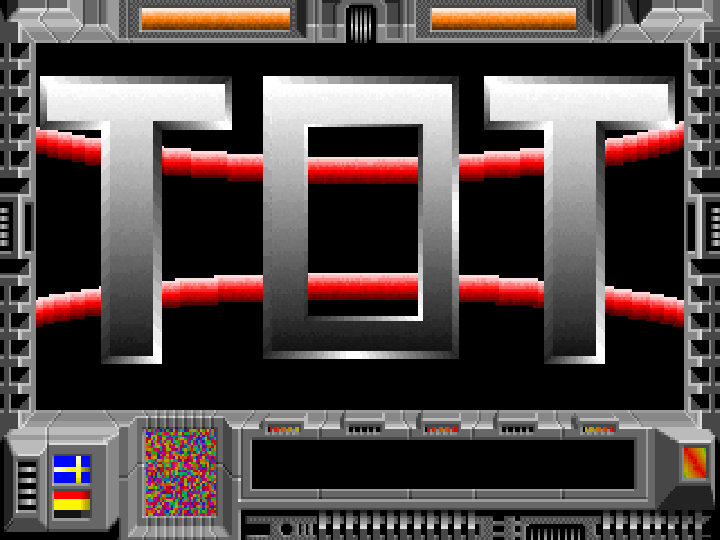
The decoded ILBM matches the runtime opening: the same large TDT letters,
red bars, grey lower panel, flags, and lower-right triangular panel are present
before the executable overlays the loader label and scroller text. That
lower-right mark is therefore part of the original artwork, not a captured
mouse cursor.
The executable's visible packed-stream fragments also support this resource path:
file offset 043Ah: LOAD / LOADIFF fragment
file offset 065Fh: ILBM
file offset 0669h: CMAP
file offset 066Eh: BODY
Those strings are still in the packed file, so the offsets are file-string
evidence rather than final unpacked-code addresses. The runtime and decoded
asset nevertheless line up cleanly: INTRO.EXE loads or decodes DATA.TDT
and then animates text over it.
MZ And LZEXE Carrier
INTRO.EXE is an MZ executable with an LZEXE v0.91 marker:
file size:          9,881 bytes
MZ image size:      9,881 bytes
MZ header size:        32 bytes
relocations:            0
visible marker:     LZ91 at file offset 001Ch
entry CS:IP:        0248:000E
entry file offset:  24AEh
initial SS:SP:      045F:0080
min/max alloc:      0FAFh / AFAFh paragraphs
The entry is the LZEXE unpacker, not the intro body. It starts by relocating the decompressor upward with an overlap-safe backward copy, then far-returns into the copied stub:
24AE  push es
24AF  push cs
24B0  pop  ds
24B1  mov  cx,[000Ch]
24B5  mov  si,cx
24B7  dec  si
24B8  mov  di,si
24BA  mov  bx,ds
24BC  add  bx,[000Ah]
24C0  mov  es,bx
24C2  std
24C3  rep  movsb
24C5  push bx
24C6  mov  ax,002Bh
24C9  push ax
24CA  retf
The following stage has the expected LZEXE bit-reservoir shape:
BPholds the current 16-bit bit buffer;DLcounts remaining bits before the nextlodsw;- a carry-set route copies literal bytes with
movsb; - the other route decodes length/offset pairs;
- match copies read from
ES:[BX+DI]and write withstosb, so overlapping back-references are intentional; - a later segment-normalization path adjusts
DS,ES,SI, andDIwhen expansion crosses a segment window; - the final path restores the unpacked program's
SS:SPand far-jumps through the recovered entry pointer.
This pass does not include a clean post-LZEXE dump. All unpacker addresses above are packed-file offsets. The honest boundary is still useful: the carrier format, entry stub, resource-loader fragments, decoded ILBM, and direct runtime are mutually consistent without pretending that every post-unpack function has been named.
Runtime Shape
Observed route:
LZEXE MZ carrier
  -> relocated depacker
  -> unpacked real-mode intro body
     -> load/decode DATA.TDT ILBM
     -> display the TDT chrome-panel title screen
     -> draw fixed lower loader label
     -> run red horizontal scroller over the title image
     -> continue into contact-bearing material after the safe opening
Pouet has a user comment saying the production has no MOD or AdLib music, but
does use a repeating sample. I did not test the audible path. The static file
does contain a visible SOUNDS REAL? ver 2.5 fragment, which is enough to
record that there is likely sample-output code or a sample helper in the packed
payload. The capture path kept host audio dummy/muted, and the public MP4 has
no audio stream.
Technical Read
Titano Cracktro is an early, compact loader-style intro rather than a large
effect engine:
- the release identity is well bounded by Pouet, Demozoo, Scene.org, hashes, and late-1990 ZIP member timestamps;
INTRO.EXEis a small LZEXE v0.91 MZ carrier whose packed entry is the standard relocated depacker path;- the visible executable fragments name the IFF/ILBM resource route;
DATA.TDTis a real 8-plane 320x200 ILBM with palette, Deluxe Paint metadata, colour-range chunks, thumbnail chunk, and compressed BODY data;- the decoded ILBM and direct runtime match at the title/backdrop level;
- the runtime adds only a fixed loader label and moving red scroller over that backdrop during the public-safe opening;
- the article and public media stop before old contact material, and all published media remains silent.
So the useful result is a bounded carrier/resource/runtime concordance pass, not a fake full function map: exact archive proof, LZEXE entry analysis, ILBM chunk evidence, direct silent runtime, and a documented publication boundary.