Analysis model: GPT-5 (Codex), reasoning level not exposed
Trekmo by Patrik Aalto - Technical Dissection
Trekmo is a compact spacecraft-rendering demo released on 7 August 1994.
It placed 13th in the Assembly 1994 PC demo competition. Rather than disguise
itself as a large multipart show, the original document describes it plainly:
a simple framework around the author's current 3D engine, with a GUS sound
system added.
That description is accurate. The authored one-pass route lasts about 52 seconds from the first presentation card to the final technical screen. Its two retained polygon datasets, exact memory ledger and restored executable make the renderer unusually measurable.
The archive and screen text spell the author as Patrick Aalto; current
Demozoo and Pouet records use Patrik Aalto. Old contact information in the
release is not reproduced here.
Sources Checked
- Demozoo production record: https://demozoo.org/productions/6797/
- Pouet production record: https://www.pouet.net/prod.php?which=15547
- Assembly 1994 results and party metadata through Demozoo
- Scene.org archive record: https://files.scene.org/view/parties/1994/assembly94/demo/trekmo.zip
Demozoo dates the release to 7 August 1994 and records its 13th place. The
original TREKMO.DOC supplies the hardware requirements, memory map,
benchmark table and -once command. The final screen supplies polygon counts,
screen layout, shading methods and music-format details.
Exact Release Package
The 609,285-byte Scene.org archive has SHA-256:
5b55e16231cbedb256976804d3fb4201de0b764996922c541367ea7a97fd65be trekmo.zip
It contains one program, one document, a short identifier and three GUS sample banks. The significant file hashes are:
e89033126af88e2979fb77df52c7129a4c09e51113f5f9100d3bd055b05ebb6a  TREKMO.EXE
37a0ad4be0e2ff398455dc195704ae1fc7ff23184572b0e26957509eac006294  BANK0.GUS
77ab01ea62feff4485dcd9327abe3b60889cc99212c50bf6b436a3e963c983c2  BANK1.GUS
3bc25b7ede61282be5ba817f5245df2243f4d2bb1bfe78516b8ae59e3249100d  BANK2.GUS
The document targets a fast 486, recommends a 486/33 with local-bus graphics
or a 486DX2/66, asks for roughly 400 KB of memory and requires a
register-compatible VGA. Music needs a GUS with at least 768 KB of card RAM,
the ULTRASND environment variable and initialized hardware. Removing
BANK0.GUS is the documented no-music route.
One Packed Program, Five Exact Regions
The distributed 116,148-byte MZ is PKLITE-compressed. Private restoration produces a 231,724-byte MZ with no appended overlay and SHA-256:
8c585904cdb31cdbd758348faeb2b8ba734230f70f8a5d43f573cc3fe7450514 TREKMO.EXE restored
The document gives five loaded regions before the Z-buffer. Their stated total is 236,337 bytes, 4,613 bytes larger than the restored file. That difference is exactly the uninitialized part of the main program area. Once it is accounted for, every retained data region lands on a file boundary:
| Region | Restored-file range | Stored bytes | Runtime bytes |
|---|---|---|---|
| PMODE 2.4 carrier | 000000h-003A77h |
14,968 | 14,968 |
| initialized main program | 003A78h-012DFFh |
62,344 | 66,957 |
| NCC-1701D dataset | 012E00h-01A5DBh |
30,684 | 30,684 |
| Romulan Warbird dataset | 01A5DCh-02952Fh |
61,268 | 61,268 |
| song-event stream | 029530h-03892Bh |
62,460 | 62,460 |
The final screen identifies 1,198 polygons for the NCC-1701D and 2,253 for the Warbird. The latter dataset is almost exactly twice the former's size, which fits the visible difference: the Warbird is a denser curved body with more local surface changes, while the Enterprise is built from broader hull, disc and nacelle forms. This size relationship is evidence about retained geometry, not a claim that every polygon occupies one fixed-size record.
A Complete 320x240 Software Pipeline
The document assigns 153,600 bytes to a 16-bit Z-buffer. This is exact storage
for 76,800 depth words, or 320 x 240 x 2 bytes. The final screen independently
calls the video mode triple-buffered 320x240 and says both ships use Gouraud
shading with a software Z-buffer.
Those details explain what the run shows. Ship surfaces cross themselves and the shaded planets without painter-order break-up; the large disc and hull remain coherent during close passes. The three colour pages let rendering and display proceed separately, while the depth buffer resolves each new frame. The planets use a cheaper special case: the program identifies them as Gouraud-shaded Bresenham circles rather than polygon meshes.
The star field, circular planets and two model banks are therefore not merely visual guesses from a recording. The runtime, screen text, byte-exact model regions and depth-buffer allocation all describe the same renderer.
GUS Event Music
The three external banks total 587,326 bytes. They contain headerless-looking 16-bit waveform words rather than tracker-module signatures. The ending calls the soundtrack stereo 16-bit material sampled at 44.1 or 22.05 kHz and calls the sequencer the author's own GUS-only event-based song format.
The 62,460-byte final executable region begins with regular eight-byte event
records: initially a zero time/value field followed by changing command and
parameter words. That structure, the separate waveform banks and the explicit
release description agree on an event sequencer driving GUS-resident samples,
not a conventional MOD embedded in the executable. The run does not need the
music as a timing clock: the document says GUS playback has no effect on frame
rate, and -once gives the visual route its own ending.
Exact Silent Run
The untouched release was run under DOSBox-X 2026.01.02 as a 486-class PC,
with emulated GUS at base 240h, DMA 3 and IRQ 5. Host audio used a dummy
device, so nothing was audible. The original command TREKMO.EXE -once was
used without patching or input injection.
The capture reaches the final information screen normally. That screen reports an emulator-dependent average of 113 fps; it is useful only as proof that the authored exit path ran, not as a period-hardware benchmark. The original table ranges from 6.5 fps on a 386/20 with ISA graphics to 40.7 fps on a 486DX2/66 with ET4000 VLB graphics.
Continuous Motion Evidence

The Enterprise begins as a small silhouette against a shaded planet, then crosses close to the camera. Continuous motion exposes the separate saucer, hull and nacelle geometry.

The camera continues around the model and through the planet field. Gouraud bands stay attached to the turning surfaces while the Z-buffer handles hull overlap.

The darker green Warbird enters near a planet and turns toward the viewer. Its changing silhouette makes the larger retained model bank visually credible.
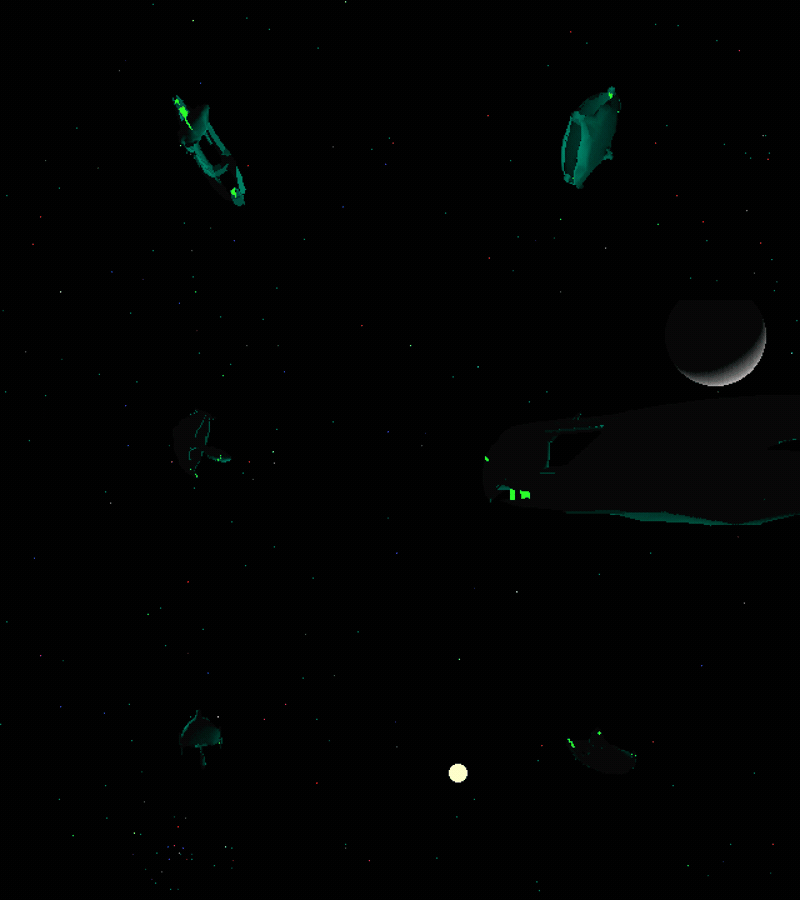
The second pass moves across the Warbird's top and side surfaces. This is a continuous six-second excerpt, not a set of tiled screenshots.
What Trekmo Actually Does
Trekmo is a focused engine demonstration: PMODE establishes a 32-bit DOS
environment, the program retains two substantial polygon models and an event
score, a software 16-bit depth buffer resolves Gouraud-shaded ship surfaces,
and three 320x240 colour pages present the result. Planets are generated with
a separate shaded-circle path, while GUS hardware plays banked stereo samples
from the custom event stream.
Its small number of scenes is a strength for analysis. The restored byte map, author's memory ledger, final technical screen and complete silent run agree down to region sizes, polygon counts and frame-buffer geometry.