Analysis model: gpt-5.5 xhigh
Final Demo by The Yellow Ones - Technical Dissection
Subject: Final Demo / The Final by The Yellow Ones.
Final Demo is a March 1993 MS-DOS VGA demo by The Yellow Ones. Demozoo lists
Errand for code and Leinad for music. Pouet identifies it as an MS-DOS demo
released in March 1993. The archive sits in the Hornet 1992 mirror directory,
but the public production metadata and the NFO context place this release in
1993.
Release year: 1993
This is the follow-up to The Yellow Ones' December 1992 Xmas '92, and it is
also explicitly a goodbye production. The public NFO says the demo is called
THE FINAL because it is the final TYO demo after Leinad left the group. The
old NFO and module sample text contain personal contact details; this analysis
intentionally omits them.
The code is less monolithic than many 1992-1993 PC demos. The visible production
is a DOS EXEC chain:
tyofinal.exe   silent launcher
finalgus.exe   launcher with a small GUS/MOD player path
tyofinal.001   child effect program
tyofinal.002   child effect program
tyofinal.003   child effect program, largest one
tyofinal.004   child effect program
tyofinal.005   child effect program
tyofinal.006   ProTracker module, usable as a renamed .MOD
That design is important. There is no single master engine holding the whole demo. The small launcher runs five separate MZ executables one after another, and each child carries its own copy of a common tweaked-VGA helper layer.
Sources
- Demozoo production record
- Pouet production page
- Pouet NFO view
- Scene.org archive record
- Scene.org release download
Complete Direct Silent Run
The original package provides two launchers, and this pass uses the one the
authors explicitly made for watching the demo without a GUS:
TYOFINAL.EXE. DOSBox-X 2026.01.02 ran that untouched launcher with a normal
386 core, fixed 30000 cycles, 16 MB RAM, XMS enabled, EMS disabled,
machine=svga_s3, and all sound devices disabled. The host used an X11
display solely for external capture.
This avoids the obsolete internal AVI recorder that crashed during the earlier attempt. The new lossless FFV1 master is 278.68 seconds long, has no audio stream, traverses all five child executables, restores text mode, and returns naturally to DOS with status 0. No key was injected to shorten the unusually long central text sequence.
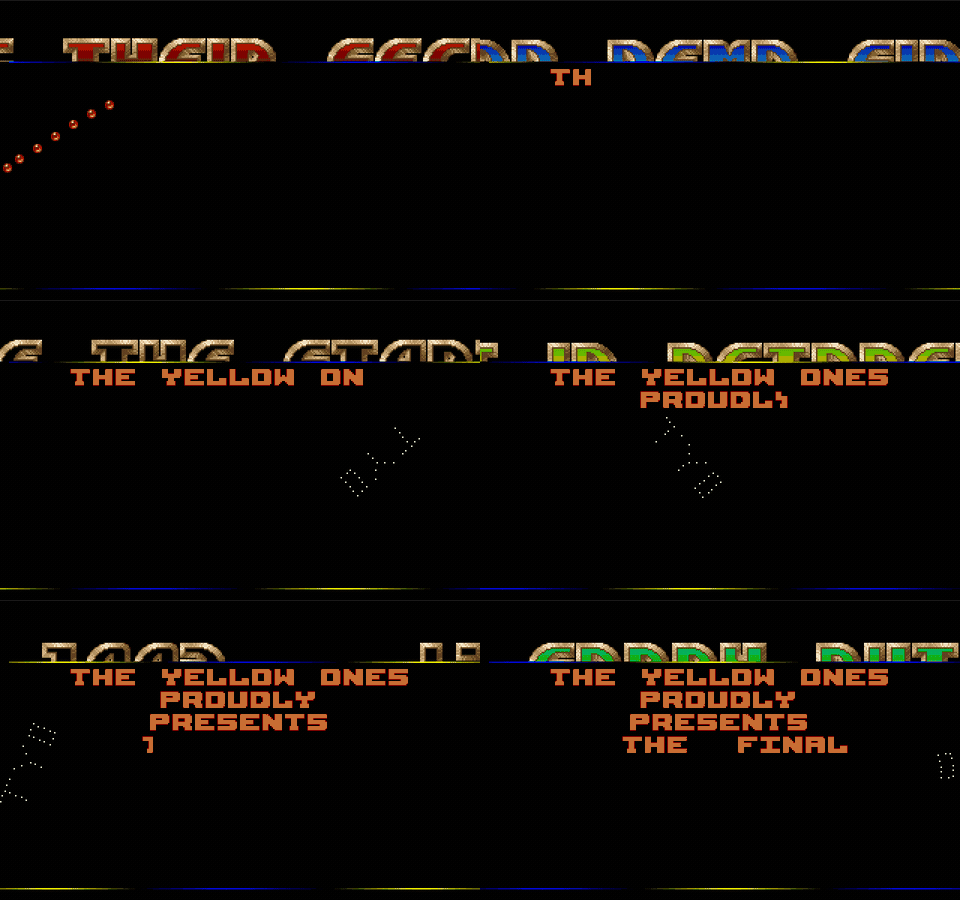
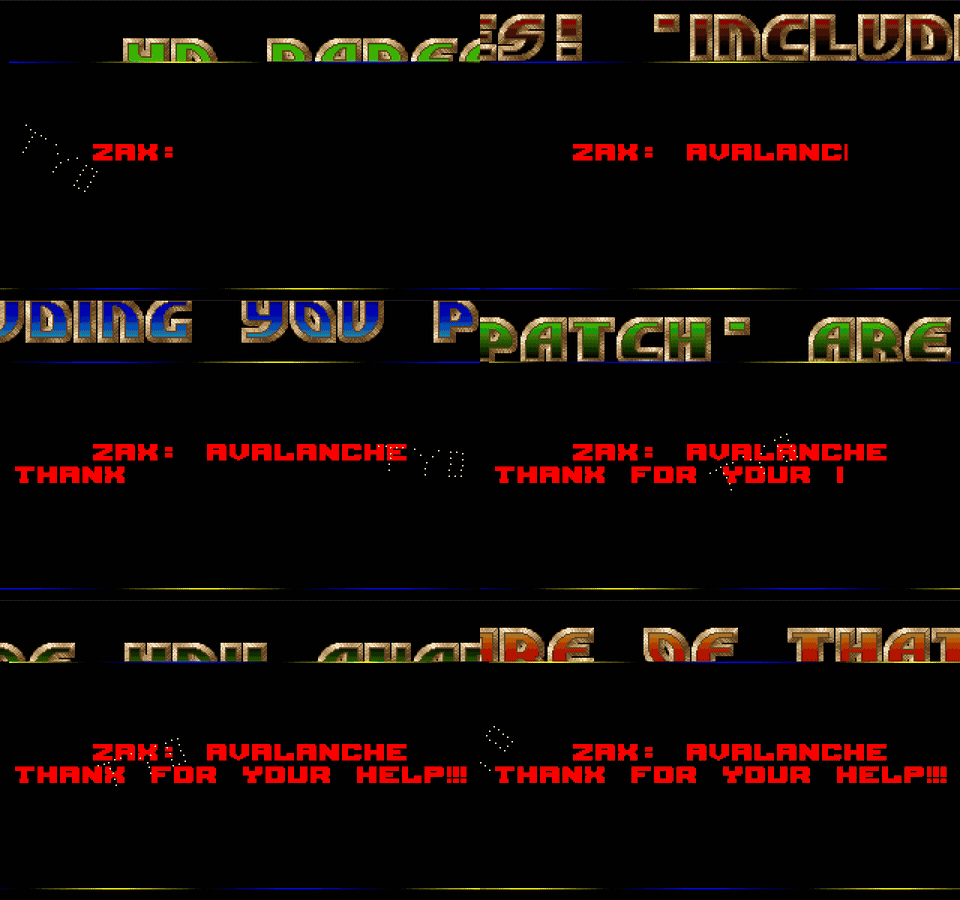
Six continuous excerpts from that direct route:




The older public Demozoo stills remain useful as archival comparison, but are no longer the primary evidence:

Runtime-To-Code Concordance
The complete run makes the launcher boundary and code mapping directly observable:
direct runtime                         code evidence
five visibly distinct program stages   five INT 21h AX=4B00h EXEC calls
opening Yellow Ones words               first child and common VGA setup
purple ring / colour motion             .002 DAC writes and retrace path
dots, title and long text system         .003 script, font and strip renderers
green line-heavy field                  .004 sine/coordinate and line paths
block-built THE END                     fifth child and shared planar kernel
natural text-mode return                launcher cleanup after child .005
tyofinal.exe shrinks its DOS allocation, builds an EXEC parameter block, and
calls INT 21h AX=4B00h for tyofinal.001 through tyofinal.005. The direct
run confirms that every child returns successfully to the launcher; the final
text-mode restoration is not an emulator timeout or an assumed endpoint.
Private isolation runs of the five released child bodies remove ambiguity from
that mapping: .001 begins with the coloured YELLOW ONES words; .002
draws the purple ring over a moving palette field; .003 owns the dots,
TYO frame, title, and long text system; .004 draws the dense green line
field; and .005 assembles the ending from coloured blocks.
Those sections expose the shared VGA layer in motion. Each child starts from
mode 13h, disables normal chain-4 behavior, uses 0x0f02 map-mask clears,
and selects planes from x & 3. The selector at .001 file 0xa473 writes
both Sequencer Map Mask and Graphics Controller Read Map Select, so writes and
reads use the same planar coordinate model.
The long middle sequence is now especially clear. .003 contains script text,
SINUS.PAS/table strings, full and partial DAC uploads, palette-ring shifts,
custom glyph dispatch, and planar strip writers. Its strip writer around
0x1bf1c uses 0x00a0 row strides and plane selection from the low two bits
of DI; the script renderer around 0x1b026 handles DAC changes, cursor
movement, column clears, and glyph lookup. The runtime shows why this child is
so much larger: it sustains minutes of moving headings, centre text, dots, and
line material rather than displaying one greeting still.
The coloured blocks assembling THE END belong to the final executable by
both launcher order and observed endpoint. .005 carries the same mode setup,
plane selector, and CRTC helper; after its animation completes, the launcher
restores text mode and exits. The direct motion also corrects the old
description of this as merely a static “vector-ball” ending.
Archive Contents
Examined archive:
tyofinal.zip  133,725 bytes
SHA-256       383d59881e628e3d64d0c4184111eef296f2f901d4a94a349b4789b7fa36c5c6
Extracted files:
| File | Size | SHA-256 | Notes |
|---|---|---|---|
finalgus.exe |
13,952 | 291fccda52bc14196c7729dafb5209c5bb6c0342304c2dd52daeddfa21e230b5 |
MZ launcher with GUS/MOD path |
thefinal.nfo |
1,423 | 172d78aee4be19717a33e222a4ebd74e78c648b664f953a99dd62500af1ec3cf |
public release note, private contact lines omitted |
tyofinal.001 |
42,983 | c693896cedeeb0a3a90f34da1883e48dc323da47d35f231164c8c3e37867a680 |
MZ child |
tyofinal.002 |
32,551 | 88a0776bbed3279040566dbd42050e7974ac18f4d720b064bedc73d79143c82d |
MZ child |
tyofinal.003 |
118,401 | a0ae5b89ccbe188a5e2a25439eaabf727f11df1923178cd62c71b6c3153ae46f |
MZ child, largest visual/text engine |
tyofinal.004 |
6,867 | 25ca6d774918ce9b601dcbe28de8a554894e77a7f3c856d2343cadc6d7de4558 |
MZ child |
tyofinal.005 |
21,591 | 171df640fd30325c38871c407045efc58b695bc055d689f5ff62b858e716c729 |
MZ child |
tyofinal.006 |
137,460 | d5fefd96aafdd379ba9eaac61a488bb01f949cc3912154389f23d1ea5c4869cf |
ProTracker M.K. module |
tyofinal.exe |
3,178 | 56e10b620ec347cbcb71f6947f149b6f070dbefc725e3c8ab6e80ec057dd2963 |
silent MZ launcher |
No child file contains an obvious RNC, PKLITE, LZ91, EXEPACK, Turbo Pascal, or Borland C signature. These are plain MZ programs, not wrapped packed payloads.
MZ Layout
The two launchers have the same small DOS carrier shape:
tyofinal.exe
  file size:          3,178 bytes
  MZ image size:      3,178 bytes
  header size:          512 bytes
  relocations:             5
  initial CS:IP:     0092:0000
  initial SS:SP:     0000:0800
  entry file offset: 0x0b20

finalgus.exe
  file size:         13,952 bytes
  MZ image size:     13,952 bytes
  header size:          512 bytes
  relocations:            15
  initial CS:IP:     0092:0000
  initial SS:SP:     0000:0800
  entry file offset: 0x0b20
The effect children are also ordinary MZ files:
| File | Header | Relocs | CS:IP | Entry file offset |
|---|---|---|---|---|
tyofinal.001 |
512 | 2 | 09ba:0045 |
0x09de5 |
tyofinal.002 |
512 | 2 | 0766:007c |
0x078dc |
tyofinal.003 |
512 | 14 | 1606:6004 |
0x1c264 |
tyofinal.004 |
512 | 2 | 00b0:0843 |
0x01543 |
tyofinal.005 |
512 | 2 | 048c:006c |
0x04b2c |
Silent Launcher
tyofinal.exe is almost all filename table plus INT 21h calls. Its string
table starts at file 0x0a00:
0x0a00  tyofinal.001
0x0a0d  tyofinal.002
0x0a1a  tyofinal.003
0x0a27  tyofinal.004
0x0a34  tyofinal.005
0x0a41  tyofinal.006
The entry code first shrinks its own memory block:
0b20  mov ax,4a00h
0b23  mov bx,046eh
0b26  int 21h              ; resize allocation to 0x46e paragraphs
That is required before EXEC: DOS children need free conventional memory.
Failure prints the internal error string and exits.
Before every child launch the program rebuilds the small parameter block:
0b3f  mov ah,51h
0b41  int 21h              ; BX = current PSP segment
0b43  mov es,bx
0b45  mov bx,002ch
0b48  mov ax,es:[bx]       ; environment segment from PSP+2c
0b4b  mov [0071],ax

0b50  lds si,[0073]
0b54  les di,[0077]
0b58  mov ax,290ah
0b5b  int 21h
0b5d  lds si,[0073]
0b61  les di,[007b]
0b65  mov ax,290ah
0b68  int 21h
INT 21h/AX=290Ah is DOS's parse-filename-to-FCB service. The launcher uses
it in a very old-compatible way: build FCB entries/parameter data, then execute
the child.
The actual chain is five EXEC calls:
0b6c  mov ax,4b00h
0b6f  mov dx,0000h         ; "tyofinal.001"
0b72  mov bx,0071h         ; parameter block
0b75  int 21h

0ba6  mov ax,4b00h
0ba9  mov dx,000dh         ; "tyofinal.002"
0baf  int 21h

0be0  mov ax,4b00h
0be3  mov dx,001ah         ; "tyofinal.003"
0be9  int 21h

0c1a  mov ax,4b00h
0c1d  mov dx,0027h         ; "tyofinal.004"
0c23  int 21h

0c54  mov ax,4b00h
0c57  mov dx,0034h         ; "tyofinal.005"
0c5d  int 21h
After the fifth child returns, it restores text mode and exits:
0c60  mov ax,0003h
0c63  int 10h
0c65  mov ax,4c00h
0c68  int 21h
So the silent path is not an in-process demo engine. It is a sequential process
runner. Any music continuity in the GUS path has to come from finalgus.exe,
not from the silent launcher.
GUS Launcher
finalgus.exe contains the same child filename table, plus a prompt string
asking for GUS music and a GUS/player surface. It also contains the module
signature cluster:
M.K.
FLT4
6CHN
8CHN
OCTA
That is the usual ProTracker/FastTracker family signature set a module loader
would probe. The NFO says finalgus.exe is the GUS version and tyofinal.exe
is the silent version. It also says tyofinal.006 may be renamed as a module,
which matches the file structure exactly.
Music Module
tyofinal.006 is a valid ProTracker module:
title:             into the darkness2
signature:         M.K.
song length:       35 positions
restart byte:      127
patterns:          31
pattern bytes:     31,744
sample bytes:      104,632
computed size:     137,460 bytes
actual size:       137,460 bytes
The size formula is exact:
1084-byte MOD header
+ 31 patterns * 1024 bytes
+ 104,632 bytes of sample data
= 137,460 bytes
The sample-name fields include credits and personal contact text. This page uses the title, signature, pattern count, and sample-size arithmetic only.
Common VGA Kernel
The five child executables are separate programs, but they share the same
tweaked-VGA support layer. tyofinal.001, .002, .003, .004, and .005
all contain:
- BIOS mode
13hentry; - immediate VGA sequencer change to disable the normal chain-4 layout;
- a table-driven CRTC register setup;
- a four-plane clear of
A000h; - a helper that selects write/read plane from
x & 3; - a retrace-synchronized CRTC start-address/pan helper.
That means the children start from BIOS's convenient 320x200x8 mode, then retune it into a planar/tweaked layout. The address math changes from:
mode 13h pixel address = y * 320 + x
to:
planar byte address    = y * 80 + (x >> 2)
plane mask             = 1 << (x & 3)
The clear loop still clears 64 KiB of aperture memory, but because all four planes are enabled it clears the full planar framebuffer.
Mode Setup Inner Loop
tyofinal.001 at file 0xa405 is representative:
a405  mov ax,0013h
a408  int 10h              ; enter BIOS 320x200x8

a40a  mov dx,03c4h
a40d  mov ax,0604h
a410  out dx,ax            ; Sequencer Memory Mode: disable chain-4 style use
a411  mov ax,0100h
a414  out dx,ax            ; synchronous reset

a41c  mov si,[bx]          ; select mode table
a41e  lodsb
a41f  mov dx,03c2h
a422  out dx,al            ; Misc Output register

a423  mov dx,03c4h
a426  mov ax,0300h
a429  out dx,ax            ; end sequencer reset

a42a  mov dx,03d4h
a42d  mov al,11h
a42f  out dx,al
a430  inc dx
a431  in  al,dx
a432  and al,7fh
a434  out dx,al            ; unlock CRTC registers 0-7
The CRTC register table is count-prefixed:
a437  xor cx,cx
a439  lodsb
a43a  mov cl,al            ; number of word writes
a43c  lodsw
a43d  out dx,ax            ; AL = CRTC register, AH = value
a43e  loop a43c
Then all planes are enabled and the aperture is cleared:
a440  mov dx,03c4h
a443  mov ax,0f02h
a446  out dx,ax            ; Sequencer Map Mask = planes 0..3
a447  mov ax,a000h
a44a  mov es,ax
a44c  xor di,di
a44e  xor ax,ax
a450  mov cx,8000h
a453  rep stosw            ; 32,768 words = 65,536 bytes per selected plane set
After setup it stores pitch/height parameters pulled from the mode table:
a455  lodsw
a456  mov [935d],ax
a459  mov [9365],ax
a45c  mov bx,ax
a45e  shr ax,2
a461  mov [935b],ax        ; byte pitch = pixel pitch / 4
a464  lodsw
a465  mov [935f],ax        ; second dimension / viewport parameter
The same structure appears at:
tyofinal.002  mode setup around 0x7b45
tyofinal.003  mode setup around 0x1ca9f
tyofinal.004  mode setup around 0x16f1
tyofinal.005  mode setup around 0x5075
This reuse is a strong sign of a local Pascal/assembler support unit or copied VGA library, not five hand-unrelated parts.
Plane Selector Inner Loop
The plane selector in .001 begins at 0xa473; .003, .004, and .005
carry the same routine at different offsets.
a476  mov cl,[bp+06]
a479  and cl,03h           ; cl = x & 3
a47c  mov ax,0102h
a47f  shl ah,cl            ; AH = 1,2,4,8
a481  mov dx,03c4h
a484  out dx,ax            ; Sequencer Map Mask

a485  mov ah,cl
a487  mov al,04h
a489  mov dx,03ceh
a48c  out dx,ax            ; Graphics Controller Read Map Select
This does both sides of planar access:
write plane = 1 << (x & 3)
read plane  = x & 3
byte offset = x >> 2, plus y * pitch_in_bytes
That is why several blitters divide an apparent pixel coordinate by four before
touching A000h.
CRTC Pan / Start Address Helper
The CRTC helper is also shared. In .003 it starts around 0x1cb45:
1cb45  mov dx,03dah
1cb48  in  al,dx           ; reset Attribute Controller flip-flop
1cb49  mov al,30h
1cb4b  mov dx,03c0h
1cb4e  out dx,al
1cb4f  inc dx
1cb50  in  al,dx
1cb51  or  al,20h
1cb53  dec dx
1cb54  out dx,al           ; keep display enabled while touching AC state
The routine clamps negative scroll/start input to zero, shifts it by a mode table parameter, then waits for a clean vertical retrace boundary:
1cb63  mov ax,[bp+06]
1cb66  jns ok
1cb68  mov ax,0000h
ok:
1cb6b  mov [e7f3],ax
1cb6e  mov cl,[e821]
1cb72  shl ax,cl
1cb74  mov bx,ax

1cb76  mov dx,03dah
1cb79  in  al,dx
1cb7a  test al,08h
1cb7c  jne 1cb79           ; wait until outside retrace
1cb7e  in  al,dx
1cb7f  test al,08h
1cb81  je  1cb7e           ; wait for next retrace
Then interrupts are briefly disabled while the CRTC start/overflow bits are patched:
1cb83  cli
1cb84  mov dx,03d4h
1cb87  mov ah,bl
1cb89  mov al,18h
1cb8b  out dx,ax           ; low start/pan-related register in this mode table

1cb8c  mov ah,bh
1cb8e  and ah,01h
1cb91  shl ah,4
1cb94  mov al,07h
1cb96  out dx,al
1cb97  inc dx
1cb98  in  al,dx
1cb99  and al,0efh
1cb9b  or  al,ah
1cb9d  out dx,al           ; overflow bit patch

1cb9e  dec dx
1cb9f  mov ah,bh
1cba1  and ah,02h
1cba4  ror ah,3
1cba7  mov al,09h
1cba9  out dx,al
1cbaa  inc dx
1cbab  in  al,dx
1cbac  and al,0bfh
1cbae  or  al,ah
1cbb0  out dx,al           ; second overflow bit patch
1cbb1  sti
This is not cosmetic. The demo is using the VGA CRTC as part of the animation system: the program scrolls or pans by moving the display start/line state at retrace rather than redrawing every byte every frame.
Child .001
tyofinal.001 is the first launched child and matches the direct opening: a
compact part that sets tweaked VGA, clears the planes, and begins the
presentation imagery and palette motion. Code evidence:
mode 13h setup:     file 0xa405
text mode restore:  file 0xa31c and 0xa7e0
port 03c8h writes:  palette programming
port 03dah waits:   retrace timing
A000h references:   planar framebuffer writes
Its most important contribution to the analysis is the clean common kernel
copy shown above. .001 establishes that the TYO code is doing deliberate
unchained/tweaked VGA rather than just normal mode-13h frame copies.
Child .002
tyofinal.002 repeats the same unchained setup, with its mode-13h entry around
file 0x7b45. The direct run shows the early production moving through
palette-heavy fields before the large text engine. The binary contains many
03C8h/03C9h DAC writes and retrace waits, but it is smaller than .003, so
it is a single-purpose visual bridge rather than the main text/line engine.
The important pattern is the same:
BIOS mode 13h
Sequencer Memory Mode write
CRTC register table
Map Mask 0x0f
clear A000h
retrace-paced animation loop
return to launcher
The complete route confirms that this child returns to the launcher and does not own the long central text sequence.
Child .003: Main Script / Palette / Line Engine
tyofinal.003 is the largest child by far. It contains the string
\MODULES\TIGER.MOD, SINUS.PAS, tab.sin, and tab.x_2.. The module path
looks like a build-time artifact, not a file the released archive needs. The
SINUS.PAS/table strings are a useful source clue: this part carries sine-ish
precomputed tables and Pascal-era source names.
It also contains visible script text for the title/credits/greetings, including TYO/Errand/Leinad handles and group greetings. The direct runtime matches this material to the long moving text system; private contact-like strings are not reproduced.
Palette Upload
The part uploads full and partial palettes through the normal DAC ports:
1c004  mov dx,03c8h
1c007  xor al,al
1c009  out dx,al            ; DAC index 0
1c00a  inc dx               ; 03c9h
1c00b  mov cx,0100h
1c00e  mov al,[si]
1c010  shr al,2
1c013  out dx,al            ; red, 8-bit table -> 6-bit DAC
1c014  mov al,[si+1]
1c017  shr al,2
1c01a  out dx,al            ; green
1c01b  mov al,[si+2]
1c01e  shr al,2
1c021  out dx,al            ; blue
1c022  add si,3
1c025  loop 1c00e
Partial palette updates target higher indices for animated highlights:
1c1f1  mov dx,03c8h
1c1f4  mov al,0bdh
1c1f6  out dx,al            ; start at DAC index 0xbd
1c1f7  inc dx
1c1f8  mov cx,003eh         ; update 62 colours
The inner loop is the same RGB triplet writer. The effect is a palette-window animation: only a selected range is rewritten, so the geometry/text buffer can stay mostly unchanged while colours move.
Palette Ring Shift
The palette table itself is shifted in memory with overlapping REP MOVSB
copies. The code intentionally uses STD so the copy runs backward and does
not overwrite the bytes it still needs to read:
1c115  mov cx,00bah
1c118  mov si,3e81h
1c11b  add si,02f0h
1c11f  mov di,si
1c121  add di,0003h
1c124  push es
1c125  push ds
1c126  pop es
1c127  std
1c128  rep movsb            ; shift 186 bytes upward by one RGB triplet
1c12a  cld

1c12b  mov si,3e81h
1c12e  add si,02f1h
1c132  mov di,3e81h
1c135  add di,0237h
1c139  mov cx,0003h
1c13c  rep movsb            ; wrap one RGB triplet
1c13e  pop es
This is the classic palette-cycling loop in raw form:
1. move a palette byte range by three bytes;
2. copy one saved RGB triplet into the other end;
3. wait for vertical retrace;
4. upload the affected DAC range again.
The two short retrace loops immediately after the copy make the update land on a display boundary:
1c13f  mov dx,03dah
1c142  in  al,dx
1c143  test al,08h
1c145  je  1c142            ; wait for retrace begin
1c147  in  al,dx
1c148  test al,08h
1c14a  jne 1c147            ; wait for retrace end
Planar Strip Writer
One of .003's central blitters writes a six-pixel-high vertical strip while
selecting the VGA plane from the low two bits of the destination coordinate.
This loop appears twice in close succession around 0x1bf1c and 0x1bf9e:
1bf19  mov dx,03c4h
1bf1c  push di
1bf1d  mov cx,di
1bf1f  shr di,2             ; byte address = x / 4
1bf22  and cl,03h           ; plane = x & 3
1bf25  mov ax,0102h
1bf28  shl ah,cl
1bf2a  out dx,ax            ; Map Mask = selected plane

1bf2b  mov al,[si]
1bf2d  mov es:[di],al
1bf30  mov al,[si+06h]
1bf33  mov es:[di+00a0h],al
1bf38  mov al,[si+0ch]
1bf3b  mov es:[di+0140h],al
1bf40  mov al,[si+12h]
1bf43  mov es:[di+01e0h],al
1bf48  mov al,[si+18h]
1bf4b  mov es:[di+0280h],al
1bf50  mov al,[si+1eh]
1bf53  mov es:[di+0320h],al

1bf58  pop di
1bf59  inc di               ; next screen x
1bf5a  inc si               ; next source column
1bf5b  dec bx
1bf5c  jne 1bf1c
The constants reveal the pitch:
0x00a0 = 160 bytes
A 160-byte pitch in a four-plane mode corresponds to 640 addressable pixels per scanline when each byte position has four planes. The strip writer is therefore not a plain 320-wide mode-13h plotter. It is a tweaked planar writer that can support wider virtual screens, panning, or double-width layouts.
The code computes a starting DI from a table value:
1bf05  mov ax,[si]
1bf07  mov bx,ax
1bf09  shl ax,9             ; *512
1bf0c  shl bx,7             ; *128
1bf0f  add di,ax
1bf11  add di,bx            ; total *640 before planar divide
That is the matching coordinate math for a 640-pixel virtual row.
Script Interpreter And Glyph Dispatch
The text renderer is not just printing ASCII. Around 0x1b026 it parses a
compact command stream. Some commands change palette entries, skip/move the
text cursor, clear rectangular vertical runs, or select colour/style state.
Examples:
1b026  cmp al,5dh
1b028  jne 1b04b
       ; command 5d: write two DAC entries around indices 40h and 42h

1b04b  cmp al,23h
1b04d  jne 1b061
       ; command 23h: decrement a countdown/advance script pointer

1b061  cmp al,26h
1b063  jne 1b0b9
       ; command 26h: clear a vertical 12-row column block
The clear command is very explicit:
1b065  mov cx,[di+03h]
1b068  mov di,[di+01h]
1b06b  mov ax,0f02h
1b06e  mov dx,03c4h
1b071  out dx,ax            ; all planes enabled
1b072  xor al,al
1b074  mov es:[di],al
1b077  mov es:[di+00a0h],al
1b07c  mov es:[di+0140h],al
1b081  mov es:[di+01e0h],al
1b086  mov es:[di+0280h],al
1b08b  mov es:[di+0320h],al
1b090  mov es:[di+03c0h],al
1b095  mov es:[di+0460h],al
1b09a  mov es:[di+0500h],al
1b09f  mov es:[di+05a0h],al
1b0a4  mov es:[di+0640h],al
1b0a9  mov es:[di+06e0h],al
1b0ae  inc di
1b0af  loop 1b074
Again, the row stride is 0xa0. The renderer clears a 12-scanline-high block
at all planes, one byte column at a time. This is exactly the kind of routine a
large text/greeting screen needs: erase old glyph columns or prepare an area
before a new message is drawn.
Normal characters are remapped before glyph lookup:
1b0e4  cmp al,'0'
1b0e6  jb  punctuation
1b0e8  cmp al,'9'
1b0ea  ja  punctuation
1b0ec  sub al,'0'
1b0ee  add al,1ah           ; digits live after letters in local font index
Punctuation has its own hand-coded map:
'!' -> 24h
'"' -> 25h
'`' -> 26h
'(' -> 27h
')' -> 28h
'+' -> 29h
',' -> 2ah
'-' -> 2bh
'.' -> 2ch
'/' -> 2dh
':' -> 2eh
So the text pages in the public stills are rendered by a custom font/script system over the planar framebuffer, not by BIOS text or DOS output.
Child .004: Green Line Field And Fade
tyofinal.004 is tiny compared to .003, but it still includes the common
tweaked-VGA helper. Its entry at 0x1543 shrinks memory, masks PIC IRQs via
port 21h, calls the VGA setup, uploads a generated palette, then enters a
frame loop.
The initial palette loop creates and stores 64 RGB entries:
156b  mov dx,03c8h
156e  xor ax,ax
1570  out dx,al             ; DAC index 0
1571  inc dx
1572  mov cx,0040h
1575  mov si,0079h

157a  out dx,al
157b  mov [si],al
157d  xchg al,ah
157f  out dx,al
1580  mov [si+1],al
1583  inc al
1585  xchg al,ah
1587  out dx,al
1588  mov [si+2],al
158b  add si,3
158e  loop 157a
The later fade loop decrements each stored RGB byte toward zero:
15cf  mov si,0079h
15d2  mov cx,00c0h          ; 64 colours * 3 bytes
15d5  cmp byte [si],00h
15d8  je  15dc
15da  dec byte [si]
15dc  inc si
15dd  loop 15d5
Then it re-uploads the 64-colour table:
15df  mov si,0079h
15e2  mov cx,0040h
15e5  mov dx,03c8h
15e8  xor ax,ax
15ea  out dx,al
15eb  inc dx
15ec  mov al,[si]
15ee  out dx,al
15ef  mov al,[si+1]
15f2  out dx,al
15f3  mov al,[si+2]
15f6  out dx,al
15f7  add si,3
15fa  loop 15ec
The delay/timing loop uses the VGA input-status register:
1596  mov dx,03dah
1599  mov cx,00c8h
159c  in  al,dx
159d  test al,01h
159f  je  159c
15a1  in  al,dx
15a2  test al,01h
15a4  jne 15a1
15a6  loop 159c
That is waiting on the display-enable bit rather than the vertical-retrace bit.
It gives a scanline/display-period paced delay, which is less common than the
simple test al,08h vertical retrace loop seen elsewhere.
It also contains a small pseudo-random generator seeded from DOS time:
1616  mov ah,2ch
1618  int 21h               ; CH/CL/DH/DL time fields
161a  mov cs:[0912],cx
161f  mov cs:[0914],dx

1625  mov cx,ax             ; caller's modulus
1627  mov ax,cs:[0914]
162b  mov bx,cs:[0912]
163e  rcr dl,1
1640  rcr ax,1
1642  rcr bx,1
1644  add bx,di
1646  adc ax,si
1648  add bx,62e9h
164c  adc ax,3619h
164f  mov cs:[0912],bx
1654  mov cs:[0914],ax
1658  xor dx,dx
165a  div cx
165c  mov ax,dx             ; random % cx
The isolated .004 run identifies the result directly: a dense green field of
moving intersecting lines. The pseudo-random positions and small bouncing
state variables feed that geometry; the 64-entry generated palette supplies
its green intensity range, and the stored RGB decrement loop fades the field
before returning to the launcher.
Child .005: Final Text / Vector-Ball Part
tyofinal.005 again carries the shared setup:
mode setup:      file 0x5075
plane selector:  file 0x50e3
CRTC helper:     file 0x511b
The direct run shows this child assembling THE END from moving coloured
blocks. The code confirms that it has the same planar renderer foundation as
the earlier children: CRTC register table, four-plane clear, plane mask writes,
and retrace-synchronized start/pan helper. It is the final child in the
launcher chain; once it returns, the launcher restores text mode and
terminates naturally.
Visual Order Summary
The complete direct run establishes this authored order:
| Chain step | File | Evidence | Visible role |
|---|---|---|---|
| 1 | tyofinal.001 |
first EXEC, isolated child run, common VGA setup |
coloured YELLOW ONES opening words |
| 2 | tyofinal.002 |
second EXEC, isolated child run, DAC/retrace-heavy code |
purple ring over a moving palette field |
| 3 | tyofinal.003 |
largest child, isolated run, script/font/palette/strip code | dots, TYO frame, title, long credits and text |
| 4 | tyofinal.004 |
fourth EXEC, isolated run, coordinate/random helpers |
dense moving green line field |
| 5 | tyofinal.005 |
final EXEC, shared VGA layer, direct final animation |
coloured blocks assemble THE END, then DOS return |
What The Demo Is Doing
At the system level:
silent path:
    shrink launcher memory
    build DOS EXEC parameter block
    run tyofinal.001
    run tyofinal.002
    run tyofinal.003
    run tyofinal.004
    run tyofinal.005
    restore text mode
    exit

GUS path:
    same overall chain
    plus module/player code around tyofinal.006
At the graphics level:
each child:
    BIOS mode 13h
    retune VGA into an unchained/planar mode
    load CRTC table
    clear A000h with all planes enabled
    render text/lines/balls through x&3 plane masks
    time visual changes from port 03DAh
    sometimes pan by changing CRTC start/overflow bits
    return to DOS launcher
At the inner-loop level, the production leans on three old-PC strengths:
- VGA register programming is used to turn a simple BIOS graphics mode into a more flexible planar layout.
- Palette changes are treated as animation data. Several loops move or rewrite DAC ranges instead of repainting whole frames.
- Text and small graphics are column-oriented. The hot loops write one column across multiple scanlines with constant row strides, selecting the VGA plane from the destination x coordinate.
That is why Final Demo feels more elaborate than the file layout first
suggests. The launcher is tiny, but the children share a real tweaked-VGA
toolkit, and .003 in particular combines script parsing, palette motion,
custom font rendering, and planar strip blitters into one large middle part.