Analysis model: gpt-5.5 xhigh
Xmas '92 by The Phoney Coders - Technical Dissection
Xmas '92 / x_mas92.zip is a 1992 MS-DOS multipart demo by The Phoney
Coders. The Hornet 1992 demo index lists it as Xmas '92 by The Phoney Coders
and tags it as a The Party 1992 demo entry with unknown final placing.
Release year: 1992
This one is useful for the early Swedish/Christmas lane because it is a real multipart production, not just a single scroller. It has a PKLITE-packed loader, several PKLITE-packed child parts, several plain MZ child parts, an external font file, a hand-written mode-13h/unchained-VGA framework in the older parts, and a later Zax C++/ASM demo library in the credits/movie-style parts.
Complete Interactive Runtime Coverage
The old failure was in DOSBox-X's internal ZMBV recorder, not in the demo.
This pass runs DOSBox-X 2026.01.02 under an external X11/FFV1 capture path with
a normal 386 core, fixed 30000 cycles, 16 MB RAM, XMS enabled, EMS disabled,
and all sound devices disabled. At the loader's one setup question, “DO YOU
HAVE A ROLAND SOUND CARD?”, the answer was N. No music was enabled, heard,
captured, or published.
This is an interactive early multipart rather than a single timed trackmo.
INTRO advances into INTRO2, but the longer children loop until Escape. A
brief Escape press exits the current child; on an uninterrupted loader run,
that key remains visible to several immediately following programs and makes
them skip. The loader still reaches the final MOVIE1 credits and returns
naturally to DOS with status 0, but that pass alone is not complete visual
coverage.
To remove the ambiguity, I also launched each released child executable in a
fresh DOSBox process, observed its motion, and ended only that isolated loop.
Those direct runs cover INTRO2, PART1, DEMO, STAR, MULTI, 3SPACE,
and MOVIE1 without inherited keyboard state. SHADE is a short transition,
not a missing major scene. Together with the original loader run, this proves
the authored order, all substantive visual stages, final credits, and DOS
return while preserving the production's genuinely interactive boundary.
Six continuous direct excerpts:


The earlier raw-frame reconstructions remain useful as asset checks:


No audio, H.264, or MP4 derivative is published.
Runtime/Archive-To-Code Concordance
The direct child runs turn the former asset-only mapping into a live runtime-to-code concordance:
| Child | Direct visual evidence | Code/resource evidence |
|---|---|---|
INTRO / INTRO2 |
title, animated floppy-like object and rotating forms | planar page around 15000h, four-plane blitter at 3100h, CRTC pan at 32EFh, DAC morph at 3313h |
PART1 |
TPC banner, starfield, emblem and unlimited-bob sequence | raw-page loader at 432Ch, four page uploads, CRTC page flip, transparent plane-by-plane sprite stamp |
DEMO |
rotating shaded object over the large TPC frame | Zax C++/ASM library, timer/retrace framework and common unchained mode |
STAR |
TPC headings, rotating emblem and greetings | common VGA kernel, star/object state and text presentation |
MULTI |
tiled backdrop with moving bob/vector material | raw page around 10000h, setup at 2FC1h, DAC fade at 3021h, frame hub at 30F8h |
3SPACE |
portrait, logo and moving perspective floor | page around 0C000h, palette shifter at 0E5Bh, shade quantizer at 0EDBh, viewport copier at 0F74h |
MOVIE1 |
production/loader/credits typography with moving blue balls | Zax library, crystal.fnt, timer/retrace and movie-text stages |
The PART1 frame remains a useful proof case for the planar loader. Its
013Fh source row step and 004Fh destination row step match a chunky
320-byte source row being deinterleaved into 80-byte VGA planes. The direct
bob motion then confirms that the later plane-selecting sprite stamp is
compositing live objects over those pages rather than merely swapping stills.
MULTI is likewise clearer in motion. It is not a major polygon engine: the
tiled page, palette fade, internal page/strip copy, and small moving objects
are exactly the mix implied by its recovered frame hub.
The 3SPACE excerpt settles the apparent perspective effect. The portrait is
loaded artwork, while the floor advances through table-driven viewport slices;
the recovered 34-byte-wide copier and palette/shade tables explain the moving
depth bands without requiring a triangle span filler.
At the production level:
LOADER.EXE
  -> setup UI, VGA/CPU checks, keyboard hook, fixed EXEC child sequence

INTRO/PART1/STAR/MULTI/3SPACE
  -> hand-written unchained-VGA framework, raw-page loaders, CRTC starts,
     plane masks, palette morphs, masked sprites, strip/viewport copies

DEMO/MOVIE1
  -> Zax C++/ASM library, crystal.fnt font path, timer/retrace routines,
     object and movie/credit text stages
The runtime boundary is now explicit: loader order and final DOS return come from the untouched launcher, while fresh-process child runs provide complete visual coverage without pretending the stale Escape state is authored timing.
Sources
Archive
The examined archive is x_mas92.zip from the Hornet mirror:
x_mas92.zip 266201 bytes
ZIP contents:
3space.exe     14885 bytes  1992-12-28 20:06
crystal.fnt    10031 bytes  1992-12-26 15:58
demo.exe       40691 bytes  1992-12-26 17:55
intro.exe      26864 bytes  1992-12-28 23:25
intro2.exe    116768 bytes  1992-12-28 23:24
loader.exe     24485 bytes  1992-12-28 23:44
movie1.exe     48308 bytes  1992-12-26 16:07
multi.exe     171066 bytes  1992-12-28 22:33
part1.exe     176706 bytes  1992-12-28 19:34
shade.exe       2690 bytes  1992-12-28 13:40
star.exe      130991 bytes  1992-12-28 22:40
Hashes:
8e1d3b2e26937338e401e896faa8956adf484e07cef938682e20c194fa2317f9  x_mas92.zip
c3e7f131d06211d5dcacf2e255c230a89c6cbfed0920ea15e9289c5660bfe53c  3space.exe packed
4061e9dc945f84e8f002b28b6df3439cdcc0d0425b1eb83ec121fa41ec940a96  3SPACE.EXE UNP-expanded
bce40bc79c89f070d1d85c7f320bfbf0ed26abc485a79f827e84aba0a07e802e  crystal.fnt
fe118ca067f1180388493764e3945471d1237e0a3fdabac65a622910a8d0f990  demo.exe packed
96e3592678e9260da496574702eb6ba9bab191d21dacd40a7094a6297e367338  DEMO.EXE UNP-expanded
917ebd36e97cc73547eeea1e9819b687d157ac44b80dfe8415a70d3b52519a68  intro.exe packed
0821f2e21aefb0ca6985da900405eb9d484d256e4f0ee6d4a8d137c48b143e63  INTRO.EXE UNP-expanded
c11df7ddb231a6bc82b0192e8298153f1c6953dfa92d12d63b0bfef57628b2f8  intro2.exe
4bad600207fb432d9a7430197c94249c2d2b667c8706c06a745934465d7ef092  loader.exe packed
9a6931587919f883e47559563e786b0352a273b15157d5c5a04f04ed02a2db5d  LOADER.EXE UNP-expanded
9ba5796694a3a5dee0266c44c4f2f27dad9fa5a8e0eced3153a13e9dcda72e98  movie1.exe
784f9e5fc4dd2a90a53ea47da27c3c5c025a1974f9b71b713070d2e3b5255628  multi.exe
450ce79f15eb59bf6c554783465933ecd7e0f7acddc7e70b9e50bcd4c5b60fbd  part1.exe
39abc838d4ee3f1d1d8f2220aab30201c0fc944e0809736b8b011dfa4c3ec5d7  shade.exe
c9b0743bd25a5979a2bba16f82dd9073b4a53785d39ad1867505e102653724a4  star.exe packed
1b7551ec2516cdb31615dec2d8e6badce34b6aced224cfd4f157e5abdf01a8bb  STAR.EXE UNP-expanded
Packing And Child Layout
file identifies five executables as PKLITE-family self-extracting MZ files:
3space.exe   PKLITE packed,  14885 -> 286656 bytes after UNP
demo.exe     PKLITE packed,  40691 -> 114381 bytes after UNP
intro.exe    PKLITE packed,  26864 -> 400704 bytes after UNP
loader.exe   PKLITE packed,  24485 ->  61705 bytes after UNP
star.exe     PKLITE packed, 130991 -> 418853 bytes after UNP
The packed headers share the normal PKLITE entry shape:
CS:IP = FFF0:0100
The other stages are ordinary MZ programs:
intro2.exe   header 512, relocations  3, entry load 00000h
movie1.exe   header 1024, relocations 166, entry load 00000h
multi.exe    header 512, relocations 12, entry load 00000h
part1.exe    header 512, relocations 17, entry load 00000h
shade.exe    header 512, relocations  1, odd packed-style FFF0:0100 entry shape
The loader's fixed child list is present in the restored load image:
INTRO.EXE
INTRO2.EXE
PART1.EXE
DEMO.EXE
SHADE.EXE
STAR.EXE
MULTI.EXE
3SPACE.EXE
MOVIE1.EXE
The sequence at LOADER load offsets ABE5h..AC78h walks that list with
INT 21h AX=4B00h, pauses between later stages to flush keyboard state, and
prints a DOS error screen if a child is missing or memory allocation fails.
Loader Control Code
The loader is not a passive batch replacement. It has its own setup screen, VGA prompt renderer, CPU/VGA checks, keyboard hook, yes/no parser, and child launch loop.
At load offset A8F7h, it probes the VGA display combination:
A8F7  mov ax,1A00h
A8FA  int 10h
A8FC  cmp bl,07h
A8FF  jne A90Fh
...
A90F  cmp bl,08h
A912  je  A916h
A914  jmp A901h          ; print VGA/color monitor error and exit
The CPU check at A857h toggles a high FLAGS bit and sees whether it sticks:
A85D  pushf
A85E  pop  ax
A85F  or   ax,4000h
A862  push ax
A863  popf
A864  pushf
A865  pop  ax
A866  test ax,4000h
A869  je   not_386
A86B  mov  ax,0001h
That value controls the loader's "cut-down on 286" state and setup text. The archive is old enough that this kind of flag-twiddling CPU probe is expected: it avoids 386-only instructions in the probe itself.
The loader renders its prompts in graphics mode. A96Dh switches to mode
13h, clears a backing area, and uploads a 768-byte DAC table:
A96D  mov ax,0013h
A970  int 10h
...
A97B  mov ds, cs:[ACA6h]
A980  mov cx,15E0h
A983  rep movsw          ; clear/copy prompt backing data
A985  call A872h         ; upload DAC table
The small text blitter at A989h draws a token stream into A000h. Each
character cell is seven rows high and eight pixels wide:
A995  mov di, cs:[A626h] ; destination in A000h
A99A  mov si, cs:[A624h] ; glyph/source offset
A99F  mov cx,0007h       ; seven rows
row:
A9A3  mov cx,0004h
A9A6  rep movsw          ; eight pixels as four words
A9A8  add di,0138h       ; next destination row: 320-8
A9AC  add si,0138h       ; next source row
A9B1  loop row
The token decoder at A917h recognizes a $ end marker, n as newline, and
otherwise maps characters through tables near the start of the code segment.
This is why the setup screen is drawn with the same VGA machinery as the demo
parts instead of using DOS text mode.
The yes/no parser is tiny:
A9E9  mov ah,00h
A9EB  int 16h
A9ED  cmp al,'y'
A9EF  je  yes
A9F1  cmp al,'Y'
A9F3  je  yes
A9F5  clc                 ; not yes
A9F6  ret
yes:
A9F7  stc
A9F8  ret
The loader also installs an INT 09h keyboard ISR at A8A9h. The new handler
only reacts specially to Escape. For other scancodes it toggles port 61h,
sends EOI to the PIC, and returns:
A88A  push ax
A88B  in   al,60h
A88D  cmp  al,01h
A88F  je   old_handler
A891  in   al,61h
A895  or   al,80h
A897  out  61h,al
A89B  out  61h,al
A89D  mov  al,20h
A89F  out  20h,al
A8A1  pop  ax
A8A2  iret
So the loader gives every child part a consistent Escape path without relying on each stage's own polling behavior.
Common Hand-Written VGA Kernel
INTRO, PART1, STAR, MULTI, and 3SPACE share the same family of
hand-written VGA routines. The exact tables differ, but the skeleton is the
same:
- Wait for vertical retrace.
- Blank the DAC palette.
- Enter BIOS mode
13h. - Disable chain-4-style addressing and program CRTC/Attribute Controller state.
- Enable all four VGA planes with Sequencer map mask
0Fh. - Clear
A000h. - Use page-start registers and plane masks for animation.
PART1 setup at 42B5h..432Bh is the clearest example:
42B5  cli
42B6  call 3BD8h         ; vblank wait
42BB  mov dx,03C8h
42C0  mov cx,0300h
42C5  out dx,al          ; black DAC
42CC  mov ax,0013h
42CF  int 10h
42E4  mov dx,03C4h
42E7  mov ax,0604h
42EA  out dx,ax          ; sequencer memory mode
42EB  mov dx,03DAh
42EE  in  al,dx          ; reset AC flip-flop
42EF  mov dx,03C0h
42F2  mov al,10h
42F4  out dx,al
42F5  mov al,61h
42F7  out dx,al          ; AC mode control
4301  mov dx,03D4h
4304  mov si,4265h
4307  mov cx,0019h
430C  mov ah,cs:[si]
430F  out dx,ax          ; 25 CRTC registers
4315  mov dx,03C4h
4318  mov ax,0F02h
431B  out dx,ax          ; map mask: all planes
4323  mov cx,8000h
4328  rep stosw          ; clear 64 KB plane window
The important trick is that this is no longer plain chained mode 13h in the
normal "one byte is one adjacent pixel" sense. The parts use map masks,
CRTC start addresses, and multiple 0x3E80/0x7D00/0xBB80 page offsets as a
Mode-X-like planar workspace.
Four-Plane Raw-Page Loader
PART1 at 432Ch and 3SPACE at 0DAAh both contain the same compact
chunky-to-planar copy routine. It copies a raw 320x200 source image into the
four VGA planes by selecting one plane at a time:
432C  mov dx,03C4h
432F  mov ax,0102h       ; map mask starts at plane 0
4332  mov cx,0004h       ; four planes
plane:
4336  out dx,ax
4337  mov bx,0140h       ; 320 decimal
433A  mov cx,0050h       ; 80 columns per plane
col:
433D  mov si,cs:[0F12h]
4342  mov di,cs:[0F14h]
4348  mov cx,cs:[0F10h]  ; row count
row:
434D  movsb
434E  add si,013Fh       ; next source row, same x modulo plane
4352  add di,004Fh       ; next destination row in planar memory
4355  loop row
4358  add cs:[0F12h],4   ; next source x with same plane
435E  inc cs:[0F14h]     ; next packed destination byte
4363  loop col
4371  shl ah,1           ; next plane mask
4374  loop plane
The 013Fh and 004Fh increments are the tell:
source row step:      320 - 1 = 319 = 013Fh
destination row step:  80 - 1 =  79 = 004Fh
So each inner movsb copies one pixel column for the selected plane, then
jumps to the same x position on the next scanline. After a column is complete,
the source pointer advances by four bytes because the next byte for the same
plane is four chunky pixels later. After all 80 columns, the plane mask shifts
from 01h to 02h, 04h, and 08h.
3SPACE has a sibling routine at 0DF5h that adds an extra add di,0050h
inside the row loop. That draws every other destination row or an interleaved
half-height pass:
0E16  movsb
0E17  add si,013Fh
0E1B  add di,004Fh
0E1E  add di,0050h       ; extra row stride
Palette Uploads And Fades
The parts use DAC streaming aggressively. The plain table upload appears everywhere:
4380  mov dx,03C8h
4382  mov ax,0020h       ; start at color 32 in this case
4386  out dx,al
4387  inc dx             ; 03C9h
4388  mov cx,0258h       ; 600 DAC bytes
438B  rep outs dx,byte ptr ds:[si]
INTRO has a more complete palette morph at 3313h. It first reads the
current DAC into a buffer:
331E  mov dx,03C8h
3323  out dx,al
3324  inc dx
3325  mov cx,0300h
3329  rep ins byte ptr es:[di],dx
Then it compares current and target RGB values byte-by-byte:
332E  mov al,cs:[bx+0003h] ; current
3333  mov ah,cs:[bx+0303h] ; target
3338  cmp al,ah
3340  mov cs:[bx+0903h],1  ; needs increment
3346  sub ah,al
334A  mov ax,003Fh
334D  div dh               ; per-channel step interval
335C  mov cs:[bx+0903h],2  ; needs decrement
The second phase runs up to 63 ticks. Each channel has a direction byte and a countdown. When the countdown expires, it increments or decrements that one DAC component by one:
338C  push cx
338F  mov al,cs:[bx+0003h]
3394  cmp cs:[bx+0303h],al
339B  dec cs:[bx+0603h]
33A0  cmp cs:[bx+0603h],0
33A8  mov al,cs:[bx+0C03h] ; reload interval
33B2  mov al,cs:[bx+0903h] ; direction
33C6  inc byte ptr cs:[bx+0003h]
33D6  dec byte ptr cs:[bx+0003h]
33EC  call 2FCFh           ; vblank
33EF  call 340Ch           ; write 768 DAC bytes
This is a real per-component fade rather than a one-shot palette copy.
PART1 also has a simple subtractive fade at 4837h: for 63 steps it copies
the 768-byte target palette from 4C9Ah, subtracts the current fade amount,
clamps underflow to zero, writes the DAC, and redraws the moving overlay.
PART1: Banner, Page Flips, And Masked Sprites
The first raw page in PART1 contains the "Welcome to our Xmas demo" banner.
The part prepares four pages by calling the four-plane loader with destination
offsets 0000h, 3E80h, 7D00h, and BB80h:
47C9  mov cs:[0F14h],0000h
47D7  call 432Ch
47DA  mov cs:[0F14h],3E80h
47E8  call 432Ch
47EB  mov cs:[0F14h],7D00h
47F9  call 432Ch
47FC  mov cs:[0F14h],BB80h
480A  call 432Ch
Page flipping is just CRTC start-address programming. 43E9h writes low and
high start bytes, then swaps two stored page pointers:
43E9  mov bx,cs:[0F0Eh]
43EE  mov dx,03D4h
43F1  mov al,0Dh
43F3  mov ah,bl
43F5  out dx,ax
43F6  mov al,0Ch
43F8  mov ah,bh
43FA  out dx,ax
43FB  mov bx,cs:[0F0Ch]
4400  mov ax,cs:[0F0Eh]
4404  mov cs:[0F0Ch],ax
4408  mov cs:[0F0Eh],bx
The sprite/object path is a small dirty-restore system. 4473h keeps ten old
positions, advances sine-table phase words at 45C2h and 45C4h, and computes
new offsets from tables around 2558h, 1478h, and 1A18h:
44BF  mov cx,000Ah
44C4  push cx
44C6  mov bx,cs:[45C2h]
44CB  mov di,cs:[bx+2558h]
44D0  mov bx,cs:[45C4h]
44D5  mov ah,cs:[bx+1478h]
44DC  add di,cs:[bx+1A18h]
44E1  add di,cs:[0F0Ch]   ; current visible page
44EC  mov cs:[bx+4437h],ah
44EE  mov cs:[bx+4441h],di
453Dh erases the previous sprites by copying a saved background patch from
+7D00h, and 4514h draws the new sprites. The actual masked blit is 4574h:
457B  mov dx,03C4h
457E  mov al,02h
4580  cmp cs:[00BAh],4
4589  push di
458A  out dx,ax           ; select plane by AH
458B  mov cx,000Dh        ; 13 rows
row:
458F  mov cx,0004h        ; 4 bytes per row per plane
4592  lodsb
4593  cmp al,00h
4595  jne plot
4597  inc di              ; transparent byte
459D  stosb               ; opaque byte
45A2  add di,004Ch        ; 80 - 4
45A8  shl ah,1            ; next plane
45B2  inc di              ; next byte-aligned x
That is a compact 4-plane transparent sprite stamp: zero source bytes preserve the background, nonzero bytes write through the currently enabled VGA plane.
INTRO: Logo Pages And Palette Morphs
INTRO uses the same raw-page/palette framework but spends more code on page
sequencing and fades. Its generic planar blitter at 3100h takes a width in
[2FC7h] and height in [2FC9h], then repeats across all four planes:
3106  mov dx,03C4h
3109  mov al,02h
310B  cmp byte ptr cs:[2FCBh],4
3114  out dx,ax
3115  mov cx,cs:[2FC9h]   ; rows
311B  mov cx,cs:[2FC7h]   ; bytes per row
3120  mov bh,es:[di]      ; latch read
3123  movsb
3126  add di,0050h
3129  sub di,cs:[2FC7h]
3131  shl ah,1
3143  inc di              ; next plane x alignment
31C9h uses it to load multiple image segments into page offsets 0000h and
7D00h, then uses 32EFh to pan through a CRTC start table:
32EF  mov bx,cs:[2E45h]
32F4  dec word ptr cs:[2E45h]
32F9  add bx,bx
32FB  mov bx,cs:[bx+2E49h]
3300  add bx,cs:[2E47h]
3305  mov dx,03D4h
3308  mov al,0Dh
330A  mov ah,bl
330C  out dx,ax
330D  mov al,0Ch
330F  mov ah,bh
3311  out dx,ax
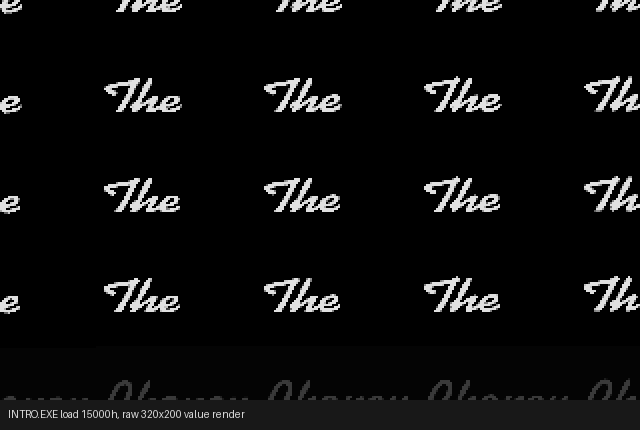
The raw frame chosen above from INTRO.EXE load 15000h is one of these
Phoney-logo wallpaper pages.
MULTI: Tile/Vector Part
MULTI contains the apology text about boring vector objects and lost new
objects after a crash. Its image data and routines match that: a tiled
background page, palette fades, and object/vector routines called through a
frame hub.
The mode setup at 2FC1h is the same kernel as PART1, and the fade-out at
3021h subtracts from all 768 target DAC bytes:
3026  mov cx,003Fh
302A  mov cs:[2C79h],cl
3031  mov cx,0300h
3034  mov al,cs:[bx+31EEh]
3039  sub al,cs:[2C79h]
303E  cmp al,3Fh
3042  mov al,00h          ; clamp underflow
3044  mov cs:[bx+2979h],al
305B  mov cx,0300h
305E  rep outs dx,byte ptr ds:[si]
The per-frame hub at 30F8h waits for retrace, calls several object/update
routines, copies a strip inside the page, and delays:
30F8  call 26ACh          ; vblank
30FB  call 294Ah
30FE  call 2D83h
3101  call 2840h
3104  call 30D8h          ; page/strip copy
3116  call 3065h          ; delay
30D8h copies 07D0h bytes inside the current page after putting the graphics
controller into write-mode style latch behavior:
30D8  mov es,cs:[2661h]
30DD  mov ds,cs:[2661h]
30E2  call 30B2h          ; save/change graphics controller mode
30E5  mov di,cs:[2663h]
30EA  mov si,cs:[2663h]
30EF  mov cx,07D0h
30F2  rep movsb
30F4  call 30CBh          ; restore graphics controller mode
The reconstructed MULTI image is a raw tile page at load 10000h.
3SPACE: Picture/Floor Part
3SPACE uses the same raw-page and palette ideas but with a different visual:
large TPC side letters, a center credit block, and a pseudo-perspective floor.
The image used above comes from load offset 0C000h.
The setup at 0D4Ah is identical in structure to PART1. The palette animator
at 0E5Bh shifts a 720-byte table and injects four new RGB triplets:
0E62  mov di,05B2h
0E65  mov si,di
0E67  add si,000Ch
0E6A  mov cx,0168h
0E6D  rep movsw           ; slide palette data left by 12 bytes
0E74  mov si,08B4h
0E77  add si,cs:[0C77h]
0E7C  mov cx,0004h
0E7F  lodsb
0E86  stosb
0E87  stosb
0E88  stosb               ; duplicate one value into RGB
0E9E  add word ptr cs:[0C77h],4
The small quantizer at 0EDBh scans 6Ch groups. If a byte is nonzero, it
replaces three adjacent bytes with the current shade value. Every fourth group
advances the shade from a table at 0EBCh:
0EEB  xor bx,bx
0EED  mov cx,006Ch
0EF0  mov al,cs:[bx+05B2h]
0EF5  cmp al,00h
0EF9  mov al,dl
0EFB  mov cs:[bx+05B2h],dl
0F01  mov cs:[bx+05B2h],dl
0F07  mov cs:[bx+05B2h],dl
0F0D  call 0F1Eh
...
0F1F  inc word ptr cs:[0ED7h]
0F24  cmp word ptr cs:[0ED7h],4
0F2C  inc word ptr cs:[0ED9h]
0F36  mov dl,cs:[bx+0EBCh]
The viewport copier at 0F74h pulls a 34-byte-wide slice from an offscreen
page and writes 280 rows to the visible page, skipping 2Eh bytes each row:
0F81  mov si,7D00h
0F84  add si,2580h
0F88  mov di,0000h
0F8B  mov cx,0118h        ; rows
row:
0F8F  mov cx,0022h        ; 34 bytes
0F92  rep movsb
0F94  add di,002Eh        ; 80 - 34
0F97  add si,002Eh
0F9B  loop row
This explains the stepped floor: it is not a polygon renderer in this stage, but a precomputed/offscreen slice copied through a narrow planar window.
DEMO And MOVIE1: Zax C++/ASM Library
DEMO.EXE and MOVIE1.EXE contain Borland C++ runtime strings plus useful
symbol names:
C++/ASM Demo Library, 1992, Zax / The Phoney Coders
VGA.CPP
VGAX.ASM
FONT.CPP
FONTX.ASM
crystal.fnt
These stages use a more library-like interface than the hand-written parts.
The mode setup in MOVIE1 at 208Eh and DEMO at 262Ch is nearly the same:
208E  mov ax,0013h
2091  int 10h
2094  mov dx,03C8h
209B  mov cx,0100h
209E  out dx,al / out dx,al / out dx,al ; zero 256 RGB entries
20A3  mov dx,03C4h
20A8  out dx,al
20AA  in  al,dx
20AB  and al,0F7h
20AD  or  al,04h          ; sequencer memory mode
20B0  mov dx,03CEh
20B5  out dx,al
20B7  in  al,dx
20B8  and al,0EFh         ; graphics mode register
20C4  mov dx,03D4h
20C7  mov al,14h
20CC  and al,0BFh
20D0  mov al,17h
20D5  or  al,40h
20D8  mov dx,03C4h
20DB  mov ax,0F02h
20DE  out dx,ax
20DF  mov ax,0A000h
20E4  xor di,di
20E9  mov cx,8000h
20ED  rep stosw
The CRTC start-address helper is a normal far-return library call:
2115  mov bx,[bp+06h]
211B  mov dx,03D4h
211E  mov ah,bh
2120  mov al,0Ch
2122  out dx,ax
2123  mov ah,bl
2125  inc al              ; 0Dh
2127  out dx,ax
2129  retf
The timed loop installs an INT 08h handler and reprograms PIT channel 0:
1E67  cli
1E6A  mov es,0000h
1E6C  mov eax,es:[0020h]
1E71  mov ds:[0737h],eax  ; save old INT 08h vector
1E75  mov ax,020Eh
1E78  mov es:[0020h],ax
1E7C  mov es:[0022h],cs
1E8E  mov al,34h
1E90  out 43h,al
1E92  mov ax,40BCh
1E95  out 40h,al
1E97  mov al,ah
1E99  out 40h,al
1E9B  sti
The ISR itself waits for retrace before acknowledging the interrupt:
1E4A  mov dx,03DAh
1E4D  in  al,dx
1E4E  test al,08h
1E50  je  1E4Dh
1E52  mov al,34h
1E54  out 43h,al
1E56  mov ax,40BCh
1E59  out 40h,al
1E5D  out 40h,al
1E5F  mov al,20h
1E61  out 20h,al
1E66  iret
So these parts are not purely BIOS-paced. They use a custom tick source and align that tick to vertical retrace.
The MOVIE1 text path uses crystal.fnt. The symbol table includes
font::load, font::write_char, font::write_xline, font::write_yline,
font::write, and font::write_centered, and the executable contains
section labels such as title, credits, loader, introduction, and Phoney scroll.
That is enough to place MOVIE1 as the credit/movie-font stage rather than a
raw image-only part.
Runtime Capture Boundary
The earlier internal ZMBV attempt failed at host-recorder mode changes and is
not evidence for the demo itself. The external FFV1 runs documented above
supersede it: MOVIE1 now renders its real credits, every substantive child
has direct motion evidence, and the original launcher reaches a natural DOS
return. Exact global wall-clock timing would be misleading because the major
children are Escape-gated loops, so this page reports the interaction boundary
instead of inventing a trackmo timeline.
Overall Structure
The production is best understood as two codebases in one ZIP:
LOADERis a PKLITE-expanded real-mode controller with setup UI, VGA text rendering, keyboard hook, and a fixed childEXECsequence.INTRO,PART1,STAR,MULTI, and3SPACEare older ASM-heavy VGA parts that directly program mode13hinto an unchained/planar workspace.DEMOandMOVIE1use Zax's Borland C++/ASM demo library, with named VGA, font, timer, and credits routines.crystal.fntis the external font asset for the C++/movie-style stage.- The visual identity is mostly raw VGA pages, palette motion, CRTC page starts, planar deinterleaving, and transparent sprite/strip copies.
The strongest inner loops are not in a polygon filler; they are in the VGA plumbing: four-plane raw-page loaders, palette morphs that update all 768 DAC components, masked plane-by-plane sprite stamps, and CRTC page-start flips.