Analysis model: gpt-5.5 xhigh
Yardemo - Renaissance
Subject
Yardemo is Yet Another Renaissance Demo, a 1992 MS-DOS VGA demo by
Renaissance. The Hornet 1992 index lists it as:
yardemo.zip 123181 ***+ Yardemo by Renaissance
Release metadata from the bundled documentation:
- Release year: 1992
- Release date in the document title: 1992-05-14
- Code: Tran
- Music: C.C.Catch
- Package examined:
yardemo.zipfrom the Hornet 1992 mirror
Sources:
The demo is a small companion piece to the early Renaissance 386 protected-mode
line that also includes Black Glass and Amnesia: clean DOS, VGA, 386+,
optional Sound Blaster, a custom loader, and a visible output style based on a
Renaissance logo, vertical colour bars, and green text pages.
No old BBS/contact details are reproduced here.
Runtime Capture

The sequence GIF below is assembled directly from the twelve 640x400
timestamped DOSBox-X frames in the table. I left the 00:00:00.200 still out
of the GIF because that early frame is 640x356; excluding it keeps the GIF a
straight frame sequence with no crop, pad, or resize step.

Capture details:
- Emulator: DOSBox-X
2026.01.02 - Capture date: 2026-06-19
- Capture command:
dx-capture /v YARDEMO.EXE - Capture format: MPEG-TS/H.264
- Config:
machine=svga_s3,core=normal,cycles=30000,xms=false,ems=false,umb=false, no emulated sound card - Timing zero: command launch inside DOSBox-X, not the first visible graphics frame
- Captured duration:
238.805500seconds
The demo did not exit by itself during the capture window. I stopped the DOSBox-X process after a long enough segment to get the timeline below. The tail of the MPEG-TS therefore has H.264 decode warnings, but the selected frames are readable.
| Time | Frame | What Is Happening |
|---|---|---|
00:00:00.200 |
 |
First stable graphics frame: a centered Renaissance logo over blue vertical bands. The demo has already passed the real-mode hardware checks and switched into the graphics runtime. |
00:00:01.000 |
 |
The title and subtitle text fade in above the logo. The background bars are already active; this is not a DOS text-mode screen. |
00:00:02.000 |
 |
A text page begins with the familiar Renaissance self-aware tone. The logo tint shifts while the bars continue moving. |
00:00:05.000 |
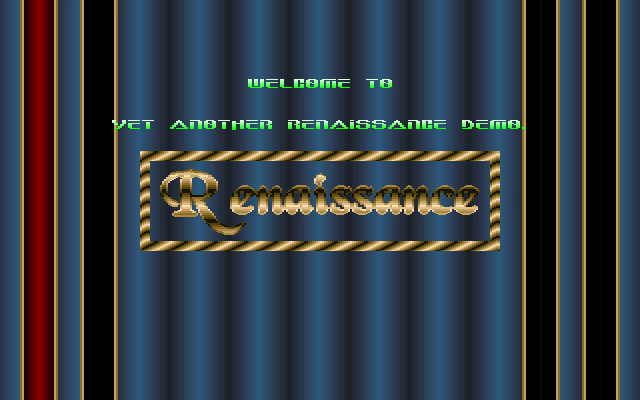 |
Text keeps updating over the same background. The right-side colour rails show that the effect is palette/register driven, not just one static bitmap. |
00:00:10.000 |
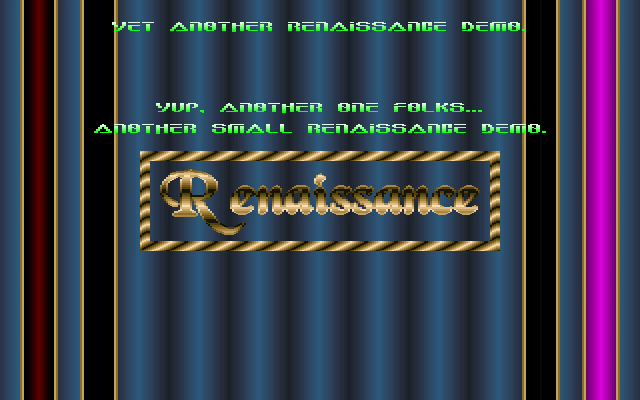 |
A sparse phase with the logo and small title line. The bars continue while the text area is mostly clear. |
00:00:20.000 |
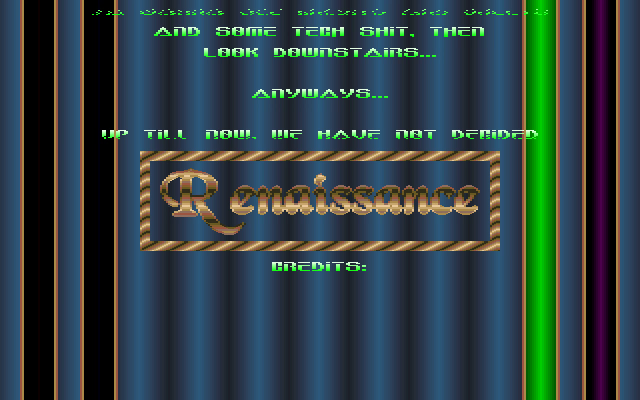 |
Another timed text page. The captured text is stable enough to show page-style sequencing rather than a continuous bottom scroller. |
00:00:40.000 |
 |
News/about text. The background has shifted toward green with multicolour rails at both edges. |
00:01:00.000 |
 |
A new "welcome" page. The logo is gold again and the bars are back to mostly blue. |
00:01:30.000 |
 |
A page talking about a sound-card limit. This matches the documentation: Sound Blaster support is optional, and this capture used no emulated card. |
00:02:00.000 |
 |
More info text over a warm brown/green version of the same rail effect. |
00:02:30.000 |
 |
The palette rotates into a purple/black phase while the text page changes. |
00:03:00.000 |
 |
Late captured text page. The runtime is still alive and producing distinct text after three minutes. |
00:03:30.000 |
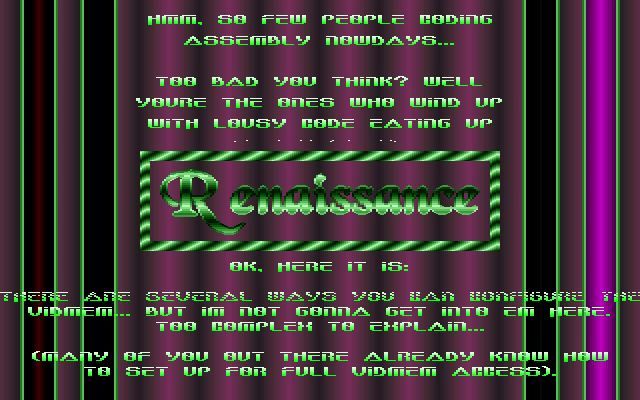 |
Final selected frame before the forced-stop tail. The same compositing model continues: logo, bars, and page text. |
Runtime-To-Code Concordance
The Yardemo frames are direct DOSBox-X evidence of the protected-mode runtime, but the fully annotated code recovered in this pass is mostly the delivery and preflight machinery. The concordance below separates what is directly tied to recovered real-mode code from what is a bounded runtime model inferred from the captured protected-mode visuals.
| Runtime evidence | Code anchor | What it explains |
|---|---|---|
First stable logo frame at 00:00:00.200 |
CBT.COM clean-boot helper, MZ entry at file offset 0x1DB8E, XOR layer 0 and layer 1, LZ unpacker entry at restored offset 0x0000 |
The graphics frame appears only after a serious delivery chain: optional clean-DOS helper, encrypted MZ body, second XOR layer, bitstream unpack, relocation pass, then runtime handoff. |
| The fact that the capture runs cleanly with XMS/EMS/UMB disabled and no memory manager | VGA check INT 10h AX=1A00h at 0x032F, 386 flags test at 0x0352, V86/protected-mode check SMSW at 0x036C, memory checks via INT 12h and INT 15h AH=88h |
The documentation's "clean DOS / 386 / VGA" warning is executable behavior. The runtime is intentionally reached only after the real-mode preflight accepts the machine. |
Blue/gold Renaissance logo phases at 00:00:01.000, 00:00:10.000, and 00:01:00.000 |
Protected-mode visual body after the unpacker; runtime model: centered logo layer plus palette/register changes | The logo is a persistent composited layer, not a new loaded picture for every page. The exact protected-mode inner loop is not flattened here, but the stable placement across minutes constrains the model. |
| Moving vertical bars and side colour rails across all frames | Runtime model: vertical colour-bar background with palette or per-column colour-register shifts | The rails continue changing while text pages change. That rules out a simple slideshow and matches a continuously updated background layer. |
Green timed text pages at 00:00:02.000, 00:00:05.000, 00:00:20.000, 00:00:40.000, and later |
Runtime model: scheduled page text over the persistent logo/bar layers | The text is page-style sequencing rather than a bottom scroller. The code-level boundary remains the restored runtime handoff; the text scheduler itself was not fully reconstructed in this pass. |
Sound-card-limit page at 00:01:30.000 in a no-sound capture |
Documentation plus startup environment; optional Sound Blaster support is outside the selected visual run | The visual runtime does not require SB hardware. This matches the doc's optional SB/SB Pro claim and the capture configuration. |
Purple/brown/green palette shifts at 00:02:00.000 and 00:02:30.000 |
Runtime model plus recovered VGA requirement; no static-frame replacement needed | The same logo/text/bar composition persists while palette families change, so the visible effect is continuous palette/register work over a stable layout. |
Late pages still alive at 00:03:00.000 and 00:03:30.000 |
Forced-stop capture boundary and no automatic exit observed during 238.805500 seconds |
The demo is long-running and still sequencing text after three minutes. The selected frames are not an artificial short loop made from repeated early frames. |
| Omitted old contact text | Analysis boundary; old BBS/contact material is present in the artifact but not reproduced | The final/public page selection is intentionally conservative. The technical model covers the loader and visible runtime without republishing historical contact details. |
This is intentionally a bounded concordance. The loader, preflight, and decompression chain are code-anchored; the late logo/bar/text pages are tied to the runtime frames and described only as far as the recovered evidence supports.
Archive Contents
The examined archive:
46fc630bb9bc500bd2e58b667e109cb8a62191a575106c6c04a6506470830002 yardemo.zip
Contents:
cbt.com          392 bytes   1992-04-30 23:04
yardemo.doc     1293 bytes   1992-05-21 22:03
yardemo.exe   121878 bytes   1992-05-07 01:18
File hashes:
056fab530b943c3607a70a970c63d7f7afe7f8d6d543d6d4290c10fb27ec2aff  cbt.com
654a2aa750a4607b3c802a063ad3c05e886d6478a3dee256e21477e87db12e61  yardemo.doc
17e60454d3f78c6135b826f9c8fb20308674e2a83c02148519adf05c0deea7e7  yardemo.exe
YARDEMO.DOC states the same requirements as the other early Renaissance
protected-mode demos:
- 386 processor or better;
- VGA graphics;
- optional Sound Blaster / Sound Blaster Pro;
- no QEMM, EMM386, 386^MAX, HIMEM, Windows, OS/2, or other supervisor that has already put the CPU in V86/protected mode.
That warning is not just prose. The recovered code performs VGA, 386, V86, and memory checks before entering the visual runtime.
CBT.COM
CBT.COM is not part of the visual effect. It is a boot helper intended to
temporarily make a clean DOS boot setup for the demo.
It contains these root-path names:
\autoexec.bat
\autoexec.666
\config.sys
\config.666
\cbt666.com
cbt666
The code flow is small and direct:
0100: jmp 01ceh
...
01ce: mov dx,0111h   ; "\autoexec.666"
01d1: mov ah,41h     ; delete
01d3: int 21h
01d5: mov dx,012bh   ; "\config.666"
01d8: mov ah,41h
01da: int 21h
01dc: mov dx,0103h   ; "\autoexec.bat"
01df: mov di,0111h   ; "\autoexec.666"
01e2: mov ah,56h     ; rename
01e4: int 21h
01e6: mov dx,011fh   ; "\config.sys"
01e9: mov di,012bh   ; "\config.666"
01ec: mov ah,56h
01ee: int 21h
Then it creates a tiny new AUTOEXEC.BAT and CONFIG.SYS:
01f0: mov dx,0103h
01f3: mov ah,3ch     ; create autoexec.bat
01f7: int 21h
01fb: mov ax,4000h   ; write
01fe: mov dx,0143h   ; "cbt666"
0201: mov cx,0007h
0204: int 21h

020a: mov dx,011fh
020d: mov ah,3ch     ; create config.sys
0211: int 21h
0215: mov ax,4000h
0218: mov dx,014ah   ; "files=20", "buffers=30"
021b: mov cx,0016h
021e: int 21h
It also writes a copy of itself as \cbt666.com, sets the BIOS warm-boot flag,
and jumps to the reset vector:
0244: xor ax,ax
0246: mov es,ax
0248: mov word [es:0472h],1234h
024f: jmp ffffh:0000h
The restore path deletes the temporary files, renames .666 files back to the
normal names, prints a message, and exits via int 21h AH=4Ch.
I did not run CBT.COM on the host. The only runtime execution here was inside
an isolated DOSBox-X mount.
MZ Shape
YARDEMO.EXE is an MZ executable, but the header points to an encrypted loader
stub near the end of the load image:
file size        121878 bytes
MZ pages         239
last page bytes  0x0016
relocations      1
header bytes     32
load bytes       121846
min extra        0x152c
max extra        0xffff
entry CS:IP      1db6:000e
stack SS:SP      fff0:0100
relocation       1db6:0000
entry file off   0x1db8e
Raw strings are intentionally unhelpful. Before decrypting, the EXE has no
plain Renaissance, V86, 386, VGA, Sound, or YAR strings.
Two XOR Loader Layers
The entry at file offset 0x1db8e, load offset 0x1db6e, is a compact
self-decryptor. Its control block lives at load offset 0x1db60:
0000  relocation segment delta, DOS-relocated at runtime
0002  relocation count = 1
0004  next IP = 000e
0006  next CS = 1dac
0008  restored SP = 0100
000a  restored SS = fff0
000c  decrypt paragraph count = 1db6
000e  decryptor code begins
The hot loop decrypts 16 bytes per outer iteration:
1db9f: xor bx,bx
1dba1: mov dx,c74ah       ; initial key: DL=4a, DH=c7

outer:
1dba4: cmp bx,0f000h
1dba8: jb short no_wrap
1dbaa: sub bx,0f000h
1dbae: mov ax,es
1dbb0: add ax,0f00h
1dbb3: mov es,ax

no_wrap:
1dbb5: mov cx,0010h       ; 16 bytes per paragraph

inner:
1dbb8: mov al,es:[bx]
1dbbb: xor al,dh          ; xor with high key byte
1dbbd: add dh,dl          ; evolve high byte
1dbbf: ror dl,1           ; rotate low byte
1dbc1: mov es:[bx],al
1dbc4: add bx,sp          ; SP is deliberately 1
1dbc6: loop inner

1dbc8: dec word [000ch]   ; paragraph counter
1dbcc: jne outer
There are two such layers:
layer 0: stub=0x1db60, count=0x1db6 paragraphs, key=0xc74a, next=1dac:000e
layer 1: stub=0x1dac0, count=0x1dac paragraphs, key=0xc528, next=fff0:0100
The second target looks impossible if treated as a raw file segment. In real
execution the word at the stub control block offset 0000 has already been
relocated by DOS. The loader adds that runtime load segment to the target
segment, then subtracts 0x10 for the PSP-style handoff. This is why offline
analysis must account for the relocation, not just read fff0:0100 literally.
After applying both XOR layers offline, the restored load image hash is:
55416ac5c1ba60e3b707339d9f892b4b6ee4dd0ad96c31a559ccd89f4b942a38 yardemo-fully-decrypted.load
At that point the hardware-check strings and a second-stage bitstream unpacker are visible.
Bitstream Unpacker
The second-stage code is a real-mode LZ-style unpacker. The startup at restored
load offset 0x0000 first checks whether there is enough memory and copies a
working decompressor body to a lower temporary segment:
0000: mov ax,32cch
0003: mov dx,1dach
0009: cmp ax,[0002h]
000d: jae not_enough
000f: sub ax,0020h
0012: cli
0013: mov ss,ax
0015: sti
0016: sub ax,0025h
0019: mov es,ax
001b: push ax
001c: mov cx,0122h
001f: xor di,di
0021: push di
0022: mov si,0144h
0025: cld
0026: rep movsw          ; copy 0x244 bytes of unpacker body
0028: retf               ; enter the relocated body
The error string at 0x0032 is:
Not enough memory$
The unpacker is built around a 16-bit bit bucket in BP and a bit-count in
DL/DX. Refill sites all use the same idiom:
00ba: lodsw              ; get another 16 compressed bits
00bb: xchg ax,bp
00bc: mov dl,10h

bit:
00c1: shr bp,1           ; next bit goes to carry
00c3: dec dx
00c4: je 00bah           ; refill when exhausted
The literal path is the shortest hot path:
00be: jb  00c8h          ; carry selects match/control path
00c0: movsb              ; literal: DS:SI -> ES:DI
00c1: shr bp,1
00c3: dec dx
00c4: je  00bah
00c6: jae 00c0h          ; keep copying literal bytes while bits allow
The match path builds a length class in CX and an offset in BX by rotating
bits through BX:
00c8: xor cx,cx
00ca: xor bx,bx
00cc: shr bp,1
00ce: dec dx
00cf: je  008ah
00d1: rcl bx,1
00d3: shr bp,1
00d5: dec dx
00d6: je  0090h
00d8: rcl bx,1
00da: cmp bl,02h
00dd: jae 0107h
...
0102: mov bl,cs:[0206h+bx] ; small length-class table
0107: xchg bx,cx
0109: xor bx,bx
Short back-references use an explicit source pointer from the current output position:
013a: lodsb              ; low distance byte
013b: mov bl,al
013d: push si
013e: mov si,di
0140: sub si,bx          ; source = already emitted output - distance
0142: cli
0143: rep movsb es:[si],es:[di]
0146: sti
0147: pop si
0148: jmp 00c1h
Longer output spans normalize the destination and source segments when the
offset crosses the 0x2000 window boundary:
01bb: push ax
01bc: lea bx,[di-2000h]
01c0: and di,000fh
01c3: add di,2000h
01c7: mov cl,04h
01c9: shr bx,cl
01cb: mov ax,es
01cd: add ax,bx
01cf: mov es,ax
01d1: mov ax,ds
01d3: mov bx,si
01d5: and si,000fh
01d8: shr bx,cl
01da: add ax,bx
01dc: mov ds,ax
01de: pop ax
01df: cmp al,0ffh
01e1: je  020ch          ; end marker
01e3: jmp 00c1h
After the compressed stream ends, the unpacker applies relocation records and far-returns into the restored program:
020c: pop bx
020d: mov bp,bx
020f: add bx,0010h       ; loaded-image segment base

reloc_group:
0212: xor ax,ax
0214: lodsb
0215: xchg ax,cx
0216: jcxz done_relocs
0218: lodsw
0219: add ax,bx
021b: mov es,ax
021e: lodsw
021f: xchg ax,di
0220: add es:[di],bx
0223: loop 021eh
0225: jmp reloc_group

done_relocs:
0227: lodsw
0228: add ax,bx
022a: cli
022b: mov ss,ax
022d: lodsw
022e: mov sp,ax
0230: sti
0231: lodsw
0232: add bx,ax
0234: push bx
0235: lodsw
0236: push ax
0237: mov es,bp
0239: mov ds,bp
023b: xor ax,ax
...
0249: retf
This is the core delivery mechanism: two XOR sweeps hide the MZ body, then a compact LZ bitstream expands the real program and relocates it.
Real-Mode Preflight
The restored image includes the same hardware intent visible in the docs.
The VGA check uses BIOS display-combination call int 10h AX=1A00h, then
accepts VGA-class display codes:
032f: mov ax,1a00h
0332: int 10h
0335: cmp bl,07h
0338: jb  fail
033a: cmp bl,0ch
033e: ja  fail
0340: ret
0341: mov dx,0221h
0344: mov ah,09h
0346: int 21h
The nearby string fragments decode to the visible intent:
You must have VGA to run this program!
a 386 or better
... already ... V86 mode
Not enough low ...
The 386 test uses the classic flags high-nibble trick:
0352: pushf
0353: pop ax
0355: and ah,0f0h
0358: cmp ah,0f0h
...
The V86/protected-mode supervisor check uses smsw ax:
036c: smsw ax
036f: test al,01h
0371: jne fail_v86_or_protected
The memory sizing path then uses int 12h for conventional memory and
int 15h AH=88h for extended memory:
0378: int 12h
037a: cmp ax,027fh
037d: jb  fail_low_memory
...
039d: mov ah,88h
039f: int 15h
The recovered preflight is enough to connect the documentation, the runtime requirement, and the executable behavior: this is another Tran 386 protected mode demo that refuses to coexist with memory managers.
Visual Runtime
The final protected-mode visual body is reached after the LZ unpacker and was not fully reconstructed as a flat annotated code image in this pass. The runtime capture still gives a clear model of what the visible loop is doing:
- A static or mostly static Renaissance logo rectangle is composited in the center.
- Vertical colour bars behind and beside the logo change continuously.
- Green page text is rendered above and around the logo at timed intervals.
- The palette and/or per-column colour registers shift between blue, green, gold, red, and purple phases.
- The sequence is long-running; the captured run remains active after
00:03:30.000.
The visible effect is therefore not a vector/ball engine like Black Glass.
It is closer to an info-demo or invitation screen: a stable logo layer, a
colour-rail background, and scheduled text pages. The interesting inner loops
that are fully recovered here are the delivery loops: the two XOR paragraph
sweeps and the bit-level LZ unpacker that gets the actual protected-mode body
into memory.
Relationship To The Other Renaissance 1992 Demos
Yardemo sits between the small information/demo side of Renaissance and the
more famous protected-mode vector pieces:
- Like
Black Glass, it is coded by Tran and warns hard against memory managers. - Like
Black Glass, it performs VGA/386/V86/memory checks before the runtime. - Unlike
Black Glass, it does not present a point-sprite vector object engine in the captured segment. - Unlike
Amnesia, it is not a large multipart megademo package. - Its loader stack is more obfuscated than the plain user-visible output might suggest: MZ entry to XOR layer 1, XOR layer 2, LZ unpacker, relocation pass, then runtime.
That makes it a useful 1992 specimen precisely because the visible demo is modest while the delivery machinery is serious 386-era demoscene engineering.