Analysis model: gpt-5.5 xhigh, sol high
Last edited: 2026-08-25
yo! by Future Crew - Technical Dissection
Scope
This covers yo! by Future Crew, released in April 1990. Pouet lists it as an
MS-DOS 32K intro, and the scene.org archive contains one packed executable,
YO.EXE.
Sources and artifact:
- Pouet: https://www.pouet.net/prod.php?which=2999
- Archive: https://files.scene.org/get/demos/groups/future_crew/intros/yo.zip
Hashes from the examined archive:
3a7d4de1b31ccf23010d67a5910e4d8e88d812d6480ce3bafe58b862830a59b5  yo.zip
091f508b5e670da7943edaa45036d79a00da4c8748a45fa97e3fb40376c5cf8a  YO.EXE packed
5036339b4fcbf6abe73324ddf83a72f723e2079f7b8ec2a2f092d656bc9964a6  YO.EXE restored
Some scroller text in the executable contains old BBS phone numbers and other personal contact details. I do not reproduce those details here.
Runtime Capture
A DOSBox-X 2026.01.02 capture on 19 June 2026 used the public Scene.org
yo.zip archive and the original packed YO.EXE. The run used SDL dummy
video/audio, machine=svga_s3, normal CPU core, cycles=30000, xms=true,
ems=false, nosound=true, and no Sound Blaster device. Timing zero is the
start of dx-capture /v YO.EXE.
The stream is a 67.930466-second MPEG-TS/H.264 capture. DOSBox-X did not exit cleanly under the noninteractive wrapper, so the process was stopped after the selected frames were already present. ffmpeg reported one corrupt decoded frame around the initial mode transition; the frames below were taken from a sequential 1 fps decode and checked visually. These screenshots document the visual text-mode/VGA trick only; audio behavior is not validated here.
The selected frames stay in the public title/credit portion of the scroller and avoid the later old BBS/contact material.
The sequence GIF below is assembled directly from those seven public DOSBox-X frames. It shows the text/VGA engine as a live palette/scroller/font effect: dark title state, bright title, entering top scroller, magenta phase, cyan/green phase, public credits, and blue coding-credit phase.

| Timestamp | Frame | Runtime context |
|---|---|---|
00:00.000 |
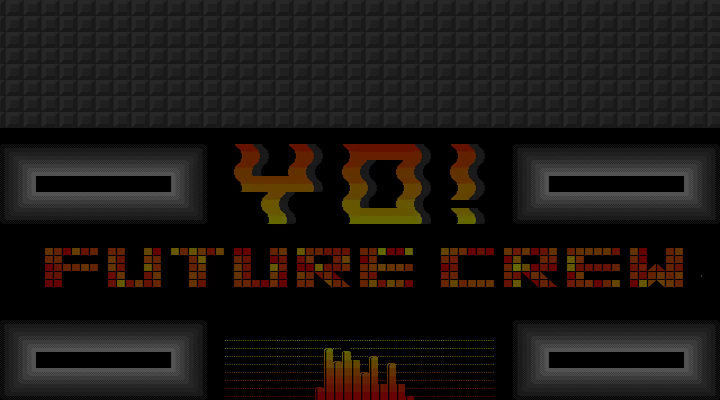 |
The custom text/VGA mode is established. The large YO! logo, Future Crew text, metal side panels, and lower meter area are already visible, but the palette is still in the first dark phase. |
00:02.000 |
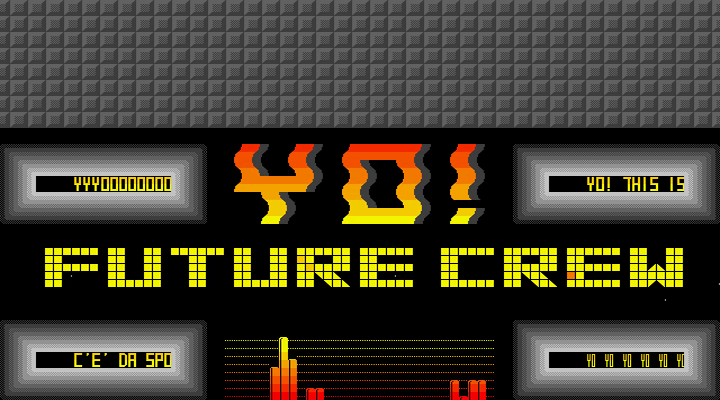 |
The title screen has brightened and the small side-panel text is active. This is a useful anchor for the prepared 80x25 text buffer, custom font banks, and DAC/attribute setup described below. |
00:04.000 |
 |
The top scroller has entered the visible area while the main YO!/Future Crew block remains stable. The effect reads like bitmap graphics, but the code is mutating text-mode font data and CRTC state. |
00:08.000 |
 |
The same layout is now in a magenta palette phase. The frame makes the palette/interpolator state and lower meter motion easier to see than the static title build. |
00:16.000 |
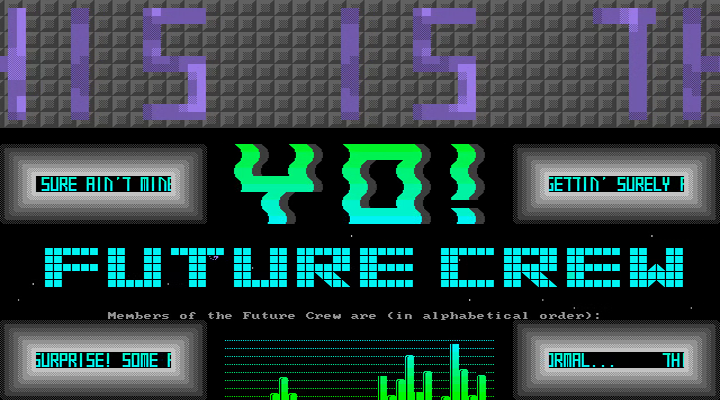 |
A later palette state is active, with the large top scroller moving over the tiled background. This corresponds to the frame update loop that combines background/tile tables, font mutation, and PC-speaker timing state. |
00:24.000 |
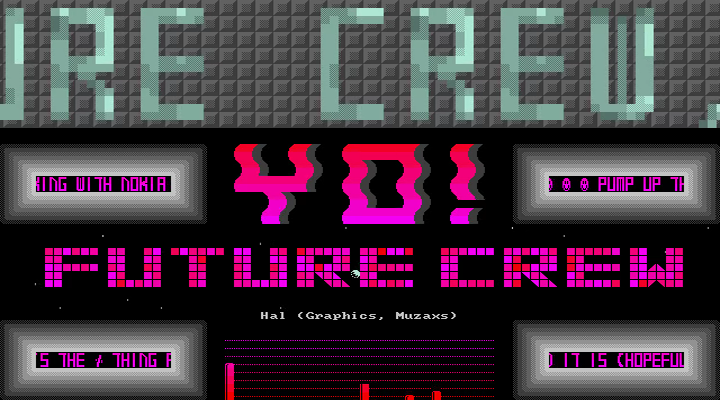 |
The public member-credit portion is visible while the main panel continues to animate. This is still the same single effect screen, not a separate picture part. |
00:32.000 |
 |
The blue palette phase shows that the long run is carried by colour/font/scroller state changes rather than scene cuts. The later private-contact portion is intentionally not shown. |
Runtime-To-Code Concordance
The seven frames are direct DOSBox-X frame evidence from the public title/credit portion of the run. They show one long text-mode engine rather than separate picture parts: the palette, font banks, CRTC start address, hardware panning, timer sound state, and B800h text cells are all moving together.
| Runtime evidence | Code anchor | What it explains |
|---|---|---|
Dark initial title at 00:00.000 |
Microsoft C startup 13A5:0016, main at 11DD:0002, prepared 80x25 buffer at DGROUP 2102h, display install 0000:E4ED |
The title screen begins as a normal character/attribute buffer, then the custom VGA setup turns text mode into a mutable-font display. |
Bright title at 00:02.000 |
CRTC offset writes at E517, attribute/sequencer changes at E545..E568, plane-2 font access at E5A3..E5E0, built-in glyph-bank copies |
The logo and side panels are not chunky VGA bitmaps. They rely on text mode with a widened 0xA4 row pitch and live character-generator data in plane 2. |
Top scroller entering at 00:04.000 |
Frame routine 0000:E7B1, horizontal pan update at E836..E867, font-bank rotate loops around E953, first glyph injection around EA02..EA5C |
The apparent pixel scroller is produced by shifting font bytes through carry and using attribute-controller horizontal panning. New characters are injected as 16-byte glyphs every eight frames. |
Magenta phase at 00:08.000 |
Palette scaler at E813..E834, retrace-safe DAC upload at E875..E88A, C-side palette targets/interpolators |
The colour changes are DAC state. The screen layout is stable while 48 palette bytes are scaled and written to 03C8h/03C9h during retrace. |
Cyan/green phase and public member-order scroller at 00:16.000 |
Four scroller text bases D12C, D873, DC77, DEA3, glyph map C3D2h, glyph source C60Ah |
The visible text streams are independent software scrollers sharing the same font-plane mechanism, not separate screen images. |
Public credits at 00:24.000 and blue coding-credit phase at 00:32.000 |
B800h/background double-buffer copy at EF98..F022, CRTC start update F177..F191, phase flag CS:[4335] returned by E7B1 |
The long run keeps the same effect screen alive by moving the display start and swapping text buffers. The C side only handles keyboard work on one display phase. |
| Lower meter motion visible across the frames | Timer IRQ install at E6A7, PIT divisor 0x6000, private INT 7F music API, VU draw routine E72F |
The VU bars are not sampled audio. The timer ISR reads player state, adds impulses to decay arrays at 488C onward, and E72F draws decaying bars in text memory. |
| Small moving/space effects over the panel | Bouncing 2x2 object draw path EDDC..EEB0, starfield update EECA..EF6B, PRNG F228 |
The object and starfield are text cells/custom glyphs. They erase old B800h cells, write special mutable-font characters, and respawn stars by row/velocity/lifetime tables. |
| Omitted later private-contact portion | Scroller text is present in the executable but not reproduced; exit cleanup E4B5..E4E3 restores mode 3, old INT 08, speaker gate, and keyboard LEDs |
The analysis deliberately stops visual publication before old BBS/contact text. The hardware cleanup is still covered because it explains how the intro returns from its custom text/VGA state. |
This bridge is the important point for yo!: the screenshots look like a VGA
bitmap demo, but the implementation is a text-mode renderer with live font
mutation, CRTC motion, palette timing, and an IRQ-driven speaker/VU side loop.
Executable Shape
The archive YO.EXE is a 27,392-byte LZEXE-packed MZ executable. After the
first UNP pass it expands to a 59,901-byte executable, but that is still not the
real program. The first expanded image contains another small executable loader
and block depacker. A second UNP pass produces the useful analysis target:
file size:       99,973 bytes
declared MZ:     99,872 bytes
header size:      1,104 bytes
loaded image:    98,768 bytes
relocations:        267
entry point:     CS:IP 13A5:0016  (load-image offset 13A66)
stack:           SS:SP 1953:0800
That final image is not a tiny all-ASM intro. It is a Microsoft C real-mode program with custom assembly modules for the display and sound-critical paths. The useful map is:
0000:E48D  custom VGA/text-mode setup and frame routine
1000:0057  PC speaker music tick engine
11DD:0002  C main program
13A5:0016  Microsoft C startup/runtime entry
1627:xxxx  DGROUP: strings, work buffers, C globals
Addresses below are load-image segment:offset addresses before DOS adds the
program's load segment. For example, 0000:E7B1 means linear offset 0x0E7B1
inside the restored image.
Runtime Entry
The program starts in the Microsoft C startup code at 13A5:0016. It checks for
DOS 2.0 or newer, shrinks its memory block with DOS function 4Ah, clears BSS,
sets up DGROUP, then far-calls the program's main routine:
13a66: mov ah,30h
13a68: int 21h              ; DOS version
13a6a: cmp al,02h
13a6e: int 20h              ; abort if too old
...
13ac4: mov ah,4ah
13ac6: int 21h              ; resize allocation
...
13b05: call far 11dd:0002   ; main()
The C runtime matters because a lot of disassembly around 13A5:* is file I/O,
heap, keyboard helpers, and string routines. The demo logic is mostly in
11DD:*, and the hand-tuned effects are in 0000:E48D..F2A6 plus the speaker
player at 1000:*.
Main Program Layout
main starts at 11DD:0002. It allocates a 0x4E-byte stack frame and sets up
many small state variables: bouncing-object position/velocity, palette target
values, palette interpolators, scroll state, and flags.
The first large loop expands a compact table at 0x48D0 into character and
attribute bytes. It is a three-level loop:
z = 0..78
  y = 0..15
    x = 0..11
      src = 48D0 + z*0180h + y*18h + x*2
      if src_byte != 0:
          code = table[src_byte + 4Ch]
          attr = table[src_byte + 6Ch] * 16 + table[src_byte + 5Ch]
          write code and attr back to the expanded cell
The constants tell the shape: 0x180 = 16 * 0x18, so one logical frame/table
entry is 16 rows by 12 word-sized cells. This is not drawing directly to B800.
It prepares a table that the custom ASM later consumes for background/tile
changes.
Then main builds a normal text screen image at DGROUP offset 0x2102.
0x0FA0 bytes are cleared as 80x25 character/attribute pairs:
1202d: mov byte ptr es:[bx+2102h],20h  ; char = space
12044: mov byte ptr es:[bx+2103h],07h  ; attr = gray on black
1204a: add word ptr [bp-8],2
1204e: cmp word ptr [bp-8],0fa0h
A 30x10 text/logo block from 0x1664 is overlaid near the center. Space cells
get attribute 07h; non-space cells get 17h, so the title card is already a
plain 80x25 text buffer before the VGA tricks start.
After that:
12113: call far 0000:e4ed   ; install custom text/VGA mode and timer hook
12118: call far 0000:e7b1   ; run first frame update
VGA Text-Mode Setup
0000:E4ED is the display install routine. It starts from BIOS mode 3, asks
BIOS to load an 8x8 ROM font, hides/moves the cursor, then rewrites CRTC,
attribute-controller, sequencer, graphics-controller, DAC, timer, and interrupt
state by hand.
The CRTC setup is the first clue that this is not ordinary text output:
e517: mov dx,03d4h
e51a: mov ax,2913h
e51d: out dx,ax          ; CRTC offset register 13h = 29h
e51e: mov ax,7f18h
e521: out dx,ax          ; line compare register 18h = 7fh
CRTC offset 0x29 means each displayed text row is 0x29 * 4 = 0xA4 bytes
wide in video memory. An 80-column text line is only 160 bytes, so the demo has
two extra bytes per row. Many later loops use 0xA4 as the row pitch.
Then the code changes the attribute controller and sequencer:
e545: mov dx,03c0h
e548: mov al,10h
e54a: out dx,al
e54b: mov al,20h
e54d: out dx,al          ; attribute mode control

e55e: mov dx,03c4h
e561: mov al,01h
e563: out dx,al
e564: inc dx
e565: in  al,dx
e566: or  al,01h
e568: out dx,al          ; sequencer clocking mode tweak
The font upload section temporarily disables normal odd/even text addressing so plane 2 of B800 can be used as character-generator RAM:
e5a3: mov dx,03ceh
e5a6: mov al,06h
e5a8: out dx,al
e5a9: inc dx
e5aa: in  al,dx
e5ac: and al,0fdh
e5ae: out dx,al          ; graphics controller misc

e5bb: mov dx,03c4h
e5be: mov al,04h
e5c0: out dx,al
e5c1: inc dx
e5c2: in  al,dx
e5c4: or  al,04h
e5c6: and al,0feh
e5c8: out dx,al          ; memory mode: access plane storage

e5d5: mov dx,03c4h
e5d8: mov al,02h
e5da: out dx,al
e5db: inc dx
e5dc: in  al,dx
e5de: mov al,04h
e5e0: out dx,al          ; map mask = plane 2
With plane 2 selected, it copies built-in glyph banks into B800 offsets such as
1E00h, 1000h, 0B60h, and 0F60h, then clears other banks. These are not
screen characters. They are live character bitmap data. This is the central
trick: the screen is text mode, but every frame mutates the font bitmaps and
the CRTC start address, so the result looks like pixel graphics.
Interrupts And Sound Control
The setup routine also installs two interrupt paths:
e680: mov ax,002ch
e683: mov cs:[432d],ax
e68d: mov ax,0fe9h
e690: mov cs:[432b],ax
e694: mov word ptr [0000:01fe],ax  ; INT 7F segment = 0FE9h

e697: mov ax,[0000:0020]
e69a: mov bx,[0000:0022]
e69e: mov cs:[4883],ax
e6a2: mov cs:[4885],bx             ; save old INT 08
e6a7: mov ax,0e6cbh
e6aa: mov [0000:0020],ax
e6ad: mov [0000:0022],cs           ; INT 08 = e6cb
INT 7F is a private music API interrupt. INT 08 is the timer IRQ hook. The
PIT is reprogrammed through channel 0:
e6b2: mov al,36h
e6b4: out 43h,al
e6b6: mov ax,6000h
e6b9: out 40h,al
e6bb: mov al,ah
e6bd: out 40h,al
0x6000 gives about 1193182 / 24576 = 48.5 Hz, close enough to a display
frame tick for a 1990 text-mode demo.
The timer ISR at E6CB calls the music engine and derives VU-meter impulses
from the music state:
e6ce: cmp byte ptr cs:[06eah],0
e6d4: je  skip
e6d6: mov ax,0000h
e6d9: int 7fh                  ; tick music

e6db: mov ax,cs:[432b]
e6df: mov ds,ax
e6e1: mov bx,cs:[432d]
e6e6: mov ax,[bx]
e6e8: mov bl,ah
e6ec: shr bx,1
e6ee: cmp bx,20h
e6f3: mov bx,20h               ; clamp bucket
e6fe: add byte ptr cs:[bx+488c],5
e704: add byte ptr cs:[bx+488d],0fh
e720: add byte ptr cs:[bx+488e],5
e726: mov al,20h
e728: out 20h,al               ; PIC EOI
So the VU display is not audio sampling. It reads a changing byte from the music player state, buckets it into roughly 33 bars, then increments three small decay arrays used by the display routine.
Music selection goes through 0000:F1B2. Main maps keys 1 through 6 into
calls to this routine; ESC exits. A special 0x63 command silences the
speaker and disables the timer-driven music flag. Other commands install one of
two INT 7F backends and call that backend with AH=1/AH=2 setup commands.
PC Speaker Player Inner Loop
The speaker tick routine at 1000:0057 is a compact two-voice tracker-style
engine. Two channel structures live at offsets 0100h and 0118h. On each
tick it advances pattern commands when fractional accumulators overflow, then
computes a PIT divisor.
The output write is the classic PC speaker path:
10100: cmp [002ch],cx
10104: je  same_period
10106: mov al,0b6h
10108: out 43h,al       ; PIT channel 2, lobyte/hibyte, square wave
1010a: mov al,cl
1010c: out 42h,al
1010e: mov al,ch
10110: out 42h,al
10112: mov [002ch],cx

10116: in  al,61h
10118: or  al,03h
1011a: out 61h,al       ; enable speaker gate and data
The note/effect interpreter at 1018B reads bytecode from the current pattern:
10199: lodsb
1019c: cmp al,0a0h
1019e: jb  command_or_note
101a0: add al,20h
101a2: jb  set_delay
101a4: mov bl,al
101a6: mov al,[bx+04e6h]    ; instrument/period remap
101aa: mov [di+09h],al
101ad: jmp 10199h

101b5: mov bl,al
101b7: shl bl,1
101bb: jmp word ptr [bx+0030h]
The period calculation at 10212 uses channel-local pitch, global transpose,
vibrato/arpeggio state, and a period table at 0054h:
10212: mov bl,[di+0bh]
10215: inc bl
10217: mov al,[bx+05b4h]    ; effect/arpeggio sequence
...
1022b: add al,[di+16h]
1022e: add al,[002ah]
10232: add al,[di+17h]
10235: shl al,1
10237: mov bl,al
10239: mov cx,[bx+0054h]    ; final PIT divisor candidate
...
10277: test bl,08h          ; slide/portamento flag
10284: mov ax,[di+14h]
10287: add ax,[di+0ch]
1028a: mov [di+0ch],ax
1028d: add cx,ax
It is not PCM playback. It is direct PIT frequency synthesis, with enough tracker-like effect handling to make the PC speaker sound far richer than a simple beep loop.
The Frame Routine
0000:E7B1 is the main per-frame display worker. main calls it once during
setup and then once per loop:
12c16: call far 0000:e7b1
12c1b: cmp ax,0001h
12c20: jmp 133dbh       ; only handle keyboard on one flip phase
The routine returns CS:[4335], a one-bit phase flag. The C side uses that flag
to do keyboard work only on one of the two display phases.
Palette And Fade
Early in E7B1, the routine scales 48 palette bytes by the fade value at
CS:[C3B8]:
e813: mov cx,0030h
e816: xor bx,bx
e819: mov dx,cs:[c3b8]
e821: mov al,cs:[bx+c358h]
e826: mul dl
e82a: shr ax,6
e82e: mov cs:[bx+c388h],al
e833: inc bx
e834: loop e821h
Later, during vertical retrace, those 48 bytes are written to the DAC:
e875: mov dx,03c8h
e878: mov al,00h
e87a: out dx,al
e87b: inc dx              ; 03c9h
e87c: mov cx,0030h
e87f: mov bx,c388h
e882: mov al,cs:[bx]
e885: out dx,al
e889: inc bx
e88a: loop e882h
So the C code owns palette targets and interpolation; the ASM routine scales and commits the current palette at a retrace-safe point.
Horizontal Smooth Scroll
The routine waits for retrace using input status register 03DAh, then updates
attribute-controller horizontal panning:
e836: mov dx,03dah
e839: cli
e83a: in  al,dx
e83b: test al,08h
e83d: jne e83ah       ; wait until not in retrace
e83f: in  al,dx
e840: test al,08h
e842: je  e83fh       ; wait until retrace starts

e859: mov dx,03c0h
e85c: mov al,33h
e85e: out dx,al       ; attribute index 13h with palette-enable bit
e85f: mov al,07h
e861: sub al,cs:[4878h]
e866: out dx,al       ; pixel pan
e867: sub byte ptr cs:[4878h],2
e86f: add byte ptr cs:[4878h],8
The -2 mod 8 panning step explains why the text-mode scrollers look smoother
than cell-by-cell movement. The font bitmap shifts do the coarse work; the
attribute-controller pan provides sub-character motion.
Font-Bitmap Scrollers
The repeated rcl/rcr loops are the heart of the intro. Each block treats
the character generator as a set of 8-pixel-high strips. A representative loop:
e953: mov cx,8
e956: mov bx,1a00h
e959: rcl byte ptr es:[bx+01e0h],1
e95e: rcl byte ptr es:[bx+01c0h],1
e963: rcl byte ptr es:[bx+01a0h],1
...
e99d: rcl byte ptr es:[bx+0020h],1
e9a1: rcl byte ptr es:[bx],1
e9a4: inc bx
e9a5: loop e959h
Offsets are spaced by 0x20, matching one byte row inside a bank of character
glyphs. The carry flag chains adjacent bytes, so a bit shifted out of one byte
enters the next byte. That is how the text appears to scroll by pixels while
the hardware is still in text mode.
Every eight frames, a new character is injected at the right edge. One of the four injection paths looks like this:
ea02: mov bx,cs:[d124h]       ; text index
ea07: add bx,d12ch            ; scroller text base
ea0b: mov al,cs:[bx]
ea10: inc word ptr cs:[d124h]
ea15: cmp bl,00h
ea1a: mov word ptr cs:[d124h],0
ea21: mov bl,20h              ; wrap as space

ea25: cmp bl,'a'
ea2a: cmp bl,'z'
ea2f: sub bl,20h              ; uppercase
ea32: mov al,cs:[bx+c3d2h]    ; ASCII -> glyph index
ea39: mov si,ax
ea3b: mov cl,4
ea3d: rcl si,cl               ; glyph index * 16
ea3f: add si,c60ah            ; 16-byte glyph

ea46: mov bx,1be0h
ea49: mov al,cs:[si]
ea4c: mov es:[bx],al          ; top 8 rows
...
ea56: mov bx,1de0h
ea59: mov al,cs:[si]
ea5c: mov es:[bx],al          ; bottom 8 rows
There are four similar text streams with bases D12C, D873, DC77, and
DEA3, and each has its own timer/index pair. This is where the many visible
scrollers come from.
Bouncing 2x2 Object
main keeps a subpixel object position in two decimal-ish fixed-point values.
Each frame it divides by 10 and then by 8:
12b45: idiv 0ah
12b5d: sar ax,1
12b60: sar ax,1
12b64: sar ax,1
12b75: and ax,0007h
The high part becomes a character-cell coordinate written to CS:[4323] and
CS:[4325]; the low three bits become sub-character offsets CS:[431F] and
CS:[4321]. E7B1 consumes those fields.
The draw path first erases the previous four cells if they were written last frame:
eddc: mov bx,cs:[4327]      ; old x
ede3: mov ax,cs:[4329]      ; old y
ede7: mov cx,00a4h
edea: mul cx
edec: add bx,ax
edf0: mov ax,0320h          ; space, attr 03h
edfc: mov es:[bx],ax
ee06: mov es:[bx+2],ax
ee11: mov es:[bx+00a4h],ax
ee1d: mov es:[bx+00a6h],ax
Then it draws a 2x2 set of special characters at the new position, but only if the underlying attribute looks low enough:
ee37: mov bx,cs:[4323]      ; new x
ee43: mov ax,cs:[4325]      ; new y
ee4b: mov cx,00a4h
ee4e: mul cx
ee50: add bx,ax
ee55: mov ax,08f7h          ; attr 08h, char F7h
ee6c: cmp byte ptr es:[bx+1],8
ee72: mov byte ptr cs:[432f],1
ee78: mov es:[bx],ax
ee7b: inc al
ee89: mov es:[bx+2],ax
ee8d: inc al
ee9c: mov es:[bx+00a4h],ax
eea1: inc al
eeb0: mov es:[bx+00a6h],ax
The four custom characters are in the mutable font bank, so the object can be sub-character shifted without leaving text mode.
The four bytes at 432Fh..4332h are not generic object state; they are one
drawn flag per cell. Old cleanup writes 0320h only for flags that were set by
the previous draw. The new pass clears all four flags, reads the four candidate
attribute bytes, and sets a flag only when it actually emits that cell. The
steady-frame traffic is therefore exact:
4 candidate attribute-byte reads
0..4 old-cell repair word writes
0..4 new-object word writes
This is selective cleanup, but not background restoration. A qualifying cell
is later replaced with character 20h, attribute 03h; no original word is
saved. The admission test is also signed JG against 8, so ordinary attributes
9..7Fh are protected while high-bit values 80h..FFh compare as negative and
would be treated as drawable. Under the authored low-attribute layout, the
four flags keep the 2x2 object from erasing cells it declined to own.
Starfield
The star loop is a 16-entry particle system. Each star has a subcell phase, screen position, speed, lifetime, and color. The inner update:
eeca: mov cx,0010h
eecd: push cx
eece: mov si,0010h
eed1: sub si,cx
eed3: add si,si              ; star index * 2
eed5: mov dx,cs:[si+e3cbh]   ; subpixel phase
eeda: mov bx,cs:[si+e3ebh]   ; text-memory position
eedf: mov ah,cs:[si+e44bh]   ; previous glyph/color marker
eee4: cmp es:[bx],ah
eee9: mov word ptr es:[bx],0020h

eeef: add dx,cs:[si+e40bh]   ; velocity
eef4: cmp dx,8
eef9: sub dx,8
eefc: dec word ptr cs:[si+e3ebh]
ef01: dec word ptr cs:[si+e3ebh] ; move left one text cell
When a star expires, the PRNG at F228 chooses a new speed, color, lifetime,
and row. The row calculation is:
ef2f: call f228h
ef32: mov cx,000bh
ef35: div cx
ef39: add ax,000ch
ef3c: mov cx,00a4h
ef3f: mul cx
ef41: add ax,009eh          ; right side of text screen
So a star respawns between rows 12 and 22 near the right edge. The visible character is chosen from a small phase table:
ef51: mov bx,cs:[si+e3cbh]
ef56: mov al,cs:[bx+e3c3h]
ef60: cmp byte ptr es:[bx],20h
ef66: mov ah,cs:[si+e46bh]
ef6b: mov es:[bx],ax
Again, the effect is text memory plus custom glyphs, not a chunky framebuffer.
The lifetime counter advances in cell space, not frame space. Speed is selected
as 1..4; phase accumulates that speed and only when it reaches eight does the
star subtract eight, move one 2-byte cell left, and decrement its lifetime.
Respawn sets lifetime to 80 and phase to zero, so the four exact post-respawn
lifetimes are 640, 320, 214, and 160 frames. Each star travels 80 cells—from
the rightmost cell at byte offset 158 through the left edge—regardless of its
speed.
The old-pixel test is deliberately tiny. Every record reads the character byte
at its old B800h address and compares it with the previous phase glyph; only a
match clears the whole character/attribute word to 0020h. It then reads the
new destination character and plots only over 20h. The saved marker is just
the glyph byte and is updated even if the destination was occupied and no plot
occurred. This is weaker than the bouncing object's explicit drawn flags: a
coincident foreign cell using the same glyph could be cleared on the next
frame, although the authored custom-character layout makes that collision
unlikely.
With 16 records, the fixed framebuffer work is 16 old-character reads plus 16 new-character reads per frame. Conditional traffic is 0..16 old word clears and 0..16 new word plots. A star can move at most one cell in one call; an expiring move adds three PRNG calls, one unsigned divide by 11 for row selection, and one multiply by the 164-byte row pitch. The aggregate loop is therefore 32 ownership reads and 0..32 word writes per frame, with respawn cost paid only on the record whose 80th movement just completed.
Background Tile Scroll
The routine also shifts a background/text buffer using rep movsw:
ef98: mov ax,cs:[487dh]
ef9c: mov ds,ax
ef9e: mov ax,cs:[487fh]
efa2: mov es,ax
efa4: mov cx,0148h
efa7: mov di,cs:[4881h]
efac: mov si,di
efae: add si,2
efb1: rep movsw
When the pixel pan passes a threshold, it swaps two buffer descriptors and
builds a new column from the expanded table at 48D0:
efc3: mov ax,cs:[487bh]
efc7: xchg cs:[4879h],ax
efd0: mov ax,cs:[487fh]
efd4: xchg cs:[487dh],ax

effb: mov bx,cs:[c354h]
f000: add bx,cs:[c356h]
f005: mov ax,cs:[bx+48d0h]
f018: mov es:[di],ax
f01e: add di,00a4h
f022: add bx,18h
This is a text-mode double-buffered scroller. The CRTC start-address registers are updated at the end:
f177: mov cx,cs:[4879h]
f17c: mov dx,03d4h
f17f: mov al,0ch
f181: mov ah,ch
f183: out dx,al
f184: inc dx
f185: mov al,ah
f187: out dx,al
f188: dec dx
f189: mov al,0dh
f18b: mov ah,cl
f18d: out dx,al
f18e: inc dx
f18f: mov al,ah
f191: out dx,al
The visible page is not copied as a whole. The display start address is moved.
The partial buffer maintenance is nevertheless measurable. Every frame's
REP MOVSW copies 0148h = 328 words, or 656 bytes, from two bytes ahead of
the destination. When the pan threshold swaps descriptors, the column builder
adds exactly 16 source-word reads and 16 destination-word writes, one per row
at a 164-byte stride. Hardware start-address movement avoids a screen-sized
copy, but the newly exposed text column still has a fixed software cost.
VU Meter
0000:E72F draws the VU-style bars from the IRQ-updated decay arrays:
e73a: mov ax,0b800h
e73d: mov es,ax
e73f: mov cx,001eh       ; 30 columns
e742: mov bx,0003h
e745: xor bp,bp          ; sum

e74a: mov al,cs:[bx+488ch]
e74f: add bp,ax
e755: dec byte ptr cs:[bx+488ch]
...
e75b: mov di,cx
e75d: shl di,1
e75f: add di,1554h       ; bottom of bar
e769: mov cx,8
e76c: sub si,5
e774: mov dl,cs:[si+4887h]
e779: mov es:[di],dl
e78a: sub di,00a4h       ; one row upward
e78e: loop e76ch
Each bar decays by one unit per draw, and the ISR adds impulses based on the current music player state. At the end the routine stores an averaged value:
e794: mov ax,bp
e796: mov cx,5
e79b: div cx
e7a2: mov ax,0027h       ; clamp to 39
e7a5: mov cs:[025fh],ax
That gives the other display code a cheap global "music energy" value.
The inner bounds are fixed at 30 bars by eight rows. One call performs exactly 240 B800h character-byte writes; attributes remain untouched. It also visits and decays all 30 channel values before dividing the accumulated energy by five and clamping it to 39. The ISR can add impulses between draws, but it does not change the renderer's 30-by-8 write budget.
Keyboard LEDs
There is a small but very 1990 hardware gag: the demo drives the keyboard LEDs.
F28A waits until the 8042 input buffer is free, sends the keyboard EDh
"set LEDs" command, waits again, then sends the LED bitmask:
f28a: mov ah,al
f28c: call f29bh
f28f: mov al,0edh
f291: out 60h,al
f293: call f29bh
f296: mov al,ah
f298: out 60h,al

f29f: in  al,64h
f2a1: test al,02h
f2a3: loopne f29fh
The exit routine clears them while restoring text mode, the timer, and the old interrupt vector:
e4b5: mov ax,0003h
e4b8: int 10h
...
e4c7: mov [0000:0020],ax
e4ca: mov [0000:0022],bx
e4ce: in  al,61h
e4d0: and al,0fch
e4d2: out 61h,al
e4e1: mov al,00h
e4e3: call f28ah
What The Demo Is Really Doing
yo! is best understood as a text-mode graphics engine:
- C code builds screen-sized text buffers, state variables, palette targets, key handling, and bouncing/object trajectories.
- Custom VGA setup makes text mode use an unusual
0xA4-byte row pitch, mutable font plane data, smooth horizontal panning, and CRTC start-address scrolling. - The per-frame ASM routine mutates font glyphs, shifts columns through carry, injects new glyph columns from four scroller texts, draws a 2x2 bouncing object, advances a 16-particle starfield, updates palette/DAC state, and flips the display start address.
- The timer ISR runs a PC speaker tracker engine and turns player state into VU-meter impulses.
That combination explains the reputation: the visible result is "all in text mode", but the code treats the text hardware as a programmable bitmap display with a second timing domain for sound and meters.