Analysis model: not recorded
You Am I You Am The Robot by Orange - Technical Dissection
you am i you am the robot is Orange's winning PC 64K intro from The
Gathering 1996. Pouet lists it as an MS-DOS/GUS 64K production by Orange, first
place in the PC 64K competition, with the public Scene.org archive named
korso100.zip.
Sources used for this pass:
- Pouet production page: https://www.pouet.net/prod.php?which=554
- Pouet Orange group page: https://www.pouet.net/groups.php?which=30
- Scene.org archive: https://files.scene.org/get/parties/1996/gathering96/in64/korso100.zip
- Public video reference: https://www.youtube.com/watch?v=2eI0OHuZ2uI
🦜 Parrot sign for the name. It earns it.
Archive Boundary
The Scene.org archive contains only three files:
FILE_ID.DIZ      97 bytes
INFO            666 bytes
RELIGION.EXE  63822 bytes
The hashes used for this pass are:
fcc2821dfed73320c02e6c9fe5c9fc10b6bdb274a962a0315ed0d4e11c08d192  korso100.zip
0497fdb790316019165518f9fdcfc35a1f974344f4f2da8e0e23a35b2916a776  FILE_ID.DIZ
61872a7b31dbba1f65ca172dcaf2cf263493043df3148fd5c18d391c9b45afc5  INFO
6b7b7b202f31631c939ae1483e3ff6e2d94b9887d72c440f58030141cb9cdfe3  RELIGION.EXE
FILE_ID.DIZ identifies the release directly:
you am i you am the robot
orange orange ORANGE
64k intro for
the gathering'96
final version
The non-private parts of INFO credit Dune with code/music attempts, Der Piipo
with graphics, and Lemming with project management and related work. It also
states that SB support was tested under SBOS, no-sound works, GUS works, and
the intro needs about 500 KB of low memory plus roughly 2.65 MB of extended
memory. Old personal contact/address lines are deliberately not reproduced
here.
Public Video Boundary
The visuals below are direct frame/GIF extracts from the public video. The MP4 is 480x360 at 29.97 fps, 246.06 seconds long, with AAC audio. The stills and GIFs are full-frame time slices from that video: no browser screenshot, no padding, and no viewport crop.
The video contact sheet gives the whole shape of the show:

The important visual sequence is:
00:00-00:25  dark blue field, particle slash, Orange/You am I title
00:30-01:05  particle text, "See the Robot inside"
01:06-01:25  black/white and green tunnel/feedback structures
01:28-01:42  low-poly terrain / "beneathe the waves" scene
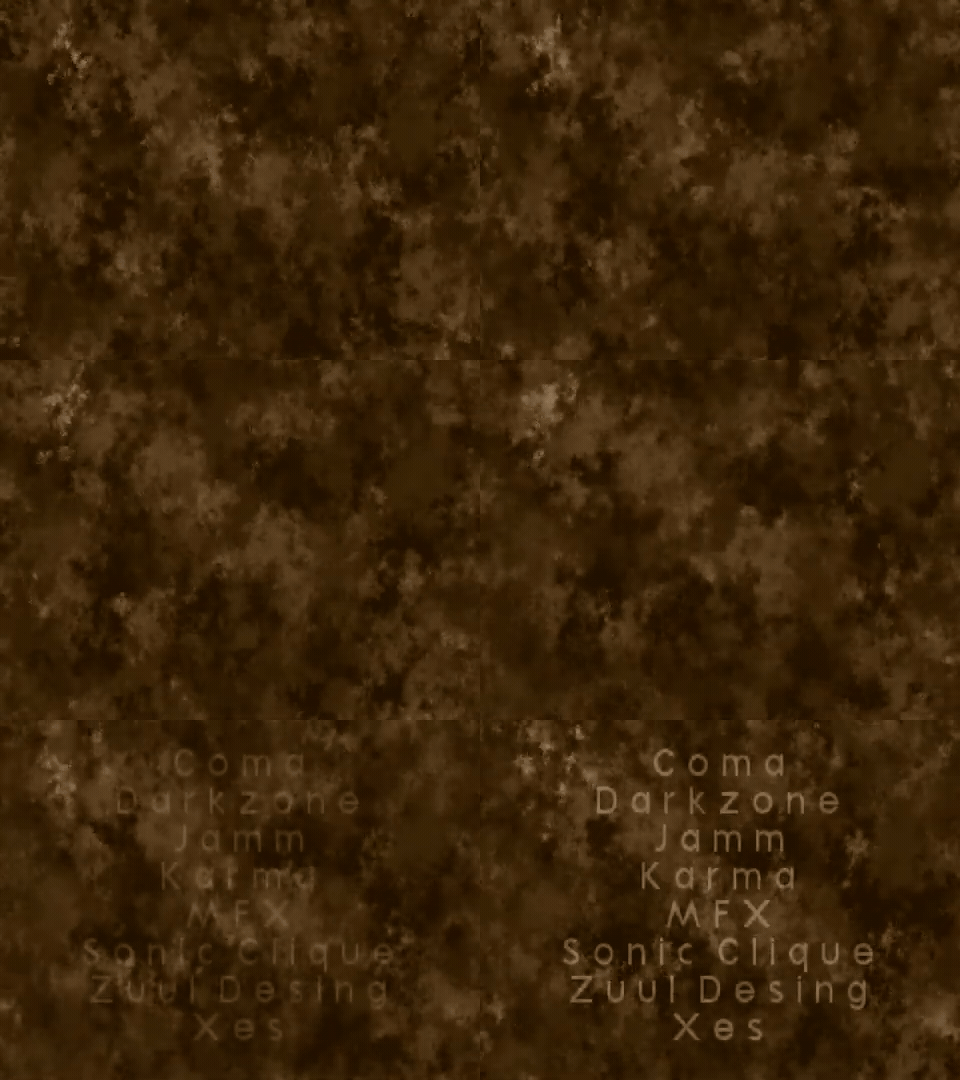
01:50-02:12  greetings over brown noisy texture
02:18-02:45  floating tunnel with "float Robot float" / "duplication process"
02:50-03:05  Dune / Der Piipo / Lemming credit card
03:08-03:40  Orange logo through heavy radial wash
Packed MZ Layout
RELIGION.EXE is a 63,822-byte DOS MZ executable. It is not a normal linked
program body; it is a small RNC ProPack carrier plus packed payload.
file size:          63822 bytes
MZ image size:      63822 bytes
header size:           32 bytes
relocations:            0
entry CS:IP:       0f65:000c
entry raw offset:  0xf67c
stack SS:SP:       6e41:04de
RNC block offset:  0x0020
The RNC block starts immediately after the 32-byte MZ header:
52 4e 43 01 00 06 e3 fe 00 00 f6 33 e9 cc 29 e1 00 27
Decoded:
method:          RNC1
unpacked size:   451,582 bytes (0x6e3fe)
packed size:      63,027 bytes (0xf633)
unpacked CRC:     0xe9cc
packed CRC:       0x29e1
leeway:           0
chunks:           39
That explains the apparent contradiction: the competition archive is a 64K intro package, but the runtime image expands to roughly 441 KiB before its work buffers and sound/video state are considered.
Unpacking the stream with the local RNC ProPack tool now gives the real expanded runtime image:
3f1b4093ea9ede61b38d945b5752ba80cbfc41a9bb7f041848f338c9f10e30e4  religion-unrnc.bin
expanded size: 451,582 bytes
That expanded image starts with the same protected-mode diagnostic strings used by several late Orange intros:
0x0000  386 or better not detected!!!
0x001e  Not enough low memory!!!
0x0038  System is already in V86 mode, and no VCPI or DPMI found!!!
0x0094  Couldn't enable A20 gate!!!
0x0539  DPMI host is not 32bit!!!
0x0573  Couldn't set DPMI descriptors as needed!!!
0x059f  Couldn't enter 32bit protected mode!!!
Depacker Entry
The MZ header points at raw 0xf67c. The recognizable RNC depacker body starts
four bytes later at raw 0xf680. I do not treat those leading bytes as useful
demo logic; the clear code begins at the standard RNC staging pattern:
0xf680: mov dx, cs
0xf682: mov ds, dx
0xf684: mov cx, [0x0008]
0xf688: mov si, cx
0xf68a: sub si, 2
0xf68d: mov di, si
0xf68f: shr cx, 1
0xf691: std
0xf692: rep movsw
0xf694: push bx
0xf695: mov ax, 0x002e
0xf698: push ax
0xf699: mov bp, [0x000a]
0xf69d: lret
The first phase normalizes DS to the packed program segment, copies the tail
of the packed image backward with std / rep movsw, and far-returns into the
relocated stage. This is the same family of RNC carrier seen in several mid-90s
PC intros: move the compressed bytes out of the way, then expand into the
target memory image.
The next phase copies in 0x1000-paragraph chunks until the remaining size is exhausted:
0xf69e: mov ax, 0x1000
0xf6a1: cmp ax, bp
0xf6a3: jbe 0xf6a7
0xf6a5: mov ax, bp
0xf6a7: sub bp, ax
0xf6a9: sub dx, ax
0xf6ab: sub bx, ax
0xf6ad: mov ds, dx
0xf6af: mov es, bx
...
0xf6bf: rep movsw
0xf6c1: or bp, bp
0xf6c3: jne 0xf69e
After that it allocates three 0x80-byte decode tables on the stack:
0xf6ca: sub sp, 0x001a
0xf6cd: mov bp, sp
0xf6cf: sub sp, 0x0180
0xf6d3: mov ax, sp
0xf6d5: mov [bp+0x08], ax
0xf6d8: add ax, 0x0080
0xf6db: mov [bp+0x0a], ax
0xf6de: add ax, 0x0080
0xf6e1: mov [bp+0x0c], ax
Then it reads three Huffman tables and enters the literal/back-reference loop:
0xf704: mov dx, [bp+0x08]
0xf707: call 0xf87d
0xf70a: mov dx, [bp+0x0a]
0xf70d: call 0xf87d
0xf710: mov dx, [bp+0x0c]
0xf713: call 0xf87d
...
0xf71e: mov dx, [bp+0x0a]   ; distance table
0xf721: call 0xf7ee
0xf724: push cx
0xf725: mov dx, [bp+0x0c]   ; length table
0xf728: call 0xf7ee
0xf72b: add cx, 2
0xf72e: pop ax
0xf72f: inc ax
0xf730: mov dx, si
0xf732: mov si, di
0xf734: sub si, ax
0xf736: mov ds, [bp+0x02]
0xf739: rep movsb
This is enough to prove the packaging and decompression model. I did not recover the runtime from a DOS memory dump, but the standalone RNC expansion is now clean enough to use for code and data offsets. The sections below still do not claim a complete source reconstruction; they map only the runtime regions that can be tied safely to visible behavior.
Audio And Text Evidence
Even before full expansion, the packed file exposes useful strings:
1. gus
2sb/n
esc for weenie$
ULTRASND
Gravis Ult
8CHN
6CHN
You am I
See th
Robot inside
human resourc
robot invader
evil duplicat
float Robo
duplication process
D U N E
super jazz quartet
The strings match the archive INFO: GUS, SB/SBOS, no-sound, and the Dune
music path are real release features, not video-only guesses. The 8CHN and
6CHN markers also fit the late DOS tracker-player world rather than a tiny
PC speaker or OPL-only intro.
The expanded image places the sound-selection text at 0x3a9ca:
1. gus
2. sb/nosound
esc for weenies
The GUS driver strings and environment scan are also visible:
0x4006d  Gravis UltraSound
0x40873  ULTRASND
So the release note's "GUS works, SB/SBOS tested, no-sound works" wording is not just documentation. The actual runtime carries the selector and the GUS environment path.
Runtime-To-Code Concordance
The expanded image lets the public-video sequence be tied to real runtime regions instead of only to visual inference.
- The opening particle/title section uses strings at
0x4c0ec:You am IandSee the Robot inside. Around0x5c219, a routine copies a full 64,000-byte source page, then repeatedly chooses screen positions with a small integer generator, tests a source mask, and stores coordinate pairs into a work table. The same region expands 80-byte source rows into repeated 320-wide rows and runs 0xfa00-byte neighbor-averaging passes. That matches the public video's particle text and soft decay behavior. - The monochrome tunnel/feedback material is backed by several full-frame
processing regions. For example,
0x623d1averages left, right, above, and below neighbors across a 0x40000-byte buffer, while0x623f8clears a 64,000 byte page and sets up pattern/state buffers before retrace-paced display. - The float/duplication tunnel is tied to the text block at
0x68120, which containsfloat Robot float,and the Robot floats,let it float,it floats back to you,duplication process, and related phrases. The nearby code at0x68487uploads a 0x300-byte DAC palette through03C8h/03C9h, builds 0x400 table entries, initializes three bank offsets0,0x4b00, and0x9600, and then waits on03DAhbefore updating phase/table-driven color output. - The show-level timing is real hardware timing, not an arbitrary sleep loop.
The PIT/vblank code at
0x64297programs channel 0, waits across VGA retrace transitions on03DAh, reads back the PIT counter, stores a calibrated period, and the interrupt path at0x642e6nudges that period against retrace before calling the saved timer callback and acknowledging the PIC. - The generic frame boundary is visible in repeated
A0000h,0x3e80, and0xfa00loops. These are the code-side explanation for the full-screen feedback vocabulary: pages are built or filtered in memory, palettes are pushed through the VGA DAC, and presentation is retrace-paced.
The conservative reading is now stronger than the first pass: this is not just an RNC-packed 64K shell with nice video evidence. The expanded runtime shows the expected Orange 1996 machinery for the visible style: protected-mode setup, hardware sound selection, script text blocks, full-frame buffers, blur/feedback passes, DAC animation, and PIT/vblank synchronization.
Particle Text Opening
The opening visual is not just a static title. White particles form and tear through the Orange/You-am-I text, leaving a blue-black field behind them.

The particle layer behaves like a full-screen accumulation pass:
- a source mask or text page supplies bright target pixels;
- particles fly along curved or biased trajectories rather than a simple row reveal;
- the field is darkened between frames, so older particles leave a decaying cloud;
- the text is treated as a shape to be invaded, not as ordinary font blitting.
That fits the internal text strings: You am I, See th, and Robot inside
are not just final cards. They are part of a scripted sequence where the words
become material for particle effects.

Tunnel And Feedback Section
The middle section uses a monochrome tunnel/feedback vocabulary: black holes, soft radial folds, and tunnel walls that appear to be lit from the center.

This does not look like a simple texture-mapped tunnel alone. The image has soft bloom and persistence, and the tunnel mouth repeatedly collapses toward a dark center. A plausible mechanism is:
- generate or sample a polar texture;
- remap screen pixels through a radial table;
- blend the result with the previous frame or a blurred backbuffer;
- modulate palette or brightness to create the breathing center.
The exact tunnel routine is still not named, but the expanded runtime now gives
stronger support than motion alone: several regions build or filter full-frame
buffers, use 0xfa00/0x40000 neighbor-averaging passes, animate DAC tables, and
pace presentation through 03DAh/PIT timing. The video shows the visible
result; the code proves the class of machinery that can produce it.
Low-Poly Terrain Interlude
The terrain scene is a short break from the abstract feedback parts:

The terrain is visibly low-resolution and faceted. It is closer to a heightfield or coarse triangle mesh than to texture-mapped free 3D:
- horizontal bands show a scanline/heightfield style horizon;
- the hills use broad shaded patches rather than dense texture detail;
- the camera moves through a narrow valley, so the scene can be generated from a small height table or compressed mesh.
In a 64K intro this is the right tradeoff: the terrain does not need a general renderer. It needs a compact landscape part that changes rhythm before the greetings and float sections.
Greetings And Credits
The greetings are deliberately legible and centered over a noisy brown texture:

The names include groups that place the intro in its 1996 PC-scene context: Amen, CNCD, Complex, Halcyon, Hirmu, NoooN, Parallax, Stellar, Coma, Darkzone, Jamm, Karma, MFX, Sonic Clique, Zuul Design, and Xes. It is a Finnish/PC-scene neighborhood card, not just a generic greeting wall.
The credit card is equally restrained:

The public video shows Dune, Der Piipo, and Lemming as the named trio. That
matches the archive INFO role summary.
Float Robot Float
The later tunnel section is smoother and more liquid than the earlier black
tunnel. It carries text fragments such as float Robot float, let it float,
and duplication process.
This part is the intro's best example of Orange's 1995-1996 design language: not a raw effect showcase, but a sequence of effects processed until they feel like album art. The technical ingredients are familiar: polar remapping, feedback, palette/brightness modulation, and text overlays. The direction is the point: the text, tunnel, and blur are one surface rather than separate demo parts.
Orange Logo Wash
The ending returns to the group identity: a bright wash over the Orange logo, then darker residual frames.

The logo treatment is consistent with the rest of the intro: high contrast, soft radial lighting, and feedback-like persistence. It is more graphic-design composition than isolated code trick.
The Pouet screenshot GIF captures the same broad visual identity in 320x200 form:

What Is Proven
Hard facts from this pass:
RELIGION.EXEis a 63,822-byte MZ carrier with a 32-byte header and no relocation entries.- The real payload starts as an
RNC\1block at raw0x20. - The RNC header reports a 451,582-byte expanded image and 63,027-byte packed payload.
- The local RNC expansion succeeds and produces
3f1b4093ea9ede61b38d945b5752ba80cbfc41a9bb7f041848f338c9f10e30e4. - The recognizable RNC depacker body starts at raw
0xf680, with backward staging, stack Huffman tables, literal copies, and back-reference copies. - The archive release text confirms final-version TG96 64K intro status.
- The release info confirms GUS, SB/SBOS-tested, and no-sound paths.
- The expanded image contains the GUS/SB/no-sound selector,
ULTRASNDand Gravis strings, the visible Robot text blocks, DAC/retrace/PIT code, and full-frame buffer loops matching the public-video vocabulary. - The visible sequence is documented from direct 480x360 public-video frames and GIF slices.
What remains for a deeper pass:
- map the GUS/SB/no-sound setup flow;
- identify the actual part scheduler;
- fully name the part scheduler and every scene boundary;
- finish the terrain renderer and final logo/compositing routines;
- turn the particle/tunnel regions above into a complete control-flow map.
With the expanded-image pass, the structure is clearer: you am i you am the robot is a compact RNC-packed 64K shell around a much larger protected-mode
runtime image, using Orange's strongest 1996 vocabulary: tracker music, soft
full-frame feedback, particle text, short terrain contrast, and a deliberately
strange title that still works better than it should.